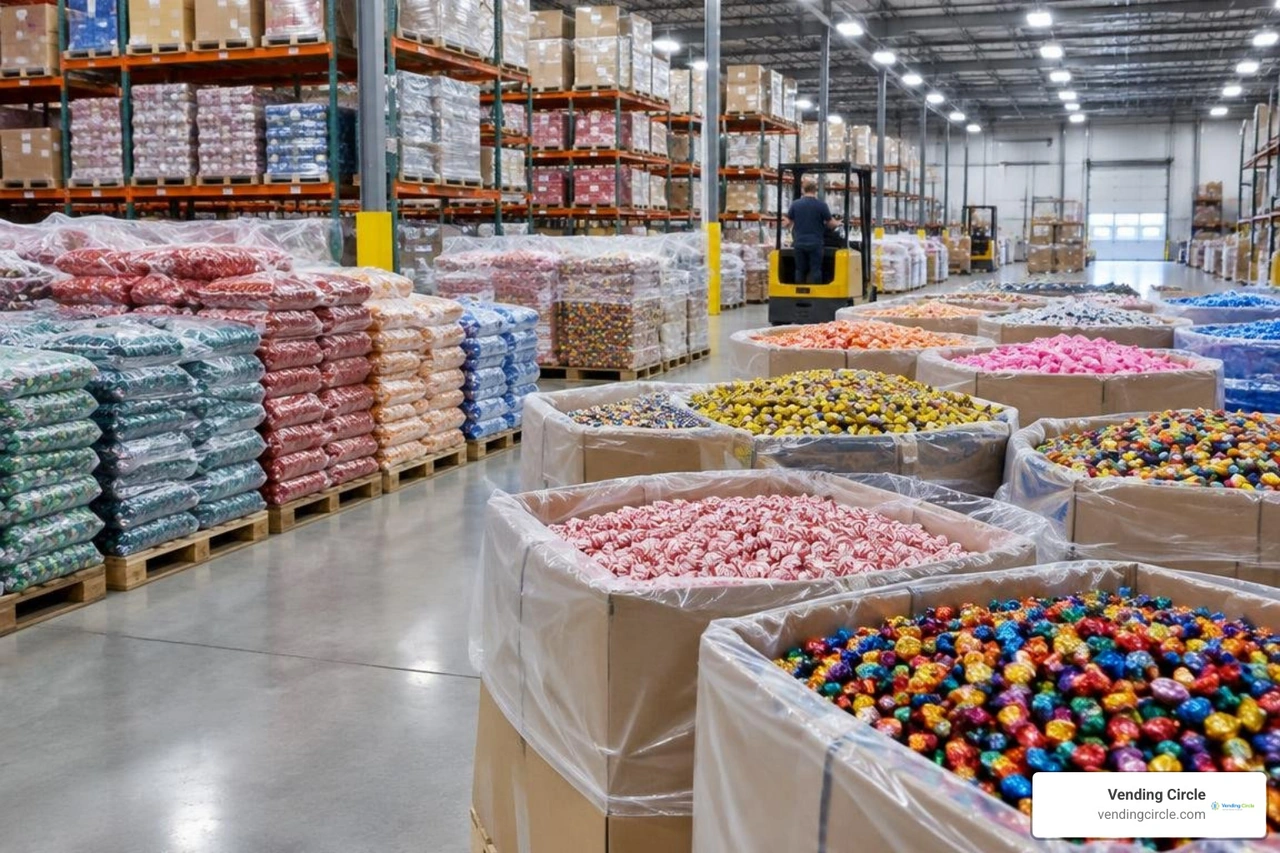
How to Choose Bulk Candy Suppliers for Faster Restocking
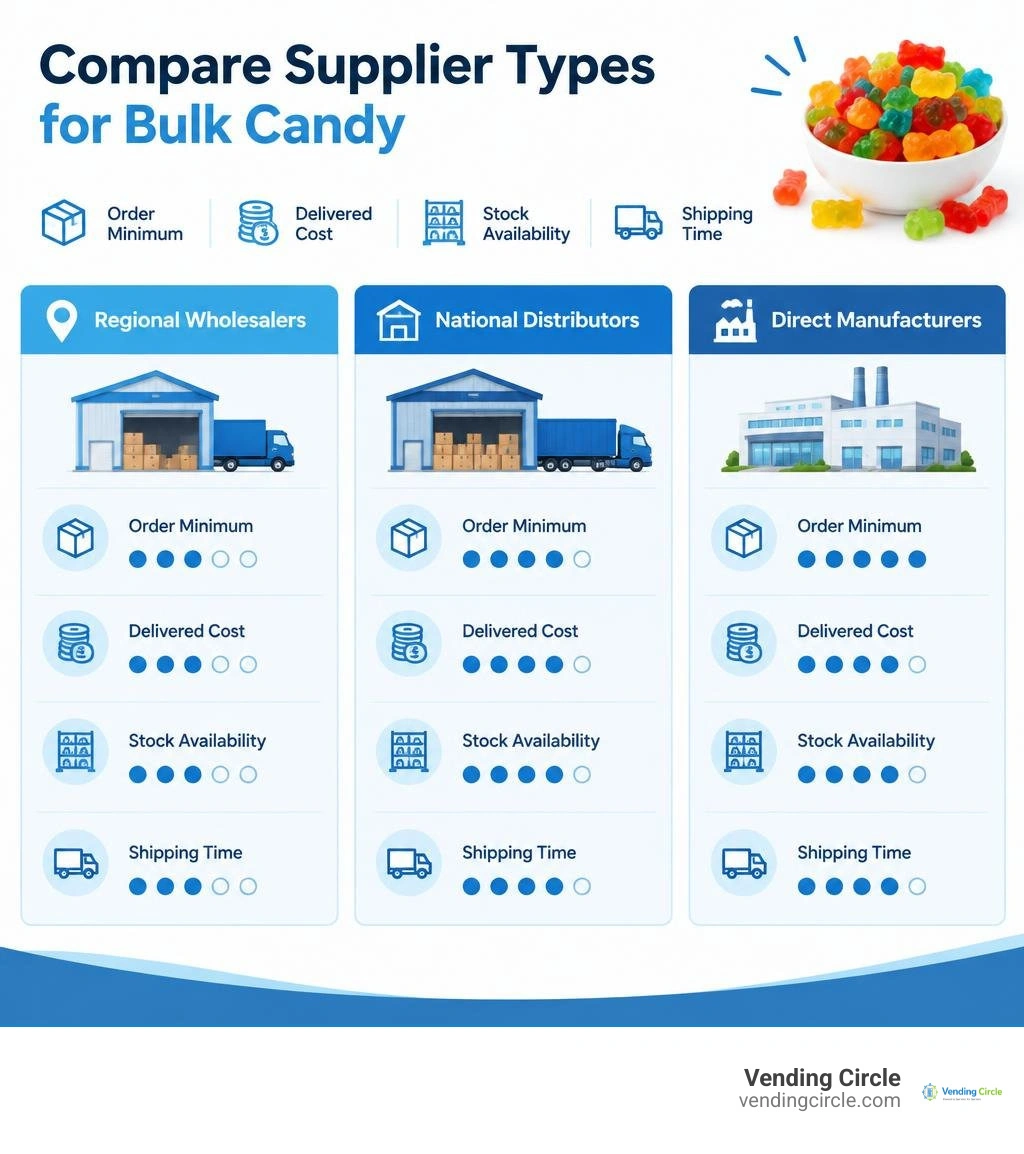
Start with the cost to get candy to your machines, not just the case price. Compare regional wholesalers, national distributors, and direct manufacturers by delivered cost per pound, order minimums, and shipping time. Ask whether your usual products are in stock, how long they have before expiration, and how the supplier protects chocolate in hot weather.
The right choice depends on your route. A nearby wholesaler may help with urgent restocks, while a distributor with a wider catalog may let you buy more of your inventory in one order.
I'm Manuel Mojica, founder of Vending Circle and former owner of MM Healthy Vending. I built Vending Circle to help operators compare bulk candy suppliers and make restocking simpler.
Bulk candy suppliers word guide:
Wholesale Confectionery Distribution Channels
Understanding how sweets travel from production lines to your stockroom is critical for protecting profit margins and avoiding stockouts. The commercial confectionery supply chain is split across distinct distribution tiers, each with its own pricing structures, order minimums, and logistical trade-offs.
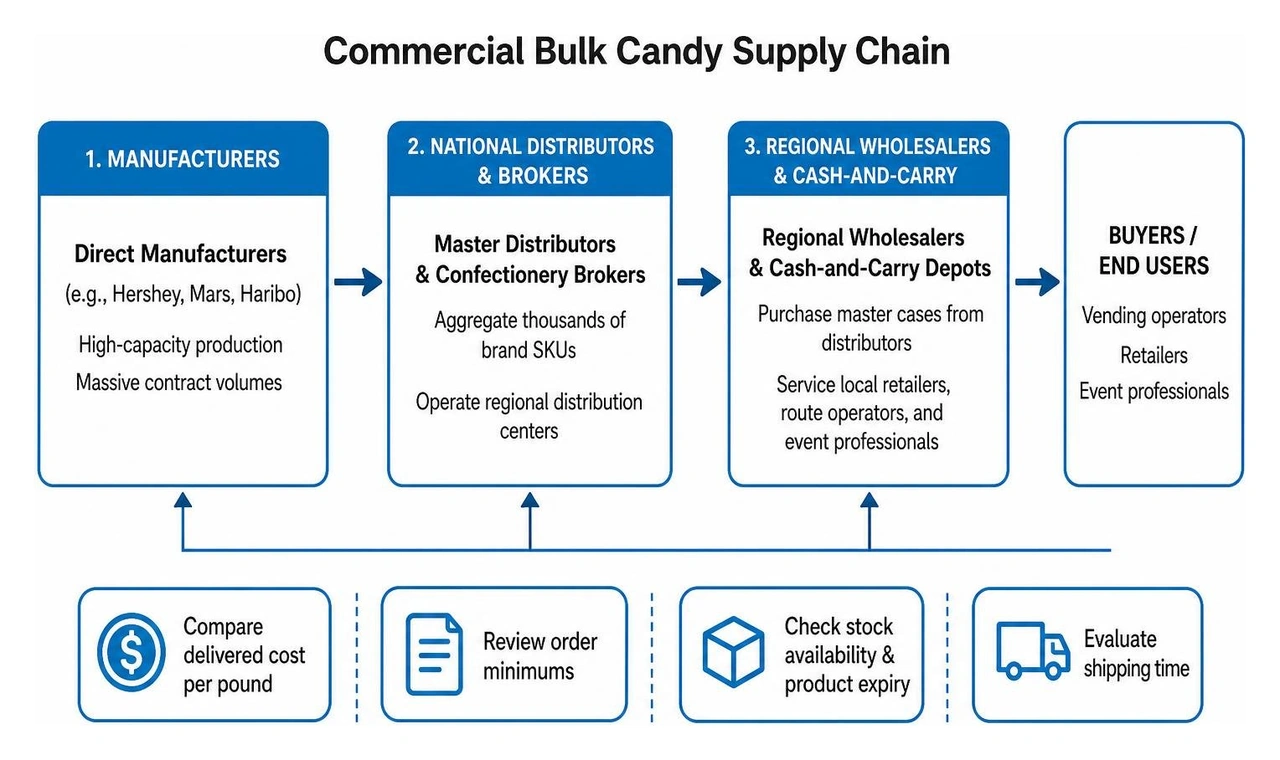
At the top of the chain sit direct manufacturers (such as Hershey, Mars, or Haribo). These producers run high-capacity manufacturing plants and deal exclusively in massive contract volumes. Beneath them are national master distributors and confectionery brokers, who aggregate thousands of brand SKUs into regional distribution centers. Finally, regional wholesalers and cash-and-carry depots purchase master cases from distributors to service local retailers, route operators, and event professionals.
When you are purchasing bulk vending supplies, knowing which tier fits your current volume saves thousands of dollars in freight surcharges and holding fees.
Regional vs. National Bulk Candy Suppliers
Choosing between a regional supplier and a national distributor comes down to a balance between delivery speed and catalog depth.
- Regional Wholesalers: Regional hubs typically operate within a radius of 150 to 300 miles. Because of their proximity, they frequently fulfill orders within 24 to 48 hours. Many offer local dock pickups, saving you substantial freight fees. However, their selection can be limited, and smaller regional warehouses may experience stock fluctuations during high-demand seasons.
- National Distributors: National suppliers maintain sprawling distribution networks with catalogs exceeding 6,000 active SKUs. They provide reliable access to everyday staples, imported sweets, and specialty lines like commercial-grade Wholesale Hard Candy. While national suppliers offer aggressive tiered discounts, shipping across multiple freight zones can extend transit times to 3–5 business days unless you meet substantial threshold minimums for expedited logistics.
Direct Manufacturer vs. Master Wholesaler Sourcing
For operators scaling up their inventory, the temptation to bypass wholesalers and buy directly from manufacturers is strong. However, direct sourcing requires substantial capital and storage capacity.
Direct manufacturers typically enforce Minimum Order Quantities (MOQs) starting at full pallet loads (often 1,500 to 2,000 lbs per single SKU) or multi-pallet truckloads. Unless you are servicing dozens of high-turnover locations, tying up cash in single-flavor pallets increases inventory holding costs and risks product expiration.
Master wholesalers, by contrast, split manufacturer master cases into manageable bulk bags (such as 2 lb, 5 lb, or 10 lb cases). This lets you mix and match dozens of flavors and brands in a single freight shipment. If you are in the phase of starting a vending business, partnering with a flexible master wholesaler protects your working capital while ensuring fresh, rotating stock.
How to Evaluate Bulk Candy Suppliers for Maximum Profit Margins

A supplier offering a master case for $40 might look cheaper than a competitor selling it for $45. But if the first supplier charges $18 for ground shipping while the second offers free freight on orders over $350, your actual unit acquisition cost flips.
To maximize margins, calculate the delivered cost per ounce. Take the case price, add the shipping cost allocated to that case, and divide the total by the net weight in ounces. This gives you a true comparison across suppliers with different freight policies.
Always examine the supplier's wholesale tiering. Many vendors offer 4% to 5% discounts on auto-delivery schedules, while others provide 10% to 25% price breaks when purchasing mixed pallet configurations.
| Supplier Tier | Typical Minimum Order Quantity (MOQ) | Average Order Lead Time | Best Suited Customer Type |
|---|---|---|---|
| Direct Manufacturer | 1 Full Pallet (1,500+ lbs per SKU) | 2–4 Weeks | National Retail Chains & Enterprise Route Operators |
| Master Distributor | $250 – $500 Minimum or 1 Mixed Pallet | 3–5 Business Days | High-Volume Route Operators & Confectionery Shops |
| Regional Wholesaler | 1 Case (10–30 lbs) / $100 Minimum | 24–72 Hours | Independent Operators & Fast Route Restocking |
| Specialty Importer | $150 – $300 Minimum | 3–7 Business Days | Gourmet Candy Buffets & Niche Retail Displays |
Core Criteria for Vetting Inventory Partners
Before committing to a primary wholesale vendor for your vending machine products wholesale pipeline, evaluate them against these operational benchmarks:
- Fulfillment Speed and Accuracy: Top distributors pick, pack, and dispatch orders within 48 to 72 hours.
- Batch Freshness Guarantees: Ensure the distributor guarantees a minimum remaining shelf life (ideally 6 to 12 months for non-chocolate items) upon arrival.
- Melt-Protection Policies: Inquire about seasonal thermal liners, gel packs, and weekend transit holds for heat-sensitive inventory.
- Multi-Location Fulfillment: If you manage machines or stores across various regions, verify if the vendor can split shipments across different addresses without imposing duplicate small-order fees.
- Damage and Shortage Claims: A dependable partner credits damaged cases or heat-damaged inventory promptly when provided with photo documentation.
Dietary and Specialty Offerings from Bulk Candy Suppliers
Consumer preferences have shifted rapidly, creating high-margin opportunities for operators who stock specialty dietary confections. Modern distributors now provide dedicated filters for specialty categories:
- Vegan and Plant-Based Sweets: Traditional gummies rely on pork- or beef-derived gelatin. High-growth specialty sectors, such as those supplied via Swedish Candy Wholesale, use pectin or modified starches to deliver premium sour and foam textures without animal by-products.
- Halal and Kosher Certifications: Certified confections open access to demographic niches that standard supermarket assortments overlook. Look for clear certification badges on bulk product spec sheets.
- Sugar-Free and Keto-Friendly Lines: Sweetened with isomalt, maltitol, or stevia, sugar-free hard candies and chocolate wafers serve health-conscious consumers, hospitals, and corporate wellness breakrooms.
- Allergen-Controlled Packaging: Cross-contamination warnings for peanuts, tree nuts, dairy, and gluten must be clearly labeled on master bags for liability protection.
Core Bulk Candy Categories and Packaging Formats

Confectionery categories behave differently in storage, transit, and dispensing mechanisms. Balancing product shelf life against product turnover prevents stale stock and clogs.
When restocking high-traffic locations, focus your catalog around these staple confectionery categories:
- Individually Wrapped Hard Candies: Extended 12–24 month shelf life, resistant to ambient humidity.
- Coated Panned Candies: Hard sugar shells over chocolate or fruit centers; optimal for bulk dispensing wheels.
- Gummy & Sour Chews: High impulse-buy appeal, requiring strict rotation and climate monitoring.
- Compound Melting Chocolate Wafers: High turnover for specialty baking and confectionery displays.
- Puffed Marshmallows & Foam Candies: Lightweight, high-volume items requiring airtight moisture-barrier packaging.
Hard Candies, Mints, and Vending Classics
Hard candies—such as root beer barrels, butterscotch buttons, fruit balls, and starlight mints—offer the highest stability across varying storage conditions.
For bulk coin-operated dispensers, using proper bulk candy for gumball machine setups prevents internal wheel jams. Panned candies with polished carnauba wax coatings withstand high mechanical friction, while individually wrapped hard candies work best in hospitality baskets, checkout displays, and spiral drop machines.
Most distributors supply hard candies in standard 10 lb. Candy Cases or larger 30-to-40 lb master cartons.
Gummies, Chews, and Marshmallows
Gummies and chews generate strong impulse purchases, but their high moisture content makes them sensitive to environmental conditions.
Gelatin-based gummies soften and fuse when exposed to temperatures above 85°F (29°C), while sour-sanded candies can pull moisture from the air if master bags are left unsealed. For commercial bulk bins, source gummies packaged in heavy-gauge, resealable poly bags.
For operational setups and dispenser wheel calibrations, refer to our bulk vending machine wholesale guide 2026 for best practices on hopper sizing.
Chocolate Formulations and Melting Wafers
Bulk chocolate distribution falls into two primary categories: pure couverture chocolate (made with cocoa butter) and compound confectionery coating (made with vegetable or palm oils).
- Couverture Chocolate: Offers a superior mouthfeel and snap, but requires precise tempering and strict climate-controlled handling. Melting occurs rapidly at temperatures above 78°F (25°C).
- Compound Wafers: Melts cleanly without tempering, making it ideal for dipped treats, bakery decorations, and warm-weather transit.
When mapping out logistics or reviewing a buying candy machine route guide, schedule chocolate replenishment during morning hours to prevent vehicle heat from softening foil-wrapped items.
Logistics, Climate Control, and Seasonal Fulfillment
Confectionery logistics require close attention to temperature and seasonal spikes. Ambient shipping in mid-summer can quickly turn a case of chocolate or gummies into a solid block of sugar.
Reliable distributors implement strict hot-weather shipping protocols between May and October:
- Insulated Thermal Liners: Reflective foil bubble wrap or recycled cotton insulation surrounds the interior of the corrugated carton.
- Refrigerated Gel Packs: Phase-change gel packs absorb ambient heat during transit without leaking moisture onto product labels.
- Weekend Transit Holds: Orders containing chocolate or soft gummies dispatched on Thursdays or Fridays are held until Monday to prevent boxes from sitting in unconditioned carrier hubs over the weekend.
Seasonal Surge Planning
Confectionery sales peak during key holiday windows:
- Q1 (Valentine's Day & Easter): High demand for pastel foil chocolates, marshmallow shapes, and jelly beans.
- Q3 / Q4 (Halloween & Christmas): The highest volume period of the year. Bulk Halloween assortments, trick-or-treat miniatures, and holiday foil-wrapped novelties must be locked in early.
Top operators place seasonal pre-orders 60 to 90 days ahead of major holidays to secure wholesale volume before distributor catalogs sell out.
Frequently Asked Questions About Bulk Candy Restocking
What are typical minimum order quantities for wholesale candy?
Minimum order quantities vary by distributor tier. Standard online confectionery wholesalers typically enforce low entry minimums ranging from a single 10 lb case ($30–$60) up to a $150–$350 order threshold for free or discounted freight. Commercial master distributors often require a $500 invoice minimum or full-case master cartons (typically 12 to 24 units per box). Direct industrial manufacturers set MOQs at full single-SKU pallets (1,500+ lbs).
How do bulk distributors maintain confectionery freshness during shipping?
Distributors preserve freshness by using multi-layer poly barrier bags, airtight heat-sealed packaging, and desiccant packs to prevent humidity transfer. During warmer months, distributors add insulated thermal liners and frozen non-toxic gel packs, while shipping heat-sensitive orders via 1-to-2 day express transit windows.
How far in advance should businesses order seasonal bulk candy?
For high-demand seasons like Halloween and Christmas, place bulk inventory orders 8 to 12 weeks in advance. Production runs for holiday-specific shapes and packaging wrappers are fixed; ordering late increases the risk of backorders and forces you into higher expedited shipping rates.
Conclusion
Building a profitable, low-stress restocking routine starts with choosing the right supply chain partners. By calculating delivered cost-per-ounce, auditing climate-controlled shipping policies, and maintaining a balanced mix of long-shelf-life classics and high-margin specialty lines, you protect your margins and keep machines fully stocked.
Ready to cut inventory overhead and connect with verified wholesale partners? Join Vending Circle for operator resources and wholesale pricing to access manufacturer-direct deals, weekly live Q&As, and our active network of commercial operators.