Find the Right Cold Drink Machines for Your Location
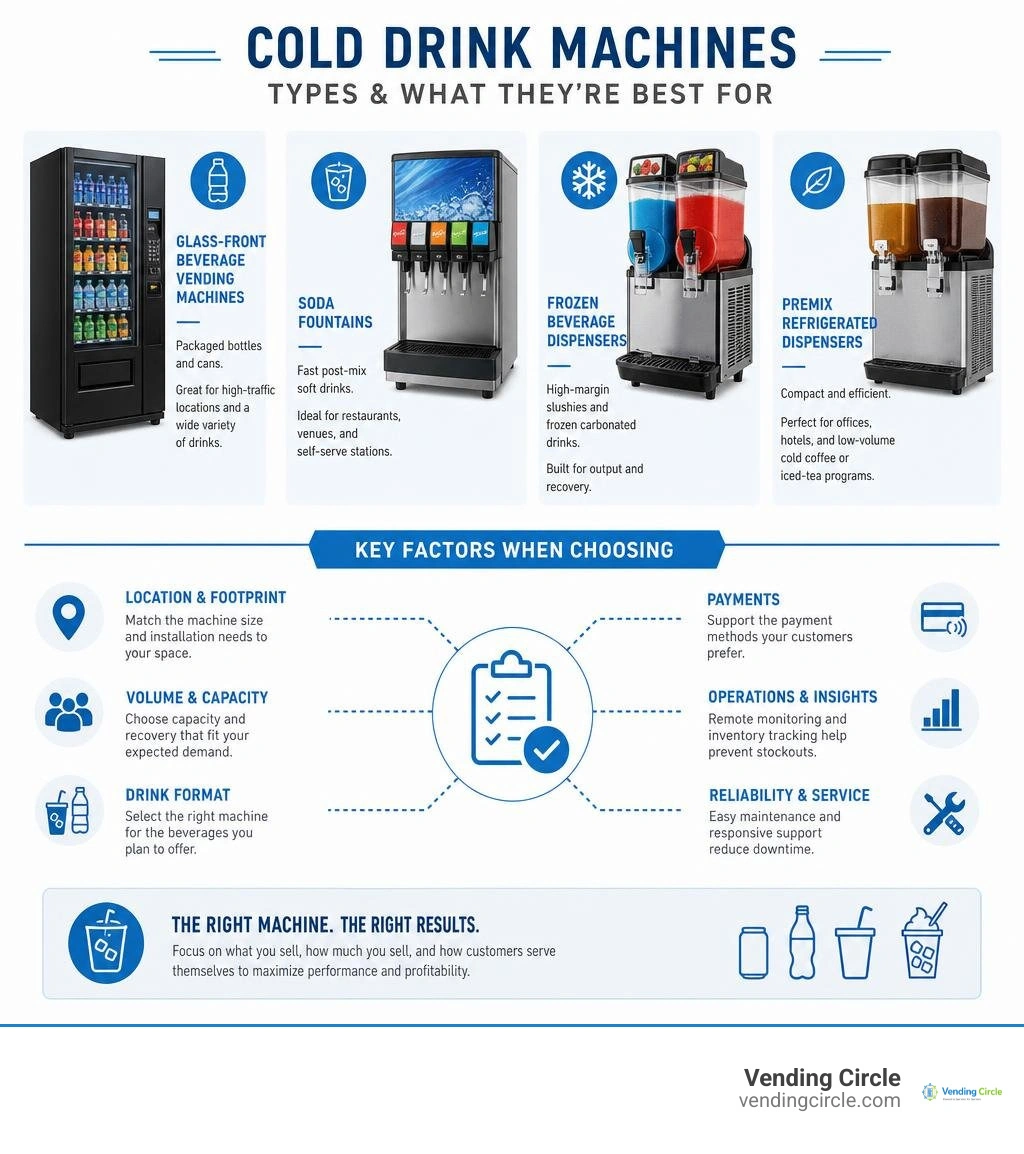
The best cold drink machines depend on what you sell, how many drinks you expect to move, and whether customers serve themselves. For most vending operators, the main choices are:
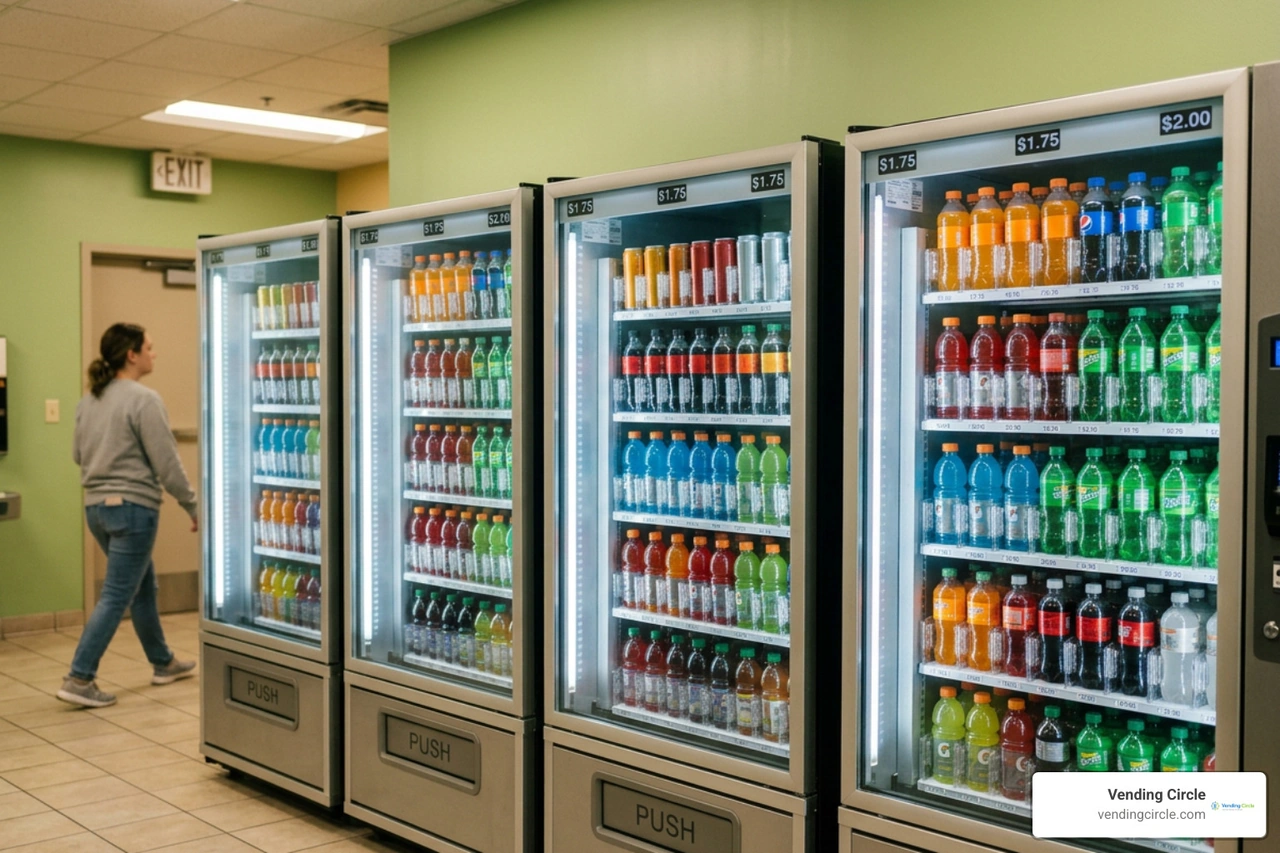
- Glass-front beverage vending machines for packaged bottles and cans, often with cashless payment and remote inventory tracking.
- Soda fountains for fast post-mix soft drinks in restaurants, venues, and self-serve stations.
- Frozen beverage dispensers for high-margin slushies and frozen carbonated drinks.
- Premix refrigerated dispensers for compact offices, hotels, and low-volume cold coffee or iced-tea programs.
A good machine does more than chill product. It should fit the location, reduce stockouts, accept the payments customers use, and be serviceable without long downtime. In high-traffic locations, capacity, cooling recovery, and telemetry can matter more than the lowest purchase price.
For example, a typical cold drink vending machine may hold about 400 to 500 bottles, while frozen carbonated beverage equipment is built around output and recovery speed. Those drinks can be especially profitable because the finished product is largely carbonated water and ice, with a smaller share of syrup.
I am Manuel Mojica, founder of Vending Circle and owner of MM Healthy Vending. Through operating machines and supporting vending operators, I focus on helping buyers compare cold drink machines, source equipment with less friction, and keep profitable locations running.
Commercial Cold Drink Machines: Types, Formats, and Applications
Selecting commercial cold drink equipment requires balancing footprint, guest traffic, and drink formats. Equipment falls across four core operational categories:

- Soda Fountains (Post-Mix): Blend concentrated syrup with filtered water and CO2 on demand.
- Frozen Carbonated Beverage (FCB) & Granita Dispensers: Freeze aerated beverage mixtures into slush textures.
- Automated Merchandisers & Smart Coolers: Refrigerated glass-front units that vend sealed bottles, cans, and cartons 24/7.
- Premix & Cold Juice Dispensers: Circulate ready-to-drink liquids through self-contained chilling bowls or compact canisters.
Physical placement options include countertop formats, drop-in counter cutouts with remote ice bins, and freestanding merchandisers.
Soda Fountains and Post-Mix Dispensers
Post-mix soda fountains run on Bag-in-Box (BIB) syrup concentrates connected via pneumatic pumps to carbonator tanks and chilling circuits. The drink chills through an internal cold plate—a cast-aluminum block containing stainless-steel coils surrounded by melting ice—or a dedicated mechanical refrigeration bath.
Fountain valves regulate flow:
- Sanitary push levers minimize hand contact in self-service cafeterias.
- Push-button electronic valves simplify portioning.
- Portion-control valves allow staff to tap a cup size and walk away, eliminating overfills and saving up to 15% in syrup waste by maintaining accurate syrup-to-water Brix ratios.
Essential Specifications for Frozen Cold Drink Machines
Frozen carbonated beverage (FCB) equipment injects CO2 into sweetened syrup under pressure inside a sealed freezing cylinder. The finished frozen drink expands into a high-margin product consisting of roughly 50% CO2, 40% water, and 10% syrup.
Key engineering benchmarks for high-volume venues include:
- Barrel Volume: Standard commercial barrels hold 1.5 to 4.5 gallons (176 oz per barrel).
- Continuous Draw Rate: Heavy-duty units like the FBD 773 3-Flavor Frozen Carbonated Beverage Dispenser | Howdy Brewer – HowdyBrewer deliver up to 5,760 oz/hr across multiple barrels.
- Recovery Time: Remote-cooled scroll compressor systems recover cylinder freeze levels in as little as 3.5 minutes between rush periods.
- Product Hardness Controls: Equipment such as the 6795-CF Frozen Beverage Machine 2 Bowl | Lancer Worldwide allows operators to adjust viscosity within 30 seconds for dairy shakes, craft slush, or frozen cocktails.
For lower-volume office environments, premix units like the Cold Beverage Vending Machine with Discount Offers Now deliver cold coffee, iced tea, or juice on demand from dry premix powders and chilled water reservoirs.
Smart Beverage Dispensers and Automated Cold Drink Machines
Unattended retail setups use refrigerated bottle-and-can vending machines. Modern models, including the Refrigerated Beverage Vending Machine with Elevator Delivery Temp Control , use internal XY-axis robotic elevators to gently collect beverages and bring them to a waist-high retrieval door, eliminating shaken soda bursts and container damage.
Standard units offer:
- Capacities of 400 to 500 bottles or cans across adjustable tilt-down shelves.
- Precise temperature control from 2°C to 40°C using liquid-injection foam insulation.
- Built-in fault diagnostics, DEX/MDB telemetry ports, and cashless credit card readers.
For grab-and-go setups, the HAHA Smart Cooler enables customers to tap a payment card, open the door, select products, and walk away via automated computer vision billing.
Top Smart Beverage Vending Machines for Maximum ROI
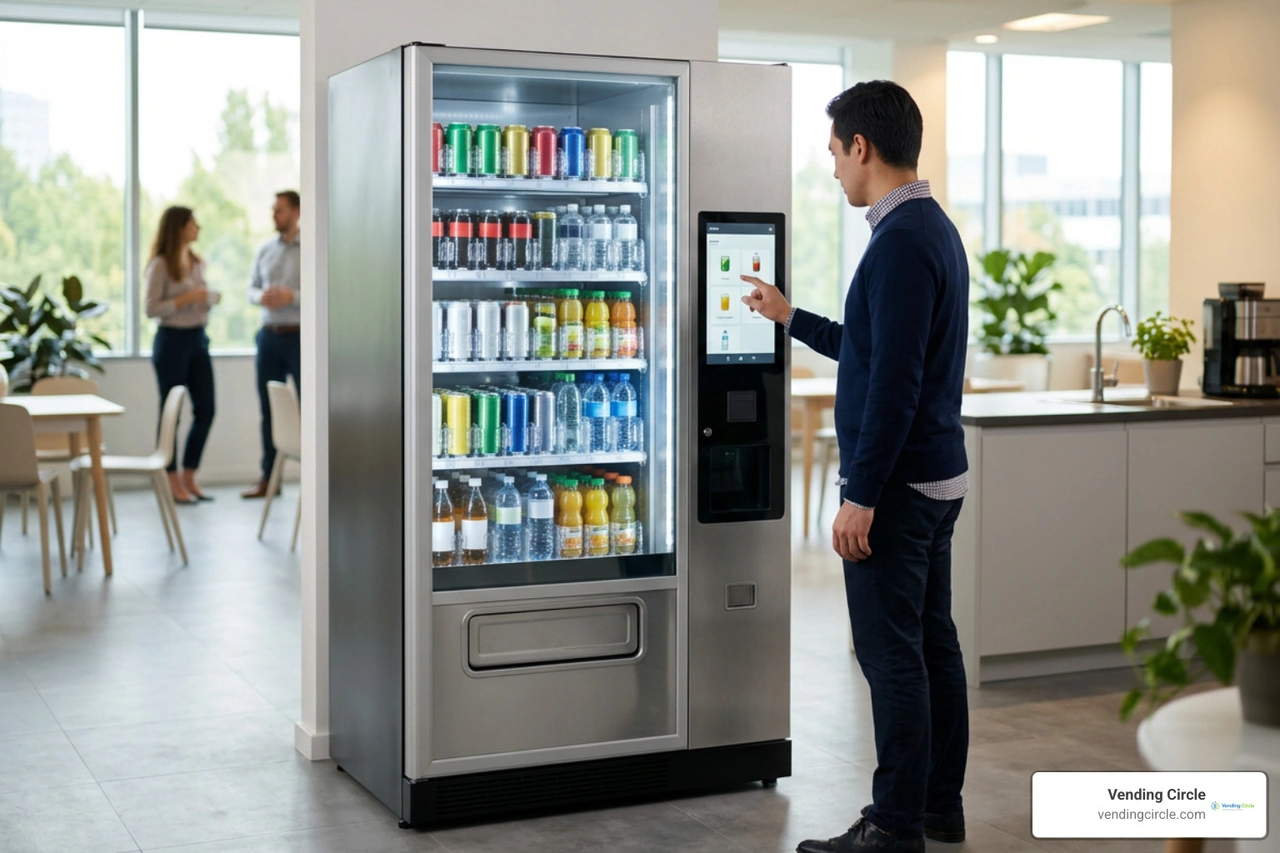
Choosing the right automated drink merchandiser balances floor space with holding capacity to optimize restocking routes.
| Machine Model | Beverage Capacity | Footprint (W x D x H) | Cooling System / Temp Range | Target Placement |
|---|---|---|---|---|
| HAHA Mini 360 | Up to 280 items | 28" x 29" x 76" | R-290 Forced Air / 36°F - 46°F | Office breakrooms, boutique studios |
| HAHA Plus 440 | Up to 360 items | 35" x 31" x 76" | R-290 Forced Air / 36°F - 46°F | Mid-sized gyms, co-working hubs |
| HAHA Pro 542 | Up to 450 items | 40" x 33" x 76" | High-efficiency deck / 34°F - 45°F | Schools, transport terminals |
| HAHA Pro 542 Nayax | Up to 450 items | 40" x 33" x 76" | Smart cooling + Nayax / 34°F - 45°F | Unattended 24/7 public concourses |
| HAHA Max 620 | Up to 520 items | 48" x 33" x 79" | Dual-zone air circulation / 34°F - 45°F | Industrial warehouses, distribution hubs |
| HAHA Max 620s with Screen | Up to 520 items | 48" x 33" x 79" | Smart multi-zone + Touch / 34°F - 45°F | High-traffic entertainment venues |
| HAHA Ultra 1200 | Up to 1,000 items | 72" x 35" x 79" | Industrial dual compressor / 34°F - 45°F | Airports, convention centers, stadium gates |
| HAHA Freezer 550 | Up to 400 frozen items | 40" x 33" x 79" | Sub-zero freezing deck / -10°F - 0°F | Ice cream, frozen novelties, mixed retail |
Compact Footprint Solutions for Tight Spaces
When square footage is limited, slim machines provide reliable chilling without crowding narrow hallways. The HAHA Mini 360 is designed for boutique studios and smaller office suites that require a compact footprint. For locations that need slightly more capacity without a wider frame, the HAHA Plus 440 adds product depth to handle higher midday traffic.
High-Capacity Smart Merchandisers for High-Traffic Hubs
Locations with continuous foot traffic benefit from wider merchandisers and integrated payment tech:
- The HAHA Pro 542 provides standard high-capacity drink storage with adjustable shelf spacing.
- The HAHA Pro 542 Nayax comes pre-configured with contactless Nayax card readers to capture mobile wallet and credit card transactions.
- High-volume hubs can use the HAHA Max 620 or the HAHA Max 620s with Screen, which adds an interactive touch display for product details and advertising.
- For large enterprise campuses and transit centers, the double-door HAHA Ultra 1200 holds up to 1,000 drinks to reduce restock visits.
- Locations selling frozen treats alongside chilled sodas can pair drink hardware with the HAHA Freezer 550.
Critical Engineering and Operational Factors Before Buying
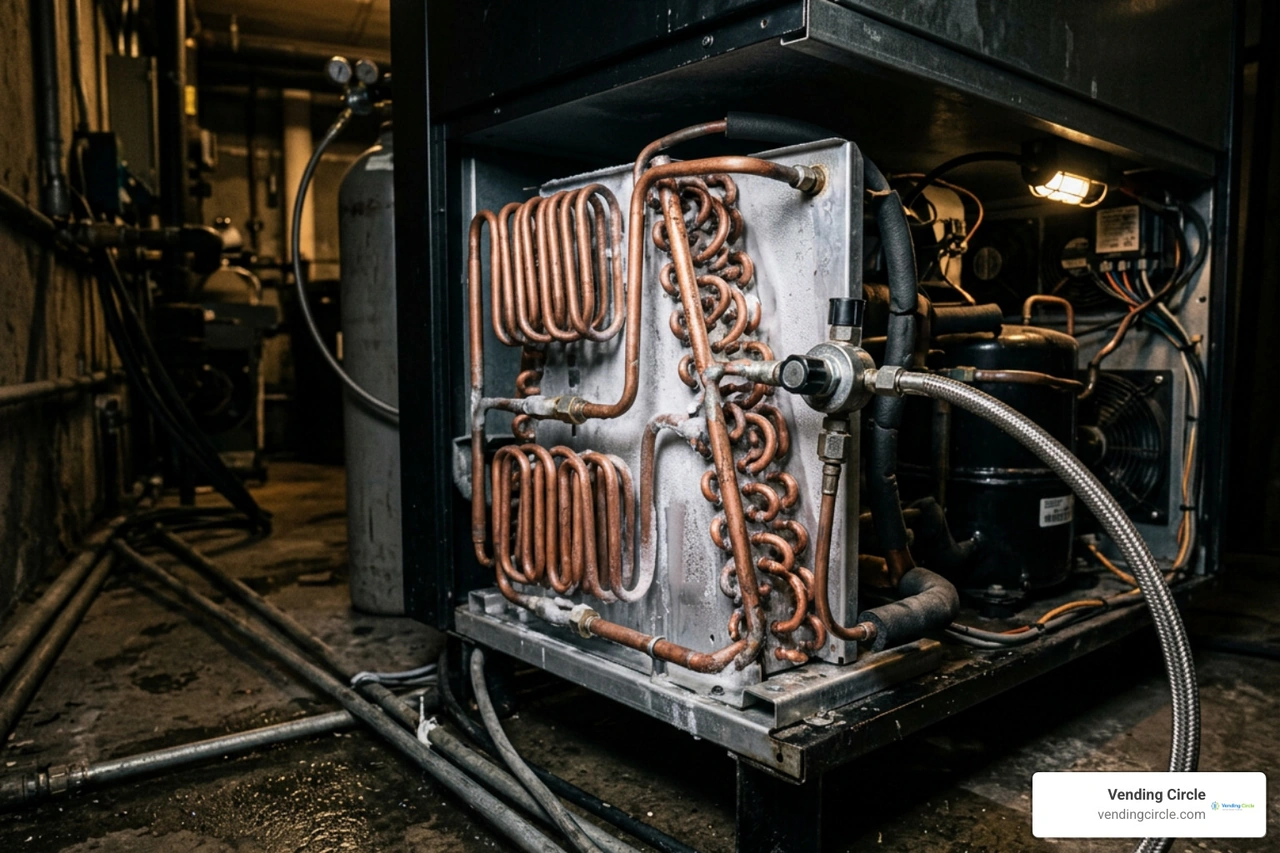
Installing commercial beverage equipment requires reviewing cooling systems, ice compatibility, and facility utilities:
- Air-Cooled Systems: Self-contained and cost-effective, but they exhaust heat directly into the room, increasing ambient air-conditioning loads.
- Remote-Cooled Systems: Position the compressor and condenser coils on an exterior wall or rooftop. This eliminates service-area noise and indoor heat, providing the 19,000+ BTU/hr cooling capacity needed for high-volume slush and fountain operations.
- Energy Management: Commercial cooling operates continuously. Reviewing Vending Machine Energy Efficiency strategies—like LED lighting, ECM evaporator fan motors, and smart sleep modes—helps keep monthly utility bills manageable.
Ice Integration and Beverage Quality Dynamics
For soda fountains, ice choice influences drink temperature and carbonation retention:
- Hard Cube Ice: Melts slowly to prevent drink dilution during dining.
- Chewable Nugget / Cubelet Ice: Features a softer, porous texture that absorbs syrup flavor. It cools drinks quickly, though it melts faster in warm environments.
Dispensers are available as integrated ice-and-beverage dispensers (which store 100 to 580 lbs of ice directly above the cold plate) or as drop-in post-mix heads requiring manual ice filling. To save staff labor, mount a compatible commercial ice maker on top of the dispenser using certified adapter kits, as detailed in the EXPERIENCE technical catalog.
Installation, Utilities, and Regulatory Requirements
Commercial drink equipment installations require dedicated utilities:
- Electrical: Standard compact coolers run on 115 VAC / 15A circuits, while high-draw commercial FCB units and heavy fountain carbo-coolers require dedicated 208–230 VAC / 30A lines (NEMA L6-30R connections).
- Water Supply & Filtration: A dedicated 3/8" or 1/2" cold potable water line delivering 40–50 PSI dynamic pressure is required. Dual-stage water filtration removes chlorine and dissolved solids to protect carbonator pumps and maintain drink taste.
- CO2 and Gas Management: High-pressure food-grade CO2 cylinders regulated between 75 and 105 PSI power beverage carbonation and syrup pumps.
- Drainage: Gravity-fed drip trays and ice bins require dedicated, air-gapped 3/4" PVC or flexible copper drains.
- Accessibility & Safety Compliance: Public self-serve stations must meet ADA guidelines for reach heights, push-button clearances, and operating levers, alongside NSF/ANSI sanitation certifications.
Total Cost of Ownership and Profitability Breakdown
Commercial beverage equipment generates reliable margins when operators match machine capacity to foot traffic. While entry-level combo machines and premix dispensers cost between $1,500 and $4,500, smart glass-front bottle merchandisers run $4,000 to $9,000, and heavy-duty multi-barrel FCB dispensers range from $12,000 to $38,000.
Traditional vending units yield median gross margins around 50%. Operators can improve revenue by pairing standard $1.50 soda cans with premium products like ready-to-drink cold brew coffees, specialty energy drinks, and sparkling waters priced at $3.50 to $5.00. Using automated equipment like a Cold Drink Vending Machine | Precise Temperature Control 24/7 eliminates dedicated staffing costs while serving customers around the clock.
Frequently Asked Questions About Commercial Cold Beverage Equipment
What is the average recovery time and continuous draw rate for frozen drink dispensers?
High-volume commercial FCB units provide continuous draw rates up to 5,760 oz/hr (roughly 480 12-oz servings per hour). Thanks to scroll compressors and remote-cooled refrigeration systems operating near 19,000 BTU/hr, recovery times between heavy draws typically range between 3.5 and 5 minutes per cylinder.
How do portion-control valves impact commercial beverage syrup costs?
Portion-control valves automatically meter out exact liquid volumes based on cup selections (Small, Medium, Large). This prevents overfills and spillage, keeping syrup-to-water Brix ratios consistent and reducing annual syrup concentrate waste by up to 15%.
What electrical and plumbing connections are needed for automated cold drink equipment?
Automated glass-front coolers run on a standard 115V, 60Hz, 15A dedicated circuit. Post-mix soda fountains and frozen drink machines require a dedicated 208–230V / 30A electrical line, a 3/8" or 1/2" filtered cold water line at 40–50 PSI, a food-grade CO2 hookup, and a dedicated 3/4" gravity drain with an air gap.
Conclusion
Choosing the right cold beverage setup requires matching equipment specs to customer volume—from multi-barrel slush dispensers in movie theaters to smart glass-front merchandisers in office corridors.
We built Vending Circle to connect operators with manufacturer-direct pricing, equipment insights, and an active peer network. Explore our machine specs and join our community to optimize your beverage vending routes.