Why a Credit Card Swipe Vending Machine Matters
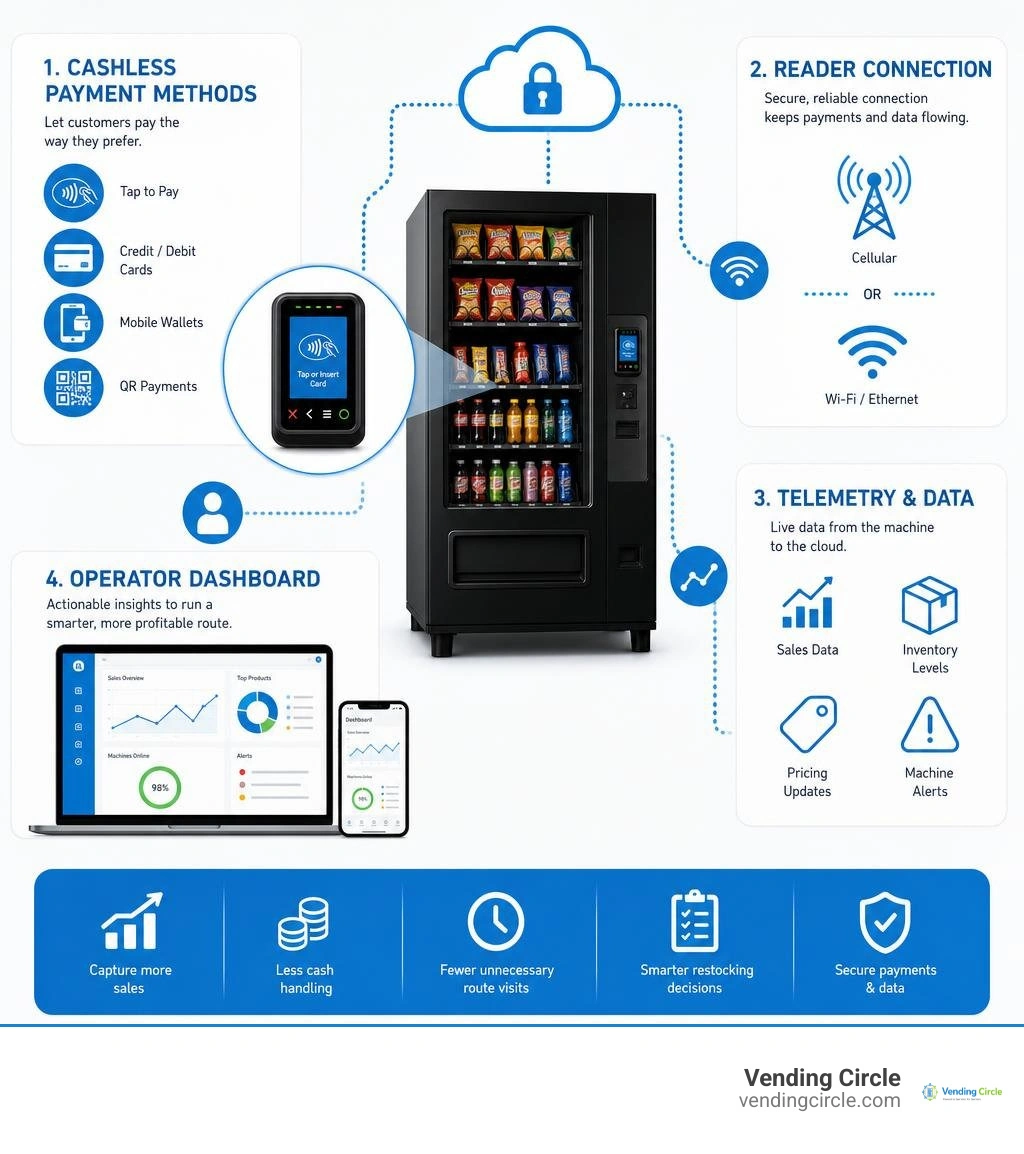
A credit card swipe vending machine lets customers pay with credit cards, debit cards, tap-to-pay wallets, and often QR-based payments instead of needing cash. For operators, the practical first step is to choose an MDB-compatible reader, confirm reliable cellular or network coverage at the location, and keep cash acceptance where the audience still uses it.
Cashless capability can capture purchases that would otherwise be lost when someone has no bills or coins. Operators commonly report sales gains of 20% to 35% after converting a cash-only machine, although results depend on foot traffic, product mix, pricing, and the location's payment habits.
Modern readers do more than process a swipe. They can send sales, inventory, pricing, and machine-error data to a cloud dashboard. That means fewer unnecessary route visits, faster refunds, less cash handling, and better restocking decisions. The best setup is often hybrid: accept cash and cards so customers can pay the way they prefer.
I'm Manuel Mojica, founder of Vending Circle and owner of MM Healthy Vending, where I have worked with the operational decisions behind a profitable credit card swipe vending machine route. My experience in vending, sourcing, and cybersecurity helps inform the practical payment, uptime, and security guidance in this guide.
Credit card swipe vending machine basics:
How a Credit Card Swipe Vending Machine Works
To the customer, buying an afternoon energy drink or a bag of chips takes two seconds: swipe, dip, or tap, select the item, and walk away. Behind the metal housing of the machine, however, a sophisticated communication exchange occurs between the payment terminal, the internal controller, and remote banking networks.
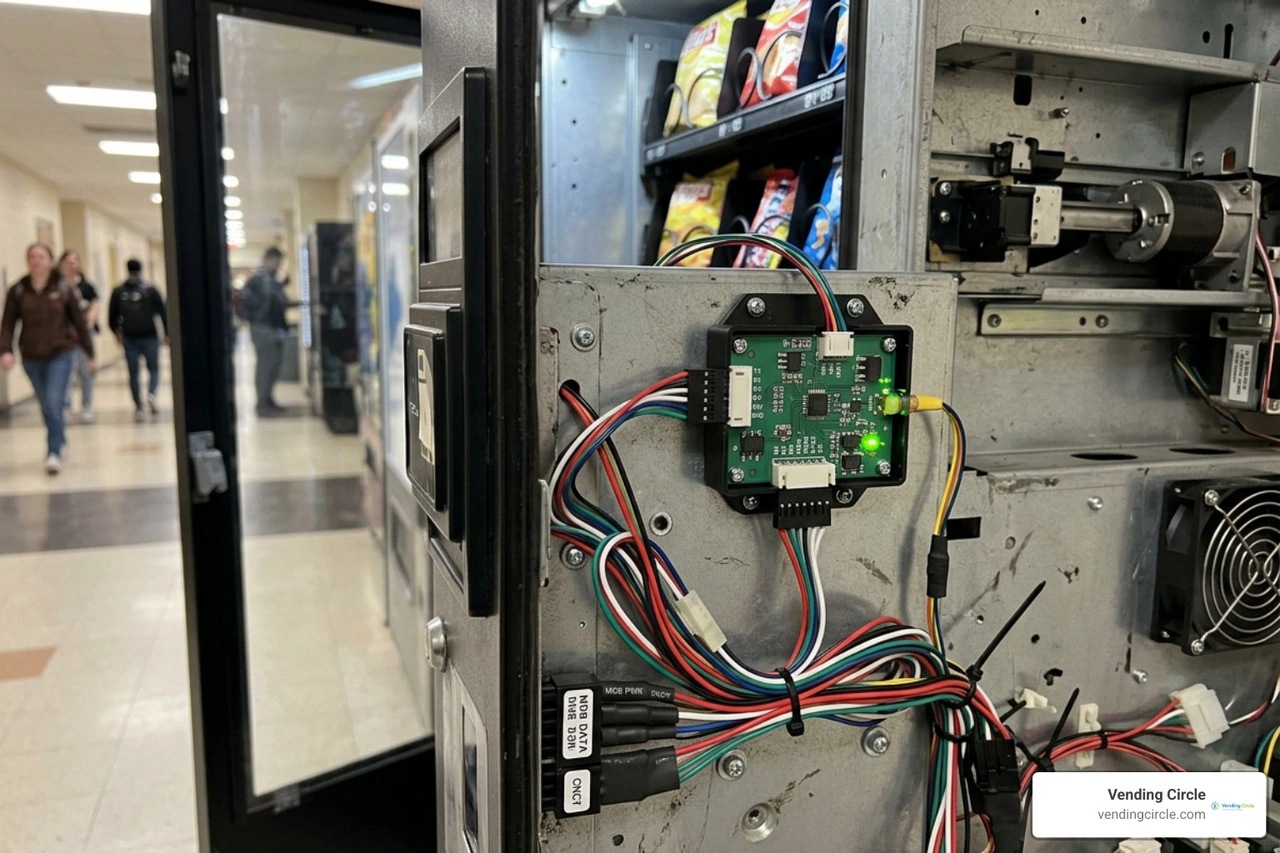
Modern vending machines rely on standardized electronic interfaces to communicate with payment hardware. When a customer initiates a transaction, the card reader acts as the front-end peripheral, capturing encrypted payment credentials and coordinating directly with the internal vending machine controller (VMC) to vend the product once authorization is confirmed.
Multi-Drop Bus Protocol and Hardware Architecture
The core of automated vending communication is the Multi-Drop Bus (MDB) protocol. MDB is an internal bus standard that allows the main VMC to communicate seamlessly with peripheral devices, such as coin mechanisms, bill validators, and modern vending card readers.
Alongside MDB, readers often connect to the machine's DEX (Data Exchange) port or an RS232 serial interface. While MDB manages real-time credit, vend requests, and dispense confirmations, the DEX port exports diagnostic data, historical cash logs, and inventory counts.
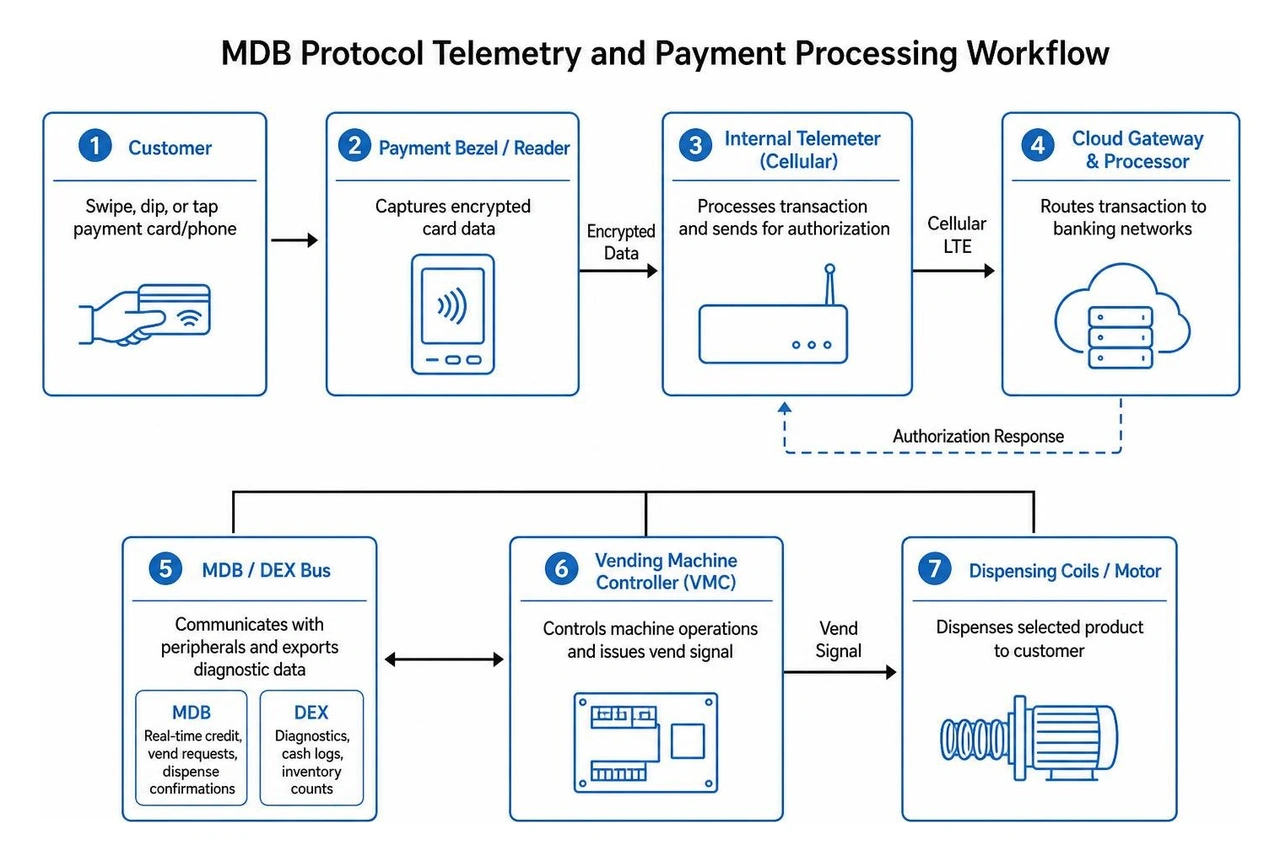
Inside the machine, the payment assembly consists of the external bezel (the interface where cards are swiped or tapped) and an internal telemeter (a cellular-enabled processing computer). The system operates on standard MDB power (typically 12V to 42V DC or 12V to 24V AC). For specialty hardware, such as mechanical drop-shelf vendors or ticket dispensers, operators can install an isolation interface pulse module. These modules allow non-MDB pulse-based controllers operating at 5V, 12V, or 24V to accept credit card inputs seamlessly.
Payment Processing Workflow from Swipe to Authorization
When a customer presents a card at a machine, the transaction follows a secure, high-speed authorization pipeline:
- Card Presentation and Encryption: The reader reads the magnetic stripe, reads the EMV chip, or intercepts the Near Field Communication (NFC) radio frequency token. Data is instantly encrypted at the point of interaction (PCI-PTS standards) to prevent data interception.
- Pre-Authorization Request: The reader's telemeter transmits a pre-authorization ping across a secure 4G/LTE cellular connection to the merchant payment gateway. This ping reserves a standard holding amount (often $5.00 to $10.00) to verify account funds.
- VMC Enablement: Once the payment gateway approves the hold, the telemeter issues a credit signal over the MDB line to the VMC, lighting up the machine's selection keypad.
- Product Selection & Dispense: The user presses their selection. If the machine features multi-vend or incremental authorization, the user can choose multiple items within that single session. Drop sensors verify the product fell into the bin.
- Settlement and Clearing: The VMC signals the telemeter that the vend was successful, providing the exact vend price. The telemeter posts the final settlement amount to the card processor and cancels any remaining pre-authorized balance.
Key Types of Cashless Vending Payment Systems
Not every cashless setup is built the same way. Operators can retrofit legacy hardware or invest directly in modern factory-integrated smart machines.
| Feature / Metric | Aftermarket Retrofit Reader Kit | Factory-Integrated Smart Terminal | Wall-Mounted / Drop-Shelf Cashless Vendor |
|---|---|---|---|
| Typical Hardware Cost | $200 – $600 | Included in base machine price ($3,500 – $7,000+) | $695 – $1,500 |
| Installation Effort | 15–30 minutes (drill bezel, plug MDB) | Zero setup (plug and play out of box) | Wall mounting + external transformer |
| Tamper Resistance | Moderate (external surface mount) | High (flush-mounted, reinforced glass) | High (heavy-gauge steel bezel) |
| Screen Capabilities | 2.4" to 3.5" color screen or static LED | 10" to 32" interactive touchscreen | Digital alphanumeric DigiMax display |
| Telemetry Integration | Third-party cloud dashboard | Unified proprietary operating system | Basic pulse/transaction counter |
| Dispensing Style | Coils, belts, or standard spirals | Grab-and-go AI smart coolers or spirals | Drop shelves, spring coils, or ticket feeds |
Retrofit Readers vs. Factory-Integrated Terminals
For existing routes, adding a card reader to a vending machine using an aftermarket retrofit kit is the standard path forward. These kits include the external card bezel, mounting hardware, MDB and DEX wiring harnesses, and an external standard-gain or high-gain antenna. Retrofit units attach to standard card reader knockout slots found on legacy machines, providing an affordable way to modernize equipment without purchasing brand-new chassis.
Conversely, if you are planning to buy a vending machine with card reader capabilities already built in, factory-integrated terminals offer distinct advantages. Integrated systems often incorporate large 10-inch to 32-inch touchscreen displays, flush-mounted bezels, and seamless single-board data processing.
Integrated smart machines—such as AI grab-and-go coolers—use pre-authorization locks: customers tap their card to open the door, take what they want, and computer vision cameras track items as they are removed, automatically billing the customer when the door closes. For traditional machines, however, retrofit bezels deliver the fastest path to modernization without voiding existing equipment investments.
Supported Payment Methods in a Credit Card Swipe Vending Machine
Modern consumers carry far more than traditional plastic cards. Modern cashless terminals combine multiple payment reading technologies into a single compact housing:
- Magnetic Stripe Swipe: Supports legacy debit, credit, and gift cards via physical swipe.
- EMV Contact Chip: Provides cryptographic authentication for dipped chip cards.
- Contactless NFC: Processes instant taps from contactless credit cards and mobile wallets like Apple Pay and Google Pay. Apple Pay alone represents more than 50% of mobile payment transactions across the United States.
- Closed-Loop Prepaid Cards: Accepts campus cards, employee meal cards, hotel keycards, or prepaid business account balances via MIFARE or RFID frequencies.
- Dynamic & Static QR Codes: Facilitates app-based digital payments and third-party mobile solutions.
By deploying devices that support every common payment rail, operators ensure they never miss a transaction due to consumer payment preferences.
Cost, Fees, and ROI Breakdown for Cashless Vending
Investing in cashless payment equipment requires evaluating hardware acquisition, recurring SaaS subscriptions, and interchange processing rates.
Upfront Hardware and Installation Expenses
Standard retrofit card reader hardware typically costs between $200 and $600 per machine, depending on screen size and processing capabilities. For example, high-performance units like the New Nayax VPOS Touch Credit Card Reader retail around $350.
Additional physical accessories may include:
- Standard or high-gain LTE antennas: $8 to $30
- Extended MDB and DEX wiring harnesses (3ft to 10ft): $15 to $35
- External power supply kits (for non-powered controllers): $30 to $50
- Weatherproof splash covers and mounting spacers: $10 to $25
Installation is straightforward and takes 15 to 30 minutes per unit. For self-installing operators, the labor cost is zero; commercial installation by a certified technician typically runs $50 to $100 per machine.
Transaction Fees and Telemetry Subscription Costs
Cashless processing involves two recurring cost layers:
- Merchant Processing Fees: Card processing networks charge an interchange processing fee, typically ranging between 3% and 5% of the vend amount (or a combination of a percentage plus a small flat fee, such as 5% to 10% on micro-transactions).
- Telemetry SaaS and Cellular Subscriptions: Readers require a dedicated cellular connection to transfer transaction logs and telemetry alerts. Monthly platform access fees generally range from $7.95 to $12.00 per machine per month, covering continuous LTE connectivity, remote dashboard access, and automated merchant account deposits.
While these fees represent an ongoing expense, the resulting jump in sales volume and route efficiencies substantially outweighs the processing cost.
Revenue Growth and Payback Timelines
The numbers behind cashless conversion consistently demonstrate strong financial performance:
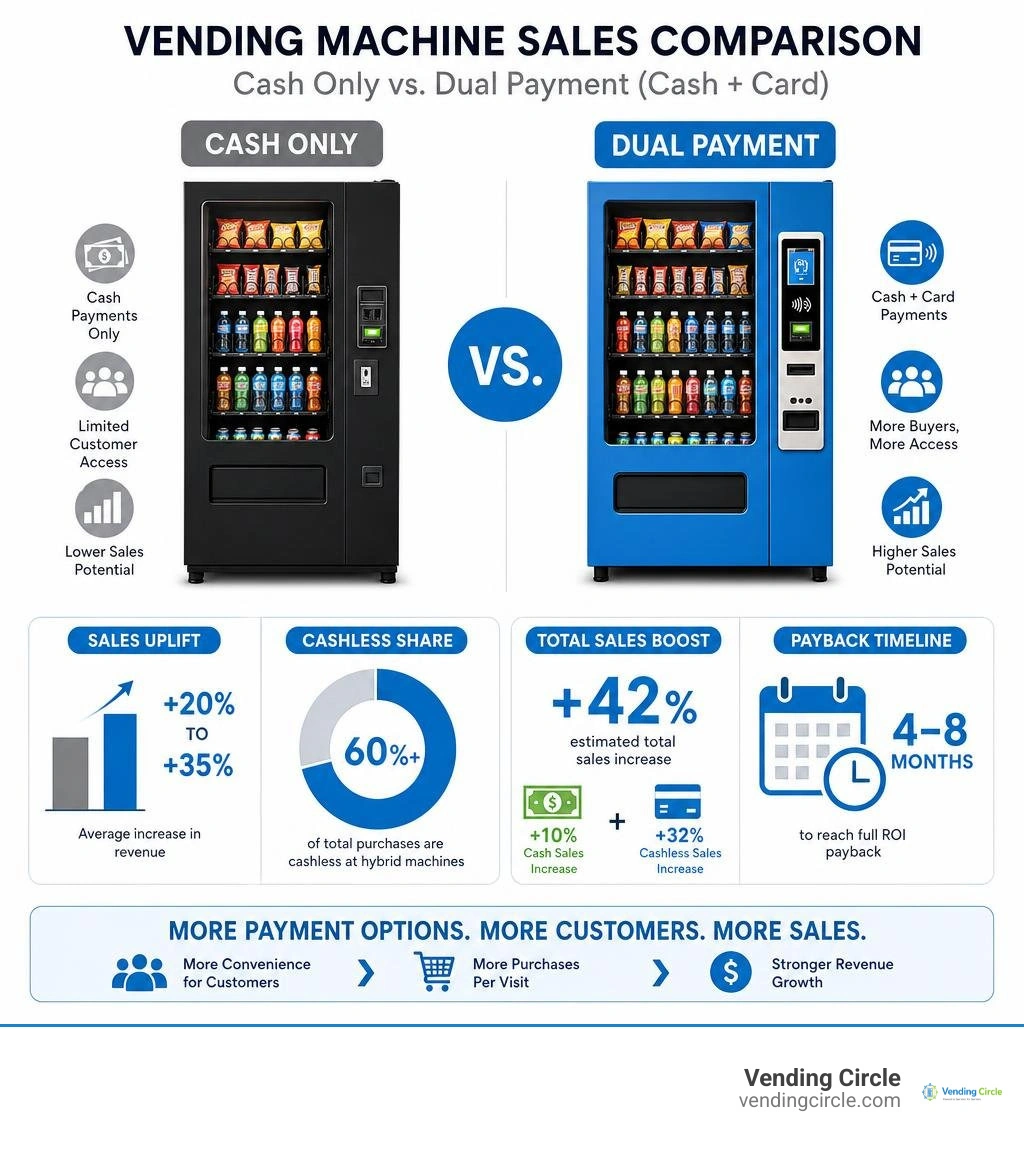
- Average Sales Uplift: Adding a card reader to a cash-only machine drives an average revenue increase of 20% to 35%.
- Cashless Transaction Share: Cashless payments account for over 60% of total purchases at hybrid machines, frequently exceeding 80% in high-income office corridors, medical centers, and college campuses.
- Dual-Payment Synergy: Maintaining a hybrid setup that accepts both physical bills and cashless transactions can generate an estimated 42% total boost in sales volume (cash sales increase by ~10% due to foot traffic visibility, while cashless sales expand by 32%).
- Payback Timeline: Across a standard route, hardware investments reach full ROI payback within 4 to 8 months. On high-traffic locations, payback is often achieved in as little as 6 to 8 weeks.
For an operator managing a 20-machine route, deploying card readers requires an upfront capital investment of approximately $6,000 to $14,000, which is typically recovered through new gross margin within two to three months.
Operational Advantages of Modern Cashless Vending
Beyond capturing credit card swipes at the point of sale, cashless readers double as advanced operational telemeters.
Operational Benefits of Operating a Credit Card Swipe Vending Machine
Deploying card readers creates significant operational efficiencies across your business:
- Elimination of Cash Constraints: When customers pay with cash, purchases are limited to the spare bills and coins in their pockets. Card readers allow customers to purchase higher-priced items ($3 to $8+ premium energy drinks, protein bars, and fresh food) and make multi-item purchases in a single session.
- Substantial Theft and Vandalism Reduction: Cash boxes represent an attractive target for theft. Reducing physical cash on site diminishes vandalism risks.
- Zero Bill Jam Failures: Bill validator jams and coin return blockages are among the most common service calls in the vending industry. Cashless readers have no mechanical transport pathways, drastically lowering mechanical maintenance costs.
- Simplified Chargeback Management: Digital transaction records with multi-year cloud retention make resolving vend disputes, partial dispense claims, and refund requests effortless via an online merchant dashboard.
Real-Time Telemetry and Route Pre-Kitting
Modern card readers continuously beam DEX audit logs to your central Vending Management System (VMS). This cloud telemetry eliminates guesswork through:
- Live Inventory Tracking: Monitor machine stock levels item by item directly from a smartphone or office computer.
- Route Pre-Kitting: Generate precise picklists before leaving the warehouse, packing only the exact drinks and snacks needed for each specific machine on your route. This reduces vehicle weight, cuts restocking times by up to 50%, and lowers overall operational costs by approximately 20%.
- Automated Machine Alerts: Receive instant text or email notifications if a machine stops dispensing, a drop sensor triggers a fault, internal refrigeration temperatures spike, or a power outage occurs.
- Remote Price Changes: Update product pricing across your entire fleet simultaneously from an online portal without spending hours driving to individual locations.
Carefully managing modern electronics also aligns with broader machine upkeep. For operators interested in lowering location operating expenses, understanding vending machine energy efficiency can further optimize machine performance and cooling power draws.
Connectivity and Network Infrastructure Requirements
Card readers rely on real-time data transmission to authorize transactions and report telemetry metrics. Choosing the proper network connection ensures high transaction success rates and customer satisfaction.
Cellular LTE vs. Local Network Options
To maintain consistent communication, operators have several connectivity pathways:
- 4G / LTE Cellular (Recommended): The gold standard for unattended retail. Readers utilize internal multi-carrier roaming SIM cards that automatically connect to the strongest local cell tower. This avoids reliance on third-party Wi-Fi networks and keeps the payment system isolated and secure.
- Local Facility Wi-Fi: While possible on certain readers, venue Wi-Fi often introduces operational challenges due to captive portal logins, corporate firewall restrictions, and periodic password updates that can knock readers offline.
- Hardwired Ethernet (LAN): Ideal for fixed indoor installations in deep basements, hospital wings, or manufacturing plants where heavy steel construction blocks cellular signals.
For low-reception environments, installing an external high-gain magnetic-mount antenna extended through the top or rear of the vending cabinet easily restores full LTE reception. For complete technical deployment tips, explore our guide on establishing a reliable vending machine network connection.
Offline Payment Authorization and Signal Reliability
What happens if a thunderstorm or local outage causes the payment reader to temporarily lose cellular connection?
Modern vending payment hardware features Offline Transaction Processing (Store-and-Forward). When signal loss occurs:
- The device switches to an internal offline authorization mode.
- It validates the payment card structure locally against strict risk parameters (such as pre-set daily transaction count thresholds per card).
- The reader signals the machine to vend the product and securely caches the encrypted transaction payload in non-volatile memory.
- Once cellular or network connectivity is restored, the reader automatically batch-uploads all cached transactions to the gateway for final settlement.
Furthermore, premium card readers are equipped with internal supercapacitors. If the vending machine loses main electrical power mid-vend, the supercapacitor provides backup voltage to complete encryption, record the transaction state safely, and execute a controlled system shutdown.
Frequently Asked Questions About Vending Card Readers
How much does it cost to add a card reader to a vending machine?
Adding a card reader typically costs between $200 and $600 for the hardware unit, plus $50 to $100 for professional installation (or $0 if you install it yourself using an MDB kit). Ongoing costs include a monthly cellular telemetry fee of $7.95 to $12.00 per machine, along with payment processing fees between 3% and 5% per transaction.
What happens if a card reader loses internet connectivity during a vend?
If a card reader loses connection, modern units utilize offline caching to store encrypted transaction details and dispense the item. Once network service is restored, the stored transactions are automatically transmitted to the payment processor. If a reader cannot establish local authorization, the transaction simply voids, ensuring the customer is not billed for an undispensed item.
How long does it take to see a return on investment after upgrading to card readers?
Most vending machine operators achieve full return on investment (ROI) within 4 to 8 months. Because card readers capture impulse purchases and expand average basket sizes, machines typically generate a 20% to 35% revenue boost. In high-foot-traffic placements like industrial facilities, hospitals, or transit hubs, payback periods can be as short as 6 to 8 weeks.
Modernizing Your Vending Fleet
The transition to cashless retail is no longer an optional upgrade; it is the industry standard. Consumer cash usage continues to decline while mobile wallet and contactless tap payments grow each year. Equipping your machines with modern card readers captures high-margin impulse sales, streamlines route logistics through real-time telemetry, and protects your business from cash-handling overhead.
Whether you are retrofitting existing machines with plug-and-play MDB telemeters or investing in new automated retail equipment, upgrading your payment systems is one of the highest-ROI decisions you can make. When you are ready to upgrade your business with factory-direct equipment, explore high-performance cashless vending machines to scale your operation efficiently.