

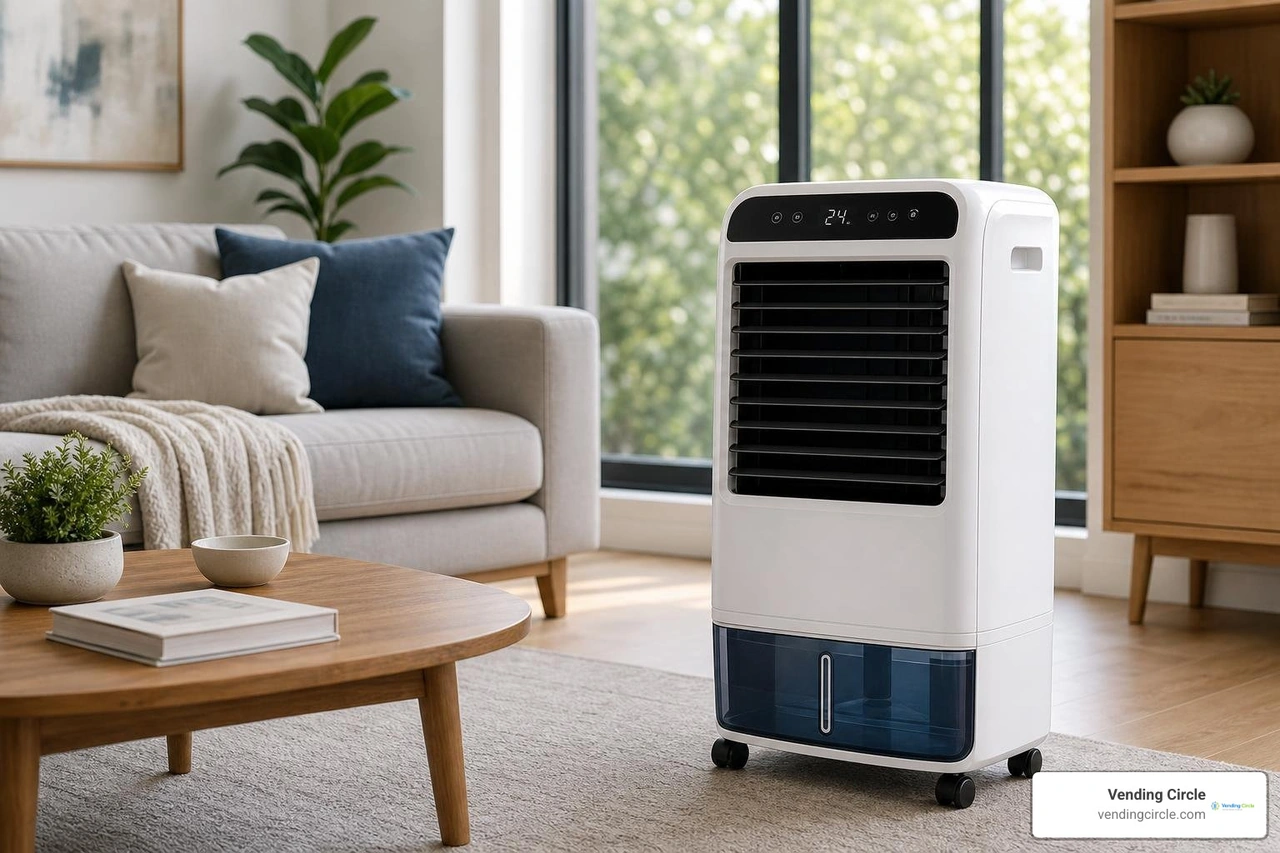
What Is a Smart Air Cooler — and Is It Right for You?
A smart air cooler is a Wi-Fi-connected evaporative cooling device that uses water evaporation — not a compressor — to lower the temperature of the air around you, while letting you control it remotely via an app or voice assistant.
Here's what you need to know at a glance:
| Feature | Smart Air Cooler |
|---|---|
| How it cools | Evaporates water through wet pads to produce cool air |
| Energy use | As low as 26.9W — up to 14x less than traditional AC |
| Best climate | Hot and dry (under ~50-60% humidity) |
| Smart features | App control, voice assistants (Alexa, Google Home), scheduling |
| Typical temp drop | Around 2°C in an hour in real-world conditions |
| Price range | ~$80 to $850+ depending on features |
| Replaces AC? | No — provides localized cooling, not whole-room temperature control |
When summer heat hits and a regular fan just moves warm air around, a smart air cooler feels like a genuine upgrade. But it is not a portable air conditioner — and that distinction matters a lot, especially if you live somewhere humid.
The promise is simple: powerful personal cooling, a fraction of the electricity cost, and the convenience of smart home control. The reality is a little more nuanced — and that's exactly what this guide breaks down.
I'm Manuel Mojica, founder of Vending Circle and former Cyber Operations Officer in the US Air Force, and my background in evaluating energy-efficient equipment for operational environments directly informs how I assess smart cooling solutions like the smart air cooler. Whether you're cooling a home office, a breakroom, or a workspace, this guide will help you make the right call.
What is a Smart Air Cooler and How Does It Work?
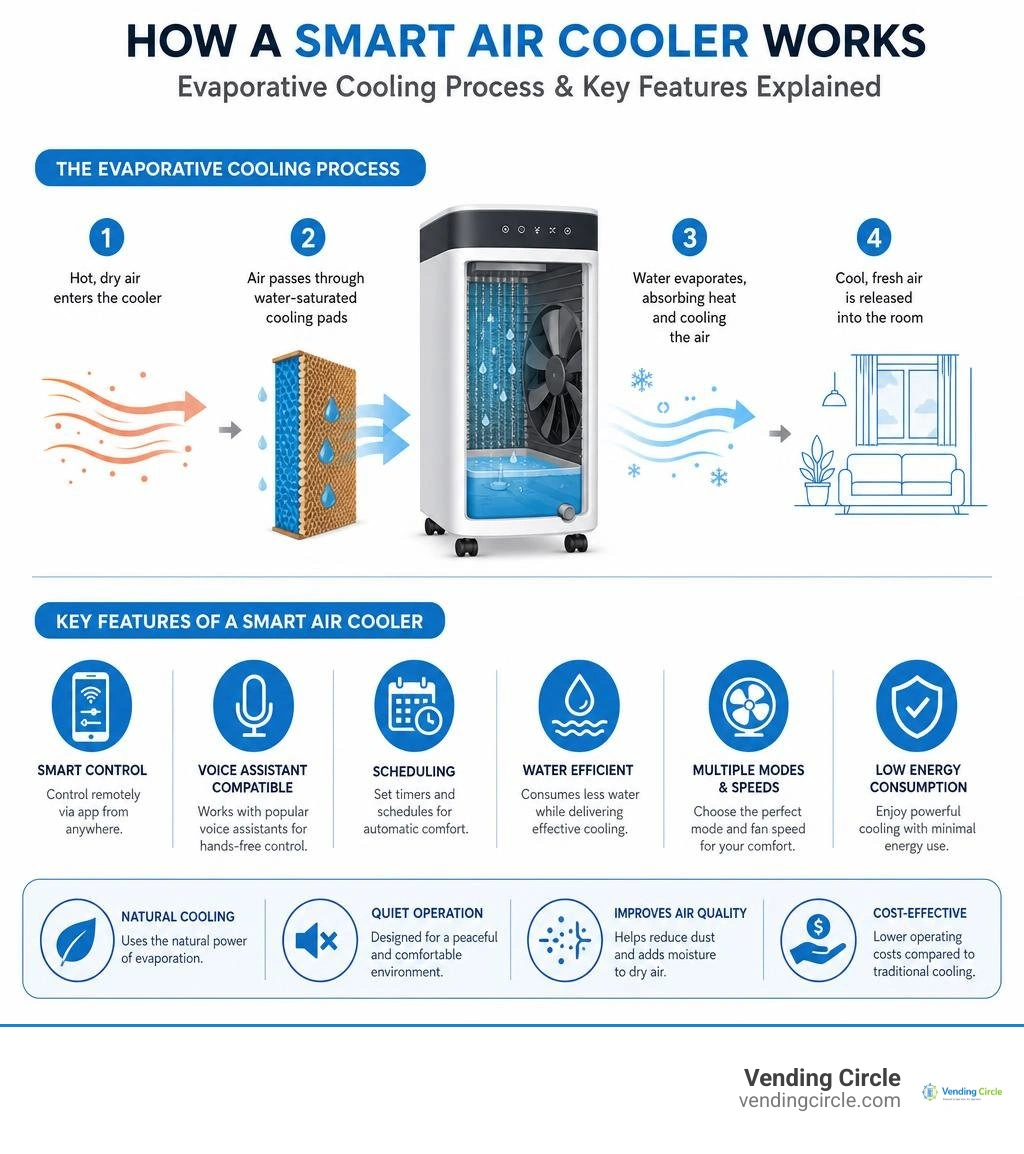
To understand a smart air cooler, we first have to look at the physics of evaporative cooling, which is the same natural process that cools your skin when you sweat. Often referred to as "swamp coolers," these devices do not use heavy, noisy compressors or chemical refrigerants. Instead, they rely on a simple, elegant mechanism: pulling hot, dry air through water-saturated cooling pads.
As the warm air passes through these wet pads, the water absorbs heat from the air to evaporate. This phase transition turns liquid water into water vapor, absorbing latent heat and leaving the air significantly cooler and more humid than when it entered.
To boost this effect, modern units feature a dedicated water tank where you can add ice or pre-frozen ice packs. The cooler pumps this ice-cold water directly over the pads, supercharging the temperature drop.
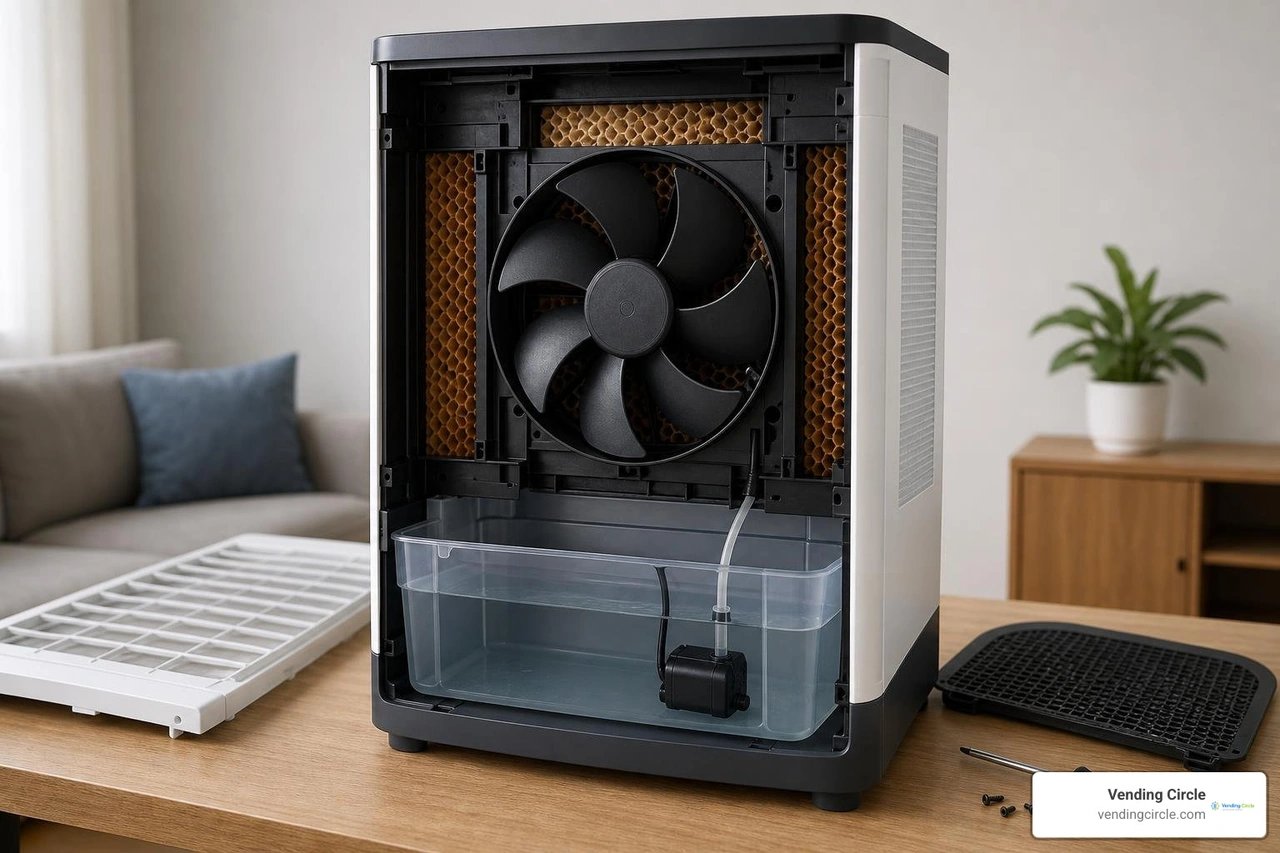
A prime example of this technology in action is the Klarstein IceWind Smart Air Cooler 7L 270m3/h Black. It integrates a 7-liter water tank with a multi-directional fan system, doubling as a humidifier and air purifier.
However, because this process adds moisture to the air, its performance is tightly bound to the relative humidity of your environment. In dry climates, where relative humidity is below 50%, a smart air cooler performs beautifully. In highly humid climates, the air is already saturated with water vapor, meaning very little water can evaporate from the pads, and the cooling effect drops drastically.
How a Smart Air Cooler Lowers Room Temperature
Unlike a traditional fan that simply circulates air to create a wind-chill effect on your skin, a smart air cooler physically lowers the temperature of the air leaving the unit. This temperature drop is achieved by utilizing the latent heat of vaporization.
Some advanced models also utilize hybrid misting technology. For instance, the Dreo TurboCool 516S misting fan uses ultra-fine misting nozzles to spray microscopic water droplets into the airflow, which evaporate instantly. In real-world tests during hot summer spells, this method has been shown to drop the immediate surrounding temperature by around 2°C within an hour.
When looking at performance, you will want to check the airflow capacity. This is usually measured in cubic meters per hour (m³/h) or cubic feet per minute (CFM). For example, the Klarstein Skyscraper Smart Air Cooler 6L 180m3/h Gray moves 180 m³/h of air, making it ideal for localized cooling in rooms up to 20 square meters. On the larger side, heavy-duty outdoor patio coolers like those from Waykar offer massive airflow capacities ranging from 3,500 CFM to 4,800 CFM, designed to sweep across large, open spaces.
Air Circulation vs. Active Cooling
It is incredibly common to confuse smart air circulators with active air coolers, but they serve two completely different purposes:
- Air Circulators: These are high-performance fans designed to move air fast and distribute it evenly. They use aerodynamic designs and DC inverter motors to project a focused column of air over long distances, balancing room temperatures and eliminating hot or cold spots. A great example of this is the Xiaomi Smart Standing Air Circulation Fan - Xiaomi Global, which moves a massive 1440 m³/h of air and can achieve whole-room circulation in a standard 17m² room in just two minutes. It creates a refreshing wind-chill effect, but it does not actively lower the air temperature.
- Active Coolers: These devices contain a water reservoir and pump system. They physically lower the air temperature passing through them by adding moisture. If you run an air cooler without water in the tank, it simply operates as a standard fan.
Key Features to Look For in a Smart Air Cooler
If you are shopping for a smart air cooler in 2026, you will want to look past the marketing buzzwords and focus on the technical specifications that dictate daily usability.

First, consider the tank size. A larger tank means longer operation times before you have to refill it. Personal tower models typically range from 3 to 7 liters, while larger commercial or semi-outdoor units can hold 20 to 40 liters (or even 6 to 8 gallons on patio models).
Second, check the oscillation angle. Multi-directional 3D oscillation (both horizontal and vertical) ensures the cool air is distributed evenly rather than blasting you in a single, freezing spot.
Third, pay close attention to noise levels. Look for units that run under 40 decibels (dB) on their lowest settings if you plan to use them in a bedroom or home office.
Finally, portability and power source are key. While most air coolers require a wall outlet, some smart air circulators, like the Smartmi 2S: Rechargeable, WiFi-Enabled Smart Air Circulator Fan, feature a built-in 5200mAh (57Wh) lithium-ion battery pack. This allows for up to 24 hours of cordless operation on lower speeds, making it incredibly easy to move around without worrying about tripping hazards.
App Control and Smart Ecosystems
What elevates a standard swamp cooler into a smart air cooler is its connectivity. Most smart models connect via 2.4 GHz Wi-Fi, allowing you to control them through a dedicated mobile app or link them to voice assistants like Amazon Alexa and Google Home.
Through these apps, you can set precise schedules, adjust fan speeds across granular levels (some models offer up to 100 distinct speeds), and program custom timers. The Air Shower Fan F225 SMART – BONECO, for example, allows users to program up to 10 custom timers and calendar events directly through its smartphone app, making it easy to automate your home's climate control throughout the day.
Advanced Sensors and AI Tracking
At the premium end of the market, smart cooling devices are beginning to integrate advanced sensors and AI-driven tracking to maximize comfort and minimize energy waste.
A prime example of this cutting-edge tech is the Find+Follow™ Purifier Cool PC3 | Find+Follow™ intelligence. This machine features a 17-point AI vision system that detects human presence. It tracks your movements around the room to project a targeted, cooling stream of purified air directly toward you.
To protect your privacy, all image processing is handled locally on the device, ensuring no data ever leaves the machine. If multiple people enter the room, the system automatically expands its oscillation angle up to 350 degrees to share the breeze evenly, and it shuts off when the room is empty to save power.
Smart Air Cooler vs. Traditional Fans and ACs: Performance & Cost
Choosing the right cooling appliance comes down to balancing performance, upfront price, and long-term running costs.
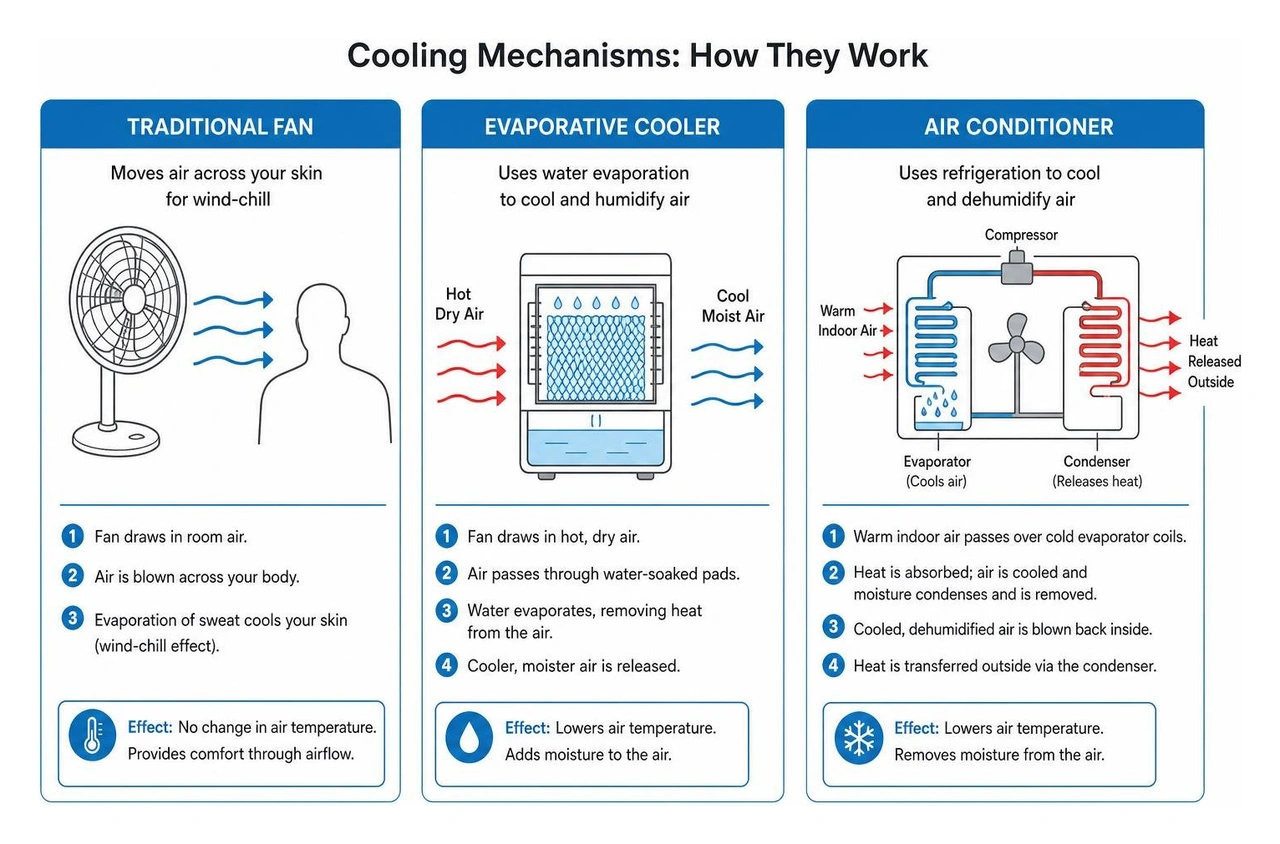
| Appliance Type | Active Temp Reduction? | Average Power Usage | Best Climate | Humidity Impact |
|---|---|---|---|---|
| Traditional Fan | No (Wind-chill only) | 30W - 60W | Any | None |
| Smart Air Cooler | Yes (Localized) | 25W - 80W | Hot & Dry | Increases humidity |
| Portable / Split AC | Yes (Whole-room) | 800W - 1500W+ | Any | Decreases humidity |
Energy Efficiency and Operating Costs
One of the strongest arguments for choosing a smart air cooler is its remarkably low energy consumption. Because they only need to power a fan and a small water pump, air coolers can use up to 14 times less energy than traditional compressor-based air conditioners.
While a portable air conditioner easily draws 1,000 to 1,500 watts of power, highly efficient smart air coolers can run on as little as 45W (like the Klarstein Skyscraper) or even an astonishing 26.9W (like the Swan Nordic). Running a 26.9W cooler costs well under a penny per hour, meaning you can leave it running all day without dreading your next electricity bill.
Climate Limitations: Humid vs. Dry Conditions
We cannot stress this enough: evaporative coolers are climate-dependent. They rely on the wet-bulb depression — the difference between the dry-bulb (air) temperature and the wet-bulb (humidity-adjusted) temperature.
If you live in an arid region, a smart cooler can comfortably lower the ambient air temperature by several degrees. However, if you live in a highly humid area, adding more water vapor to the air will only make the room feel stuffy and damp.
Additionally, unlike air conditioners which require sealed rooms, evaporative coolers need a constant supply of fresh air. You must keep a window or door slightly ajar to allow the added moisture to escape, preventing the indoor air from becoming oversaturated.
Smart Home Integration and Automation Protocols
For smart home enthusiasts, the ultimate goal is local, automated climate control. Imagine your air cooler turning on automatically when a Bluetooth temperature sensor in your room reads above 27°C, and turning off when it drops below 22°C.
Integrating Your Smart Air Cooler into Home Automation
Most commercial smart air coolers rely on Wi-Fi and cloud-based APIs (like the Tuya or Smart Life ecosystems) to communicate with platforms like Google Home or Amazon Alexa. While Matter v1.2 (released in late 2023) officially added support for smart fans, native Matter-compatible air coolers remain rare in 2026.
If you are building a local-first smart home using platforms like Home Assistant, cloud dependencies can be frustrating. If your internet goes down, your automations fail. Fortunately, there are several clever workarounds used by the smart home community:
- IR Blasters: Many budget-friendly air coolers come with simple infrared (IR) remote controls. By pairing a Wi-Fi or Zigbee-enabled IR blaster (like a Broadlink device) with Home Assistant, you can mimic the remote's signals locally.
- Power Monitoring Smart Plugs: Because IR blasters only send one-way commands, your smart home won't natively know if the cooler is actually on or off. By plugging the cooler into a power-monitoring smart plug, you can track its energy draw. If the plug registers a draw of 45W, Home Assistant knows the cooler is running on high; if it registers 2W, it is in standby.
- ESP32 and Tasmota Flashing: For advanced DIYers, proprietary Wi-Fi modules inside some smart coolers can be desoldered and replaced with ESP32 microcontrollers running open-source firmware like Tasmota or ESPHome, enabling 100% local MQTT control.
Frequently Asked Questions about Smart Air Coolers
Can a smart air cooler replace a traditional air conditioner?
No. A smart air cooler cannot replace a compressor-based air conditioner, especially in humid climates or sealed rooms. While an AC actively strips moisture from the air and cools an entire room to a set temperature, an air cooler uses natural evaporation to provide a localized, cooling breeze. Think of it as a high-powered personal spot-cooler rather than a whole-house climate control system.
How do you maintain and clean a smart air cooler?
Regular maintenance is vital to prevent mold, scale buildup, and unpleasant odors. We recommend:
- Draining and drying the water tank completely when not in use for extended periods.
- Cleaning the honeycomb cooling pads and rear dust filters every two to four weeks using mild soapy water or a diluted vinegar solution.
- Using filtered or distilled water to minimize mineral deposits.
- Placing ice packs carefully (ideally on the left side of the tank in models like the Klarstein IceWind) to ensure they do not float freely and block the water pump nozzle.
Do smart air coolers work in high humidity?
They do not perform well in high humidity (above 60%). Because the air is already saturated with water, the evaporation rate slows down dramatically, meaning the air leaving the unit will not feel significantly cooler than the ambient room temperature. In these conditions, they will function primarily as standard fans.
Conclusion
A smart air cooler represents an incredibly energy-smart, eco-friendly way to stay comfortable during hot, dry summer days. By pairing the natural power of evaporative cooling with modern Wi-Fi connectivity, app scheduling, and smart home integrations, these devices offer a highly cost-effective alternative to expensive, power-hungry air conditioning.
Just remember to match the technology to your climate: keep a window slightly ajar, use pre-chilled water or ice packs to supercharge performance, and look for local integration options if you are building an automated smart home.
If you are looking to optimize your workspace, breakroom, or commercial setup with the latest energy-efficient climate control strategies, we are here to help. Join our active community of operators to share proven strategies, ask questions in our weekly live Q&As, and access exclusive manufacturer-direct pricing on top-tier equipment.
Optimize your workspace with smart climate control solutions on Vending Circle