Why Vending Machine Agreements Can Make or Break Your Business
Vending machine agreements are legally binding contracts between a vending operator and a property owner that define who owns the equipment, how revenue is split, who handles maintenance, and what happens when things go wrong.
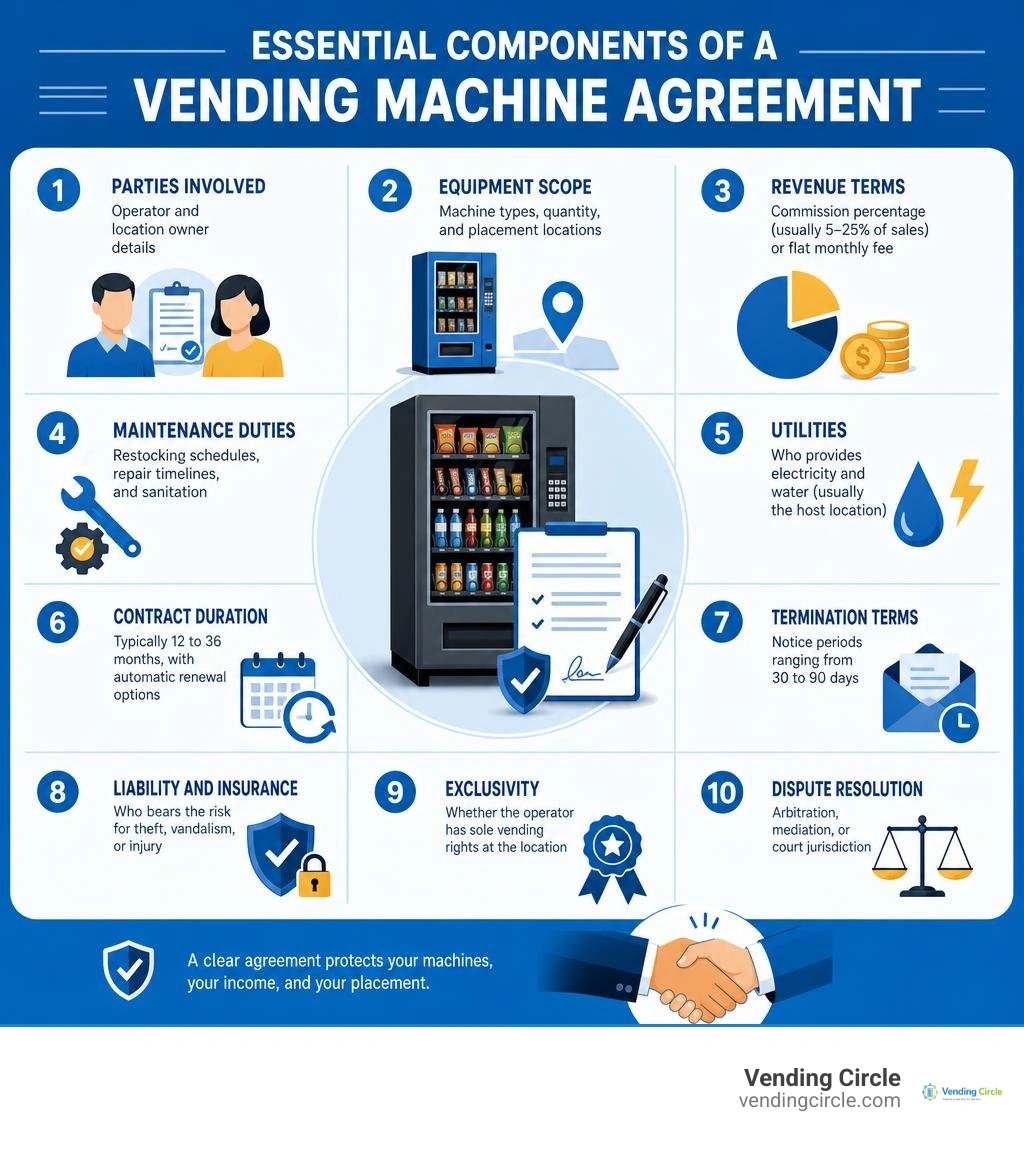
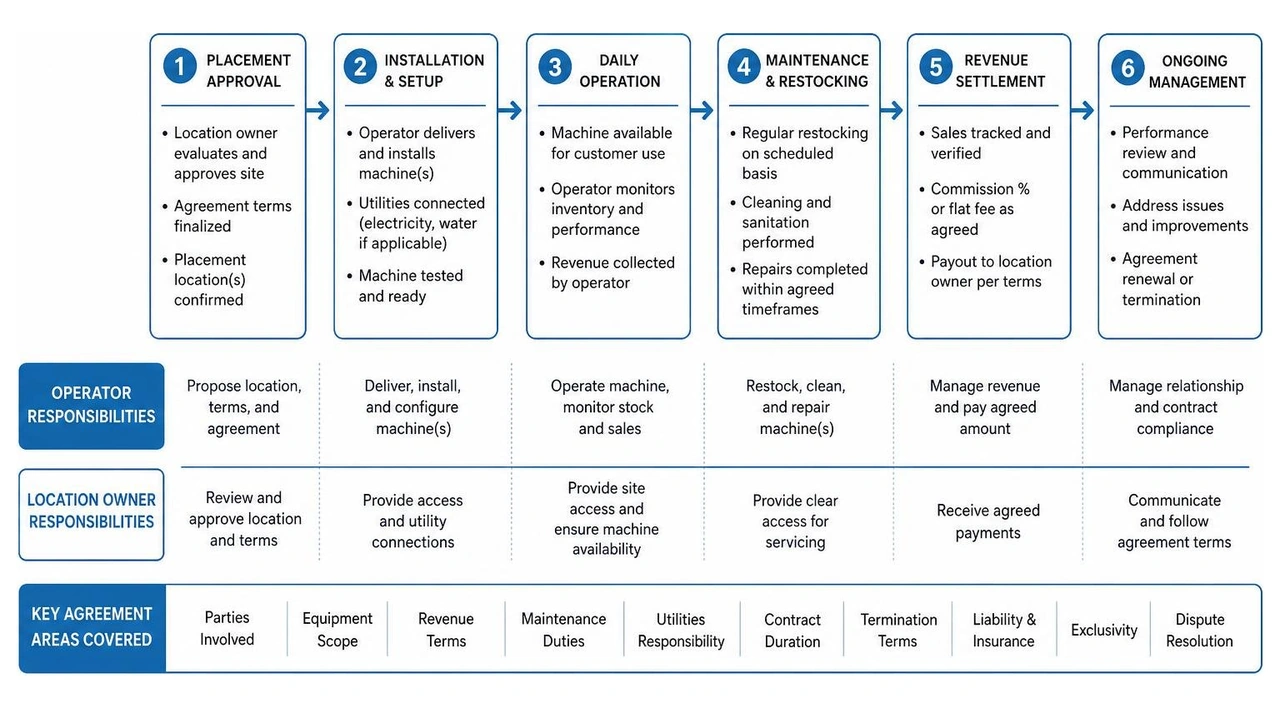
Here's what a solid vending machine agreement typically covers:
- Parties involved — operator and location owner details
- Equipment scope — machine types, quantity, and approved placement locations
- Revenue terms — commission percentage (usually 5–25% of sales) or flat monthly fee
- Maintenance duties — restocking schedules, repair timelines, and sanitation
- Utilities — who provides electricity and water (usually the host location)
- Contract duration — typically 12 to 36 months, with automatic renewal options
- Termination terms — notice periods ranging from 30 to 90 days
- Liability and insurance — who bears the risk for theft, vandalism, or injury
- Exclusivity — whether the operator has sole vending rights at the location
- Dispute resolution — arbitration, mediation, or court jurisdiction
Without a written agreement, a handshake deal can collapse the moment a property manager changes, a machine gets vandalized, or a revenue dispute arises. A clear contract protects your machines, your income, and your placement.
I'm Manuel Mojica, founder of Vending Circle and owner of MM Healthy Vending, and I've negotiated vending machine agreements across dozens of locations — from small offices to municipal facilities. In this guide, I'll walk you through everything you need to draft contracts that protect your business and win better placements.
Key Elements of Enforceable Vending Machine Agreements
Creating an enforceable contract begins with establishing clear legal boundaries. Whether you are using a basic location consent form or a comprehensive formal AGREEMENT, the primary purpose of the document is to protect your asset ownership and outline day-to-day operating expectations.
Core Provisions and Utility Responsibilities
At its core, every contract must explicitly declare title retention. The agreement must state that 100% of all right, title, and interest in the vending equipment, inventory, and monetary profits remain exclusively with the vendor. Host locations receive a service or a revenue split, but they never acquire equity in your hardware or stock.
Site specifications and utility access represent another vital baseline:
- Utility Allocation: Host locations agree to provide dedicated electrical power (and water access for hot beverage machines) at their sole expense.
- Electrical & Structural Standards: The host ensures the site meets voltage requirements, floor weight capacity, and clearance dimensions prior to installation.
- Servicing Standards: Vendors commit to regular inspection, sanitization, restocking, and maintaining clean equipment. When upgrading modern routes, deploying hardware like a Buy a Vending Machine with Card Reader requires consistent connectivity, which should also be acknowledged in the placement guidelines.
Exclusivity and Revenue Models in Vending Machine Agreements
Exclusivity provisions protect your financial investment. An exclusivity clause explicitly prohibits the host location from bringing in competing vending operators or placing alternative food and beverage hardware on the premises. Granting exclusive rights ensures you won't share foot traffic with another operator down the hall.
As highlighted in Vending Machine Industry Statistics 2026, standard commission rates range from 5% to 25% of monthly revenue. Operators usually select between two primary payment structures:
- Percentage of Gross Sales / Cash in Bag (CIB): Commissions calculated on cash and cashless collections after deducting applicable sales taxes, card processing fees, or bottle deposits. Contracts often set a minimum threshold — such as $300 in gross monthly revenue — before commission payouts apply. If sales drop below this minimum, payouts may convert from a monthly to a quarterly schedule to offset administrative costs.
- Flat Monthly Fee: The operator pays a fixed amount (e.g., $50 per month) regardless of sales volume, which simplifies accounting for smaller commercial offices.
Managing Liability, Vandalism, and Risk Allocation

When machines sit in semi-public or public spaces, equipment damage and theft become operational risks. A well-crafted contract defines who absorbs these losses.
Theft Protocols and Damage Liability
In standard commercial agreements, vendors bear the financial risk of loss for damaged machines, stolen cash, or stolen products caused by third-party vandalism. However, the host location assumes specific legal duties:
- Prompt Notification: The host must notify the vendor immediately upon discovering equipment failure, physical damage, or tampering.
- Continuous Vandalism Clause: If vandalism or theft occurs repeatedly at a single site, the vendor retains the right to remove equipment immediately without notice, default, or penalty, while preserving claims for lost revenue.
- Host Personnel Liability: If damage or theft is directly attributable to the host's employees, contractors, or agents, the host becomes financially responsible for repairs and missing inventory.
Insurance Coverage and Legal Compliance Requirements
Presenting proof of insurance build immediate credibility with commercial property managers. To protect your operations, maintain a robust commercial insurance portfolio:
- General Liability Insurance: Protects against property damage or third-party bodily injuries (for example, if a customer trips over an extension cord or a unit tips over).
- Business Owner's Policy (BOP) & Personal Property: Covers physical hardware, internal components, and stock against fire, flood, or severe damage.
- Cyber Insurance: Essential for smart vending terminals, cloud inventory management systems, and credit card readers handling customer payment data.
- Commercial Auto & Workers' Compensation: Covers delivery trucks, transit, and employee injuries during route servicing.
Beyond insurance, ensure strict legal compliance by securing state and local business licenses, sales tax permits, and health department approvals for food service handling. Operators stocking perishable products must maintain appropriate temperature logs and source products through authorized distributors offering Vending Machine Products Wholesale. To shield personal assets from business liabilities, operators should establish an LLC or corporate entity.
Contract Terms, Termination, and Dispute Resolution
Contract terms dictate how long your hardware stays on site and how easy it is to exit an underperforming location.
| Contract Parameter | Standard Commercial Agreement | Government / Airport Agreement |
|---|---|---|
| Initial Term | 12 to 36 months | 36 to 60 months (via public bid) |
| Renewal Windows | 12 to 24 months (automatic) | Formal renewal options or re-bidding |
| Notice Period | 30 to 90 days written notice | Strict 30 to 60 day formal cure windows |
| Termination Fee | Minimal / Equipment removal costs | Liquidated damages or performance bonds |
Termination Clauses in Vending Machine Agreements
Termination provisions establish how either party can cancel the arrangement:
- Termination Without Cause: Allows either party to end the contract by delivering 30, 60, or 90 days' prior written notice.
- Termination With Cause: Triggered by material breaches, such as non-payment of commissions, failure to service machines, or repeated hardware breakdowns. Contracts usually grant a 7 to 14 day window to remedy breaches.
- Equipment Removal Post-Termination: Following contract termination, contracts must grant vendors explicit legal access to retrieve machines within 7 to 14 days, protecting the operator against trespass or conversion claims.
Force Majeure and Binding Arbitration
Force majeure clauses excuse non-performance during unforeseen extreme events, such as natural disasters, civil unrest, or government-mandated facility closures.
For resolving routine operational conflicts, include binding arbitration and mediation clauses. Choosing arbitration over court litigation saves legal expenses. Contracts should explicitly select the governing law and local county jurisdiction (such as Cook County, Illinois) to settle disputes predictably.
Strategies to Find, Win, and Manage Location Contracts
Securing high-performing locations requires active sales efforts and organized administrative systems:
- Conduct Targeted Cold Outreach: Combine cold calls, direct walk-ins, and professional email pitches aimed at facility managers, HR directors, and building superintendents.
- Build Pitch Packages: Provide formal proposals containing equipment photographs, product menus, health department credentials, and a Certificate of Insurance (COI).
- Incentivize Network Referrals: Offer flat referral fees (e.g., $100) or gift cards to property managers who introduce you to peer facility heads.
- Leverage Modern Inventory Systems: Implement tools like Vending Machine Inventory Management to monitor real-time sales data. Tracking daily stock movement helps prevent stockouts and lets you schedule a Vending Machine Emergency Restock before host management notices empty shelves.
Frequently Asked Questions about Vending Contracts
Who pays for electricity and utilities for a vending machine?
The host location supplies all electricity (and water lines, if required) at its own expense. Vending machines draw standard utility power, and host sites cover these costs as part of providing amenities to their tenants or employees.
Who is responsible for vending machine theft and vandalism?
The vending machine operator assumes the primary risk of loss for damaged equipment, stolen inventory, and missing cash resulting from third-party vandalism. However, if damage stems directly from negligence or misconduct by host employees, the host location must reimburse the vendor. Continuous vandalism also gives the vendor the right to remove equipment immediately without penalty.
What is the standard commission rate for location owners?
Standard commission rates range between 5% and 25% of gross monthly sales (or Cash in Bag collections). High-traffic locations like airports or hospital waiting rooms command higher commission rates, while smaller offices with under 50 employees often receive a 0% commission split or a flat monthly fee structure.
Conclusion
Mastering vending machine agreements gives you control over your route's profitability, asset protection, and long-term security. Standard commercial contracts running 12 to 36 months provide stable revenue streams, while precise legal clauses protect your hardware against unexpected loss.
When renewing or renegotiating contracts, evaluate your machine performance data using route management software. If foot traffic declines, renegotiate commission splits down from 15% to 5%, or exercise your removal options to relocate equipment to a busier site. Ready to expand your placement route with modern, high-earning hardware? Find Quality Vending Machines at Vending Circle and discover the tools, network, and supplier pricing needed to scale your operations.