
How Do Vending Machine Credit Card Readers Work?
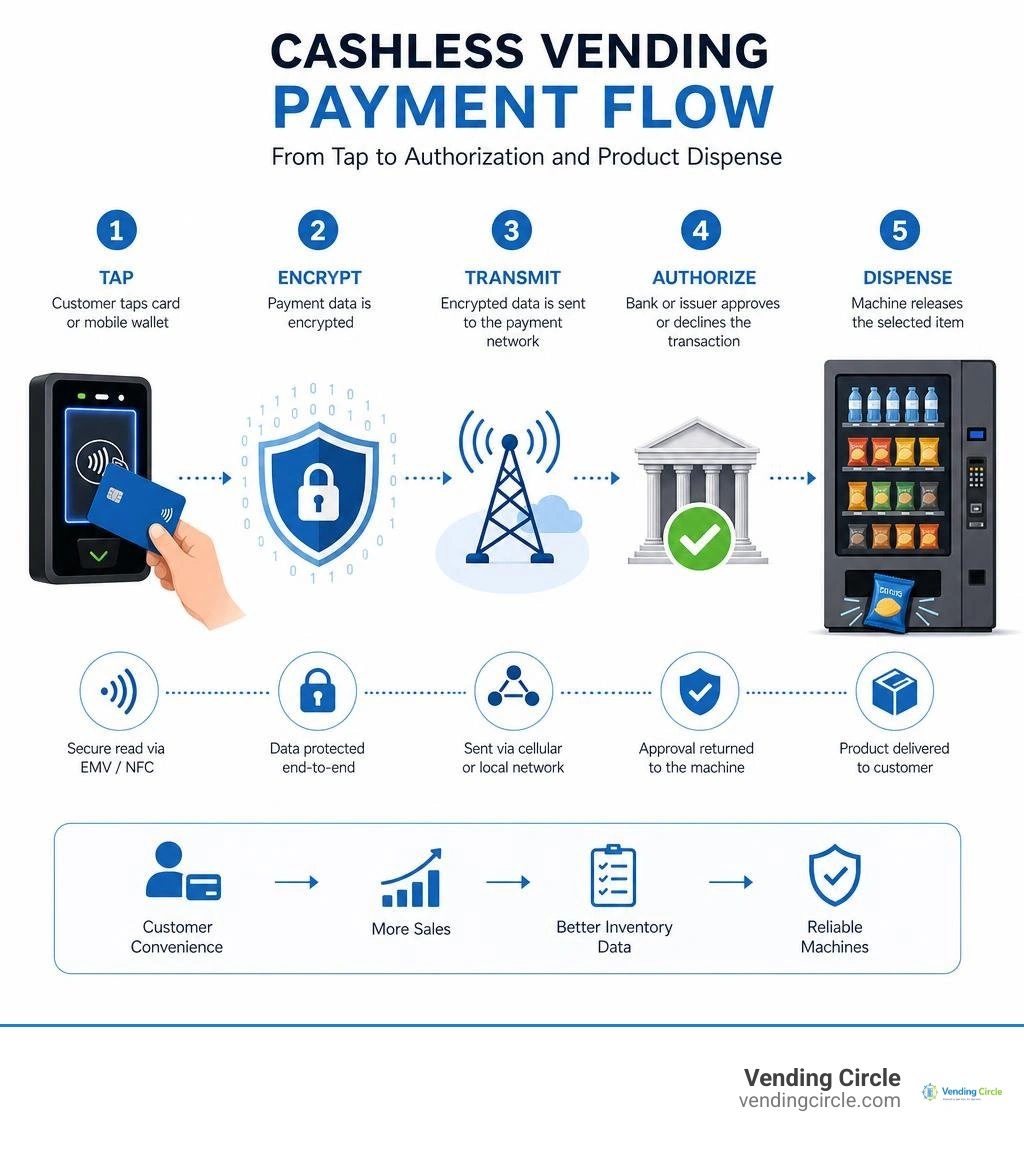
Vending machine credit card readers work by reading a card or mobile-wallet credential, encrypting the payment data, and sending an authorization request over a cellular or local network. If the bank approves it, the reader tells the vending machine controller to release the selected item. For operators, the practical priorities are simple: use a secure EMV and NFC-capable terminal, confirm reliable connectivity at the machine location, and monitor approval rates and reader uptime.
Cashless payments now account for about 70% of vending transactions, and card purchases average 37% more than cash purchases. That makes a reader more than a way to accept a tap - it is a link between customer convenience, sales, inventory data, and machine reliability.
I am Manuel Mojica, founder of Vending Circle, vending operator, and former U.S. Air Force Cyber Operations Officer. I help operators understand how do vending machine credit card readers work so they can choose secure equipment, reduce downtime, and run more profitable routes.
How do vending machine credit card readers work vocab explained:
Core Anatomy: The Hardware Components Inside Cashless Vending
To understand how unattended payment systems operate, we have to look behind the sheet metal. A modern cashless vending system is not just a consumer-facing payment bezel; it is an integrated ecosystem of digital communication relays, microcontrollers, and wireless transceivers.
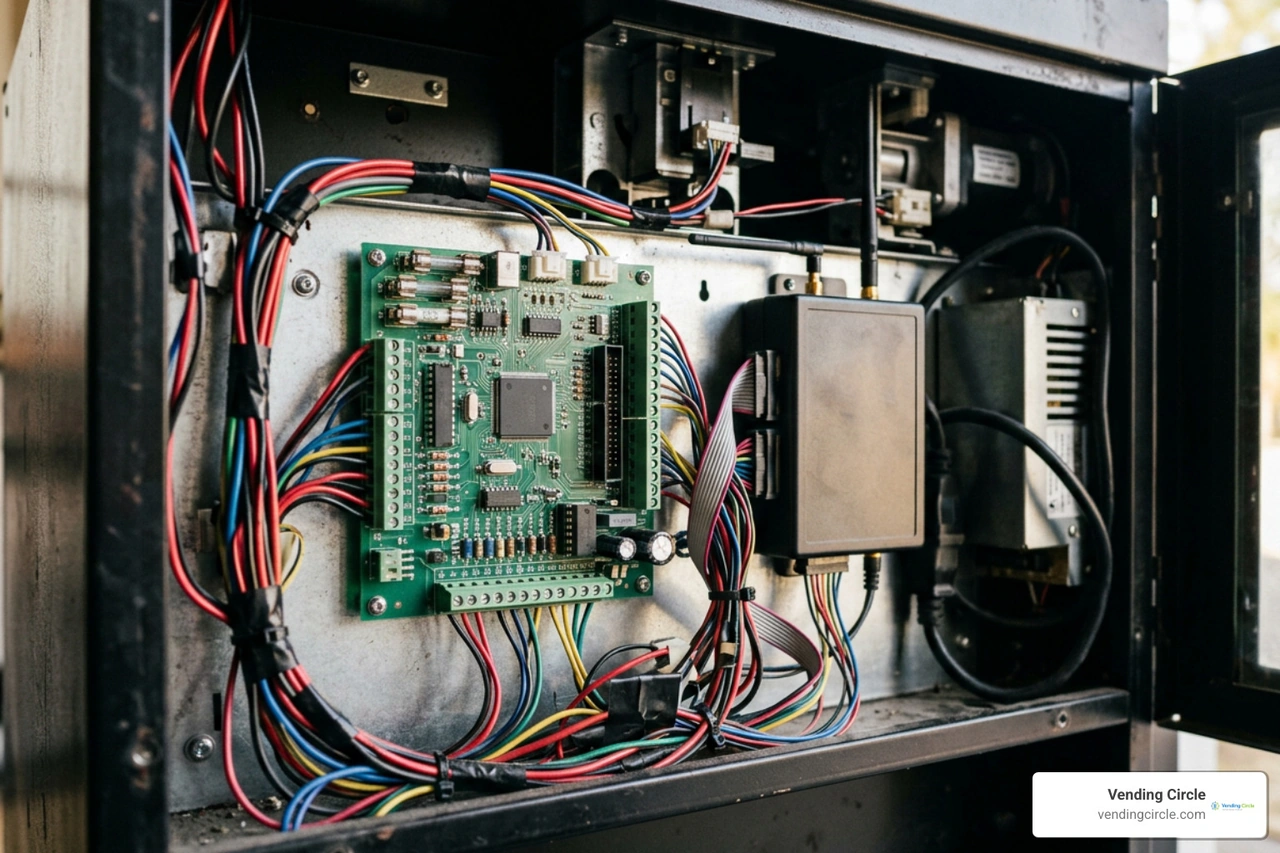
At the center of this hardware setup sits the internal machine bus. Modern vending units communicate through an industry-standard serial bus interface known as the Multi-Drop Bus (MDB) protocol. Standardized by the National Automatic Merchandising Association (NAMA), the MDB harness connects peripheral payment devices—such as bill validators, coin coin mechanisms, and external vending card readers—to the master brain of the unit: the Vending Machine Controller (VMC).
Payment Reader Interfaces: NFC, EMV Chip, and Magnetic Stripe
The front-facing terminal—often called the bezel—is the customer's interface. Modern bezel assemblies house multiple sensor heads to process various payment methods:
- Near Field Communication (NFC) Antennas: Positioned right behind the protective front housing, these radio frequency loops communicate with smartphones, smartwatches, and contactless credit cards at a short range (under 4 cm) using 13.56 MHz frequencies.
- EMV Contact Chip Slots: A physical slot equipped with precision contact pins reads the integrated circuit embedded in smart chip cards, facilitating encrypted dynamic validation.
- Magnetic Stripe Readers: While transitioning out of common use in automated retail, legacy swipe tracks read the magnetic tracks on older cards. If you operate an older credit card swipe vending machine, these tracks read static track 1 and track 2 magnetic data, though they lack the dynamic cryptographic protection of EMV and NFC.
The Telemeter and Vending Machine Controller (VMC)
Behind the exterior bezel lies the telemeter. Sometimes integrated directly into the reader casing and sometimes housed in a separate internal black box, the telemeter is the communication bridge. It contains an industrial cellular modem, a processor for cryptographic operations, and connection ports for two critical communication cables:
- The MDB Line: Transmits credit authorization signals, vend approval pulses, and motor spin confirmations between the reader and the VMC.
- The DEX Port: Direct Exchange (DEX) is an electronic audit trail protocol. The telemeter uses DEX to pull historical sales data, exact item dispense counts, coin-tube levels, and internal cabinet temperatures, packaging that telemetry data alongside payment streams to send to your remote management dashboard.
When adding a card reader to a vending machine, operators connect the telemeter inline with the existing MDB harness, effectively placing the cashless system in constant, low-latency dialogue with the machine's primary logic board.
Technical Deep-Dive: How Do Vending Machine Credit Card Readers Work?
Unattended payment processing is remarkably fast. When a consumer taps their payment device or dips a chip card, the system executes an encrypted relay race across multiple networks in just a few seconds.
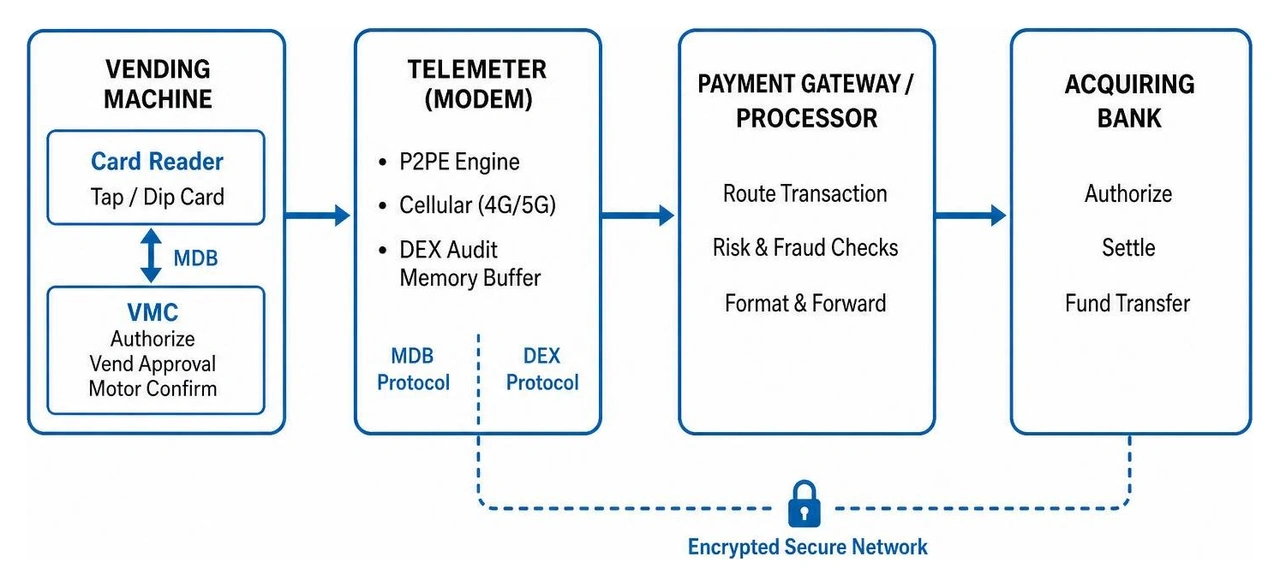
When evaluating how payment technologies operate under the hood, security and processing speed vary significantly across hardware types:
| Reader Interface | Average Transaction Speed | Cryptographic Protection | Fraud Vulnerability Level |
|---|---|---|---|
| Magnetic Stripe | 0.5 – 1.0 Seconds | None (Static Track Data) | High (Vulnerable to skimming/cloning) |
| EMV Contact Chip | 1.0 – 2.5 Seconds | High (Dynamic Cryptogram Per Vend) | Low (PCI DSS and EMV Level 1 & 2 Compliant) |
| Contactless (NFC) | 0.2 – 0.5 Seconds | Ultra-High (Tokenization + Cryptogram) | Minimal (Biometric + Dynamic Device Account) |
Step-by-Step: How Do Vending Machine Credit Card Readers Work During a Purchase?
Let's break down the exact microsecond-by-microsecond process that takes place during a standard transaction:
- Credential Acquisition: The customer taps an NFC-enabled smartphone or card against the reader. The reader powers the card's passive chip via inductive radio frequency coupling and captures the encrypted payment token.
- Point-to-Point Encryption (P2PE): The payment bezel instantly encrypts the sensitive payment data before it even travels over the internal MDB cable, ensuring that no raw, unencrypted cardholder data touches the vending machine controller.
- Cellular Uplink: The internal telemeter packages the encrypted payload and transmits it over an encrypted cellular connection (typically 4G LTE or 5G IoT bands) to the payment gateway.
- Gateway Routing & Acquiring Bank Validation: The payment gateway decodes the routing instructions and sends an authorization request through the payment card network (Visa, Mastercard, American Express, Discover) to the consumer's issuing bank.
- Multi-Vend Pre-Authorization: The issuing bank checks for available funds. If the account is valid, the bank places a temporary pre-authorization hold (for example, $5.00 to $10.00 to allow multi-item vends) and sends an approval code back to the gateway.
- Vend Execution: The gateway returns the approval code to the telemeter. The telemeter signals the VMC over the MDB bus to display credit. When the customer makes a selection, the VMC fires the appropriate coil motor, confirms the drop via optical infrared drop sensors, and reports back the exact final sale amount (e.g., $2.50).
- Financial Settlement: The telemeter transmits the final settled amount back to the gateway, clearing the unused portion of the pre-authorization hold and capturing the true transaction balance.
Data Transmission: Cellular WAN vs. Local LAN Networks
To process payments remotely, vending machines need an active WAN (Wide Area Network) or LAN (Local Area Network) data link.
Individual machines in dispersed spots (like gas stations or school staff rooms) rely on a standalone cellular WAN connection, utilizing an industrial multi-carrier SIM card. These modems auto-switch between major wireless providers to find the strongest local tower. Dedicated cellular WAN plans typically cost around $10 per month per machine.
However, in multi-bank placements—such as airport concourses, college cafeterias, or industrial plants—operators often connect several nearby machines together using a local Ethernet or Wi-Fi LAN setup. These satellite units route through a single master telemeter hub. By using an aggregated vending machine network connection, an operator can run four to six machines off one cellular line, lowering ongoing connection costs.
Security and Authorization Architecture in Unattended Retail
Because vending machines sit unattended in public places, their security architecture is designed to prevent physical tampering, network interception, and fraudulent chargebacks.
Unattended card readers adhere to strict Payment Card Industry Data Security Standards (PCI DSS Level 1) and EMV Level 1 and 2 certifications. Early historical card systems relied on physical capacitive encoding patents with embedded dielectric arrays to validate identity. Modern security, however, is purely cryptographic.
- Tokenization: When a customer pays via Apple Pay or Google Wallet, the vending reader never handles the real credit card account number (PAN). Instead, it receives a dynamic, single-use mathematical token that is useless to bad actors if intercepted.
- Hardware Tamper Sensors: Commercial readers feature internal tamper-detection loops. If someone tries to pry open the bezel or attach a hardware skimmer, the unit detects the case breach and zeroes out its cryptographic memory keys, rendering the reader inert.
- Velocity Checks: Payment gateways enforce automated velocity filters on vending fleets. If a single card is tapped 20 times across five machines within a five-minute window, the gateway flags the pattern and rejects subsequent authorization requests to prevent automated card-testing fraud.
Pre-Authorization Holds vs. Post-Authorization Billing
In traditional sit-down retail, the cashier rings up your goods, knows the exact checkout total, and charges that precise balance. In vending, that sequence is flipped: the customer swipes before selecting their product.
To accommodate multi-vend features (letting a customer buy multiple snacks in one session), the system relies on pre-authorization mode. If a machine stocks a premium $3.50 energy drink and is configured for multi-vend increments of three, the payment system places a temporary authorization hold of $10.50 on the customer's account.
Once the customer finishes their selections and the session times out, the telemeter submits the final batch-close capture for the items actually dispensed (for example, $3.50 for one drink). The issuing bank's ledger updates within a few business hours, releasing the remaining $7.00 hold back to the customer's available balance.
Signal and Sync: How Do Vending Machine Credit Card Readers Work in Low-Coverage Areas?
One common operator headache is placing machines in cellular "dead zones," such as hospital basements, parking garages, or steel-reinforced industrial warehouses.
When connectivity drops, modern payment systems use offline transaction buffering, commonly known as Store-and-Forward. Under this protocol, if a reader loses its cellular ping, it temporarily caches small offline transactions in its encrypted non-volatile memory.
To mitigate fraud risk while offline, the reader enforces strict parameters:
- Offline transactions are restricted to low dollar limits (typically under $5.00).
- The terminal enforces a global cap on offline sales volume (e.g., maximum 5 buffered sales or $20.00 total) until connectivity is re-established.
- The device performs local card structure validation checks (such as Luhn algorithm checks and local chip cert checks) before approving the offline vend.
- Once the cellular modem reconnects, the telemeter sends the stored transactions to the payment gateway in a single batch.
Financial and Operational Impact for Operators
Upgrading an unattended route from cash-only to cashless involves clear operational trade-offs and financial returns.
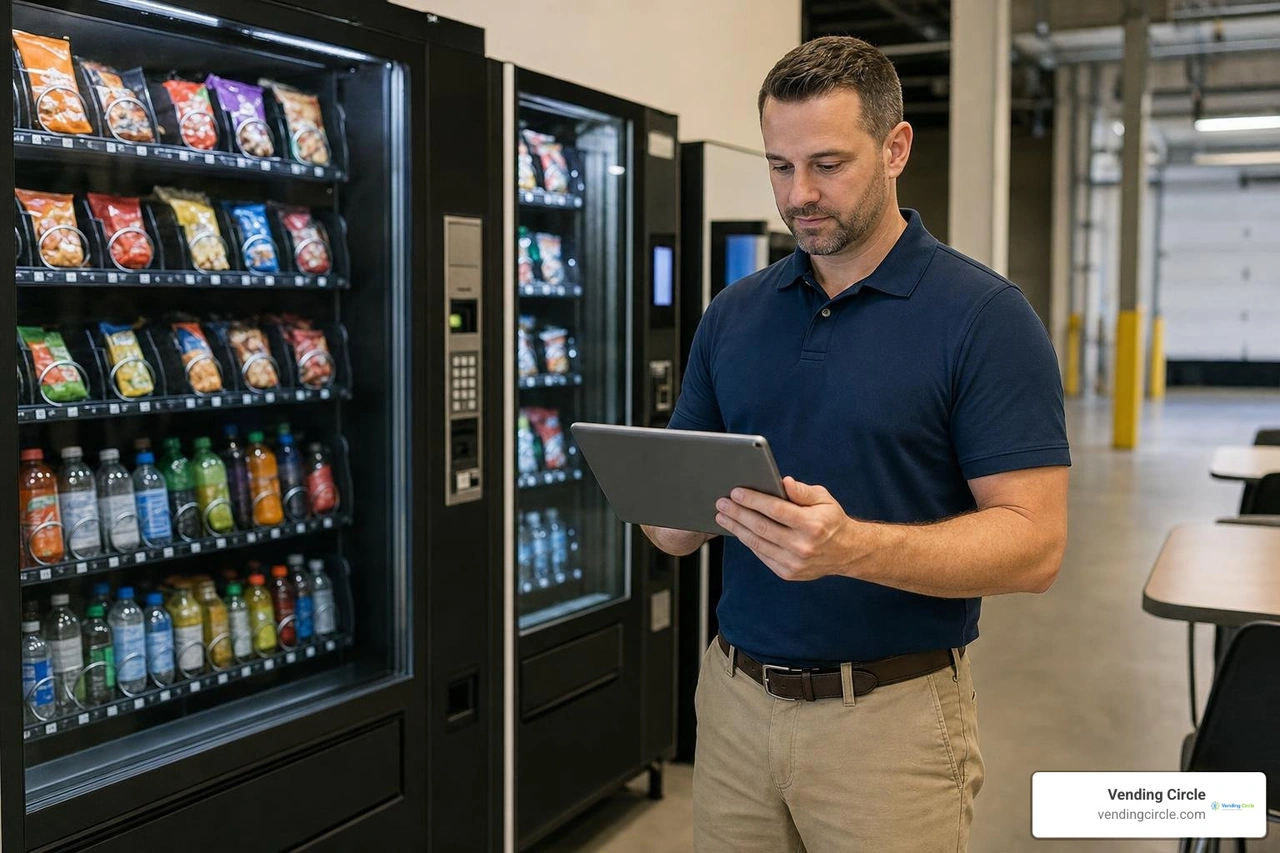
When an operator provides tap-and-pay capability, average transaction values rise significantly. Unconstrained by the loose change in their pockets, customers regularly make multi-item purchases and select higher-margin premium items. For a deeper breakdown of reader types and compatibility, see our comprehensive vending machine cards guide 2026.
Beyond top-line sales growth, cashless systems streamline daily operations:
- Reduced Cash Handling: Fewer coins and bills mean fewer coin jams, less time spent counting cash trays, and reduced cash-in-transit security risk.
- Dynamic Restocking: Because the telemeter streams DEX sales figures in real time, operators can pack pre-kitted restock totes at their warehouse, eliminating unnecessary site visits.
Cost Breakdown: Hardware, Subscriptions, and Processing Fees
Operating a cashless fleet involves three primary costs:
- Hardware Investment: A commercial card reader and telemeter package generally ranges from $250 to $400 per unit, depending on whether the bezel includes a touchscreen or video display.
- Monthly Network & SaaS Fees: Cellular network connectivity, DEX remote analytics, and automated cloud alerts typically cost $8 to $12 per machine per month.
- Merchant Processing Fees: Payment processors usually charge a blending fee structured around 2.5% to 5.5% + $0.05 to $0.10 per transaction (or an equivalent flat rate suited for micro-transactions).
Maximizing Authorization Rates Across Your Fleet
One metric that experienced route managers monitor closely is the fleet-wide authorization rate. While an operator running a single location might not notice a failed transaction here or there, a 2% to 3% difference in authorization rates across a route of 50 machines can mean thousands of dollars in lost annual revenue.
To maintain high authorization rates:
- Optimize Cellular Antennas: Move internal magnetic-mount antennas out of internal steel framing and position them on top of the cabinet to prevent packet dropouts.
- Keep Firmware Updated: Run regular over-the-air (OTA) updates on your telemeters to ensure your terminals have the latest bank routing logic and chip compliance protocols.
- Manage Gateway Timeout Windows: Set transaction authorization timeouts between 4.0 and 5.5 seconds. If timeouts are set too short, the machine may cancel approvals during slight cellular delays; set them too long, and customers may walk away before the vend cycle begins.
Frequently Asked Questions About Vending Card Readers
Can vending machine card readers work without a cellular signal?
Yes, provided the payment terminal supports offline transaction buffering (Store-and-Forward mode). The device runs cryptographic checks locally, issues a vend approval for low-dollar purchases, and stores the transaction data in its encrypted memory until cellular connectivity returns.
Why do vending machines put a temporary hold on credit cards?
Vending systems use pre-authorization holds because the payment reader takes your card details before you choose your snack. To allow for multi-vend features (buying more than one item in a single session), the processor temporarily holds an amount covering several items (often $5.00 to $10.50). Once your vend cycle finishes, the system settles the exact final amount and clears the remaining hold balance.
Do modern vending card readers support digital wallets like Apple Pay?
Yes. Modern vending readers feature integrated 13.56 MHz NFC antennas that communicate directly with Apple Pay, Google Wallet, and Samsung Pay. These transactions use dynamic device tokenization and biometric authentication (Face ID or fingerprint), making them faster and more secure than traditional magnetic swipe cards.
Conclusion
Understanding how vending card readers work helps you make better decisions for your route. Today's cashless readers act as connected edge computers that process payments, transmit inventory telemetry, and streamline daily machine operations.
As cashless payments continue to dominate unattended retail, maintaining reliable hardware, strong signal reception, and healthy authorization rates is central to running a successful route.
At Vending Circle, we support operators through every stage of their business—from selecting payment hardware to optimizing route operations. To upgrade your fleet or add new equipment, explore modern credit-card enabled vending machines built for reliable, long-term performance.