

The Best Coolers for Camping in 2026: Don't Let Your Food Melt
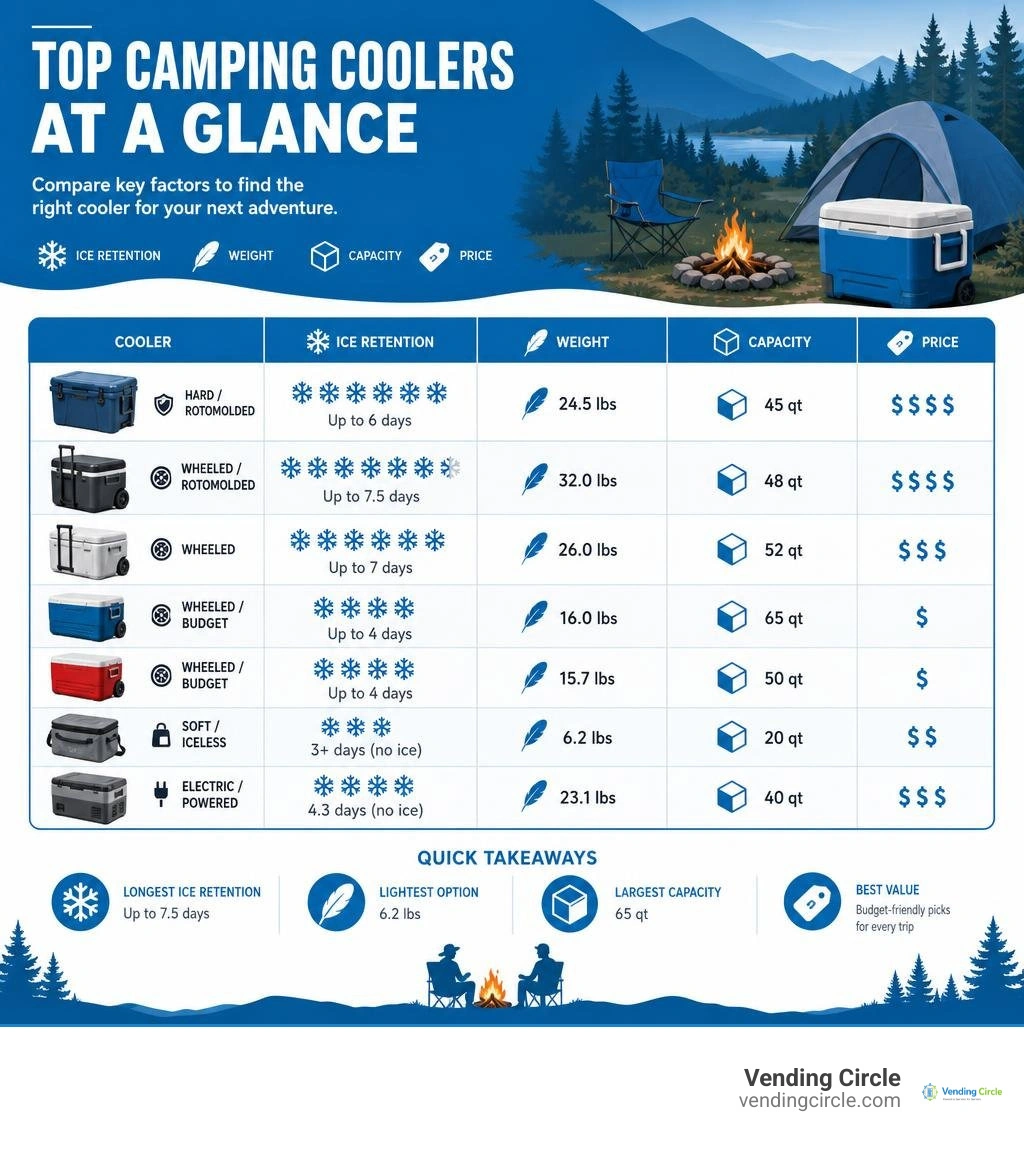
Finding the best coolers for camping comes down to a few key factors: ice retention, capacity, portability, and durability. Here's a quick look at the top picks:
| Cooler | Type | Ice Retention | Best For |
|---|---|---|---|
| Yeti Tundra 45 | Hard / Rotomolded | Up to 6 days | Rugged multi-day trips |
| Yeti Roadie 48 | Wheeled / Rotomolded | Up to 7.5 days | Portability + performance |
| RTIC Ultralight 52 | Wheeled | Up to 7 days | Value + ice retention |
| Coleman Classic 65 | Wheeled / Budget | Up to 4 days | Everyday family camping |
| Coleman Xtreme 50 | Wheeled / Budget | Up to 4 days | Budget car camping |
| Oyster Tempo | Soft / Iceless | 3+ days (no ice) | Lightweight short trips |
| Anker EverFrost 2 | Electric / Powered | 4.3 days (no ice) | Off-grid adventures |
If you've ever pulled out a waterlogged sandwich because your ice melted too fast, you already know how much a cooler can make or break a camping trip. Food safety, freshness, and convenience all depend on one piece of gear — and not all coolers are built the same.
The difference between a cheap cooler and a high-performance one isn't just price. It's how long your food stays below 40°F — the critical threshold for preventing spoilage. Premium rotomolded coolers can keep food safe for nearly a week. Budget models often struggle past two days.
I'm Manuel Mojica, founder of Vending Circle and a former US Air Force Cyber Operations Officer — and while my day job is helping vending operators source smarter, I've spent plenty of time testing what it takes to keep perishables cold in the field. My research into the best coolers for camping draws on hands-on testing data and real-world performance comparisons so you can make a confident choice before your next trip.
Rotomolded vs. Traditional: What Makes a Great Camping Cooler?
When shopping for the best coolers for camping, you will quickly notice a massive price gap between different models. On one end of the spectrum, you have premium coolers that cost several hundred dollars; on the other, you have basic plastic boxes that cost less than a tank of gas. The primary reason for this disparity lies in how these coolers are manufactured.
The two dominant manufacturing methods in the hard cooler industry are rotational molding (rotomolding) and traditional blow-molding or injection molding. Understanding the difference between these two processes will help you decide whether a premium investment is truly necessary for your camping style.
The Science of Rotomolding and Ice Retention
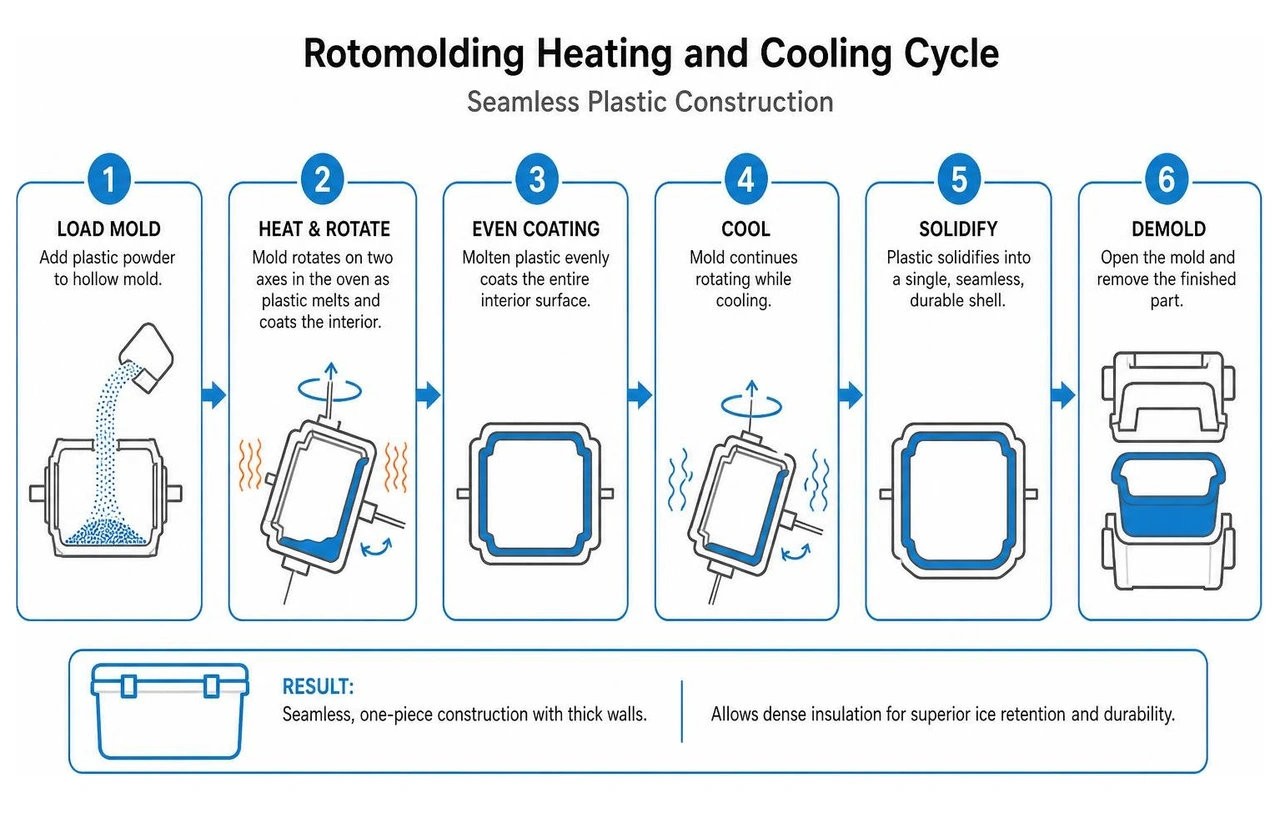
Rotomolding involves filling a hollow, heated metal mold with powdered polyethylene plastic. The mold is then slowly rotated on two axes as it heats, causing the melting plastic to coat the entire interior surface evenly. As the mold cools, it solidifies into a single, seamless, incredibly thick plastic shell.
Because rotomolded coolers are made from a continuous piece of plastic, they have no weak seams or joints that can split when dropped. This seamless construction also allows manufacturers to inject high-density polyurethane foam insulation under high pressure between the inner and outer walls. This results in a dense, uniform layer of insulation that completely blocks out external heat.
According to comprehensive testing highlighted in The 9 Best Coolers for Camping, Tested and Reviewed (June 2026), this thick, pressure-injected polyurethane insulation is the gold standard for multi-day ice retention. While a standard cooler might keep ice for a day or two, a high-quality rotomolded model can easily hold ice for five to ten days, even in direct summer sunlight. If you are heading deep into the backcountry or planning a week-long off-grid road trip, this level of performance is not just a luxury—it is a food-safety necessity.
Traditional Plastic and Budget-Friendly Alternatives
Traditional plastic coolers are typically made using blow-molding or injection-molding processes. Instead of a single, continuous piece, these coolers are constructed by piecing together separate plastic panels. This manufacturing method requires less material and is significantly faster, which keeps production costs low and makes the final product highly affordable.
The major benefit of traditional plastic coolers is their weight. Because their walls are much thinner and they contain lighter, less dense insulation, they are incredibly easy to carry. For instance, the Coleman Classic Series 65 Wheeled weighs just 13.8 pounds empty. Compare that to a heavy-duty rotomolded wheeled cooler of a similar size, which can easily exceed 30 pounds before you even add a single bag of ice.
However, the trade-off for this lightweight, budget-friendly design is thermal efficiency. Traditional blow-molded coolers lack the airtight, freezer-grade gaskets and heavy-duty latches found on rotomolded models. As a result, warm air easily creeps inside, causing ice to melt roughly 1.6 times faster than it would in a top-rated premium cooler. If you only plan short weekend trips or backyard BBQs where you can easily buy more ice, a traditional plastic cooler offers excellent cost-efficiency and portability.
How to Choose the Best Coolers for Camping
Selecting the perfect camping cooler requires balancing several competing factors: how much food you need to store, how you plan to transport the cooler, and where you will be camping. Let's look at the key features you should evaluate before making a purchase.
| Cooler Feature | Rotomolded / Premium | Traditional / Budget |
|---|---|---|
| Average Ice Retention | 5 to 10 Days | 2 to 4 Days |
| Empty Weight (Approx.) | 25 to 40 lbs | 10 to 15 lbs |
| Wall Thickness | 2 to 3 inches | 0.5 to 1 inch |
| Typical Price Range | $200 - $450+ | $50 - $100 |
| Wildlife Protection | Often IGBC Bear-Resistant | Standard Latches (Not Bear-Resistant) |
Portability and Transport: Are Wheeled Coolers Worth It?
A fully loaded camping cooler can easily weigh 70 to 100 pounds once you pack it with food, drinks, and a proper 2:1 ice-to-contents ratio. Lugging that heavy box from your vehicle to a campsite can quickly turn into a back-straining chore. This is where wheeled coolers prove their worth.
Wheeled coolers are absolutely worth the extra cost if you frequently camp at walk-in sites, visit the beach, or find yourself hauling gear across gravel, grass, and dirt paths. Look for models equipped with large, rugged, all-terrain tires. Cheaper wheeled models often feature small, hard plastic wheels that sink into soft sand or get stuck on tree roots, forcing you to carry the heavy cooler anyway.
For example, the Yeti Roadie 48 is widely regarded as one of the most portable and ergonomic wheeled coolers on the market, featuring a space-saving upright footprint and a durable telescoping handle. However, if weight is your primary concern, the Coleman Classic 65 Wheeled offers a fantastic lightweight alternative, keeping empty weight to a minimum while still providing rolling convenience.
Bear Country Safety and Durability Standards
If you plan to camp in national parks or regions inhabited by bears, your cooler choice becomes a matter of safety and environmental responsibility. The Interagency Grizzly Bear Committee (IGBC) tests and certifies outdoor products to ensure they can withstand a bear's attempts to break inside.
Many premium rotomolded coolers are IGBC-certified, meaning they are built with reinforced padlock holes on the corners. However, a bear-resistant cooler is only effective if you actually lock it. To meet safety standards, you must secure the cooler with proper padlocks or bolt-and-nut closures when leaving it unattended at your campsite. This rugged construction not only keeps your food safe from wildlife but also ensures the cooler can survive being tossed into the back of a truck bed or dropped on rocky trails.
Top-Tier Cooler Reviews: Hard, Soft, and Electric Options
To help you find the absolute best coolers for camping, we have broken down our top recommendations into four distinct categories: classic hard-sided coolers, wheeled heavy-duty models, innovative soft-sided/iceless designs, and high-tech powered electric coolers.
Top-Rated Hard-Sided Best Coolers for Camping
Yeti Tundra 45
The Yeti Tundra 45 is a legendary choice for rugged, multi-day camping trips. Featuring thick rotomolded walls and PermaFrost polyurethane insulation, it is built like a tank and can easily double as a sturdy campfire seat or a casting platform on a boat. In direct 95-degree sun testing, the Tundra 45 held ice for six full days, with a portion of the ice still intact on the final day. While its internal capacity is slightly smaller than its name suggests due to the ultra-thick insulation walls, its durability is unmatched.
RTIC Ultralight 52
If you want premium rotomolded performance without the premium price tag, the RTIC Ultralight 52 is an exceptional choice. It is designed to be up to 30% lighter than traditional rotomolded coolers of the same capacity while maintaining outstanding thermal efficiency. In controlled testing, the RTIC Ultralight 52 held food safely below 40°F for nearly six days, with total ice retention lasting seven days. It is a highly practical, mid-range option that delivers top-tier performance at a fraction of the cost.
Larcool ChillElite 45 QT
The ChillElite 45 QT Hard Cooler | Larcool is another highly competitive option for family camping trips. This rugged, rotomolded cooler features 3 inches of polyurethane insulation and is designed for multi-day ice retention. What makes the ChillElite stand out is its honest pricing strategy: unlike other premium brands that charge extra for add-ons, this cooler includes essential accessories like an elevated dry goods basket and a center divider that doubles as a cutting board. It is a smart, fully loaded choice for campers who appreciate practical, built-in features.
Why Wheeled Models are the Best Coolers for Camping on Rough Terrain

Yeti Roadie 48
For those who prioritize easy transport, the Yeti Roadie 48 stands out as the best overall wheeled cooler. Scoring exceptionally high in insulation, portability, and ease of use, this model kept food safely below 40°F for 6.8 days and drinks cold for 7.5 days during controlled testing. Its tall, upright design allows you to store wine bottles and two-liter soda bottles completely upright, preventing messy spills. The flat-topped lid is sturdy enough to sit on and serves as a convenient platform for stacking other camping gear while rolling to your campsite.
RTIC 52-Qt. Ultra-Light Wheeled Cooler
The RTIC 52-Qt. Ultra-Light Wheeled Cooler combines the excellent ice retention of the RTIC brand with heavy-duty, puncture-resistant wheels. It is designed to roll smoothly over gravel, sand, and dirt, making it ideal for beach camping and rugged trails. It kept drinks ice-cold for six days in real-world testing, offering a fantastic balance of price, performance, and mobility.
Coleman Xtreme 50 with Wheels
If you are on a tight budget, the Coleman Xtreme 50 with Wheels is a reliable workhorse. While its ice melts roughly 1.6 times faster than premium rotomolded models, it can still hold food below the safe 40°F threshold for about four days. It is incredibly lightweight, easy to pack, and perfect for casual weekend car camping trips where you do not need a week's worth of ice retention.
Innovative Soft-Sided and Iceless Coolers
Oyster Tempo
The Oyster Tempo is a fascinating disruptor in the cooler industry, utilizing a sleek, iceless aluminum design with vacuum-insulated panels. Instead of filling half the cooler with loose ice, the Tempo relies on flush-fitting, proprietary freezer packs. This design maximizes internal storage space and eliminates the dreaded "soggy sandwich" problem. In heatwave testing, it successfully kept drinks at 38°F after two hours and maintained a cool 53°F after three days. It is a premium, lightweight option for those who want to leave loose ice behind.
Traverseon ChillCore™ Airtight Cooling Bag
For those who prefer the flexibility of a soft-sided bag, the Traverseon ChillCore™ Airtight Cooling Bag is a top-tier performer. Constructed from raft-grade TPU material, this bag is highly resistant to abrasions, punctures, and leaks. It features a high-pressure airtight zipper and a triple-layer thermal insulation system that keeps ice solid for 48 to 72 hours. An added bonus is its dual-temperature versatility: it can also retain heat for 6 to 8 hours, making it perfect for carrying hot meals on cold-weather camping trips.
Electric and Powered Coolers for Off-Grid Adventures
If you are planning an extended off-grid camping trip and want to eliminate the need for ice entirely, a powered electric cooler is the ultimate solution. These high-tech units function as portable refrigerators and freezers, drawing power from your vehicle, a portable power station, or solar panels.
Anker SOLIX C1000 + EverFrost 2 40L Electric Cooler
The Anker SOLIX C1000 + EverFrost 2 40L Electric Cooler - Anker SOLIX CA is a powerhouse setup for overlanding and extended car camping. This bundle pairs a high-capacity 1,056Wh portable power station with a sophisticated 40L electric cooler. Featuring advanced compressor technology, the EverFrost 2 can cool from a warm 77°F down to freezing 32°F in just 15 minutes. It eliminates ice completely, giving you 100% usable storage space for your food and beverages.
Anker Solix EverFrost 2 Powered Cooler 40L with Anker Beach Wheels
If you need mobility with your electric setup, the Anker Solix EverFrost 2 Powered Cooler 40L with Anker Beach Wheels is an exceptional choice. This model features a built-in, removable 288Wh LiFePO4 battery that can run the cooler for up to 52 hours on a single charge (or up to 104 hours if you use a second battery). Equipped with specialized 9-inch all-terrain beach wheels, it rolls smoothly over soft sand and rough dirt paths, making it the ultimate mobile refrigeration system for beach camping and remote off-grid adventures.
Frequently Asked Questions about Camping Coolers
How long can different coolers keep ice?
Ice retention varies dramatically based on construction, ambient temperature, and how you pack the cooler. Premium rotomolded coolers, such as the Yeti Tundra 45 and RTIC Ultralight 52, can reliably hold ice for 6 to 7 days in hot summer conditions. Traditional budget coolers typically keep ice for 3 to 4 days, while high-performance soft-sided cooler bags generally offer 2 to 3 days of ice retention. Powered electric coolers can run indefinitely as long as they are connected to a power source like a portable power station or solar panels.
How do I maximize ice retention in my cooler?
To get the absolute best performance out of your cooler, follow these proven strategies:
- Pre-chill the cooler: Bring your cooler indoors the night before your trip and sacrifice a bag of ice (or use frozen jugs of water) to cool down the interior walls.
- Pre-chill your food and drinks: Never pack warm drinks or room-temperature food, as this will immediately melt your ice.
- Use the 2:1 ratio: Always aim for two parts ice to one part food and beverages.
- Minimize empty space: Air pockets accelerate ice melt. Fill any leftover empty space with extra ice or reusable ice packs.
- Keep it closed: Only open the lid when necessary, grab what you need quickly, and latch it shut immediately. Keep the cooler in the shade whenever possible.
What is the best budget-friendly cooler?
For campers seeking the best value, the Coleman Classic Series 65 and the Coleman Xtreme 50 with Wheels are outstanding options. While they do not feature the indestructible rotomolded construction of premium brands, they offer excellent ice retention for standard 2-to-4-day weekend trips at a fraction of the cost. They are lightweight, highly portable, and perfect for casual family camping.
Conclusion
Finding the best coolers for camping comes down to matching your gear to your camping style. If you are a casual weekend camper who stays close to local stores, a lightweight, budget-friendly wheeled cooler like the Coleman Classic 65 will serve you beautifully. If you frequently head deep into the backcountry, camp in bear country, or plan week-long road trips, investing in a premium rotomolded model like the Yeti Tundra 45 or the RTIC Ultralight 52 is a smart choice that will last a lifetime. For those who want to ditch the ice entirely and embrace the future of off-grid living, a powered electric cooler like the Anker EverFrost 2 offers unmatched convenience.
At Vending Circle, we understand the critical importance of reliable refrigeration, temperature control, and smart procurement. Whether you are managing a fleet of advanced vending machines or preparing for a rugged outdoor adventure, having the right equipment makes all the difference. Explore our vending machines and outdoor equipment solutions to discover how we can help you streamline your operations and keep your supplies perfectly chilled.