How a Gift Card Dispenser Machine Automates Prepaid Sales
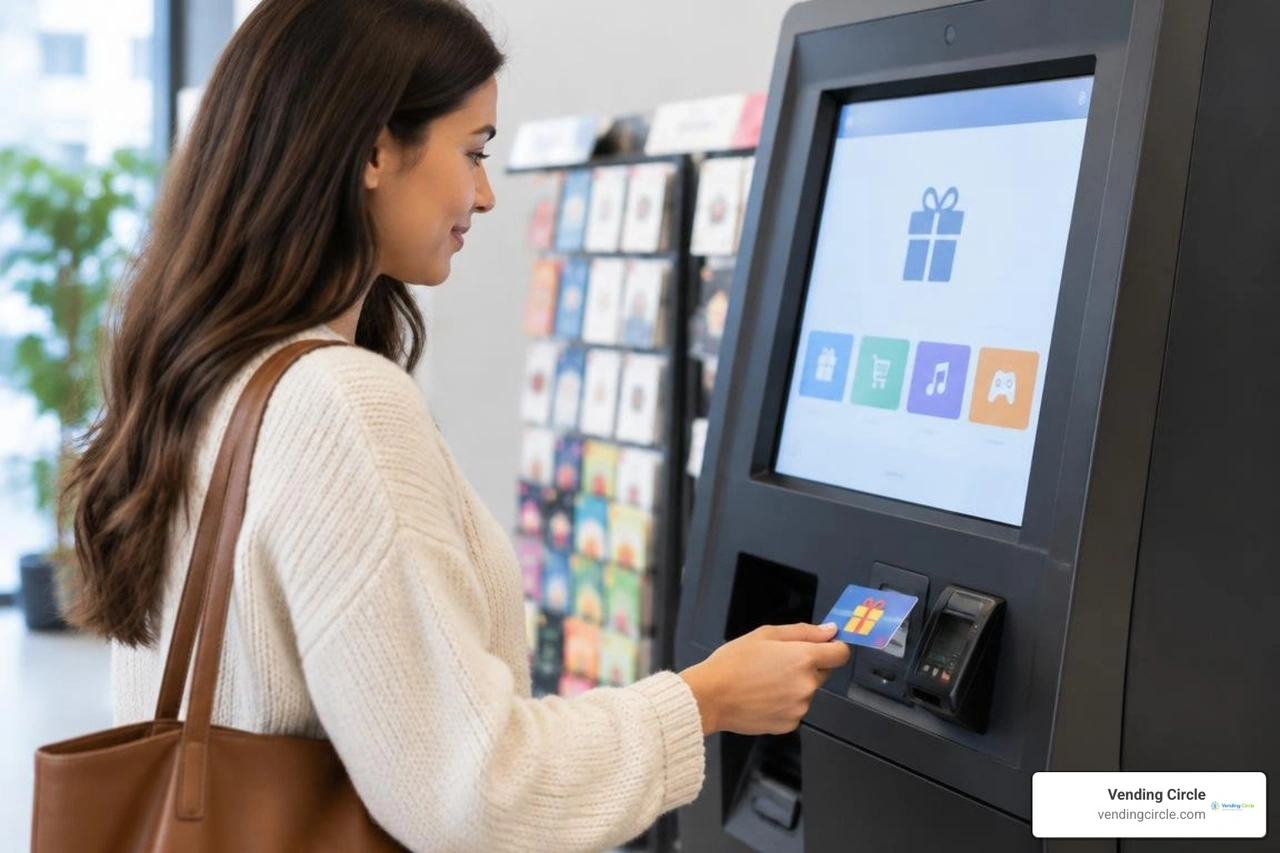
A gift card dispenser machine is a self-service kiosk that takes payment and gives the customer a physical card. Depending on the model, it can sell cards with a preset value or connect to a gift card system to activate a card during the sale. Some machines take cash; others accept credit cards or contactless payments. For an operator, the key is matching card capacity, payment options, and software integration to the location.
I’m Manuel Mojica, founder of Vending Circle and owner of MM Healthy Vending. My experience helping vending operators compare equipment and manage day-to-day operations shapes this guide to choosing a gift card dispenser machine. According to the National Retail Federation, gift cards remain one of the most requested holiday and special-occasion purchases, which makes automated dispensing a practical way to capture that demand.

Essential gift card dispenser machine terms:
What Is a Gift Card Dispenser Machine and How Does It Work?
At its core, an automated card dispensing unit replaces the manual checkout counter for prepaid products. Instead of waiting in a long line for a cashier to fetch a plastic card from behind a counter, swipe it, and process payment, consumers walk up to a standalone terminal. The transaction lifecycle is lightning fast—typically taking just 30 to 60 seconds from initial screen touch to card ejection.
To ensure seamless operation, modern units follow strict prepaid card dispensing standards. Most commercial hardware is engineered around the universal CR80 physical card standard—the familiar 30 mil (0.030-inch or roughly 0.76 mm to 0.8 mm) plastic dimension used in standard debit cards and retail gift cards. However, industrial-grade dispensers are versatile enough to handle materials ranging anywhere from thin 0.2 mm paper tickets up to dense 2.4 mm multilayer smart passes.
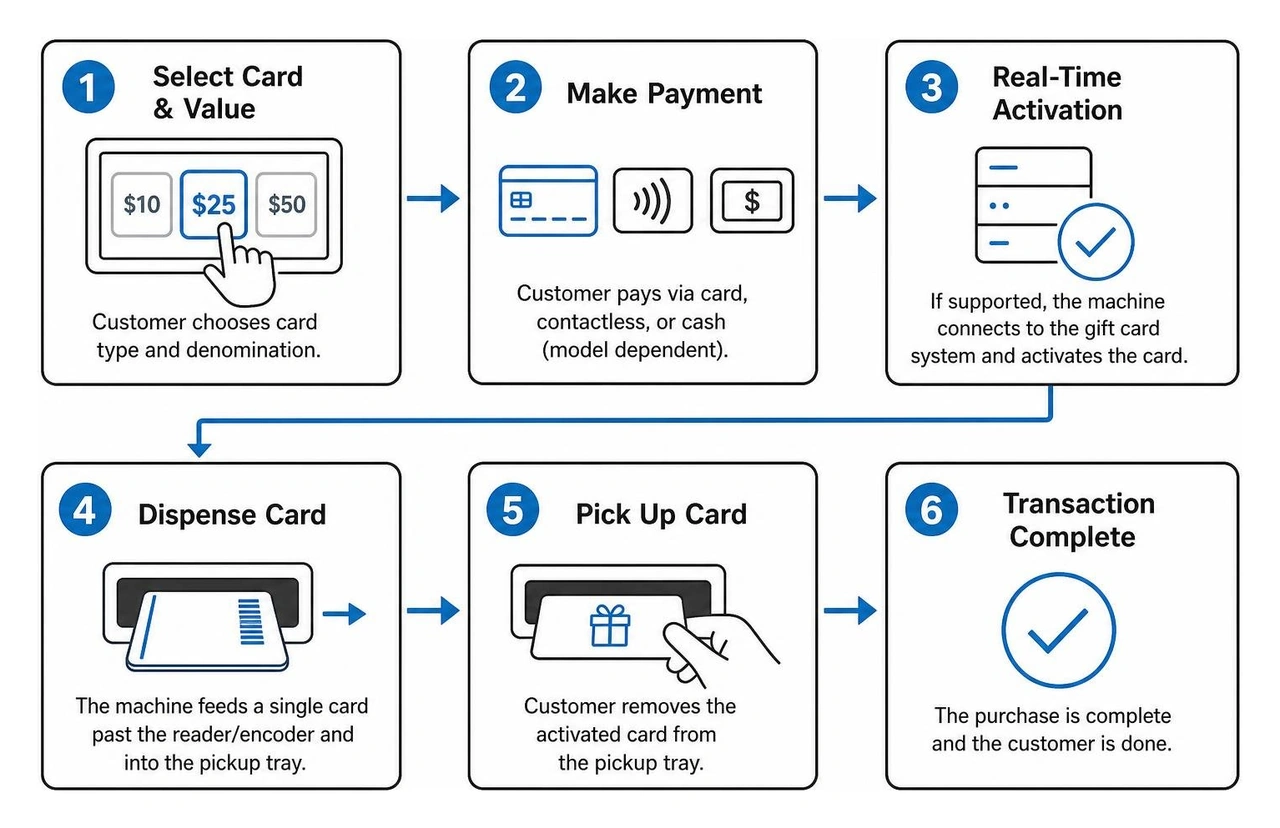
When a customer selects a denomination on the kiosk's touchscreen, the machine prompts for payment. Once authorized, the internal controller communicates via standard I/O signals or an RS232 serial interface to trigger the mechanical dispensing motor, feeding a single card past an integrated magnetic stripe, barcode, or RFID reader/writer to encode or activate it before pushing it into the pickup tray.
Internal Mechanics and Dispensing Technology
The engineering inside a dedicated card kiosk focuses heavily on precision feeding and friction management. To prevent the dreaded "double dispense" (where two slick plastic cards slide out together), units utilize precision separation wheels paired with adjustable thickness gates.
Key mechanical specifications in high-performance dispensers include:
- Motorized Feed Rollers: Industrial polyurethane or high-friction rubber rollers that grip smooth PVC, polycarbonate, or paper stock.
- Adjustable Thickness Calibration: Manual or micrometric gate settings that allow operators to dial in the exact millimeter clearance required for their specific card stock.
- Optical Inventory Sensors: Infrared and mechanical switches positioned throughout the card channel. A red LED illuminates or a buzzer sounds when inventory reaches a critical low threshold (typically under 20–30 cards remaining).
- Anti-Jamming Watchdog Circuits: Built-in microcontrollers continuously monitor motor current. If a card hangs or slips, the machine initiates an automatic pre-dispense recovery reverse-and-forward cycle or halts gracefully without charging the customer.
- Fast Cycle Times: At standard 24V DC operating voltages, a commercial mechanism ejects a card in approximately 0.5 to 2.0 seconds.
Multi-Payment Processing and Connectivity
A kiosk is only as profitable as its payment versatility. Today's commercial units can be fitted with multi-drop bus (MDB) bill validators accepting standard currency denominations ($1, $2, $5, $10, $20, and $100 bills) alongside high-capacity bill stackers.
On the electronic side, modern payment terminals feature EMV chip contacts, magnetic stripe tracks, and contactless NFC readers supporting Apple Pay, Google Pay, and closed-loop mobile payment apps.
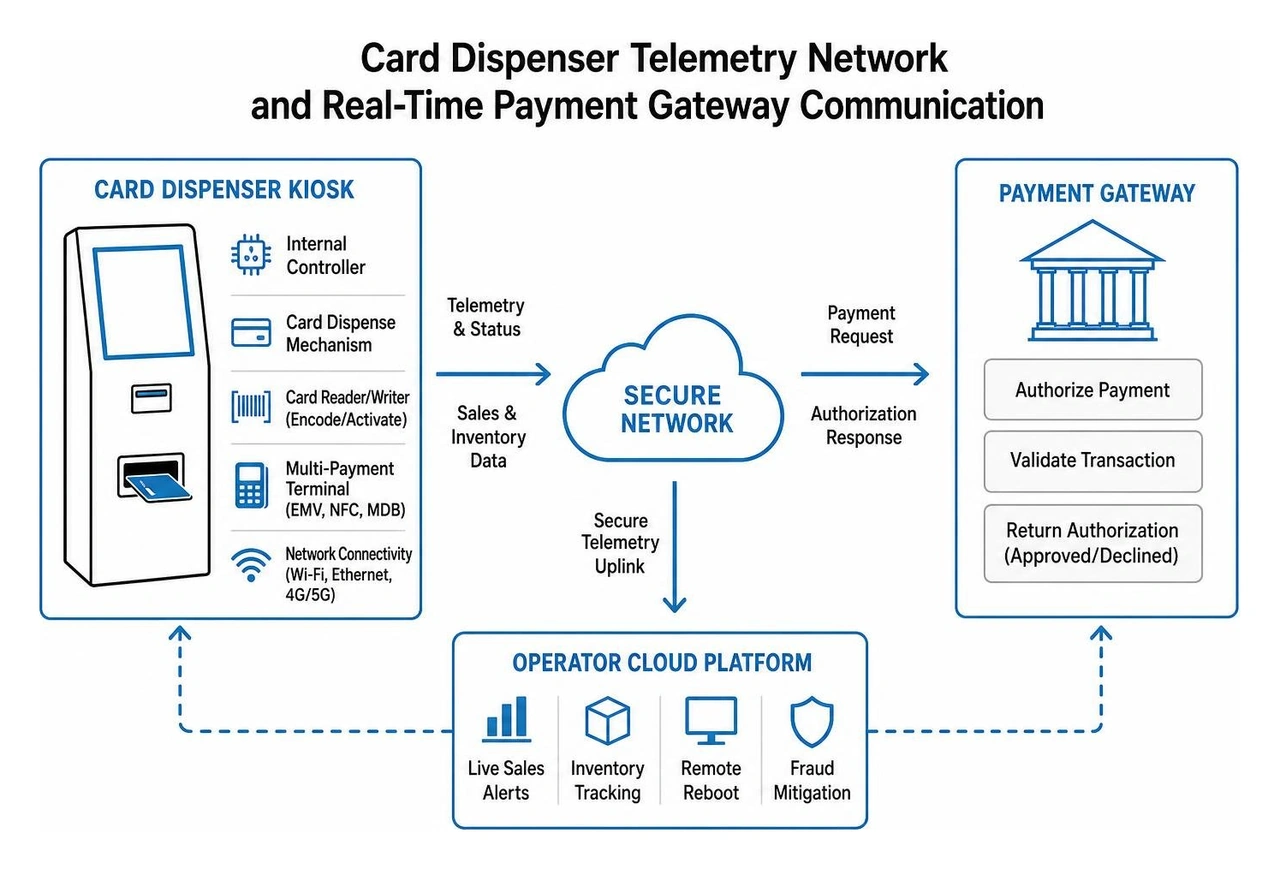
Maintaining high uptime requires reliable network connectivity through dual-band Wi-Fi, Ethernet, or integrated 4G/5G cellular modems. This enables cloud-based cashless payment telemetry, providing operators with live sales alerts, dynamic inventory tracking, remote rebooting capabilities, and real-time fraud mitigation.
Business Benefits of Automated Prepaid Card Kiosks
Automating gift card distribution delivers immediate operational advantages over traditional front-desk or cashier sales. For retail centers, entertainment venues, and service businesses, a dedicated dispenser operates 24/7/365 without taking breaks, calling in sick, or requiring hourly wages.
Driving Higher Spend and Same-Store Sales
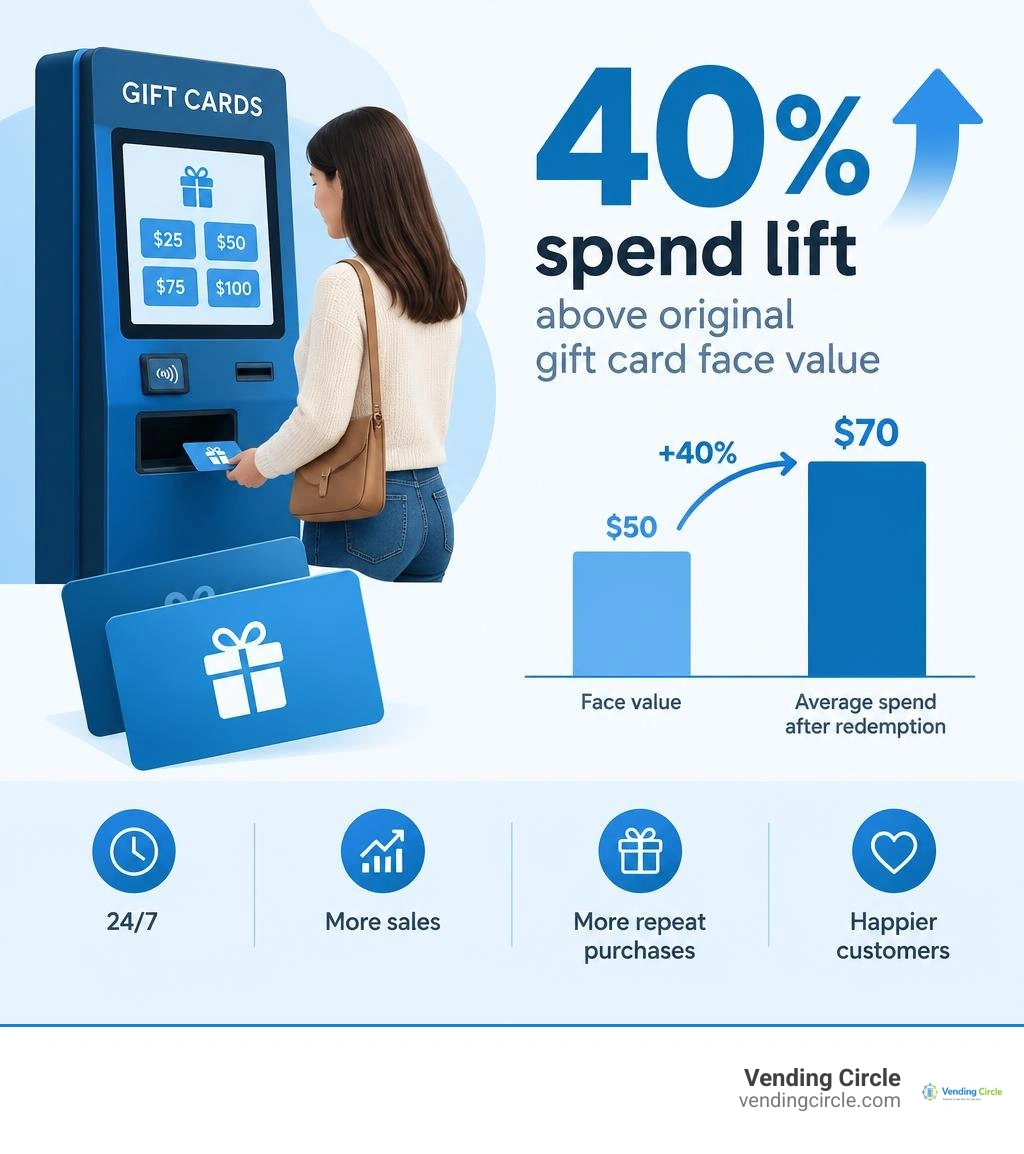
Deploying a self-service kiosk significantly increases sales volume. Retail industry data shows that customers who purchase gift cards from a dedicated kiosk spend, on average, 40% more than the card’s initial face value when they return to redeem it.
Furthermore, kiosks open up powerful closed-loop gifting opportunities:
- Instant Upselling: On-screen prompts encourage buyers to jump from a $25 preset to a $50 or $100 tier with just one tap.
- Omnichannel Synergy: Self-service machines bridge physical foot traffic with digital ecosystems, allowing shoppers to buy physical cards for gifts or scan on-screen QR codes to send digital vouchers straight to a friend's phone.
- Multi-Store Aggregation: In shopping malls and mixed-use developments, a centralized kiosk lets visitors buy universal gift vouchers valid across dozens of independent tenant shops.
Operational Efficiency and Labor Cost Reduction
By removing transactional friction, kiosks drastically reduce wait times at main registers during peak holiday seasons. During peak shopping rushes, processing card sales through a kiosk keeps the main checkout lines moving briskly.
Moreover, automated kiosks streamline administrative back-office work:
- Staff Notifications: Advanced kiosks can send automated pager, SMS, or email alerts to floor staff if maintenance is needed or if card stock drops below preset levels.
- Instant Balance Inquiries: Customers can tap or swipe an existing card to check their remaining funds without tying up a service desk worker.
- Automated Reconciliation: Cloud management portals consolidate physical cash counts and electronic transactions into exportable accounting reports, eliminating end-of-day manual tally errors.
Hardware Configurations and Dispenser Specifications
Choosing the right machine requires understanding the physical form factors and access configurations available on the commercial market.
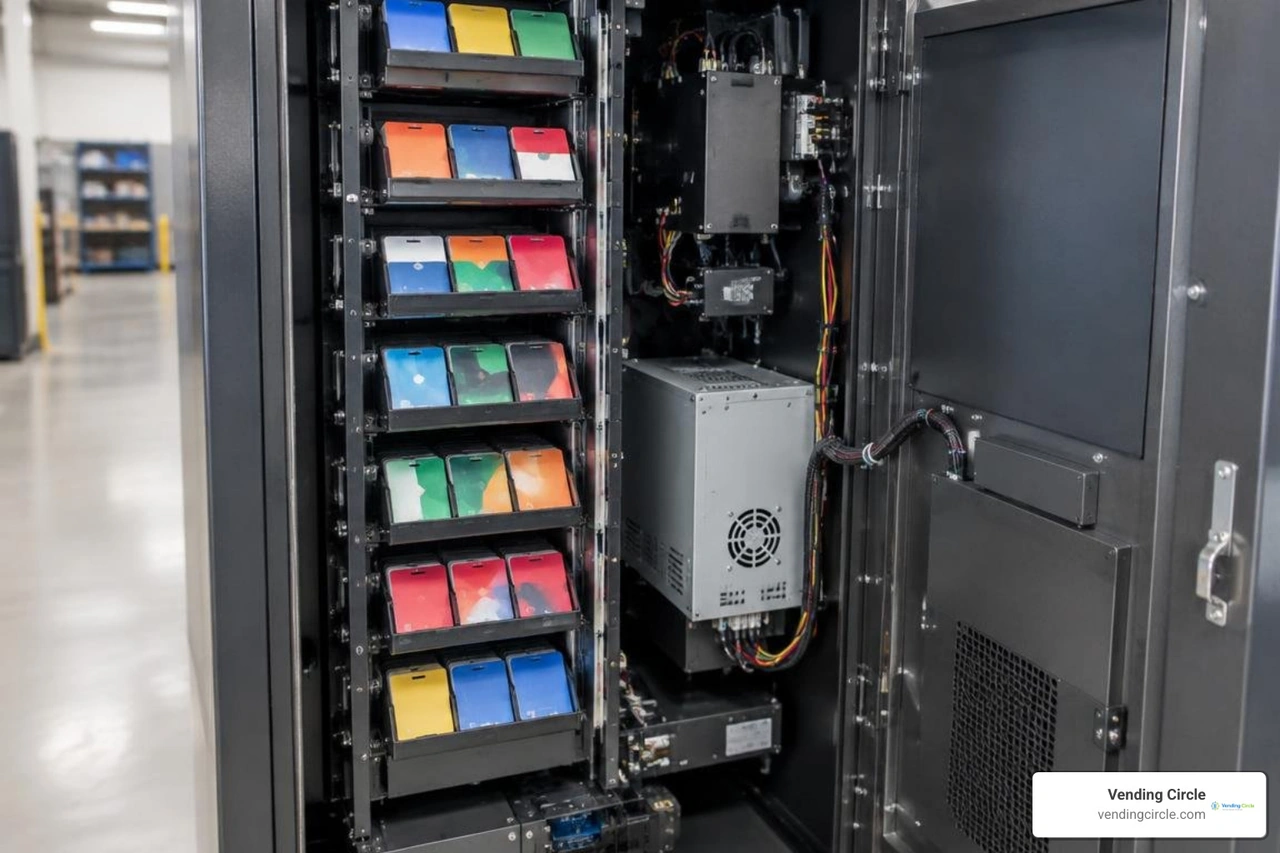
Dispenser bodies are typically fabricated from heavy-duty 14-gauge cold-rolled steel to withstand vandalism and physical tampering. Depending on your spatial constraints and security requirements, machines are split into several architectural types:
| Configuration Type | Card Capacity per Channel | Payment Acceptance | Access Style | Best Use Case | Typical Price Range |
|---|---|---|---|---|---|
| Single-Bin Compact | 130 – 180 cards | Cashless (NFC / EMV) or Cash-only | Front Load | Small retail shops, car washes, laundromats | $895 – $2,825 |
| Multi-Bin Front-Load (2 to 4 Bins) | 260 – 600+ cards | Cash & Credit Card (Hybrid) | Front Load | Shopping mall corridors, arcades, cinema lobbies | $3,800 – $6,339 |
| Through-the-Wall / Rear-Load | 130 – 500+ cards | Cash & Nayax / EMV Reader | Rear Access (Secure Room) | High-security outdoor walls, bank vestibules, transit stations | $3,200 – $7,500+ |
| Interactive Dual-Screen Kiosk | 150 – 300+ cards | Full Cashless + Bill Acceptor + Scanner | Front / Pedestal | Flagship retail, telecom SIM sales, corporate lobbies | $3,500 – $5,500 |
Choosing the Right Machine Configuration
When scoping out equipment, evaluate your location's operational layout:
- Single-Cassette Units: Compact models (such as benchtop or slim wall-mounted cabinets) work best when you only sell one card denomination or issue generic re-loadable loyalty cards.
- Multi-Bin Configurations: Multi-cassette dispensers allow you to load distinct card designs or pre-valued increments (e.g., $10, $25, $50, and $100 cards) into separate bins.
- Front-Load vs. Rear-Load: Front-load kiosks are freestanding or wall-hung, making them easy to service right on the sales floor. Rear-load models are designed to be installed flush through a secure wall, allowing staff to restock inventory and collect cash from inside a locked back-office room without exposing cash boxes on the retail floor.
If you are upgrading an existing standalone vending cabinet, you can explore adding credit card processing capabilities using modular payment hardware kits.
Security and Anti-Tamper Mechanisms
Because card dispensers hold high-value plastic stock and cash vaults, physical and digital security cannot be overlooked:
- Tamper-Resistant Housings: Welded cold-rolled steel enclosures with pry-resistant flange edges, tubular high-security cam locks, and multi-point deadbolt latching.
- PCI-PTS Compliance: Electronic payment keypads and card readers comply with PCI standards, ensuring that customer cardholder data is tokenized and encrypted at the point of interaction.
- Biometric and Identity Verification: Premium commercial units can integrate fingerprint scanners, document scanners, and face-recognition cameras for high-security environments issuing debit cards or verified telecom SIMs.
- Surveillance Integration: Many modern operators mount wide-angle security cameras within the upper kiosk bezel to capture video proof of every transaction and deter unauthorized access.
High-Traffic Deployment and Industry Applications
Strategic placement is the single most important factor determining your return on investment. Before finalizing a site, consult industry equipment pricing benchmarks to calculate your break-even metrics based on foot traffic and average ticket margins.
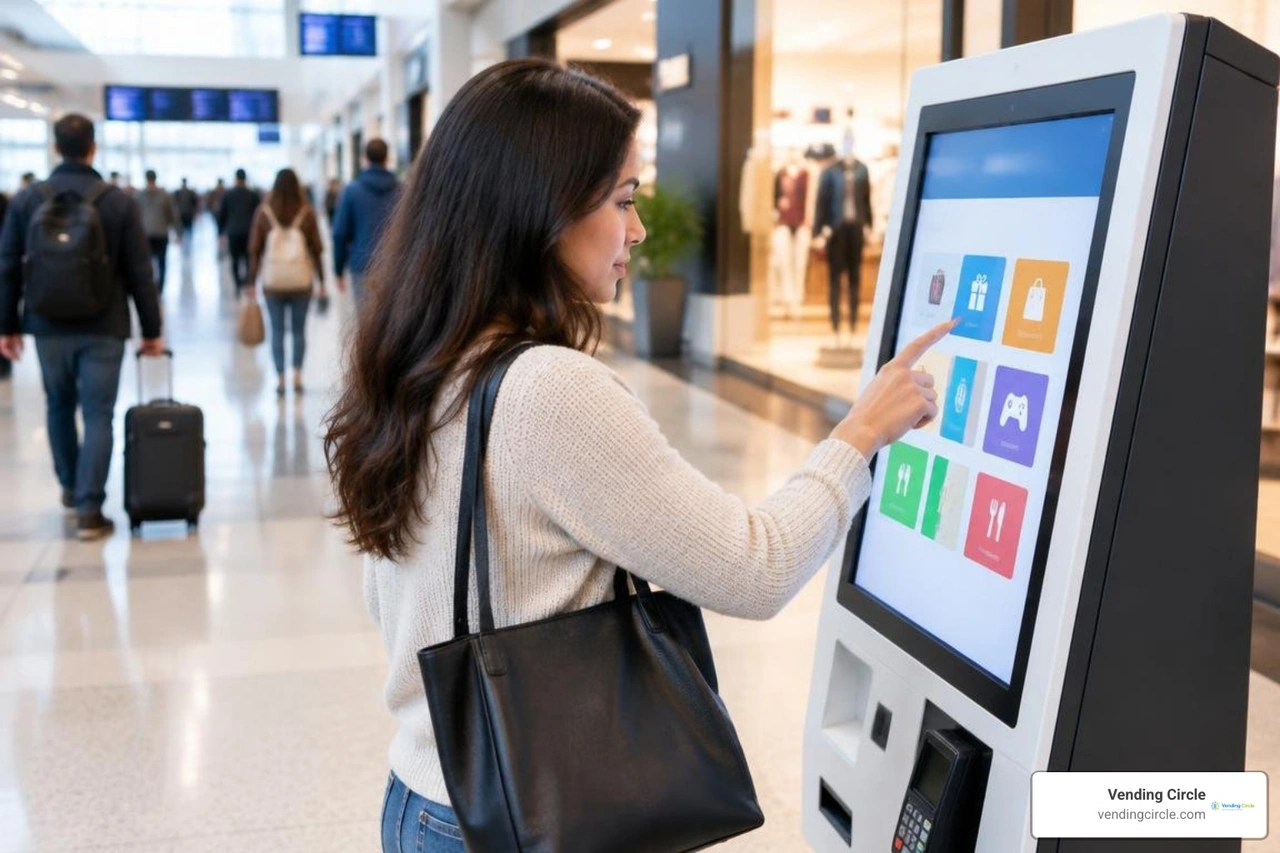
Retail Malls, Hospitality, and Transit Hubs
- Shopping Centers: Deploying multi-brand gift card kiosks in central food courts or main entry corridors provides shoppers with instant access to mall-wide gift certificates.
- Hotels and Resorts: Kiosks can dispense automated room keys, prepaid resort activity vouchers, or spa gift cards directly to arriving guests, eliminating front-desk congestion.
- Transit Hubs & Airports: Automated terminals issue tap-and-go transit cards, tourist city passes, and international telecom SIM cards around the clock.
Entertainment Venues and Event Activations
- Arcades & Family Entertainment Centers: Automated dispensers issue RFID game cards loaded with credits, streamlining admission and game floor traffic.
- Car Washes & Laundromats: High-security wall units issue pre-valued wash cards and RFID club memberships that encourage customer retention.
- Pop-Up Events & Expos: Specialized capsule or card vending machines provide gamified event merchandise, VIP passes, and promotional discount cards.
When setting up operations, remember to maintain an organized pipeline for your vending inventory and operational supplies, including replacement receipt paper rolls, cleaning cards, and custom-printed blank card batches.
Frequently Asked Questions About Gift Card Kiosks
How many cards can a standard gift card kiosk hold?
Standard single-bin card mechanisms (such as the TCD-180M series) hold between 130 and 180 standard 0.030-inch (CR80) plastic cards. Multi-bin and high-capacity floor kiosks can hold anywhere from 300 to over 1,000 cards across multiple internal cassettes. Many dispensers support optional hopper expansion magazines to double capacity without increasing machine footprint.
What payment methods do self-service card dispensers accept?
Depending on the modular peripherals installed, dispensers can accept:
- Paper currency ($1 to $100 bills) via multi-denomination bill acceptors.
- Credit, debit, and prepaid cards via EMV chip, magstripe, and contactless NFC readers.
- Mobile payment platforms including Apple Pay, Google Pay, Samsung Pay, and QR-code mobile wallets.
Can gift card kiosks integrate with existing POS and loyalty systems?
Yes. Commercial card dispensing kiosks feature integrated micro-PCs running Windows or Android, backed by comprehensive software development kits (SDKs) and REST APIs. These enable the kiosk to communicate in real time with major POS backends, CRM databases, and cloud inventory portals for dynamic balance assignment, card encoding, and live transaction ledger sync.
Conclusion
Automating your prepaid card sales through dedicated self-service kiosks unlocks a proven, scalable revenue stream. By offering 30-to-60-second checkout speeds, seamless cashless and cash acceptance, and 24/7 availability, your business can capture impulse gifting purchases while significantly cutting labor overhead.
At Vending Circle, we support vending and kiosk operators with the technical guides, peer insights, and manufacturer-direct connections needed to build reliable unattended retail operations.
Ready to upgrade your dispensing setup? Explore our complete guide to advanced vending card readers to find the right hardware and connectivity setup for your machines.