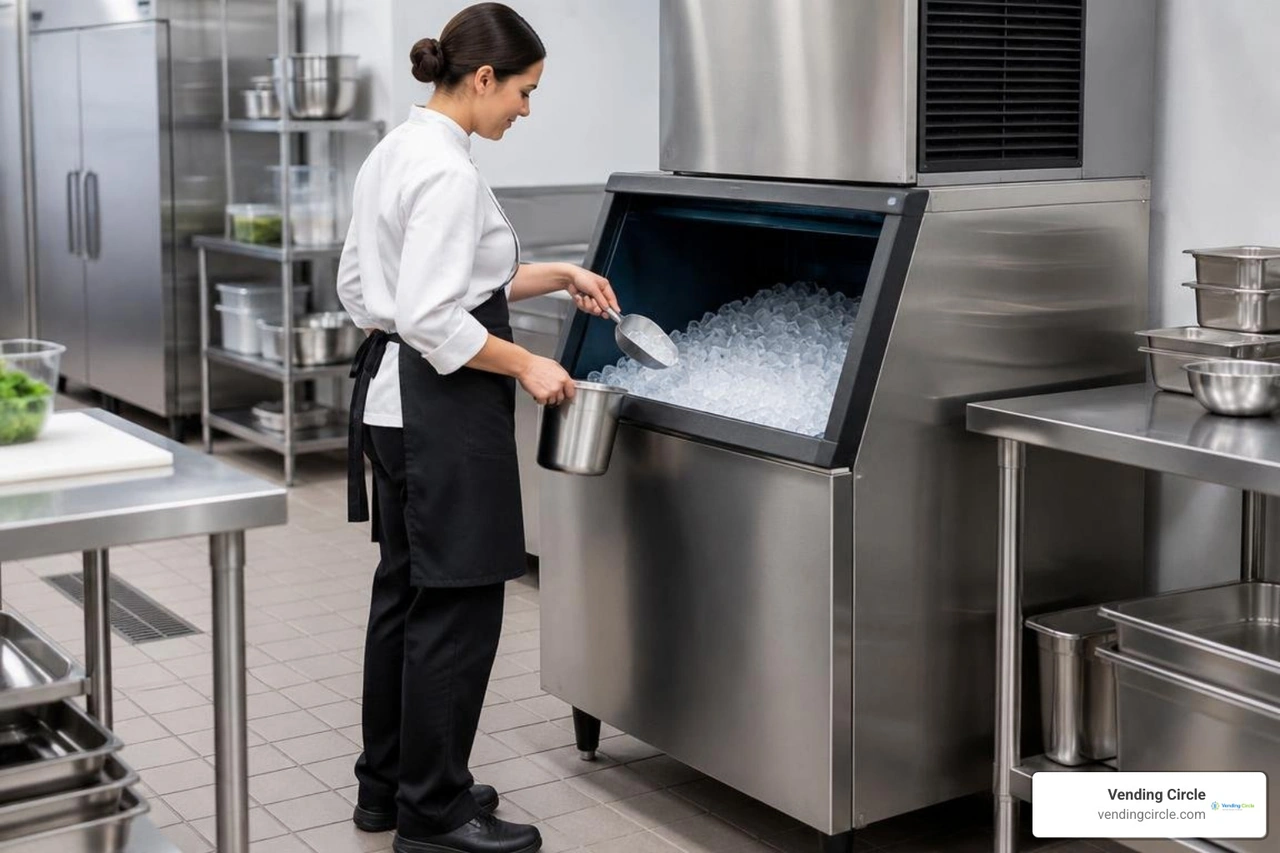
How an Ice Machine Expert Keeps Your Business Supplied
Hire an ice machine expert who can size the machine for your busiest day, check your site’s airflow and water, and provide a clear maintenance plan. Before you book, ask whether they service your model, what the visit includes, and how they handle parts, warranties, and urgent repairs.
For a vending operator, the right help can mean fewer empty bins and less time spent chasing separate suppliers and technicians. This guide will help you choose equipment, spot avoidable problems, and know when to call a professional.
I’m Manuel Mojica, founder of Vending Circle and a former vending operator. I help operators compare suppliers and reduce downtime; here, I’ll show you how to work with an ice machine expert when sizing, service, or repairs are on the line.
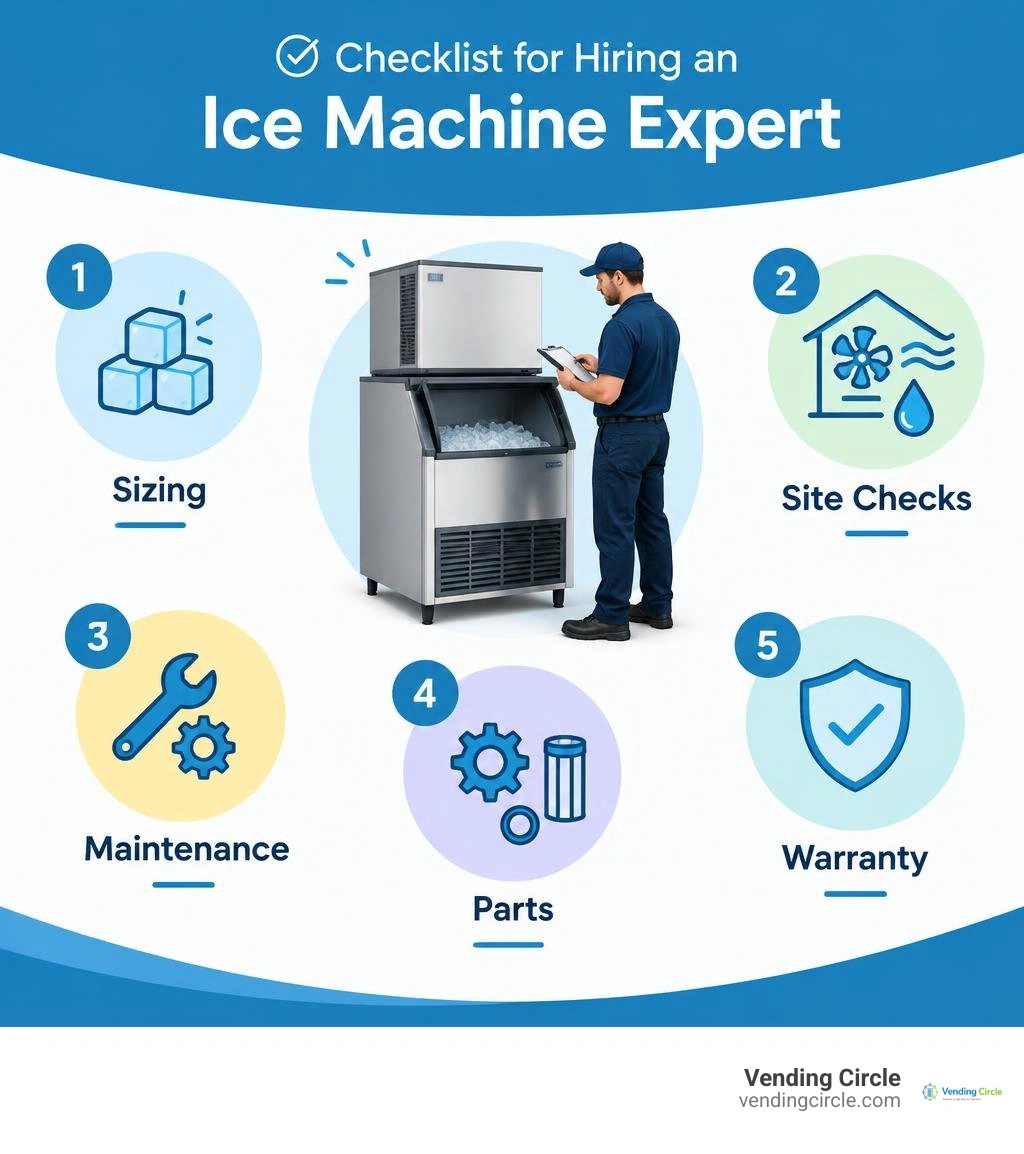
Ice machine expert terminology:
Why Every Growing Foodservice Business Needs an Ice Machine Expert
Commercial ice makers are among the hardest-working appliances in any commercial kitchen or vending setup. Unlike standard refrigerators that cycle on and off merely to keep internal air cold, an ice maker continuously freezes water, harvests cubes, and manages drainage 24 hours a day. Because ice is legally classified as a food, ice equipment must meet stringent sanitary and operational requirements.
When an ice maker fails during a summer rush, the downstream impact hits customer satisfaction and revenue immediately. Independent evaluations, like The Best Ice Machines tested by Popular Mechanics, show that equipment output varies dramatically based on duty cycles, internal mechanics, and ambient conditions. An expert ensures that you avoid unexpected output drops and stay compliant with commercial health standards.
Commercial vs. Residential Ice Systems: Understanding the Core Differences
Residential countertop and undercounter ice makers are built for intermittent, low-volume use. In domestic settings, producing 15 to 30 pounds of ice per day using an uncooled storage bin is usually sufficient. In contrast, commercial units must handle hundreds or thousands of pounds per day with fast harvest cycles, robust refrigeration components, and dedicated drain lines.
Commercial systems must also comply with strict health and safety standards. If you manage a retail or vending spot, relying on domestic equipment can cause premature compressor failure and health code violations. Exploring options for locating a commercial ice kiosk near you shows how dedicated, automated commercial systems operate reliably under high demand.
Sizing Capacity: How an Ice Machine Expert Calculates Peak Demand
A common operational mistake is sizing an ice maker based on average daily volume instead of peak demand. Commercial machines manufacture ice on a continuous 24-hour cycle rather than on demand.
To calculate your capacity requirements:
- Estimate your peak daily customer count.
- Multiply by average consumption rates (typically 1.5 to 2 pounds of ice per person in restaurants, or 3 pounds per seat in busy bars).
- Add a 10% to 20% safety margin to accommodate heat waves and unexpected surges.
| Business Type | Average Consumption Metric | Recommended Safety Buffer | Target 24-Hour Production Head |
|---|---|---|---|
| Quick-Service Restaurant | 1.5 lbs per customer | 20% | 400–800 lbs (180–360 kg) |
| Bar / Cocktail Lounge | 3.0 lbs per seat | 20% | 300–600 lbs (135–270 kg) |
| Hotel / Hospitality | 5.0 lbs per room | 15% | 500–1,200 lbs (225–540 kg) |
| Healthcare Facility | 10.0 lbs per patient bed | 10% | 300–500 lbs (135–225 kg) |
| Café / Coffee Bar | 1.0 lb per customer | 15% | 150–300 lbs (70–135 kg) |
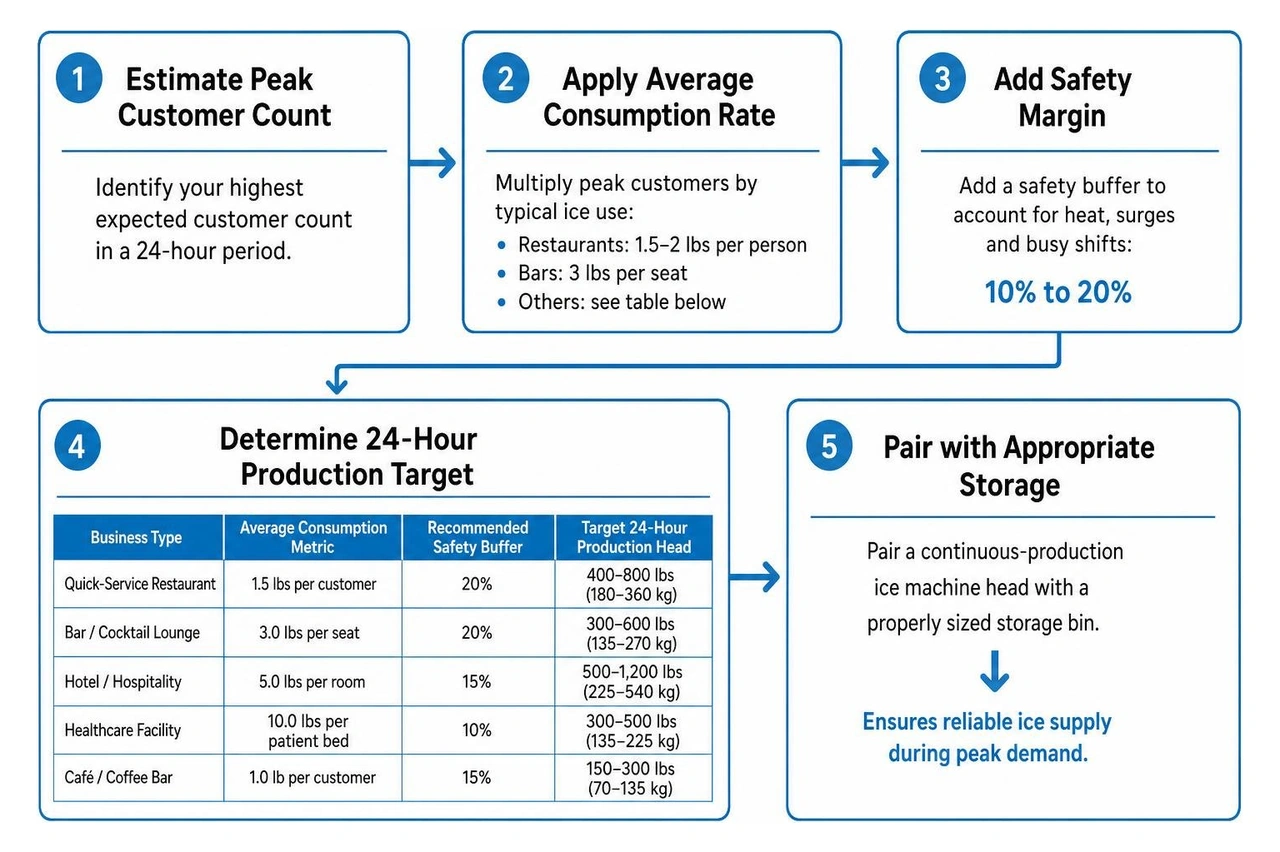
Pairing a continuous-production modular head with an appropriately sized storage bin ensures your business handles busy shifts without paying for an oversized refrigeration unit.
Core Ice Types and Matching Equipment to Business Applications
Selecting the correct ice geometry affects drink quality, melt rates, and beverage profit margins.

For detailed drink pairings, review this selection guide on cocktail ice types to see how geometry impacts chilling and dilution.
Full Cube, Half Cube, and Gourmet Clear Ice
- Full Cube & Half Cube: The standard workhorses for dining and bars. Full cubes melt slowly, preserving the flavor balance of sodas, iced coffees, and mixed drinks. Half cubes offer better liquid displacement, reducing the volume of beverage poured per glass.
- Gourmet Clear Ice: High-end cocktail bars rely on crystal-clear spheres, large cubes, and Collins spears. Clear ice freezes directionally to push out trapped air and mineral impurities, yielding dense, slow-melting ice that enhances spirit presentation.
Nugget and Flake Ice Applications
- Nugget Ice (Pellet/Chewable): Popular in quick-service chains and healthcare facilities. Its soft, porous texture absorbs beverage flavors and displaces more liquid per cup, which helps reduce syrup usage. In medical facilities, nugget ice provides safe, chewable hydration for patients.
- Flake Ice: Flake ice forms soft, flat shavings that pack smoothly around uneven surfaces without bruising delicate goods. It is the primary choice for seafood markets, salad bars, and buffet cold pans. Operators can also find automated bulk options by finding local ice house machines in their area.
Environmental Factors and Water Quality: Preventing Production Decay
Approximately 90% of ice machine performance issues stem from poor environmental conditions and neglected water systems rather than mechanical failure.
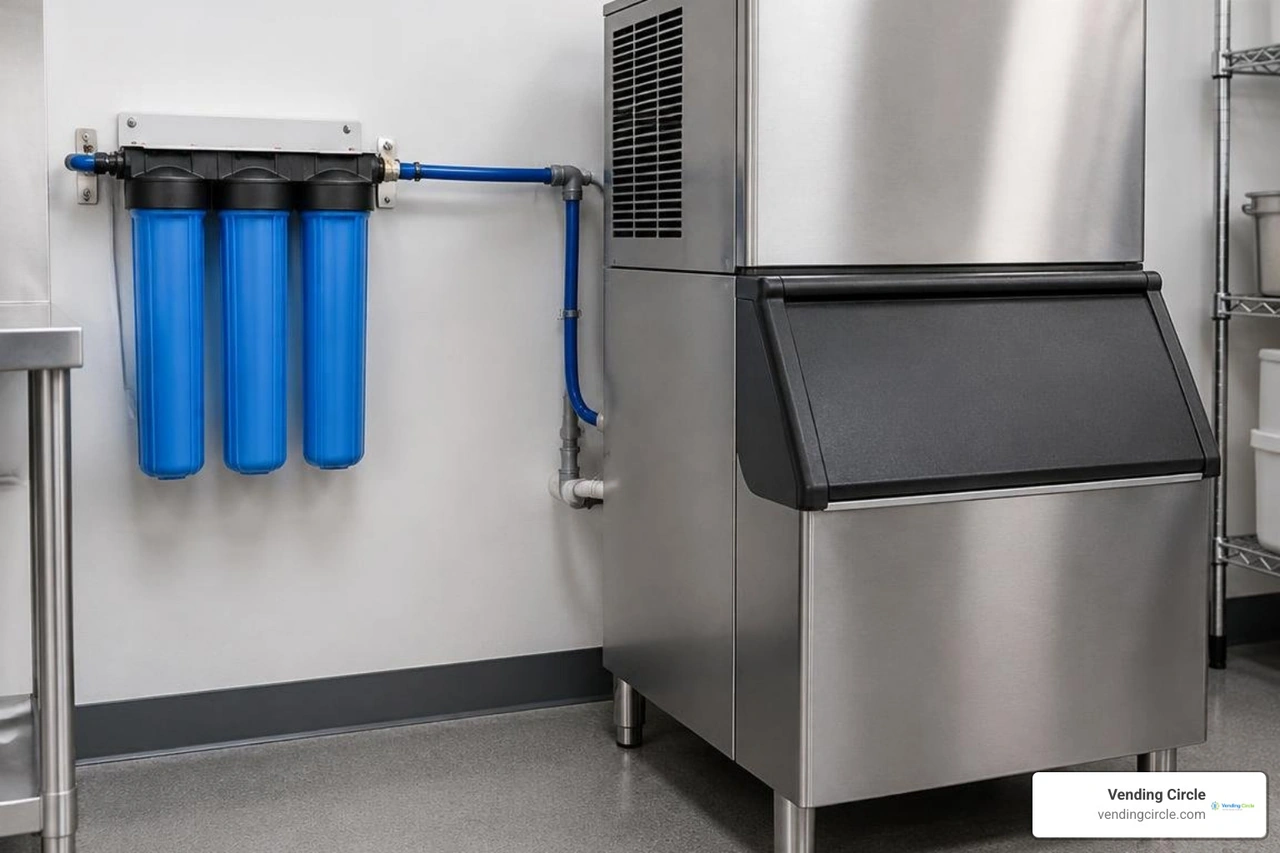
Managing Ambient Temperature and Airflow Clearances
Commercial air-cooled ice machines perform best in ambient room temperatures between 70°F and 90°F (21°C to 32°C). When kitchen temperatures rise above 90°F, condensing pressure climbs, compressor efficiency falls, and ice output drops significantly. A machine rated for 500 lbs per day at 70°F ambient may only produce 350 to 380 lbs when ambient temperatures reach 100°F.
Ensure your machine has at least 12 inches of clearance around all air intake and exhaust vents. If your unit is confined in a tight utility closet without proper airflow, it can create a localized microclimate of hot exhaust air that shortens the life of the compressor.
Water Quality, Filtration, and Scale Mitigation
Mineral buildup causes up to 90% of ice machine service calls. Hard water contains dissolved calcium and magnesium that precipitate onto evaporators, water distribution tubes, and sensors during the freeze cycle.
To keep your water system running smoothly:
- Install high-grade commercial pre-filtration and polyphosphate scale-inhibiting cartridges.
- Use reverse osmosis (RO) systems where total dissolved solids (TDS) exceed 200 parts per million.
- Regularly inspect the water circuit and clean components when troubleshooting ice machine water pump systems to avoid mineral blockages.
Strategic Procurement, TCO, and Factory Sourcing
Evaluating equipment involves looking beyond the initial purchase price to consider total cost of ownership (TCO), including energy efficiency, water use, and parts availability over a 7- to 10-year lifespan.
Buying imported commercial ice makers through multiple layers of third-party distributors can add 30% to 60% in middleman markups. Sourcing directly from verified manufacturers or working with procurement networks provides better access to original equipment parts and lower unit pricing.
OEM and Global Sourcing: What an Ice Machine Expert Looks for in a Manufacturer
When assessing manufacturers for direct supply or private labeling, verify their build specifications and quality metrics:
- Evaporator Material: Look for food-grade, copper-nickel-plated evaporators rather than standard thin-wall stainless steel, as copper-nickel provides superior thermal conductivity and corrosion resistance.
- Core Components: Confirm the use of reputable compressor brands and commercial-grade expansion valves.
- Defect Rates: Top-tier manufacturers maintain factory defect rates near 1%, well below the 3% to 5% industry average.
- Real-World Testing: Ask for performance data gathered under high ambient conditions (up to 109°F / 43°C) rather than relying solely on idealized lab ratings. Independent testing standards, such as those used in evaluation standards in countertop ice testing, highlight how real-world conditions affect output.
Essential Certifications and Compliance Standards
Ensure any equipment you purchase carries recognized regional and global certifications:
- NSF/ANSI Standard 12: Verifies cleanability and food-contact sanitation.
- UL 563 / ETL Listed: Confirms compliance with electrical safety standards in North America.
- CE & RoHS: Meets European Union safety, health, and environmental standards.
- ISO 9001: Demonstrates that the factory uses verified quality-management processes.
Preventive Maintenance and Troubleshooting Common Ice Machine Failures
Routine maintenance prevents emergency service calls and extends the operating life of your refrigeration equipment. If you encounter service interruptions, finding the nearest ice machine services quickly helps minimize downtime.
Diagnostic Checklist for Low Output and Cloudy Ice
Routine Sanitation and Bi-Annual Servicing Protocols
- Every 2 Weeks: Wash reusable air filters with warm water to remove airborne grease and dust.
- Every Month: Sanitize the storage bin, ice door, and scoops using an EPA-approved, food-safe sanitizer.
- Every 6 Months: Run a full chemical descaling cycle with nickel-safe ice machine cleaner. Disassemble and sanitize the water pump, sensors, and distribution tubes, and replace all water filtration cartridges.
Frequently Asked Questions About Commercial Ice Machines
Why does an ice machine produce significantly less ice during hot summer months?
Ice makers rely on ambient air to cool their condensers and cold tap water to form ice slabs. In high summer heat, incoming water temperatures can jump from 55°F to 80°F, while kitchen ambient air often exceeds 95°F. This forces the refrigeration system to run longer freeze cycles to remove the extra heat, reducing daily ice production by 20% to 35%.
How often should a commercial ice machine be professionally descaled and cleaned?
Commercial ice machines should undergo professional descaling and sanitization at least once every six months. Operations in hard-water areas or locations with high airborne yeast (such as bakeries and craft breweries) may require service every three months to prevent scale buildup and microbial biofilms.
What are the main hidden costs when importing ice equipment from overseas?
Hidden costs often include unexpected freight and customs duties, local electrical certification fees, and the expense of sourcing replacement parts. If a supplier lacks a domestic spare-parts depot, waiting weeks for a replacement pump or control board can cause costly operational downtime.
Conclusion
A reliable ice supply requires more than just buying a machine—it calls for proper capacity sizing, clean water filtration, adequate ventilation, and steady preventive care. Managing these technical factors protects your bottom line and keeps your operations running smoothly through peak demand.
Join the Vending Circle community to connect with operators, get manufacturer-direct equipment pricing, and use our Vending Circle marketplace and ice machine locator to find dependable commercial equipment for your business.