

Keep Your Ice Machine Water Pump From Stopping Production
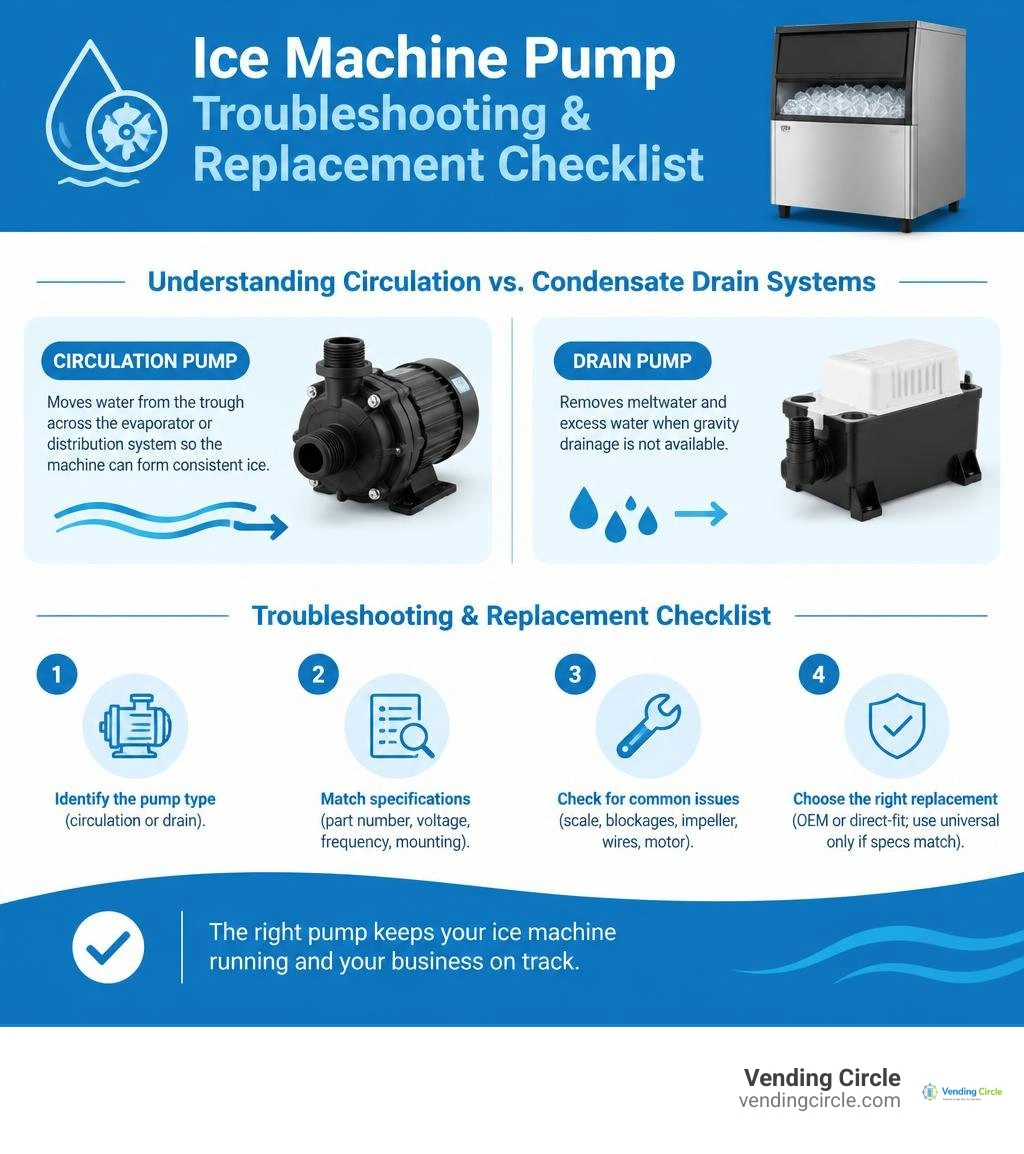
A failing ice machine water pump can slow ice production, create uneven or hollow ice, or stop a machine from freezing at all. Before ordering a replacement, check these four basics:
- Confirm whether the failed part is a circulation pump or a drain pump.
- Match the old pump's part number, voltage, frequency, and mounting connections.
- Inspect for scale, blocked screens, damaged impellers, loose wires, or a motor that hums without moving water.
- Choose an OEM or proven direct-fit replacement when possible; use a universal pump only when its electrical, flow, impeller, and fitting specifications match.
The circulation pump moves water from the trough across the evaporator or distribution system so the machine can form consistent ice. A drain or condensate pump does a different job: it removes meltwater and excess water when gravity drainage is not available. Ordering the wrong type can leave the machine down even if the new part fits physically.
For operators managing several locations, pump issues are more than a repair task. They mean lost sales, emergency service calls, and a machine that may not be ready for the next rush. This guide helps you identify the failure, test the likely causes, and source a compatible replacement without guessing.
I am Manuel Mojica, founder of Vending Circle and a vending operator focused on helping businesses reduce downtime and simplify equipment sourcing. My experience running MM Healthy Vending informs this practical approach to diagnosing and replacing an ice machine water pump before a small issue becomes a costly outage.
Understanding Circulation vs. Condensate Drain Systems
When troubleshooting an ice maker that fails to harvest or leaves puddles on the floor, the first step is separating the water circulation system from the drainage system. These two functions use completely different pump technologies, and confusing them is a common misstep in field maintenance.
The Circulation Pump
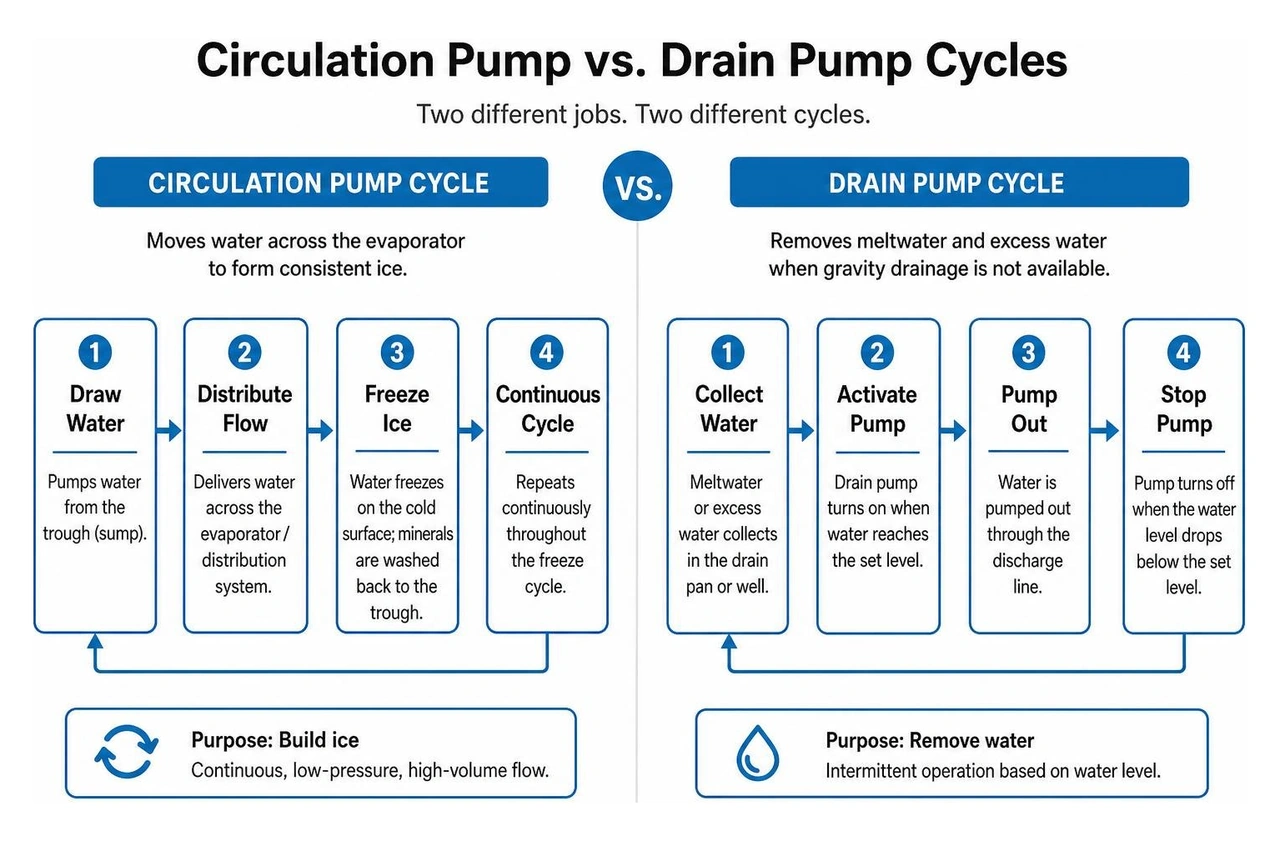
The circulation pump is the engine of the freezing process. Positioned directly in or above the sump trough, its primary job is lifting water continuously over the freezing grid or evaporator plate. As water flows in a steady curtain over sub-freezing metal channels, pure water freezes layer by layer, washing away mineral impurities into the trough below.
Circulation pumps prioritize continuous, low-pressure, high-volume flow. For example, a heavy-duty Replacement Ice O Matic 9161076-01 Water Pump Assembly delivers a flow rate of 2.53 gallons per minute (GPM) at 120V to maintain uniform ice slab formation. These pumps operate non-stop throughout the freeze cycle, demanding thermal overload protection and moisture-resistant internal windings.
The Drain or Condensate Pump
In contrast, a drain or condensate removal pump manages wastewater and purge discharge. While many commercial units rely on gravity drainage, units installed in basements, central islands, or outdoor kiosks require mechanical assistance to discharge meltwater.
Drain pumps operate intermittently using a float switch mechanism or dual-switch safety control (such as a buoyancy switch combined with a water pressure switch). Rather than cascading water over plates, a drain pump pushes discharge through narrow tubing against vertical head pressure. Dedicated kits, like the Whirlpool Model 1901A (engineered for 50-lb ice makers made in 2000 or later), can lift purged water up to 10 feet vertically. Specialized condensate pumps (like the RPUMP series) move up to 65 GPH at a 1-foot lift and conquer up to 15 feet of vertical lift to ensure undercounter setups remain dry.
Managing moisture and maintaining steady cooling fluid lines is just as vital when balancing ambient temperature control in nearby cold drink machines or supporting localized air regulation via a smart air cooler. Knowing whether your failure lies in continuous freezing circulation or intermittent drain discharge saves hours of misguided diagnostic work.
Diagnostic Steps for a Faulty Ice Machine Water Pump
When an ice maker stops producing, diagnosing the issue systematically avoids swapping expensive parts unnecessarily. Water pump failure ranks among the top three causes of unscheduled downtime in commercial ice production, making a clear diagnostic routine essential.
Common Symptoms of a Damaged Ice Machine Water Pump
Physical signs often reveal pump distress before total electrical failure:
- Motor Humming with Zero Flow: The motor energizes and emits a low hum or vibration, but no water moves over the distribution tube. This usually points to a seized impeller caused by scale accumulation, a failed run capacitor, or physical debris jamming the housing.
- Sloped, Tapered, or Incomplete Ice Slabs: If the cubes at the top of the evaporator grid are thick while the bottom is paper-thin (or vice versa), the pump is suffering from low flow or cavitation.
- Hollow Cubes and Extended Freeze Cycles: When water fails to cascade across the evaporator at full design velocity, the refrigeration cycle runs longer, yielding fragile, hollow ice shells.
- Evaporator Freeze-Ups: A sudden drop in water circulation while the refrigeration compressor continues running can cause residual water to freeze into an unharvestable block of solid ice across the evaporator grid, tripping safety limit switches.
Electrical and Mechanical Testing Procedures
To pinpoint whether the issue is mechanical, electrical, or related to the control board, follow this step-by-step diagnostic workflow:
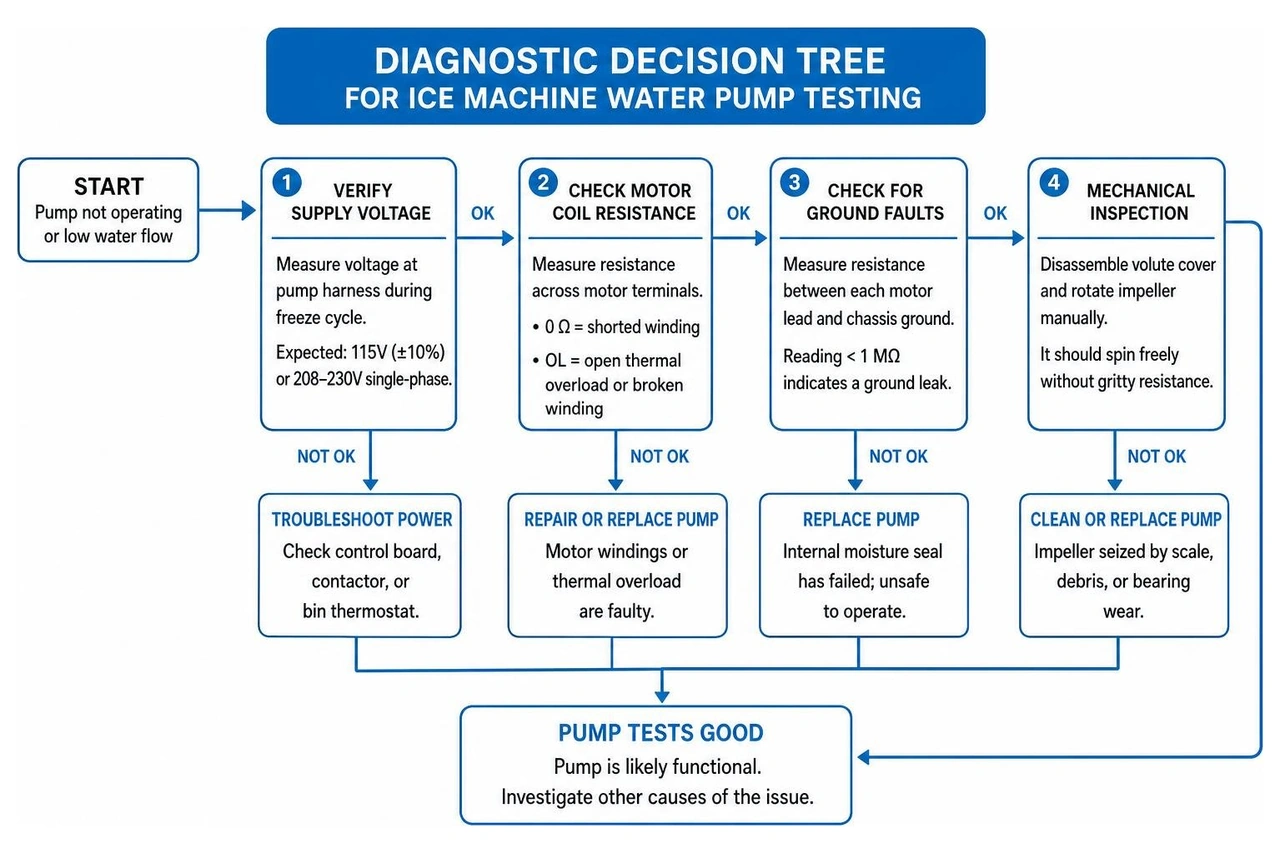
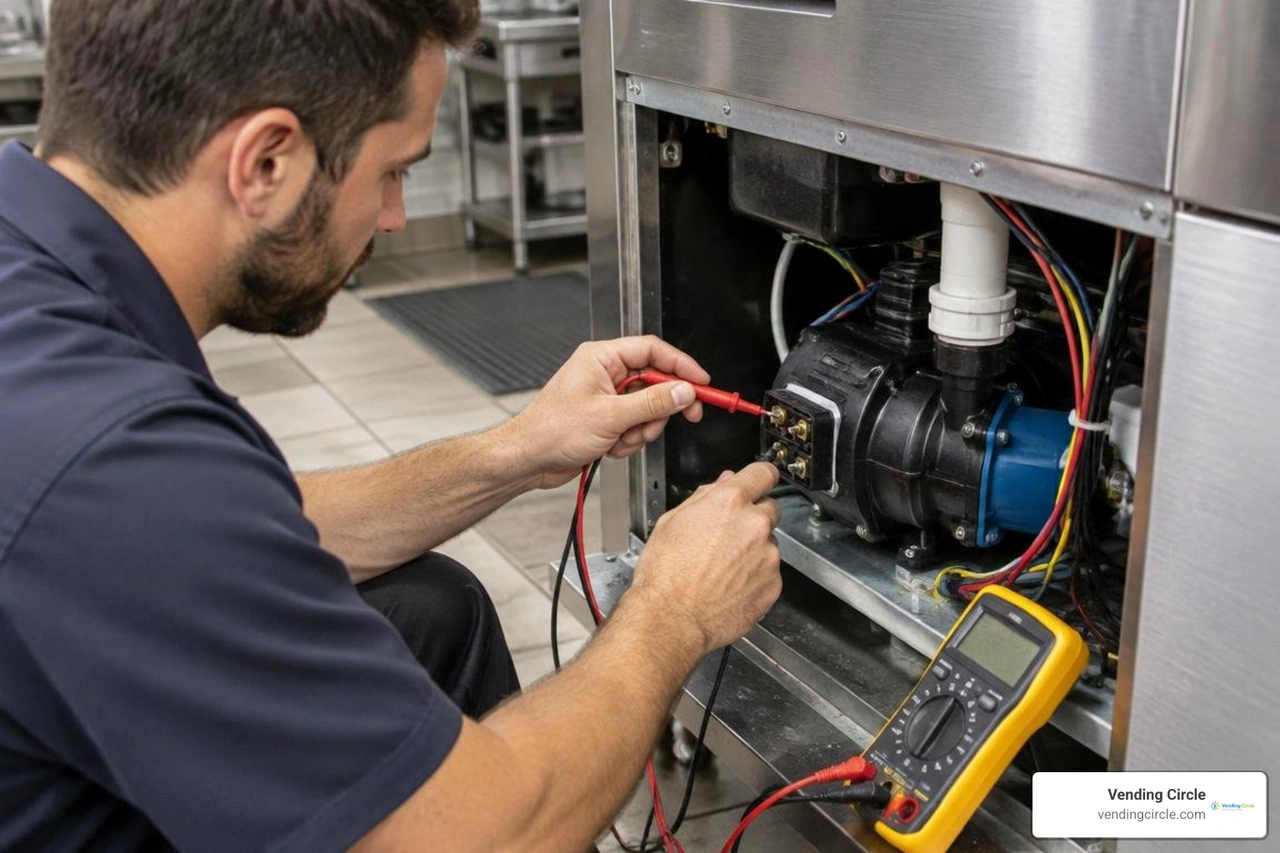
- Verify Supply Voltage: Set a digital multimeter to AC voltage (or DC if servicing a 12V mini maker). Check the voltage at the pump harness during the freeze cycle. Standard commercial North American units require 115V (±10%) or 208–230V single-phase power. If voltage is absent, troubleshoot the control board, contactor, or bin thermostat.
- Inspect Motor Coil Resistance: Disconnect the electrical quick-connect plug and switch the meter to ohms ($\Omega$). Measure resistance across the motor terminals. A reading of $0\,\Omega$ indicates a shorted winding, while an infinite reading ($OL$) signals an open thermal overload or broken winding.
- Check for Ground Faults: Measure resistance between each motor lead and the metal chassis ground. Any continuity reading below 1 Megohm ($1\,\text{M}\Omega$) means the internal moisture-proof seal has failed, creating a dangerous ground leak.
- Mechanical Impeller Inspection: Disassemble the pump volute cover. Rotate the impeller manually. It should spin freely without gritty resistance. Mineral scale from hard water frequently glazes the bearing journals, creating locked-rotor conditions that overheat the motor.
Sourcing the Correct Replacement: OEM vs. Universal Models
Selecting a replacement requires weighing the precision of an Original Equipment Manufacturer (OEM) part against the flexibility of universal aftermarket assemblies.
| Feature / Metric | OEM Replacement Pumps | Universal Replacement Pumps |
|---|---|---|
| Fit & Mounting | Exact drop-in match; reuses factory brackets | Requires modular brackets, shims, or adapters |
| Electrical Interface | Plug-and-play factory harness connectors | Lead splicing or wire nut termination required |
| Flow & Head Pressure | Tuned to exact evaporator dimensions | Multi-impeller kits match flow rates approximately |
| Certifications | Factory UL, CSA, and NSF standards | Broad NSF / UL compliance (brand dependent) |
| Typical Cost Range | $170.00 – $450.00+ | $60.00 – $180.00 |
| Warranty Protection | Preserves full equipment warranty terms | Varies; may limit manufacturer machine warranty |
Matching Voltage, Flow Rate, and Impeller Dimensions
If you choose a direct OEM replacement, match the specific part number:
- The Manitowoc Ice 2007679 Water Pump 115V 60Hz Commercial Ice Machine Replacement Part serves 300-lb cube units across the classic S Series (S300) and Indigo Series (I300).
- The Manitowoc Ice 2008489 Water Pump, 115V, 60Hz draws 0.42A and powers high-capacity workhorses like the S1000C and SD1272C.
- The Manitowoc Ice 2008929-ORA Water Pump, MSP2, 115 Volt, 60HZ, 1 Phase covers over 80 commercial configurations including the I0322 and SR0420AP.
- For high-capacity 230V operations (such as the Indigo NXT iT1900 or CVD1485), sourcing a Manitowoc Machine Water Pump 230 Volt 000013434 ensures the 6W / 0.21A draw matches the factory control profile.
When sourcing direct drop-in aftermarket options, manufacturers like Hartell provide replacements across four styles and thirteen models built to UL and NSF standards. If an emergency demands a universal solution, an Ice Machine Universal Pump (such as the Little Giant RIM-U series) provides 1/25 HP dual-voltage (115/230V) operation and includes multiple interchangeable impellers (1.75", 1.83", 1.95", and 2.10") to match system dynamics.
Household Mini Makers vs. High-Capacity Commercial Units
Never swap pumps between residential countertop ice makers and commercial machines.
Compact countertop bullet-ice makers commonly run on miniature 12V DC food-grade pumps drawing roughly 0.3A (3.6W), like the ZLWB-12 series. These are self-priming diaphragm or micro-centrifugal units designed for intermittent 10-minute cycles.
Installing a 12V DC pump into a 115V commercial setup will instantly destroy the component and create an electrical hazard. Commercial ice cubers require heavy-duty, continuous-duty, fan-cooled shaded-pole or permanent split capacitor (PSC) motors moving 2.5 to 12 GPM under continuous load.
Whether stocking up for retail beverage stations, packing the best coolers for camping, or evaluating an automated outdoor ice kiosk near me, selecting components matched to the machine's duty cycle protects equipment reliability.
Step-by-Step Installation and Repair Procedures
Replacing a failed water circulation pump takes between 20 and 45 minutes with basic hand tools.
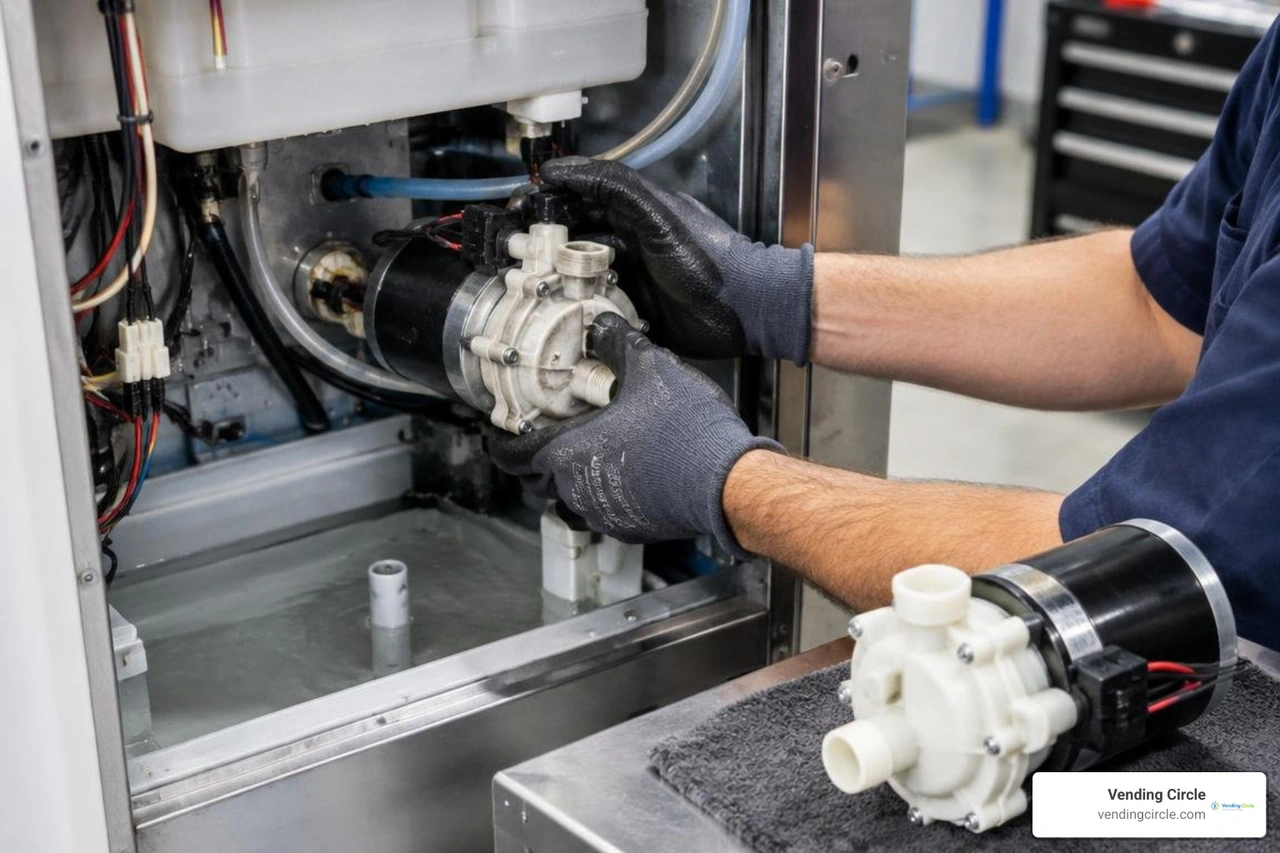
How to Replace an Ice Machine Water Pump Safely
- Isolate Power and Water Supplies: Disconnect the machine from electrical power at the breaker or unplug the unit. Shut off the incoming potable water line.
- Access the Water Compartment: Remove the front panel and splash curtains. Locate the water trough and pump mounting bracket.
- Drain the Water Sump: Pull the drain plug or siphon out remaining water from the trough to prevent spills over internal wiring.
- Disconnect Tubing and Wiring Harness: Loosen the hose clamp securing the vinyl discharge tube to the pump outlet nozzle. Unplug the factory wiring harness from the control box junction.
- Release Mounting Brackets: Most OEM pumps use slide-in brackets, thumbscrews, or quick-release tabs. Carefully slide the motor assembly out of the sump.
- Prep and Seat the New Pump: If installing a direct-fit OEM assembly, ensure new food-grade rubber O-rings and splash gaskets are seated correctly. If using an aftermarket unit, verify the pump is close-coupled and that the motor housing remains fully outside the water line (non-submersible motors must stay dry).
- Secure Connections: Attach the 5/8" or 1/2" vinyl discharge line, tighten clamps securely to prevent pressure blow-off, and snap the electrical harness into place.
- Test Cycle and Prime Verification: Restore water and power. Initiate a manual freeze cycle. Watch the water curtain cover the evaporator uniformly from edge to edge without surging, cavitating, or leaking at the discharge neck.
Preventive Maintenance to Maximize Pump Lifespan
Mineral scale accumulation from calcium carbonate and magnesium is the leading cause of premature pump motor failure. As water evaporates and freezes into pure ice crystals, residual minerals concentrate in the sump, forming abrasive deposits along the impeller shaft.
To protect your circulation pump:
- Descale Bi-Annually: Run an approved nickel-safe ice machine cleaner through the circulation cycle every six months (or quarterly in hard-water regions). This dissolves lime scale from the impeller volute and motor shaft before it hardens and binds the bearings.
- Inspect the Water Inlet Screen: Clean the fine mesh strainer positioned at the pump inlet. Debris, slime, or loose scale flakes trapped in the screen starve the impeller, causing cavitation and motor overheating.
- Maintain Upstream Filtration: Upstream sediment and phosphate scale-inhibiting water filters keep abrasive particulate from entering the water distribution manifold.
Frequently Asked Questions About Ice Maker Pumps
Can I use a 12V DC pump in a commercial ice machine?
No. Commercial ice machines use 115V or 208–230V AC line power routed through mechanical contactors or solid-state control boards. A 12V DC pump lacks the voltage compatibility, physical dimensions, flow rate (GPM), and head pressure needed to maintain a continuous water curtain over commercial evaporator plates.
Why is my new ice machine pump humming but not moving water?
A humming pump that fails to move water is usually air-locked or obstructed. If air gets trapped in the volute during initial filling, the impeller spins in an air pocket without generating suction. Power down the unit, verify the sump water level covers the pump intake base, check that the inlet screen is free of debris, and restart the cycle to purge the air pocket.
How often should an ice maker circulation pump be descaled?
Circulation pumps should be descaled at least every six months as part of a complete sanitation cycle. In locations with water hardness exceeding 7 grains per gallon (GPG), quarterly descaling prevents scale binding and extends the operational life of the pump bearings.
Keep Your Ice Production Running
Water pump failures do not have to halt your ice production or disrupt daily business operations. By identifying whether your system needs a continuous circulation pump or an intermittent condensate drain pump, testing voltage and continuity systematically, and selecting properly rated OEM or universal components, you can restore ice harvest cycles quickly and safely.
At Vending Circle, our mission is helping operators streamline equipment maintenance, reduce unnecessary service expenses, and connect directly with trade knowledge. If you are tracking down parts or locating machines in your territory, visit our interactive ice machine locator to discover local resources, connect with fellow operators, and keep your equipment operating at peak profitability.