Machine Electrical Repair Starts With a Safe Diagnosis
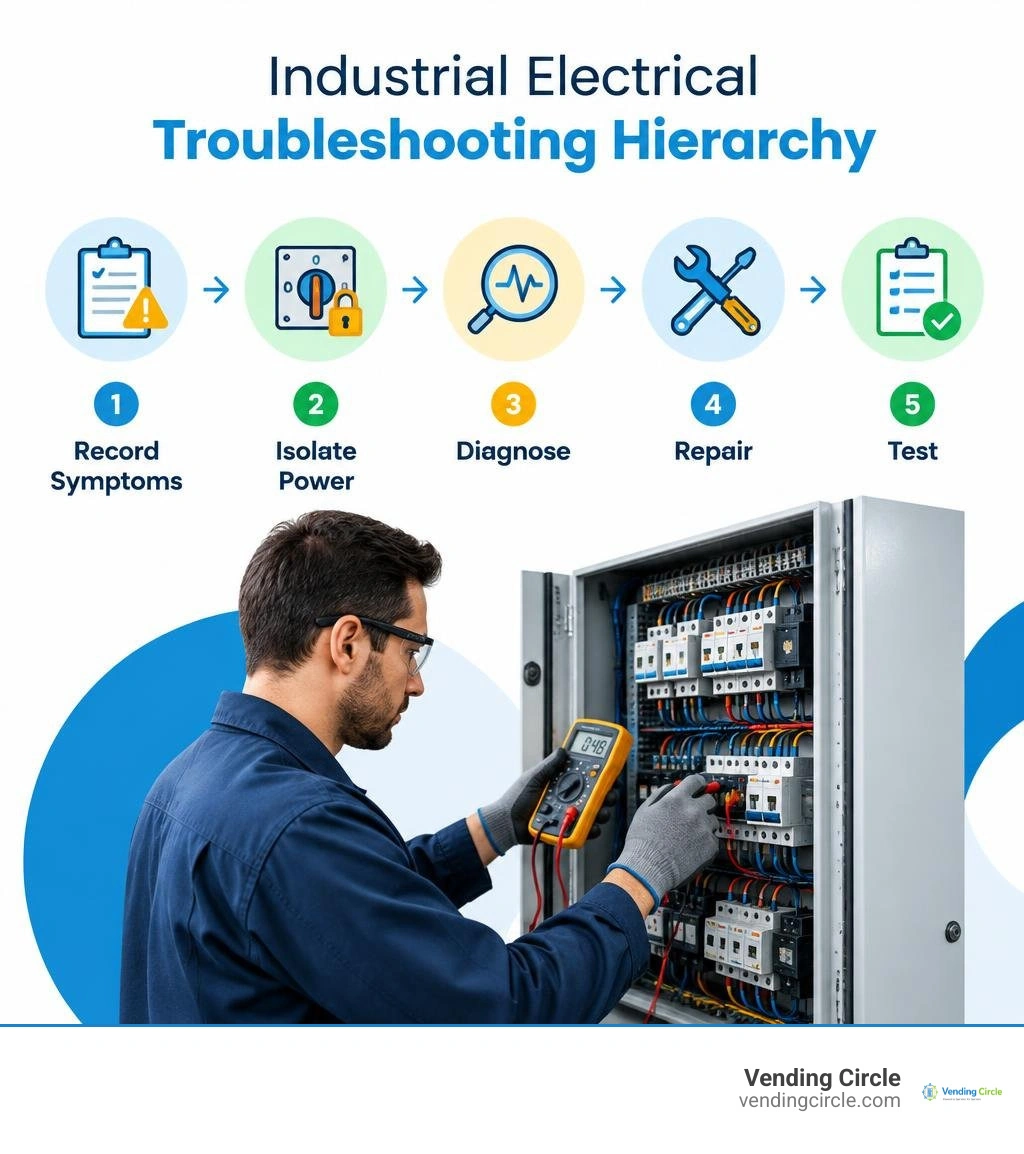
If a machine stops, note its fault code and what happened just before it failed. Then check for visible damage, unusual noise, or a tripped breaker without opening a live panel. A machine that loses power may have an electrical fault; one that powers on but will not move may have a mechanical fault. Neither sign proves the cause. Stop using the machine and have a qualified technician isolate power before testing or machine electrical repair.
The goal is to find the root cause, not just replace the part that failed. That matters when downtime affects sales across several machines. This guide covers safe diagnosis, repair decisions, and maintenance habits that can help prevent repeat breakdowns.
I'm Manuel Mojica, founder of Vending Circle and owner of MM Healthy Vending. My experience managing vending operations, along with my background in cyber operations, shapes this practical guide to machine electrical repair and keeping equipment in service.
Common Causes of Electrical Failure in Industrial Machinery
Industrial equipment operates under demanding physical and environmental conditions. Over time, internal components face persistent degradation from electrical transients, ambient heat, vibration, and mechanical fatigue. When an automated line or commercial unit suddenly cuts out, the culprit is rarely a random event; it is almost always the culmination of specific operating stresses.
- Overvoltage Spikes and Transient Surges: Rapid voltage spikes caused by utility switching, lightning, or large inductive loads turning off nearby can punch microscopic holes through semiconductor junctions and degrade wire insulation.
- Insulation Degradation: Heat is the natural enemy of dielectric materials. Continuous high temperatures dry out and embrittle winding varnishes and cable jackets, paving the way for phase-to-phase shorts or ground faults.
- Loose Terminal Connections: Industrial vibration gradually backs screws out of terminal blocks. A loose connection introduces high contact resistance, which generates localized heat, further oxidizes the contact surface, and eventually causes terminal burnout.
- Harmonic Distortion: Non-linear loads like variable frequency drives (VFDs) and switched-mode power supplies introduce higher-frequency currents that overheat transformers, trip protective breakers prematurely, and vibrate motor windings.
- Environmental Contaminants: Airborne dust, oil mist, and humidity settle on circuit boards and between relay contacts. This creates conductive paths that lead to tracking faults and catastrophic arc-overs, a common issue seen during ice machine water pump diagnostics.
Diagnostic Signals: Differentiating Electrical vs Mechanical Faults
Pinpointing whether a failure originates in the electrical control circuit or the mechanical drivetrain saves hours of trial-and-error part swapping. A systematic evaluation of physical symptoms and onboard instrumentation provides clear guidance.
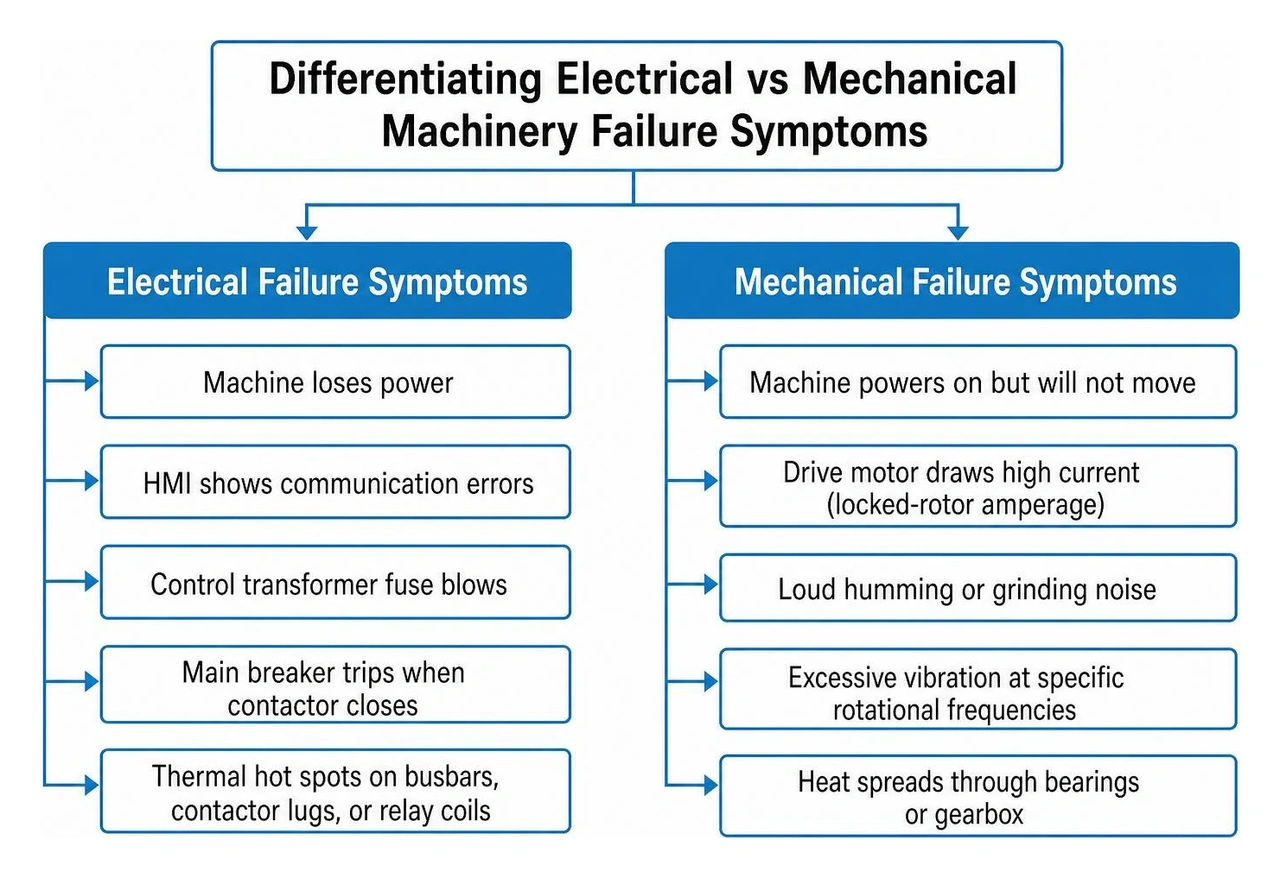
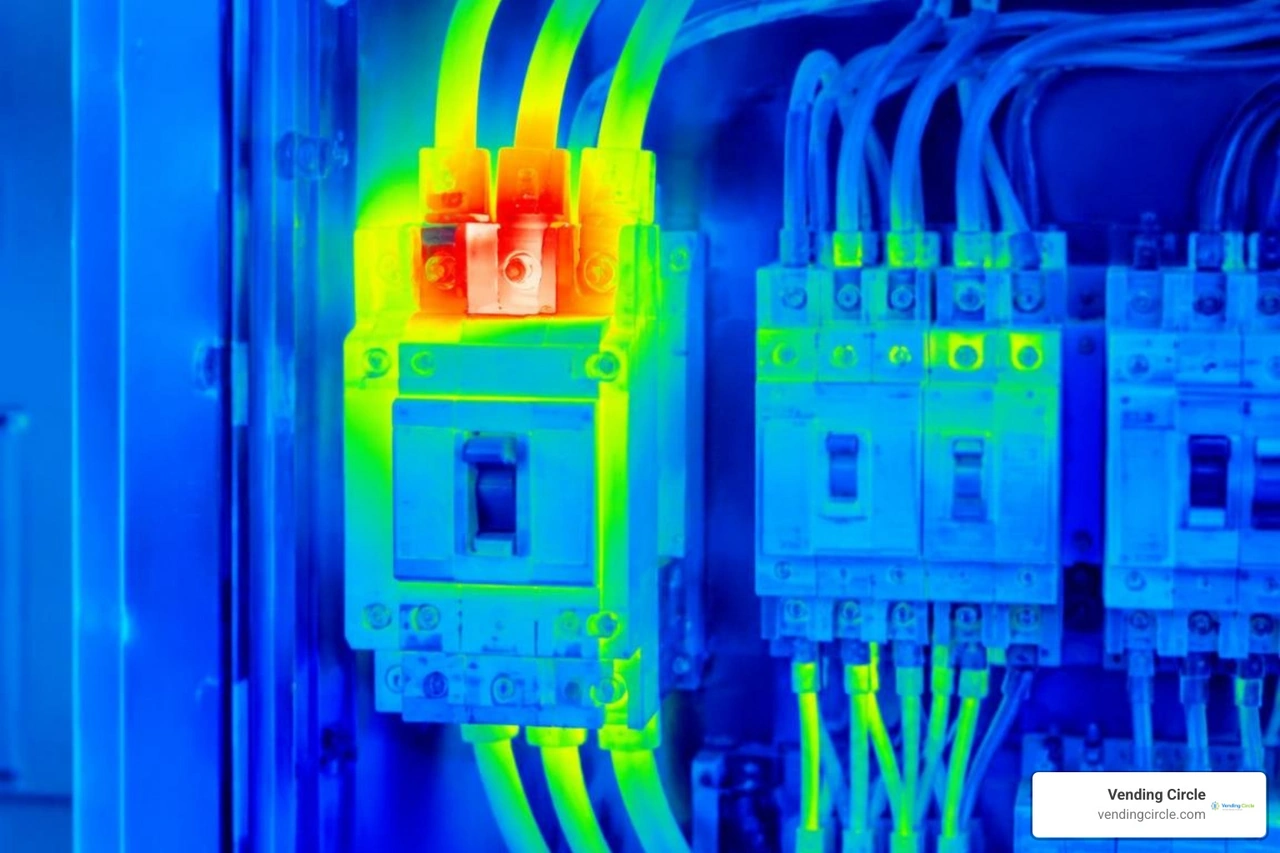
When evaluating a stalled machine, observe how the system responds to start commands. If the human-machine interface (HMI) displays communication errors, the control transformer fuse blows, or the main breaker trips the instant the contactor closes, the fault is decidedly electrical. Thermal imaging will reveal localized hot spots on busbars, contactor lugs, or relay coils long before mechanical heat spreads through a housing.
Conversely, if the drive motor draws sustained high current (locked-rotor amperage) while humming loudly, the problem often lies in mechanical binding, seized bearings, or a jammed gearbox. Excessive vibration picked up by an accelerometer at specific rotational frequencies typically indicates unbalance or misalignment, whereas a high-frequency electrical whine points toward phase unbalance or drive carrier-frequency resonance.
Power Surges, Circuit Overloads, and Capacity Limits
Every electrical circuit has clear operational boundaries defined by conductor gauge and protective device ratings. Pushing branch circuits beyond their design thresholds is a primary cause of nuisance breaker trips and melted wiring.
In standard commercial and industrial branch circuits, power capacity follows basic electrical relationships (watts = volts × amps). However, continuous loads—defined by electrical standards as running for three hours or more—must not exceed 80 percent of the circuit's total rated capacity:
- 15-Amp Branch Circuits (120V): Theoretical maximum capacity is 1,800 watts, but the safe continuous operating limit is 1,440 watts.
- 20-Amp Branch Circuits (120V): Theoretical maximum capacity is 2,400 watts, while the practical continuous limit is 1,920 watts.
When sizing circuits for heavy machinery, technicians must also account for motor inrush currents, which can reach six to eight times normal full-load operating amperage during across-the-line starts. Circuit breakers with tailored trip curves (such as Type C or D curves) accommodate these brief surge windows without tripping. Additionally, monitoring three-phase supply lines for phase-to-phase voltage unbalance is vital. A voltage unbalance of just 1 percent can cause a 6 to 10 percent current unbalance in motor windings, leading to severe thermal stress.
Systematic Steps in the Machine Electrical Repair Process

Executing an electrical repair on industrial machinery demands a disciplined, repeatable process. Skipping steps or guessing at component failures leads to repeat outages and risks worker safety.
- Symptom Verification and Operator Interview: Collect detailed operational history, fault logs, and environmental context from machine operators prior to touching any tooling.
- Schematic and Blueprint Analysis: Trace circuit paths on OEM electrical schematics to locate interlocks, safety relays, fuses, and terminal junctions relevant to the fault code.
- Circuit Isolation and Zero-Energy Verification: Disconnect incoming power sources using certified safety hardware and verify the absence of voltage across all phases.
- Component-Level Testing: Isolate suspected sub-circuits and test individual devices (coils, contacts, solid-state sensors) using calibrated diagnostic meters.
- Defect Rectification and Harness Restoration: Replace compromised parts with exact OEM-spec components, clean oxidized terminals, re-torque connections to specification, and dress wiring harnesses.
- Controlled Re-energization and Functional Commissioning: Restore power in stages, verify control voltages, test all emergency stops and safety interlocks, and run the machine through unloaded and loaded test cycles.
Essential Safety Protocols and Lockout/Tagout Procedures
Electrical safety in machinery servicing centers around achieving and verifying an absolute zero-energy state. Working on live industrial circuits exposes technicians to lethal shock hazards and arc-flash blasts that release tremendous thermal energy.
Strict adherence to OSHA standard 29 CFR 1910.147 and NFPA 70E guidelines is mandatory during any intervention:
- De-energization and Padlocking: Open the primary disconnect switch, apply an assigned personal lockout padlock, and attach a standardized warning tag.
- Stored Energy Dissipation: Discharge residual energy stored in large variable-frequency drive capacitor banks, hydraulic accumulators, and pneumatic lines before beginning work.
- Three-Point Voltage Verification: Using an appropriately rated multimeter and personal protective equipment (arc-rated face shield and insulated gloves), test the meter on a known live source, verify zero voltage between all phase conductors and ground on the target circuit, and immediately re-test the meter on the known live source.
- Insulated Tooling: Technicians must utilize 1,000V-rated insulated hand tools (complying with ASTM F1505) to eliminate short-circuit risks when working near terminal strips.
On-Site Diagnostics and Machine Electrical Repair Protocols
Once safety isolation is established, on-site diagnostics isolate the exact physical breakdown. We use specialized test instruments to evaluate the condition of conductors, contacts, and magnetic coils:
- Insulation Resistance Testing (Megohmmeter): Applying a high DC voltage (typically 500V or 1,000V) between motor windings and ground reveals microscopic insulation fractures through leakage current measurements.
- Baker Surge Testing: By injecting rapid, matched voltage pulses into individual stator phases, surge testing compares wave patterns to identify turn-to-turn and coil-to-coil insulation shorts that standard multimeters miss entirely.
- Continuity and Voltage-Drop Analysis: Low-resistance ohmmeters detect burned internal relay contacts by measuring millivolt drops across closed contact sets under load.
- Harness Inspection: Technicians inspect control cabinet wire ducting for pinched cables, insulation chafing against sharp metal chassis edges, and corroded multi-pin connectors. For complex plants, engaging certified rotating equipment diagnostic services ensures high-voltage machinery meets precise operational baselines before going back online.
Motor Rewinding and Component Overhauls in Industrial Equipment
Electric motors and generators form the backbone of industrial automation. When high-voltage stator coils short or rotor bars crack, complete machine replacement is rarely the only solution. Component overhauls and precision rewinding restore rotating equipment to factory efficiency while avoiding the long lead times of new machinery.
During an overhaul, the motor undergoes complete mechanical disassembly, chemical cleaning of mechanical housings, and microscopic inspection of iron core laminations. Technicians evaluate shaft runout, hone bearing journals, rebuild worn slip rings, and dynamically balance rotating assemblies to eliminate destructive mechanical vibrations.
Stator Rewinding, Dynamic Balancing, and Surge Testing
When electrical testing reveals compromised winding insulation, the stator undergoes a comprehensive rewinding cycle according to strict industry guidelines such as the Model Repair Specifications for Low Voltage Induction Motors:
- Controlled Core Burn-Off: The damaged stator is placed in a temperature-controlled burnout oven kept strictly below 700°F (371°C) to prevent damaging the interlaminar insulation between the core's thin electrical steel sheets.
- Coil Stripping and Core Preparation: Old copper coils are extracted, and the core slots are deburred, thoroughly cleaned, and lined with high-dielectric slot liners (such as Nomex or Kapton).
- Precision Rewinding and Insertion: Automated or hand-wound coil groups using inverter-duty magnet wire are carefully inserted into core slots, wedged securely, and laced tightly to prevent movement under magnetic loads.
- Varnish Impregnation: The wound stator undergoes Vacuum Pressure Impregnation (VPI) or dip-and-bake cycles using Class H (180°C) synthetic resins to seal out moisture, optimize thermal transfer, and eliminate internal air voids.
- Dynamic Computer Balancing: Rotors are mounted on computer-controlled dynamic balancing machines—handling assemblies weighing up to 10,000 pounds—to balance rotating mass down to ISO G1.0 or G2.5 precision tolerances.
- Verification Testing: The rebuilt assembly undergoes Baker surge testing, hi-pot dielectric testing, and core-loss testing to ensure magnetic efficiency meets or exceeds original factory standards, mirroring established electric motor and generator rewind standards.
Variable Frequency Drives and Custom Control Panel Servicing
Modern industrial machinery relies on solid-state electronics to govern speed, torque, and sequential positioning. Variable Frequency Drives (VFDs), servo controllers, and Programmable Logic Controllers (PLCs) present unique electrical failure modes requiring specialized troubleshooting.
Solid-state drive diagnostics require careful inspection of DC bus capacitor banks, which dry out, lose capacitance, and vent electrolyte after years of continuous heat exposure. Technicians use ESR (Equivalent Series Resistance) meters to test electrolytic capacitors, replace failing cooling fans, clean heavy dust from aluminum heat sinks, and replace degraded insulated-gate bipolar transistors (IGBTs).
Custom control panels also require regular attention. Technicians must trace loose terminal jumpers, verify 24VDC power supply output ripple, replace mechanical relays reaching their rated cycle lives, and confirm proper shielding on analog feedback lines. Similar detailed electrical protocols are required across specialized refrigeration and dispensing platforms during proper coke machine maintenance.
Repair vs. Replace: Making the Right Financial Decision
Industrial maintenance managers constantly weigh whether to rebuild a failing piece of machinery or invest in a modern replacement unit. This decision requires evaluating capital expenditure, operational disruption, parts availability, and environmental factors.
| Evaluation Metric | Choose Electrical Repair / Overhaul | Choose Full Machine Replacement |
|---|---|---|
| Direct Cost Benchmark | Total repair estimate is under 50% of new unit cost | Total repair exceeds 50–60% of replacement machinery price |
| Equipment Lead Time | Immediate (turnaround within 24 to 72 hours) | Extended factory delivery windows (weeks to months) |
| Infrastructure Compatibility | Existing mounting footprint, piping, and wiring remain intact | Requires structural modifications, panel upgrades, and rewiring |
| Parts Availability | Component parts available or can be reverse-engineered | Proprietary electronics obsolete; manufacturer discontinued support |
| Energy Efficiency Gains | Premium rewind preserves base machine efficiency | Modern high-efficiency motor or drive slashes ongoing utility costs |
| Environmental Impact | Reduces landfill scrap and slashes carbon emissions | Generates substantial manufacturing and logistics carbon overhead |
Evaluating Machine Electrical Repair vs Replacement Costs
The standard rule of thumb across industrial maintenance operations is the 50 Percent Rule: if the documented cost to overhaul and electrically certify a machine is less than half the purchase price of an equivalent new unit, repair is generally the most economical choice.
However, direct purchase cost is only one element of the equation. Total cost of ownership accounts for:
- Production Downtime: If a custom-built motor or specialized packaging drive takes 16 weeks to ship from an overseas manufacturer, the resulting lost production revenue far outweighs the cost of an emergency 48-hour stator rewind.
- Carbon Footprint and Sustainability: Manufacturing a new industrial motor or production press consumes massive amounts of virgin ore, energy, and transportation fuel. High-quality rewinding and electrical restoration saves nearly 60 percent in carbon dioxide emissions compared to producing a brand-new unit, making it an exceptionally climate-friendly choice for sustainable operations.
- Reverse Engineering for Obsolete Units: When older machines rely on discontinued components, specialized machine shops can reverse-engineer iron core laminations, shafts, and slip rings, extending the operating life of legacy systems by decades.
Selecting Certified Service Providers and EASA Standards
Entrusting high-value machinery to an unqualified repair shop can result in ruined iron cores, reduced operating efficiency, and repeat field failures. Quality-focused operations seek repair facilities that adhere to internationally recognized industry benchmarks:
- EASA Accreditation: The Electrical Apparatus Service Association (EASA) sets rigorous technical standards (such as ANSI/EASA AR100) ensuring motor rewinds maintain or improve electrical efficiency and torque characteristics.
- Testing and Quality Assurance: Reliable facilities feature in-house computerized dynamometer load testing (often rated up to 250 horsepower or more) to test motors under real load conditions and generate comprehensive performance validation reports before delivery.
- Specialized Certifications: For hazardous production environments (chemical processing, grain handling), verify that the repair facility holds UL explosion-proof listings and ISO 9001 quality management certifications.
- 24/7 Rapid Response: High-throughput manufacturing requires service partners capable of immediate dispatch, complete on-site laser alignment, and round-the-clock emergency workshop overhauls.
Preventive Maintenance and Electrical Infrastructure Upgrades
Shifting from reactive breakdown servicing to structured, proactive maintenance dramatically reduces operating overhead and extends machine longevity. A well-designed electrical maintenance program catches minor component degradation before it triggers a catastrophic shutdown.
Implementing modern Condition-Based Monitoring (CBM) tools empowers maintenance teams to inspect equipment during normal operation:
- Thermographic Infrared Inspections: Performing quarterly thermographic scans of power distribution boards, contactors, and disconnect switches flags high-resistance connections and phase imbalances as localized thermal hot spots.
- Ultrasonic Acoustic Detection: Ultrasonic listening tools detect early corona discharge, arcing, and tracking inside medium-voltage cabinets long before physical burning or insulation failure occurs.
- Routine Panelboard Cleaning and Retorquing: Dust and metallic particulate accumulation inside control cabinets should be vacuumed out annually using anti-static equipment. Technicians should verify torque specifications across all power terminals using calibrated torque screwdrivers.
- Power Factor Correction and Harmonic Mitigation: Installing power factor correction capacitors and harmonic active filters cleans up plant power quality, minimizes line losses, and maximizes operational vending machine energy efficiency.
Frequently Asked Questions About Industrial Machine Electrical Maintenance
How long does a typical industrial machine electrical repair take?
Turnaround times depend heavily on the severity of the failure and parts availability. Basic on-site electrical repairs—such as swapping out a blown power supply, replacing a contactor, or repairing a damaged wire harness—are routinely completed within 2 to 6 hours.
For major overhauls involving complete stator rewinding, core baking, dip-and-bake resin curing, and dynamic balancing, repair timelines typically span 24 to 72 hours under emergency service arrangements. If custom components require specialized reverse engineering or obsolete parts must be remanufactured, turnaround can extend to several business days.
What is the most common reason for motor winding insulation breakdown?
Thermal degradation is the leading cause of winding insulation failure. Operating a motor above its rated temperature class—caused by continuous overloads, poor ventilation, high ambient temperatures, or voltage unbalance—rapidly bakes winding varnish, causing it to crack and flake away.
As a general rule in electrical engineering (Arrhenius rate equation), every 10°C increase in operating temperature above a motor's rated insulation thermal limit cuts the insulation's useful operating lifespan by half. Other contributing factors include transient voltage spikes from variable frequency drives, moisture condensation, and mechanical friction from rotor vibration.
How much CO2 can be saved by repairing an industrial motor instead of buying new?
Opting to overhaul and rewind an electric motor rather than purchasing a newly manufactured replacement reduces associated carbon dioxide emissions by approximately 60 percent.
Manufacturing a new electric motor requires significant raw materials—such as mined copper, structural cast iron, and specialized electrical steel laminations—all of which generate heavy embedded carbon emissions during smelting, precision stamping, and global freight distribution. Refurbishing an existing frame, shaft, and core steel retains the vast majority of original embodied energy, contributing directly to circular economy principles and lowering plant emissions.
Conclusion
Industrial machinery reliability depends on a disciplined electrical maintenance strategy. From understanding continuous circuit limits and enforcing zero-energy safety procedures to executing precision motor rewinds and thermographic inspections, proactive care eliminates the high costs of sudden production outages.
At Vending Circle, we help operators build sustainable, profitable operations by taking the guesswork out of machine maintenance, diagnostics, and component sourcing. By treating machinery maintenance as an investment rather than an emergency expense, you protect your assets, ensure operator safety, and keep production moving. To learn more about structured servicing workflows, explore our detailed guide to vending machine maintenance.