Why Vending Machine Inventory Management Can Make or Break Your Route
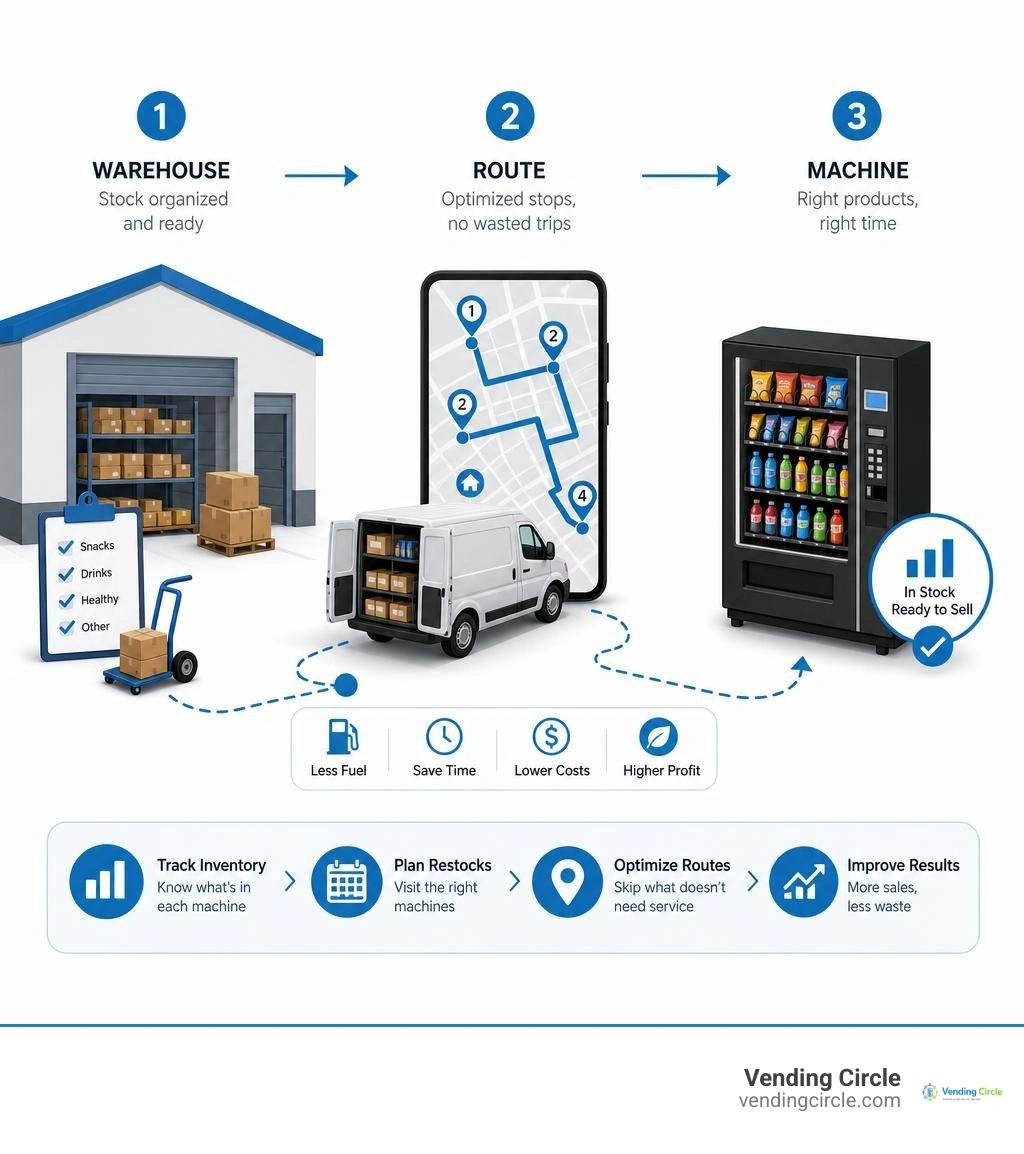
Vending machine inventory management is the process of tracking what products are inside each machine, when they need restocking, and how stock moves from your warehouse to your route — so you never miss a sale or waste a trip.
Here's a quick breakdown of what it covers:
- Stock tracking — knowing exactly what's in each machine at any time
- Restocking planning — deciding which machines to visit and when
- Route optimization — skipping machines that don't need service yet
- Product performance — identifying what sells fast and what sits
- Financial visibility — understanding profit per machine after costs
Most operators start by tracking everything in spreadsheets. It works when you have a handful of machines. But as your route grows, manual tracking creates blind spots — you drive to a machine that's still 80% full, or you show up to a sold-out machine hours too late. Both cost you money.
The vending industry is valued at $34.9 billion, and operators who use data to drive restocking decisions consistently outperform those who rely on gut instinct and fixed schedules.
I'm Manuel Mojica, founder of Vending Circle and former owner of MM Healthy Vending, where I managed routes and learned the hard way how poor vending machine inventory management drains time, fuel, and margin. Everything in this guide comes from real operational experience, not theory.
What is Vending Machine Inventory Management and Why It Matters
At its core, vending machine inventory management is about matching supply with demand at the point of purchase. In the vending business, your retail storefront is scattered across dozens of locations. Each machine has a limited capacity, and when a popular slot runs empty, that revenue is gone forever. Customers do not wait for you to restock; they simply walk away or buy from a competitor.
Effective inventory management ensures that you maintain the perfect balance of products to maximize sales while minimizing waste. It directly impacts several areas of your business:
- Preventing Stockouts: If your best-selling energy drink is sold out on a Friday morning, you lose an entire weekend of peak sales.
- Improving Cash Flow: Keeping too much inventory sitting in a warehouse or slowly expiring in a low-volume machine ties up your working capital.
- Optimizing Product Velocity: Different locations have different tastes. A school wants healthy snacks, while a manufacturing facility wants heavy snacks and energy drinks. Tracking product velocity helps you customize the product mix for every single machine.
- Reducing Shrinkage: Inventory can disappear at the warehouse, during transit, or at the machine. Tight inventory tracking creates an audit trail that keeps everyone accountable.
According to recent vending machine industry statistics 2026, operations that adopt automated inventory tracking see a significant boost in profit margins simply by eliminating underperforming products and reducing wasted service trips. By understanding exactly what is selling and how fast, you can make data-backed decisions that keep your machines profitable.

The Role of Telemetry and Real-Time Data
In the past, inventory management was purely reactive. You visited a machine, opened the door, looked at what was missing, and filled it from a box of mixed snacks in your truck. Today, modern technology has turned vending into a data-driven retail business.
This transformation is driven by telemetry. Telemetry devices are small hardware units installed inside your vending machines that connect directly to the machine's controller (using the MDB protocol). These devices transmit real-time sales and machine status data over cellular networks to your management dashboard.
When a customer taps their card or inserts cash, the transaction is recorded instantly. This allows you to:
- Monitor Stock Levels Remotely: You can see exactly how many cans of soda or bags of chips are left in every single coil without leaving your office.
- Reconcile Cash and Card Payments: Telemetry systems track cash collections and card sales separately. This prevents cash discrepancies and helps you spot machine malfunctions or driver theft instantly.
- Receive Real-Time Alerts: If a machine loses power, a coin mechanism jams, or a temperature sensor spikes in a cold food machine, you receive an immediate notification before products spoil or customers get frustrated.
Integrating your telemetry hardware with a dedicated Vending Management System (VMS) like VendSoft — Vending Machine Management Software consolidates your sales data, warehouse inventory, and route planning into a single, unified workspace. Instead of logging into multiple payment processing portals, you get a single source of truth for your entire fleet.
The Cost of Manual Tracking: Why Spreadsheets Fail
When you are starting out with one or two machines, a simple Excel sheet or a notebook is perfectly fine. You can easily remember what products you bought and what needs to be refilled. However, as you scale to 5, 10, or 50 machines, manual tracking quickly becomes a logistical nightmare.
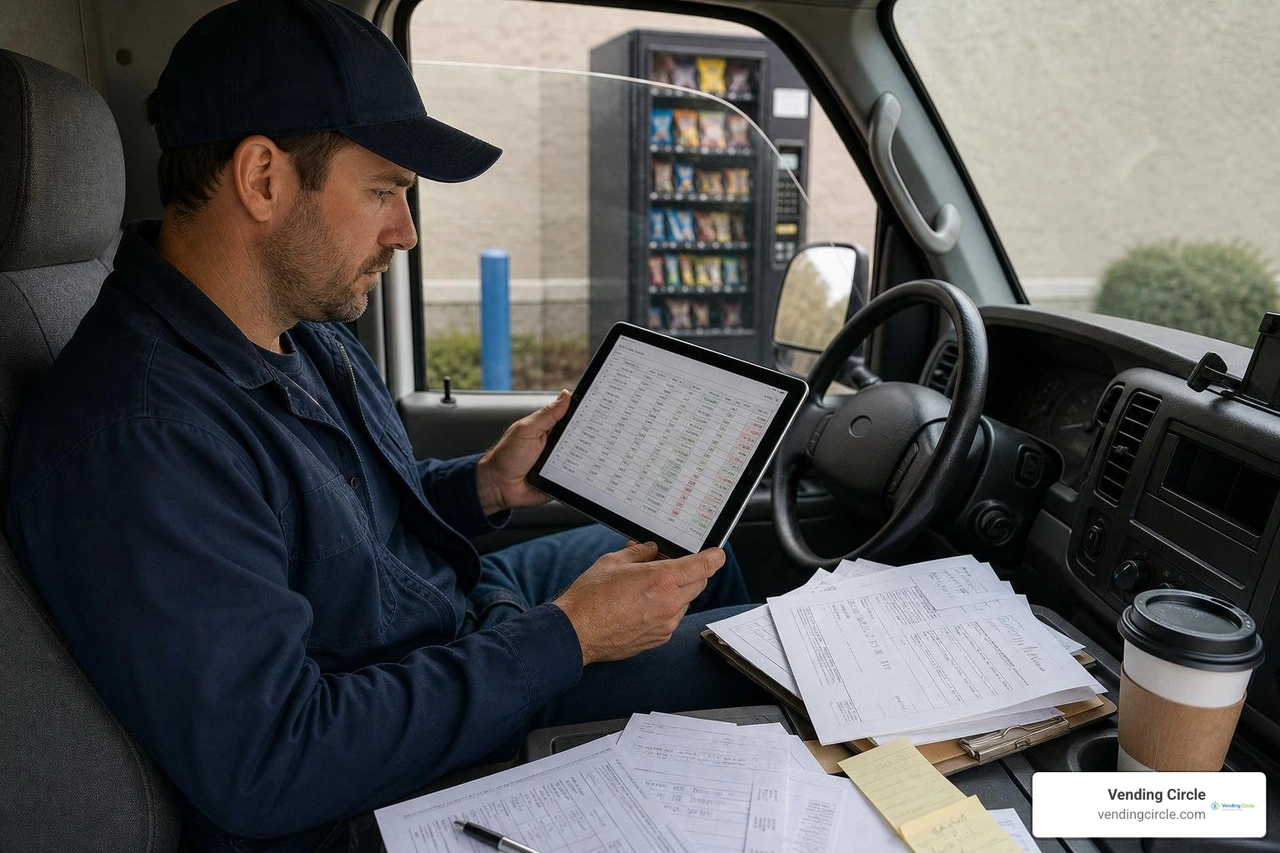
Spreadsheets are static. They cannot talk to your machines, they cannot predict when a product will run out, and they certainly cannot plan your driving route. Relying on manual spreadsheets introduces several critical risks to your business:
- Data Lag: A spreadsheet only shows you what happened the last time you manually entered data. It does not tell you what is happening right now. If a machine sells out of water bottles on a hot Tuesday morning, your spreadsheet won't show it until your next scheduled visit.
- Human Error: Manually entering product counts, prices, and cash collections across dozens of columns inevitably leads to typos. One misplaced decimal point can throw off your inventory valuation and profit calculations for weeks.
- Wasted Trips: Without real-time visibility, you have to service machines on a fixed schedule. You might drive 30 minutes to a machine only to find it has sold only three items. That is a waste of time, labor, and fuel.
- Inventory Shrinkage: If you do not have a system tracking exactly how many items left your warehouse, how many were loaded onto the truck, and how many were placed in the machine, it is impossible to identify where missing inventory is disappearing.
The Pitfalls of Manual Vending Machine Inventory Management
Let's look at a common scenario for an operator using manual tracking:
You have a weekly route schedule. Every Thursday, you load your truck with an assortment of snacks and drinks based on what you think sold last week. You drive to a corporate office location. When you open the machine, you realize that while the chips are completely sold out, the chocolate bars haven't moved at all.
Now you have two problems:
- You didn't bring enough chips to fully restock the machine, meaning you have to leave slots empty (losing future sales) or make a second trip.
- You brought a box of chocolate bars that you don't need, which will sit in your hot truck, risking melting and spoilage.
This mismatch between truck stock and machine needs is a direct result of manual vending machine inventory management. It leads to heavy vehicles carrying unnecessary weight, high fuel costs, expired products, and highly inefficient routes.
How to Optimize Your Route and Save Fuel with a VMS
The secret to a highly profitable vending business isn't just selling more products — it is running an efficient operation. Fuel and labor are your two largest variable expenses. If you can reduce the mileage you drive and the hours your drivers spend on the road, your profitability will skyrocket.
A Vending Management System (VMS) uses your real-time inventory data to automatically optimize your routes. Instead of visiting every machine on a fixed weekly schedule, the software analyzes the depletion rates of each machine and builds a dynamic schedule. You only visit machines that actually need servicing.
| Operational Feature | Manual Routing (Spreadsheets / Schedules) | VMS Dynamic Routing |
|---|---|---|
| Scheduling Basis | Fixed calendar days (e.g., every Tuesday) | Actual product depletion levels |
| Restock Accuracy | Guesswork; driver carries mixed stock | "Pre-kitted" bins with exact items |
| Wasted Trips | High (visiting full or nearly full machines) | Extremely low (skipped if stock is high) |
| Fuel Consumption | High due to heavy truck loads and extra miles | Low due to lighter loads and optimized paths |
| Labor Efficiency | Driver spends hours counting stock at the machine | Driver quickly fills machine and moves on |
By transitioning to dynamic routing, many operators reduce their physical service stops by 30% to 50% without experiencing any increase in stockouts. This translates directly to lower fuel bills, less wear and tear on your vehicles, and more free time to focus on securing new locations.
Key Features of Modern Vending Machine Inventory Management Software
If you are looking to invest in a VMS, you should look for specific features that directly support route and inventory optimization:
- Real-Time Tracking: Integration with your telemetry devices (such as Nayax or Cantaloupe) to pull hourly sales and inventory data.
- Low-Stock Alerts: Customizable thresholds for each coil. For example, if a high-volume coil drops below 3 items, the system flags the machine for restocking.
- Visual Planograms: A digital layout of your machine's coils, showing exactly which product goes where, its capacity, and its current stock level. Platforms like Vending Machine Management Software | Vendric | Vendric offer visual planogram editors that make organizing your machines incredibly simple.
- Route Optimization Algorithms: Software that calculates the most efficient driving path between your scheduled stops, taking traffic and distance into account.
- Multi-User Access Control: The ability to create restricted accounts for drivers so they can only see their assigned routes and inventory lists without accessing your sensitive financial data.
Implementing Pre-Kitting to Reduce Vehicle Weight
One of the most powerful workflows enabled by modern software is pre-kitting.
Traditionally, drivers operate "off the truck." They pack their vehicle full of bulk boxes of inventory, drive to a location, walk inside to count what the machine needs, walk back to the truck to pull the products, and walk back inside to fill the machine. This "double-walking" is incredibly exhausting and time-consuming.
With pre-kitting, the process is streamlined:
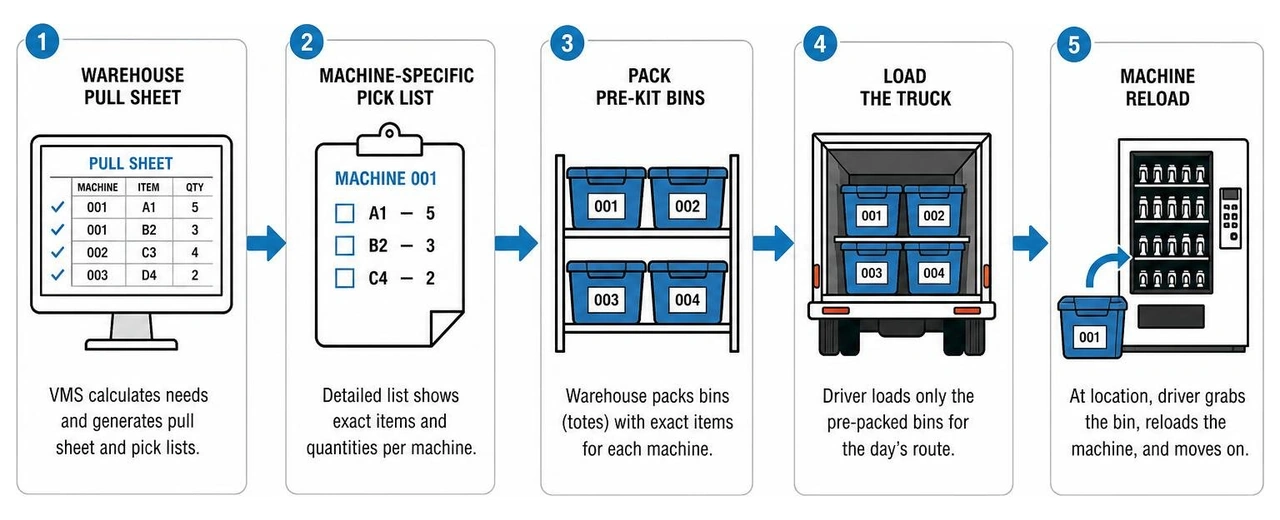
- The VMS calculates exactly what products are missing from each machine on the route before the driver leaves the warehouse.
- The system generates a warehouse pull sheet and a machine-specific pick list.
- The warehouse team packs individual bins (totes) with the exact items required for each specific machine.
- The driver loads only these pre-packed bins onto the truck.
- At the location, the driver grabs the designated bin, walks in, fills the machine completely, and walks out.
Because the truck is only carrying the exact inventory needed for that day's route, it is significantly lighter. A lighter truck consumes much less fuel, saving you money on every single mile driven. Additionally, pre-kitting can easily double a driver's daily stop capacity, allowing your business to scale without hiring more staff.
Frequently Asked Questions About Vending Machine Inventory Management
At what stage of growth should an operator invest in a VMS?
A common mistake is waiting too long to adopt professional tools. Many operators believe they need 20 or 30 machines before a VMS is worth the cost. In reality, the best time to implement a VMS is day one.
Starting organized prevents you from building bad habits, running into messy spreadsheet errors, or losing track of your actual margins. If you only have 1 to 5 machines, many software platforms offer highly affordable starter tiers or free trials. Adopting a system early ensures that your workflows are already built for scale when you add your 10th or 50th machine.
If you are feeling overwhelmed or aren't sure how to set up your first route, finding an experienced vending machine mentor can help you navigate these early software decisions and avoid costly operational mistakes.
How do you manage inventory for offline or cash-only machines?
While smart, connected machines are ideal, almost every operator has a mixed fleet that includes older, offline, or cash-only machines. You do not need expensive telemetry hardware on every single machine to run professional inventory management.
Modern vending software solves this through hybrid tracking:
- Manual Mobile Counts: When a route driver visits an offline machine, they use the VMS mobile app to log the current physical count of each coil before restocking.
- Inventory Decrementing: The software uses these manual entry points to calculate sales velocity and update your central warehouse stock levels.
- QR Code Systems: Some operators use QR codes on offline machines. Customers can scan the code to report issues or even pay via a web portal, which sends basic telemetry data back to your system.
By combining manual mobile entries with automated telemetry, you can manage your entire business from a single dashboard, regardless of how advanced your physical machines are.
What are the direct financial benefits of inventory software?
Investing in inventory software isn't just an expense — it is an investment that pays for itself in several clear ways:
- Per-Machine Profitability (P&L): True profitability isn't just revenue minus product cost. You have to account for location commissions, local taxes, card processing fees, and machine-specific maintenance. A VMS calculates your true net profit per machine with a single click, helping you quickly identify and remove unprofitable locations.
- Automated Commission Tracking: If you pay your location owners a percentage of sales, calculating this manually in Excel can take hours and lead to disputes. Software automates these calculations and generates clean, professional PDF reports for your hosts.
- Accurate Tax Reconciliation: Vending sales often include sales tax built into the retail price. Professional software back-calculates tax-inclusive pricing to ensure your tax filings are accurate to the penny, saving you from expensive audit headaches.
Conclusion
Optimizing your vending machine inventory management is the single most effective step you can take to build a highly profitable, scalable unattended retail business. By moving away from manual spreadsheets and embracing real-time data, telemetry, and smart pre-kitting, you will save hours of labor, cut your fuel bills, and ensure your machines are always stocked with the products your customers want.
At Vending Circle, we believe that you don't have to figure out this journey alone. We've built an active, supportive community where operators of all experience levels share proven routing strategies, troubleshoot hardware, and get direct access to wholesale pricing.
Whether you are looking to buy your very first machine or scale an existing fleet of fifty, we are here to support you every step of the way.
Ready to streamline your operations and scale your business? Join our community and explore our marketplace to start optimizing your fleet today.