What Vending Machine Parts Cost in 2026
In 2026, vending machine parts cost about $15-$40 for a vend motor, $25-$80 for a spiral, and $30-$80 for a thermostat. Bigger replacements cost more: a new bill validator runs $200-$400, while a control board repair can reach $400-$1,200. These figures are estimates, not quotes. A technician may charge $95-$150 per hour plus a service-call fee, so check whether a price covers the part alone or the full repair.
I’m Manuel Mojica, founder of Vending Circle and former owner of MM Healthy Vending. My work with vending operators has shown me why tracking vending machine parts cost matters: it helps you stock useful spares and decide when a repair is worth paying for.
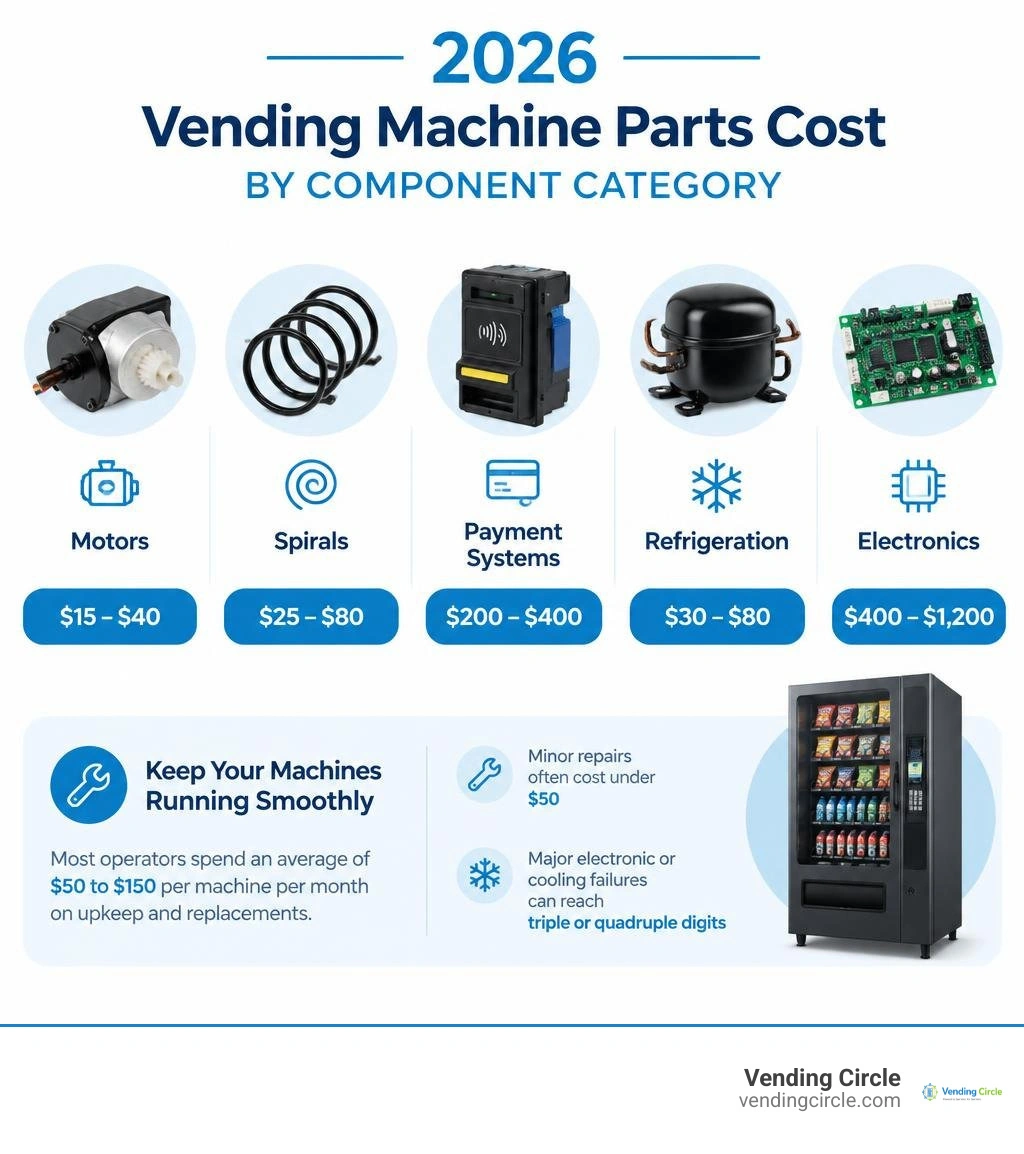
Average Vending Machine Parts Cost by Component Category
Managing a route means accepting that mechanical and electrical components wear down over time. Most operators spend an average of $50 to $150 per machine per month on upkeep and replacements across a typical route. While minor repairs might cost under $50, major electronic or cooling failures can easily run into triple or quadruple digits.
Understanding component lifespans and standard pricing ranges makes route budgeting straightforward rather than stressful. You can review verified vending parts specifications to cross-reference dimensions and OEM part numbers before placing an order.
| Component Category | Typical Replacement Cost (Parts Only) | Average Lifespan | Common Failure Frequency |
|---|---|---|---|
| Vend Motors | $15 – $40 | 5 – 8 years | Low to Moderate |
| Dispense Spirals / Coils | $25 – $80 | 8 – 12 years | Low (Physical Damage/Jams) |
| Product Pushers & Shims | $5 – $25 | 4 – 7 years | Moderate (Wear & Tear) |
| Bill Validators (New) | $200 – $400 | 3 – 5 years | High (Dirt & Optical Wear) |
| Bill Validators (Refurbished) | $100 – $180 | 2 – 4 years | Moderate to High |
| Coin Mechanisms | $150 – $300 | 4 – 6 years | Moderate (Jams & Sensor Flaws) |
| Cashless Readers | $280 – $400 | 3 – 5 years | Low to Moderate |
| Thermostats / Cold Controls | $30 – $80 | 5 – 7 years | Moderate |
| Sealed Compressor Units | $300 – $800 | 5 – 10 years | Low (High Severity) |
| Main Controller Boards (MDB) | $400 – $1,200 | 6 – 10 years | Low (Surge Dependent) |
| Keypad Overlays & Displays | $30 – $300 | 4 – 8 years | Moderate |
Small Mechanical Hardware and Vending Machine Parts Cost
Small mechanical hardware keeps products dropping cleanly into the delivery bin. When a spiral binds or a motor burns out, that specific selection stops producing revenue until you swap the hardware.

Vend motors generally cost $15 to $40 each. When replacing snack coils, individual spirals run between $25 and $80 depending on pitch and diameter. If you are refurbishing an entire tray, complete multi-drop kits—such as a 4-wide dual coil and motor kit for legacy units—often retail for around $64.27.
Product pushers ($5 to $15) and beverage shims ($8 to $25) are inexpensive plastic and metal guides that prevent cans from wedging in column stacks. Inspecting these parts during regular route restocks is one of our top essential machine maintenance tips to stop mis-vends before they cause customer refund requests.
Payment System Upgrades and Cost of Vending Machine Parts
Payment systems generate the highest volume of service tickets across any route. Dust, worn dollar bills, and sticky coins regularly challenge validators and coin acceptors.
A brand-new bill validator runs $200 to $400, while a tested refurbished unit costs $100 to $180. A multi-tube coin mechanism typically ranges from $150 to $300.
Upgrading to cashless payment hardware requires budgeting $280 to $400 for devices like the Nayax VPOS or Cantaloupe Seed reader. For detailed hardware specifications, review our comprehensive card reader guide or step-by-step instructions for adding a card reader to an existing setup using Multi-Drop Bus (MDB) cables.
Refrigeration Units, Compressors, and Thermostats
Refrigeration issues are the most expensive mechanical failures on any beverage or combo route. If a drink vendor stops cooling, warm inventory quickly leads to lost sales and potential product spoilage.
- Digital Thermostats & Cold Controls: $30 – $80
- Condenser Fan Motors: $40 – $95
- Door Perimeter Gaskets: $40 – $100
- Sealed Compressor Replacement (Parts Only): $300 – $800
- Complete Drop-In Refrigeration Deck: $650 – $1,400

A failing compressor is often mistaken for a bad thermostat or leaky door seal. Always check the $40 door gasket first before spending hundreds on major cooling components.
When a compressor genuinely fails, total repair costs run $450 to $1,050 when including parts and certified labor. Because handling refrigerants like R-134a or R-290 requires EPA Section 608 certification, compressor swaps are not DIY jobs. For broader operational context, explore our overall vending machine costs guide.
Electronic Control Boards, Displays, and Wiring
Main logic boards manage motor sequencing, temperature safety cutoffs, and MDB payment communication. A sudden electrical surge from an ungrounded wall outlet can damage these sensitive circuits instantly.
Replacing a modern main controller board costs $400 to $1,200 depending on machine complexity. Upgrading an older machine with an all-in-one controller kit—such as a USI CB300 OneBoard retrofit kit featuring an updated OLED screen and MDB interface—typically costs around $419.00.

Smaller user-interface components are much more affordable:
- Replacement LCD/OLED Displays: $100 – $300
- Selection Keypad Membrane Overlays: $30 – $75
- Door Interlock Safety Switches: $15 – $35
- Internal MDB & DEX Wiring Harnesses: $20 – $60
Learning the basics of handling machine electrical repair enables you to safely diagnose power supply faults and swap faulty membrane switches without hiring an outside technician.
Component Price Variations Across Different Machine Types
Different machine formats carry wildly different repair profiles. A traditional mechanical snack vendor has straightforward mechanical needs, whereas connected micro-market smart coolers rely on specialized sensor arrays and telemetry modules.
Traditional Snack Machines
Snack units rely heavily on low-voltage DC motors, helical spirals, and drop sensors. These machines represent the lowest average part costs on a route. Aside from occasional control board glitches or bill jams, maintenance revolves around $15 to $40 motor replacements and $5 alignment pushers.
Cold Beverage and Combo Machines
Drink machines place significant strain on drop chutes, solenoid gates, and refrigeration decks. Heavy beverage cans demand durable delivery linkages and functional fans. Annual component budgets for cold vendors are roughly double those of dry snack machines due to condenser coil cleaning and cooling cycle demands.
Smart Coolers and Micro-Market Hardware
Connected smart coolers eliminate spirals and bill acceptors entirely, substituting automated vision systems and digital shelf sensors.
- Internal AI Camera Modules: $150 – $400
- Weight & Shelf Load Sensors: $80 – $200 per tray
- Electronic Magnetic Door Locks: $40 – $120
- Cellular Telemetry Modems & SIM Hardware: $60 – $150
Bulk Vending Equipment
Mechanical bulk candy and toy capsule machines require no electricity, resulting in low maintenance costs.
- Replacement Lock & Key Sets (e.g., Rhino style): $19.95
- Quarter Coin Mechanism Assemblies: $35.00
- Chute Door Flappers (e.g., Northwestern Super 80): $14.99 – $18.89
- Replacement Coin Wheels: $14.99
When evaluating used equipment acquisitions, factor these part costs into your budget by assessing used vending machines for worn wiring, damaged cooling decks, or obsolete payment harnesses.
Repair Labor Costs and the 50% Decision Rule
Hiring an experienced third-party technician is often necessary for major cooling overhauls or complex wiring diagnostics. However, understanding standard labor rates helps you decide whether to fix a machine yourself or make a service call.
According to data from the U.S. Bureau of Labor Statistics, the national mean hourly wage for coin, vending, and amusement machine servicers is approximately $22.04 per hour. However, commercial field service companies charge retail clients significantly more to cover insurance, fuel, tooling, and overhead.
If a technician arrives to replace a $20 motor, your final invoice will likely total $190 to $245. For straightforward part swaps, DIY repairs deliver substantial cost savings.
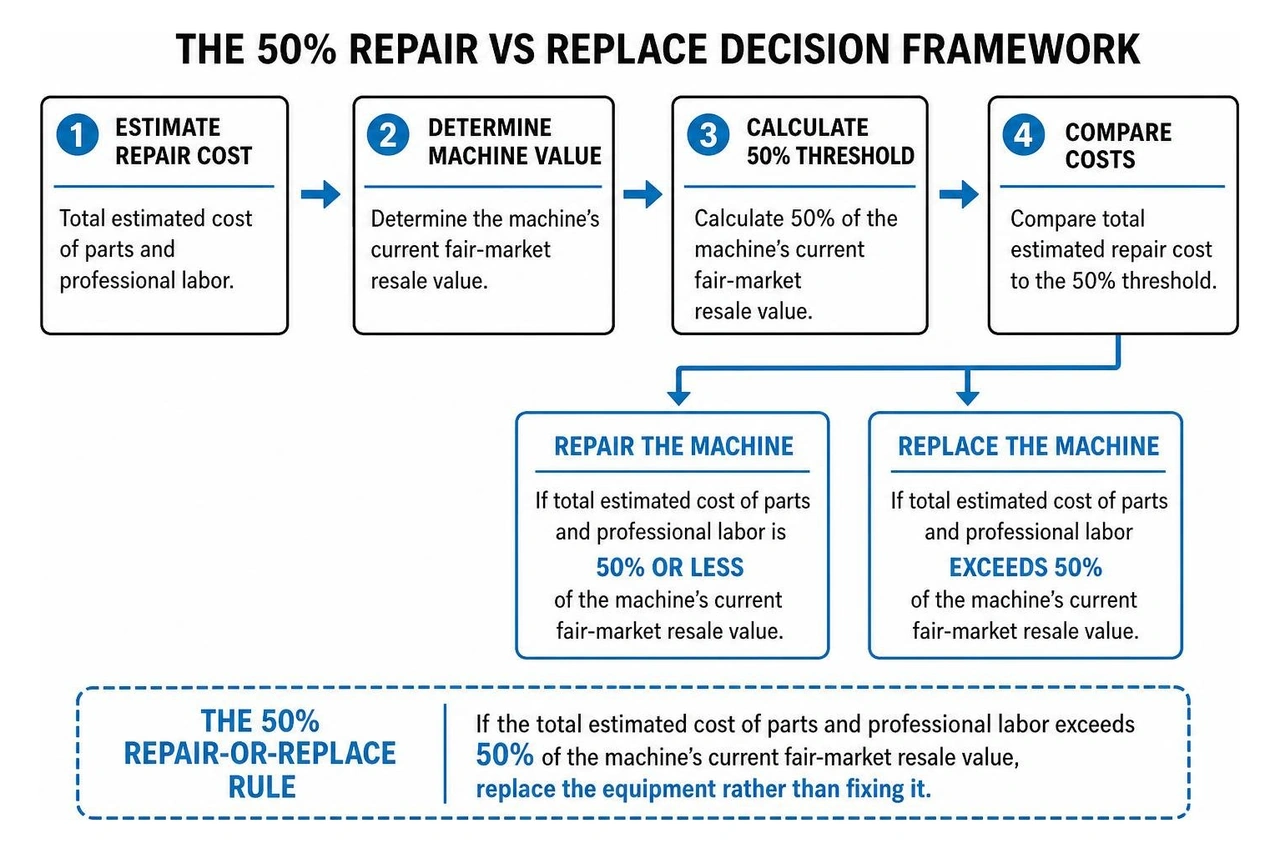
The 50% Repair-or-Replace Rule
When faced with an expensive repair bill, apply the 50% Rule:
If the total estimated cost of parts and professional labor exceeds 50% of the machine's current fair-market resale value, replace the equipment rather than fixing it.
For instance, spending $850 to install a new compressor and control board on an aging $1,200 combo machine rarely makes financial sense. That capital is better applied toward upgraded equipment via our ultimate guide to buying equipment or by reviewing flexible equipment financing options.
Preventive Maintenance Strategies to Reduce Replacement Costs
Reactive maintenance—waiting for a component to break before ordering parts—erodes route margins through emergency shipping fees and lost sales. Operators who adhere to a structured preventive maintenance schedule report 30% to 40% lower annual repair expenses compared to reactive operators.
Essential Route PM Schedule
- Weekly Restock Visits: Run quick motor diagnostics, wipe validator optical lenses with a dry microfiber cloth, and test coin return flappers.
- Monthly Checkups: Clean dirt and debris from bottom product delivery bins, check door alignment, and confirm temperature display accuracy.
- Quarterly Service: Vacuum refrigeration condenser coils thoroughly, inspect door gaskets for tears using a dollar-bill pinch test, and lubricate mechanical hinges.
- Annual Overhauls: Clean coin mechanism payout tubes, update control board firmware, check wiring harness grounds, and replace worn selection price decals.
Keep critical spares in your service vehicle: two common vend motors, a spare bill validator, a tested coin mech, extra fuses, and a tube of food-grade silicone lubricant. Pairing sensible part sourcing with stocking essentials and vending machine supplies helps you resolve 90% of route breakdowns on the spot. Maintaining high machine uptime also protects your product margins, which you can optimize using our product pricing strategy guide.
Frequently Asked Questions About Vending Machine Parts
What is the most expensive vending machine part to replace?
The most expensive single part replacement is a sealed refrigeration compressor, which costs between $450 and $1,050 all-in ($300–$800 for the compressor unit plus $150–$250 in EPA-certified labor). Proprietary main controller logic boards for specialized or imported machines are a close second, running from $400 to $1,200 for the bare board.
How much should operators budget annually for vending machine parts?
For newer or fully refurbished name-brand equipment, budget $150 to $400 per machine per year for replacement parts and minor hardware. For older, high-mileage machines without warranty coverage, set aside $300 to $800 annually per machine (or approximately $50 to $150 per month averaged across your route).
Can operators replace vending machine parts without a technician?
Yes. Most small mechanical and electronic parts are plug-and-play. You can easily swap vend motors, dispense spirals, keypad overlays, display panels, bill validators, and coin mechanisms using standard hand tools like nut drivers and screwdrivers. You should only hire a professional for sealed refrigeration repairs involving pressurized refrigerants or complex high-voltage line wiring issues.
Conclusion
Managing replacement component costs comes down to proactive maintenance, accurate troubleshooting, and disciplined capital allocation. By maintaining a backup stock of common mechanical parts, using the 50% Rule on major repairs, and performing regular condenser cleanings, you can keep your machines running smoothly and protect your bottom line.
At Vending Circle, we help operators scale efficiently through weekly live Q&A sessions, hands-on repair courses, discounted supply channels, and an active network of route owners sharing proven strategies. When you are ready to expand your route or upgrade legacy hardware, explore quality vending machines and parts to source reliable, revenue-ready equipment.