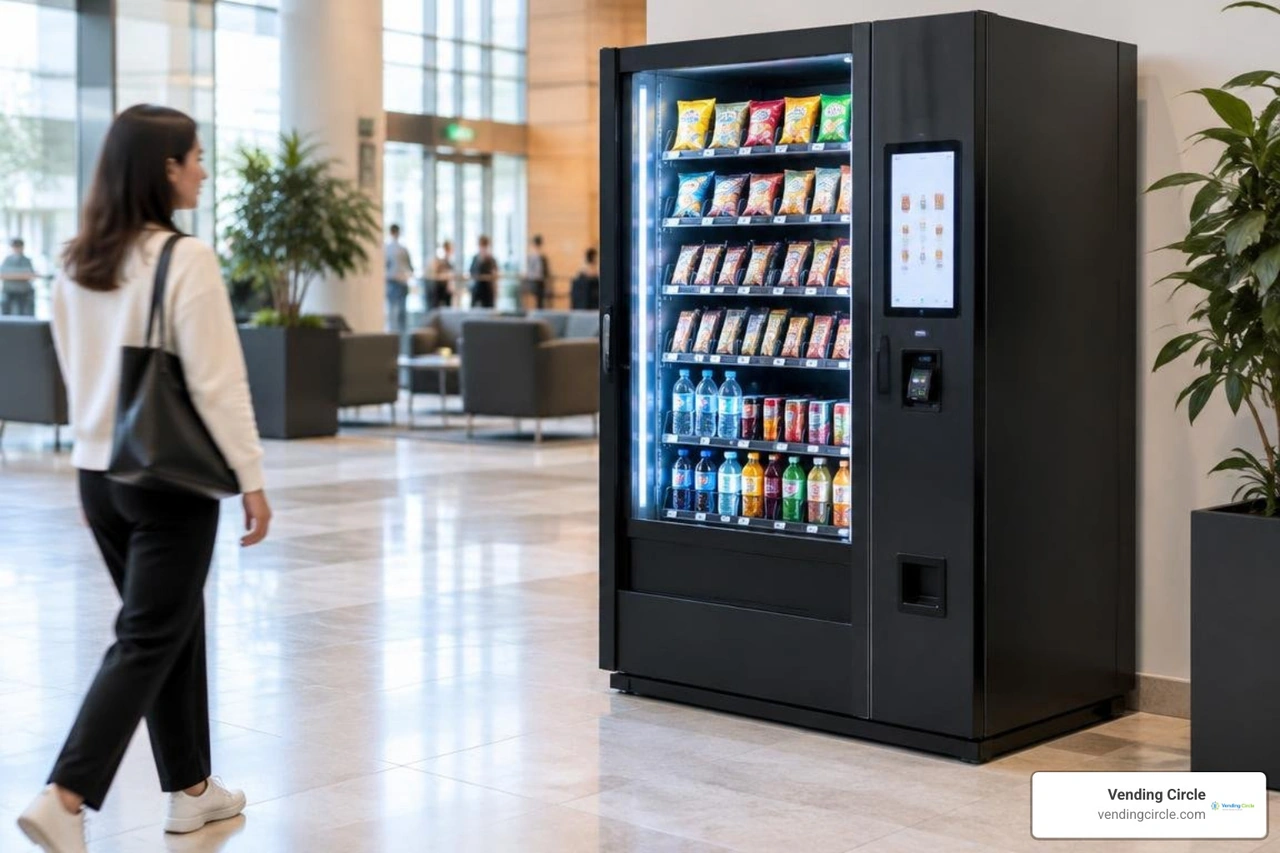
What to Check Before You Buy a Vending Machine
Start with the location, not the machine. Before you buy a vending machine, check who will use it, how often they pass the spot, and whether they have nearby food or drink options. Then compare machines on these five points:
- Fit: Choose a combo machine if you need snacks and drinks in one small space. Consider separate machines when demand is high enough to keep both stocked.
- Total cost: Include the machine, payment reader, freight, setup, and first stock order.
- Condition and support: Ask what was tested, what the warranty covers, and who handles repairs.
- Payments: Confirm the machine is MDB-ready and can take the cashless payments your customers use.
- Delivery: Measure doors and the final spot before arranging freight.
I'm Manuel Mojica, founder of Vending Circle and former owner of MM Healthy Vending. My experience running machines and working with other operators shapes this checklist for anyone ready to buy vending machine equipment.

Machine Types to Consider Before You Buy Vending Machine Hardware
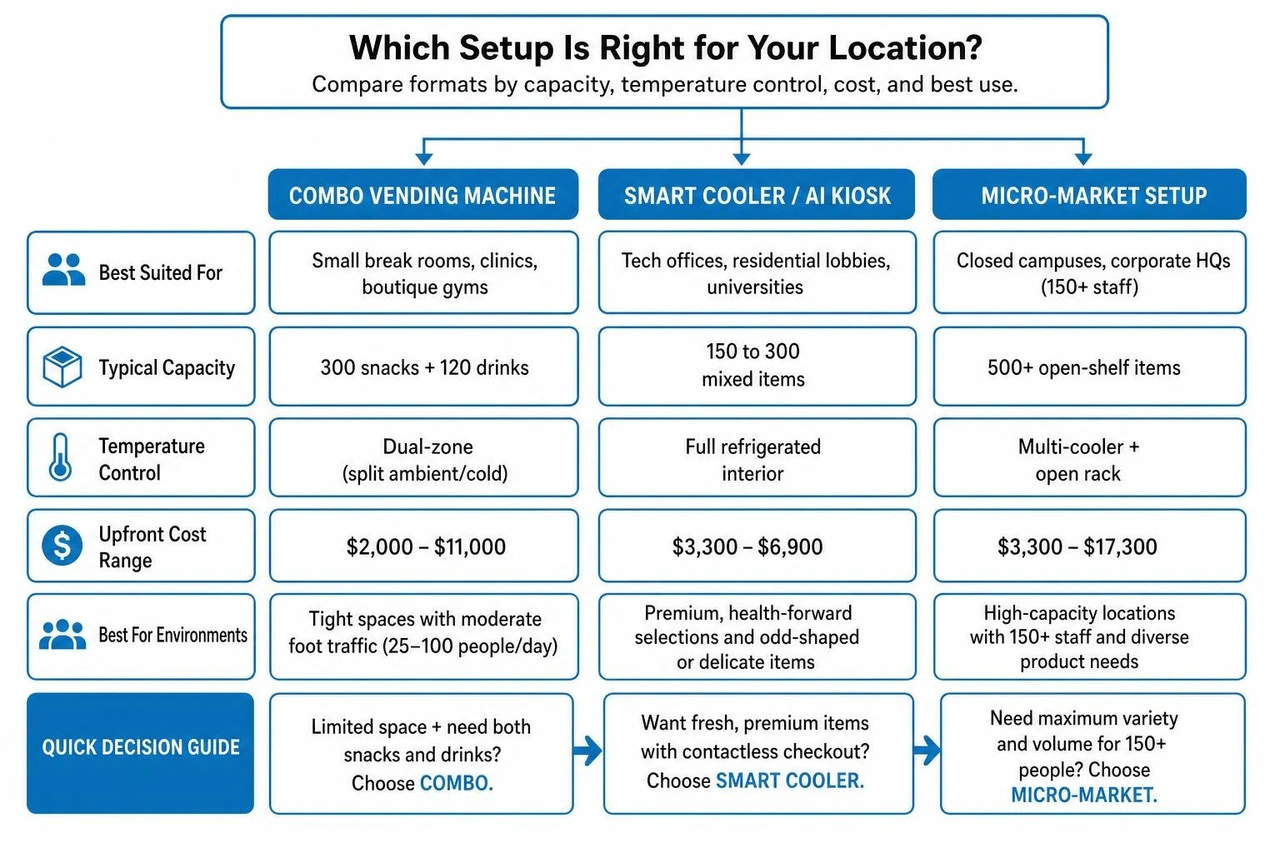
Selecting the right hardware configuration is the most important operational choice you make after securing a site. The vending machine landscape spans traditional ambient snack units, closed-front cold drink dispensers, dual-zone combination units, smart grab-and-go coolers, and full unattended micro-markets.
Understanding how each hardware format aligns with foot traffic volume, user dwell time, and site dimensions ensures you avoid over-investing in excess capacity or under-serving high-demand accounts.
| Machine Format | Best Suited For | Typical Capacity | Temperature Control | Upfront Cost Range |
|---|---|---|---|---|
| Dedicated Snack | Medium-to-large offices, high-dwell wait rooms | 300 to 500 items | Ambient (Non-refrigerated) | $1,300 – $8,000 |
| Dedicated Drink | High-traffic warehouses, transit hubs, gyms | 250 to 500 cans/bottles | Single-zone cold (33°F–38°F) | $1,700 – $8,200 |
| Dual-Zone Combo | Small break rooms, clinics, boutique gyms | 300 snacks + 120 drinks | Dual-zone (split ambient/cold) | $2,000 – $11,000 |
| Smart Cooler / AI Kiosk | Tech offices, residential lobbies, universities | 150 to 300 mixed items | Full refrigerated interior | $3,300 – $6,900 |
| Micro-Market Bundle | Closed campuses, corporate HQs (150+ staff) | 500+ open-shelf items | Multi-cooler + open rack | $3,300 – $17,300 |
Choosing the Right Format When You Buy a Vending Machine
For operators launching their first accounts, dedicated single-purpose machines often require substantial floor space and high foot traffic to justify their footprint. A dedicated 4-wide ambient snack machine delivers between 32 and 40 unique selections across adjustable helix coils, while a dedicated closed-front cold drink machine holds stacks of cans and bottles. When deployed side-by-side, these units demand wide footprints, twin electrical outlets, and high product turnover.
When square footage is tight or foot traffic ranges between 25 and 100 people per day, dual-temperature combination units are the standard recommendation. These machines feature an upper ambient section for chips, pastries, and candy bars, paired with a lower refrigerated compartment engineered to hold canned sodas, bottled waters, and energy drinks at food-safe temperatures.
Exploring high-capacity combo vending machines for sale helps you evaluate units like the USI Wittern Mercato 3573 Combo Vending Machine, which features 36 selections and holds roughly 300 snacks alongside 120 cold drinks. Similarly, the USI Alpine Combi 3000 Combo Vending Machine and the Jofemar V4 Combo Vending Machine deliver flexible dual-zone shelving without requiring multiple wall drops.
If your location already provides chilled beverages through an onsite fountain or cafeteria, a dedicated ambient unit such as the National 158 Snack Vending Machine provides 32 snack selections across 6 shelves using dual-helix motors that prevent product hang-ups.
Smart Coolers, AI Kiosks, and Micro-Market Solutions
Modern unattended retail extends beyond traditional spiral coil vendors. Smart coolers and AI-powered kiosks utilize computer vision cameras and weight-sensing shelves to track customer interaction in real time. Customers tap their payment card or digital wallet to unlock the glass door, select fresh salads, artisan sandwiches, glass-bottled juices, or snacks, and walk away. The internal sensor array registers what was removed and charges the card automatically upon door closure.
Units such as the Haha Mini 360, Haha Plus 440, Haha Pro 542, and Haha Ultra 1200 allow operators to stock premium, odd-shaped, or delicate items that cannot pass through traditional drop-chutes or spiral coils. For frozen novelties and premium meals, the Haha Freezer 550 provides smart refrigeration down to sub-zero temperatures.
For high-capacity environments requiring expanded merchandising, multi-door setups like the Qingo Pair 1208, Qingo Ace 779, and Qingo King 509 deliver open-shelf presentation while keeping inventory locked behind pre-authorized access doors.
New vs. Refurbished Machines: Costs, Warranties, and Financing
Deciding between factory-fresh equipment and professionally reconditioned units depends on your available startup capital, technical familiarity, and placement site expectations. Reviewing a comprehensive vending machine costs guide clarifies the balance between initial purchase expenses and ongoing operational profitability.
| Consideration Factor | Refurbished Vending Machines | New Factory Vending Machines |
|---|---|---|
| Typical Purchase Price | $1,300 – $2,800 | $3,500 – $11,000 |
| Warranty Protection | 90 days to 18 months limited parts | 1 to 5 years manufacturer parts & refrigeration |
| Aesthetic Condition | Cleaned, repainted, minor visual wear | Flawless cabinet, modern LED trim |
| Payment Integration | Standard MDB (may need telemetry updates) | Modern MDB, pre-integrated touchscreens & NFC |
| Energy Consumption | Standard commercial compressor draws | Advanced energy-efficient cooling cycles & LED |
| Best Operational Fit | Route expansion, initial location testing | Class-A lobbies, corporate campuses, long contracts |
Upfront Pricing Breakdown and Warranty Coverage
Refurbished hardware offers an economical route to launch a location without burning reserve capital. A reconditioned ambient snack vendor typically sells between $1,300 and $2,300, while a refurbished refrigerated drink machine ranges from $1,700 to $4,800. Fully tested dual-zone combo machines sit between $2,000 and $2,800. Commercial refurbishing facilities disassemble these units, steam-clean internal delivery chutes, test drop sensors, tune compressor cycles, and replace aging harness wiring.
Refurbished models generally include a 90-day to 18-month limited parts warranty along with lifetime phone technical support. When evaluating used vending machines, ensure the control board supports standard modern peripheral interfaces.
New equipment requires higher upfront investment, ranging from $4,400 to $8,000 for snack units, $5,200 to $8,200 for dedicated beverage machines, and $3,500 to $11,000 for advanced dual-zone combo models. Smart retail coolers and AI kiosks price between $3,300 and $6,900, while extensive micro-market bundles span $3,300 to $17,300. New machines come backed by multi-year factory warranties covering mechanical assemblies and refrigeration decks, modern ADA-compliant keypad elevations, and factory-integrated high-definition displays like those on the Haha Max 620s with Screen.
Equipment Financing and Cash Flow Management
Preserving liquid capital allows operators to absorb initial product purchases, unexpected route vehicle maintenance, and site security deposits. Securing flexible vending machine financing options enables you to place revenue-generating hardware on location before paying off the total purchase balance.
Commercial equipment leases and equipment-backed term loans break a $3,500 to $7,000 purchase into predictable monthly payments spanning 24 to 48 months. If a machine placed in an apartment clubhouse yields $1,800 in gross monthly revenue and costs $140 per month to finance, the machine effectively covers its own debt service while leaving a healthy operational surplus for inventory replenishment and profit distribution.
Essential Hardware, Payment Systems, and Delivery Logistics
Hardware reliability depends on internal communication protocols and standard site utility access. Before arranging freight transit, verify that your machine meets baseline technical standards for connectivity, power access, and consumer ergonomics.
Upgrading Payment Tech When You Buy Vending Machine Models
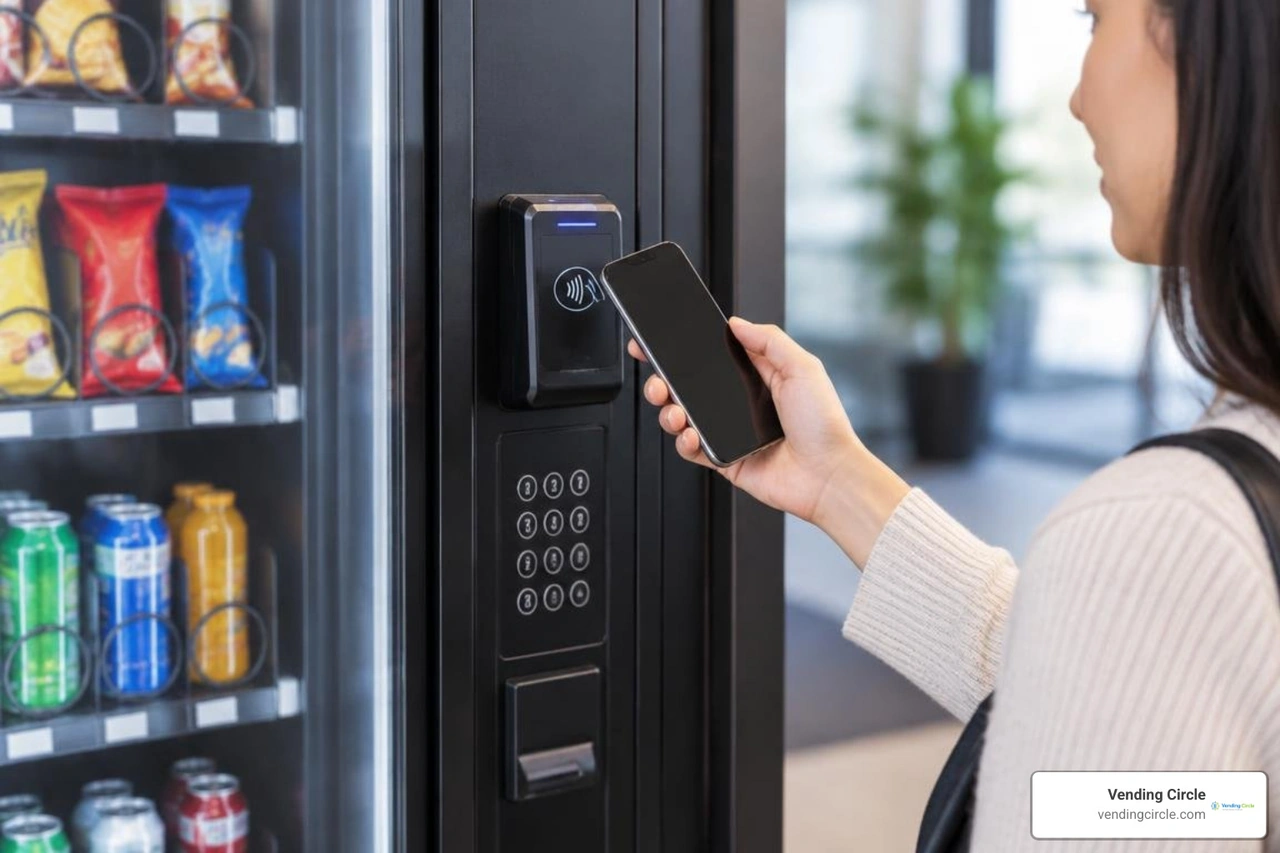
Modern consumers rarely carry cash. Installing or verifying an MDB (Multi-Drop Bus) protocol control board is mandatory for running digital transactions. MDB is the universal standard that allows the central logic board to communicate seamlessly with bill validators, coin changers, and cashless telemetry hardware.
Equipping your vendor with an integrated card reader—such as the Haha Pro 542 Nayax—enables credit cards, debit cards, Apple Pay, Google Pay, and NFC touchless transactions. If your hardware lacks integrated telemetry, adding a card reader to a vending machine captures impulse purchases that cash-only machines lose. Operators frequently document 30% to 50% increases in total sales volume after enabling cashless payment options. Furthermore, integrated telemetry transmits real-time inventory levels to your smartphone, eliminating blind restocking trips.
In public facilities, verify that the physical coin slots, card tap zones, and selection keypads comply with federal ADA Accessibility Standards, ensuring reach ranges sit between 15 and 48 inches from the finished floor surface.
Freight Shipping, Curbside Delivery, and Site Setup
Vending machines are heavy, dense commercial appliances. A standard 4-wide snack vendor weighs roughly 565 lbs, while a fully refrigerated combo unit ranges between 650 lbs and 730 lbs.
When coordinating delivery logistics, confirm the following freight elements:
- Palletized Freight & Liftgate: Freight carriers transport machines upright on heavy wooden pallets. If your placement location lacks a commercial loading dock, book liftgate service so the driver can safely lower the unit to ground level.
- Doorway Clearances: Measure all access doors, hallways, and elevator entries. Standard 4-wide machines measure 32 to 39 inches in cabinet width and require standard 36-inch commercial doorways. Removing the outer styling bezel or front door can gain 1 to 2 inches of clearance if navigating tight turns.
- Power Requirements: Standard vending machines operate on regular 115-volt AC, 60 Hz household circuits, drawing between 3 amps (ambient snack) and 7 to 10 amps (refrigerated cold beverage start-up surges). Avoid using domestic extension cords; plug directly into dedicated, grounded wall outlets.
- Unboxing, Leveling, and Settling: Once rolled into position using an industrial appliance dolly, adjust the threaded leg levelers to ensure the cabinet sits flat. If the machine contains a refrigeration compressor and was tilted during transit, keep it upright and unplugged for 12 to 24 hours before powering on to allow compressor oils to settle into the reservoir.
Location Evaluation, Pitching Strategy, and Revenue Potential
Even the most advanced vending hardware will fail without consistent foot traffic. Machine selection should match the physical environment and customer habits of the target account.
Pitching Business Owners and Qualifying Placement
Securing high-performing spots relies on positioning vending services as an employee amenity rather than a commercial solicitation. Following proven strategies for securing vending machine locations involves identifying sites that demonstrate four core operational traits:
- Dwell-Time Foot Traffic: Foot traffic that pauses or sits generates far more sales than rapid transit traffic. Focus on waiting rooms, shift break areas, and laundry lounges.
- Captive Audiences: Properties with limited nearby commercial dining (e.g., suburban business parks, distribution warehouses, overnight facilities) force staff to stay onsite during short 15-minute breaks.
- Extended Operating Hours: Accounts running second and third shifts, or residential complexes with 24/7 access, allow continuous purchasing cycles.
- Supportive Onsite Management: A property manager who views modern vending as a valuable building perk will grant optimal floor space near main elevators, entrance vestibules, and break areas.
When approaching property decision-makers, review the fundamentals of starting a vending business and present a simple, no-cost amenity agreement that defines your operational schedule, liability insurance coverage, and product lines.
Realistic Monthly Revenue, ROI, and Valuation Multiples
The U.S. retail vending machine industry was valued at roughly $15 billion in 2024, supported by recurring, daily small-dollar purchases across commercial properties. Understanding average earnings by location type helps set accurate return-on-investment timelines:
- Medical Outpatient Facilities: A single dual-zone combo machine in an outpatient waiting room or clinic break area typically generates $1,200 to $1,800 per month in gross sales.
- Multi-Family Residential Properties: A combo vendor or smart cooler placed in a Class-A apartment building with 200+ units often averages over $2,500 per month.
- Multi-Shift Manufacturing & Warehousing: A machine operating across multiple overlapping shifts on a busy plant floor with 150+ workers can reach roughly $5,000 per month.
Well-placed machines often recoup their total upfront capital cost within 6 to 14 months of operation. Furthermore, documenting verified revenue and net operating margins converts individual vending locations into valuable commercial assets. Established vending routes commonly sell for 24 to 30 times monthly net profit on the secondary market.
Frequently Asked Questions About Vending Machine Purchases
What is the most reliable vending machine type for a complete beginner?
A dual-zone combo vending machine is the most reliable format for beginners. It lets you sell snacks and cold drinks from a single footprint, requires only one electrical outlet, and cuts upfront costs compared to buying two separate machines.
How much should I expect to spend on my first machine setup?
A starter setup using a refurbished combo machine generally requires between $2,600 and $3,500. This budget covers the reconditioned unit ($2,000–$2,600), an MDB-compatible cashless card reader ($250–$350), curbside freight delivery ($100–$300), and an initial product stock ($250–$400).
How quickly can a well-placed vending machine pay for itself?
In accounts with steady dwell traffic (such as residential complexes, medical clinics, and industrial plants), a machine earning $1,500 to $2,500 in monthly gross revenue with standard 50% gross margins typically achieves full break-even on hardware expenses within 6 to 12 months.
Conclusion
Succeeding in unattended retail begins with thorough site evaluation, matching hardware capabilities to your customer base, and selecting dependable equipment backed by parts warranties and modern payment infrastructure. Whether launching your first account with a dual-zone combination vendor or scaling a route with AI-driven smart coolers, verifying MDB compatibility, dimensions, and delivery logistics protects your initial capital.
At Vending Circle, our online community and marketplace support operators at every stage of their business journey. Through weekly live Q&A sessions, structured operational courses, discounted procurement pricing, and direct networking with active operators, we provide the real-world strategies needed to scale profitably.
Explore our full catalog of smart and traditional vending machines to find the right hardware for your target accounts, and leverage manufacturer-direct pricing to build your route today.