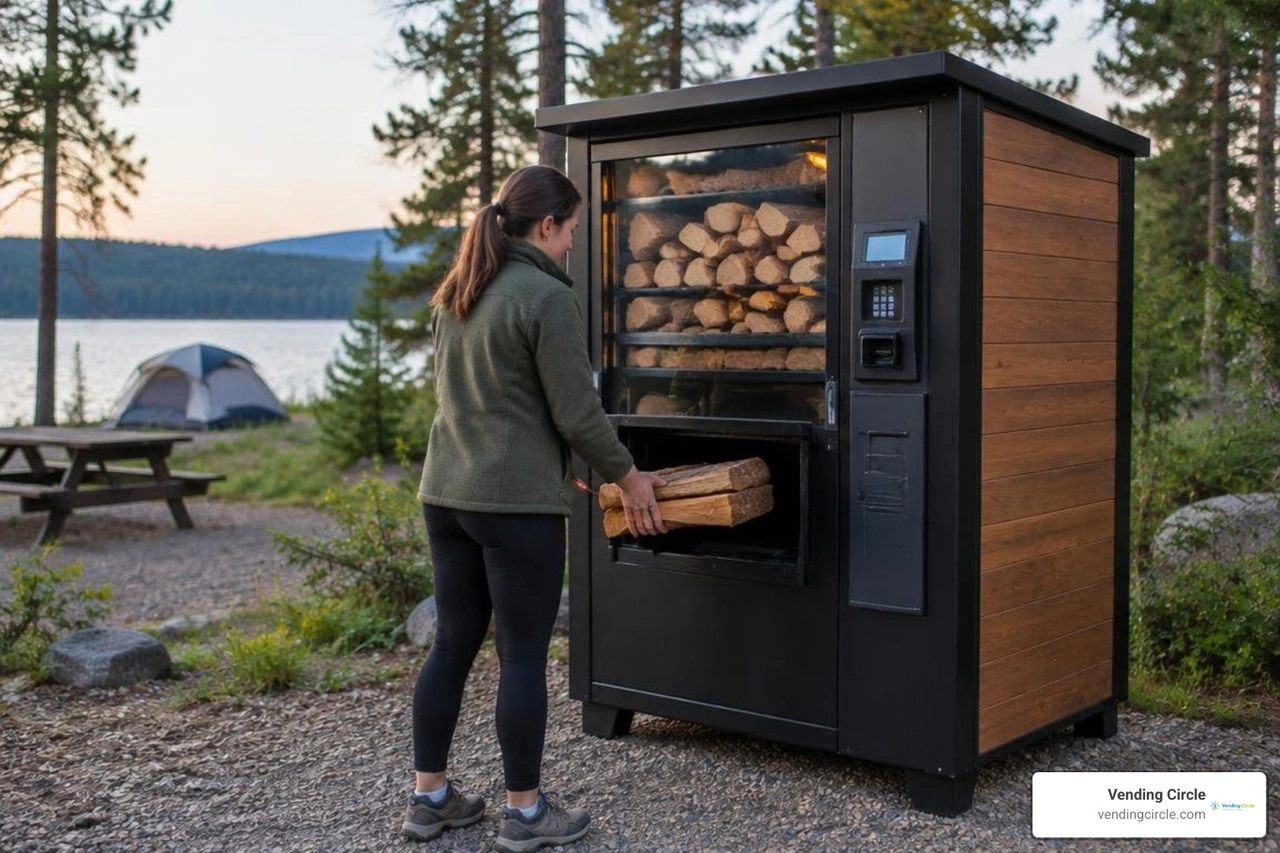
Firewood Vending Machine Cost: What to Budget
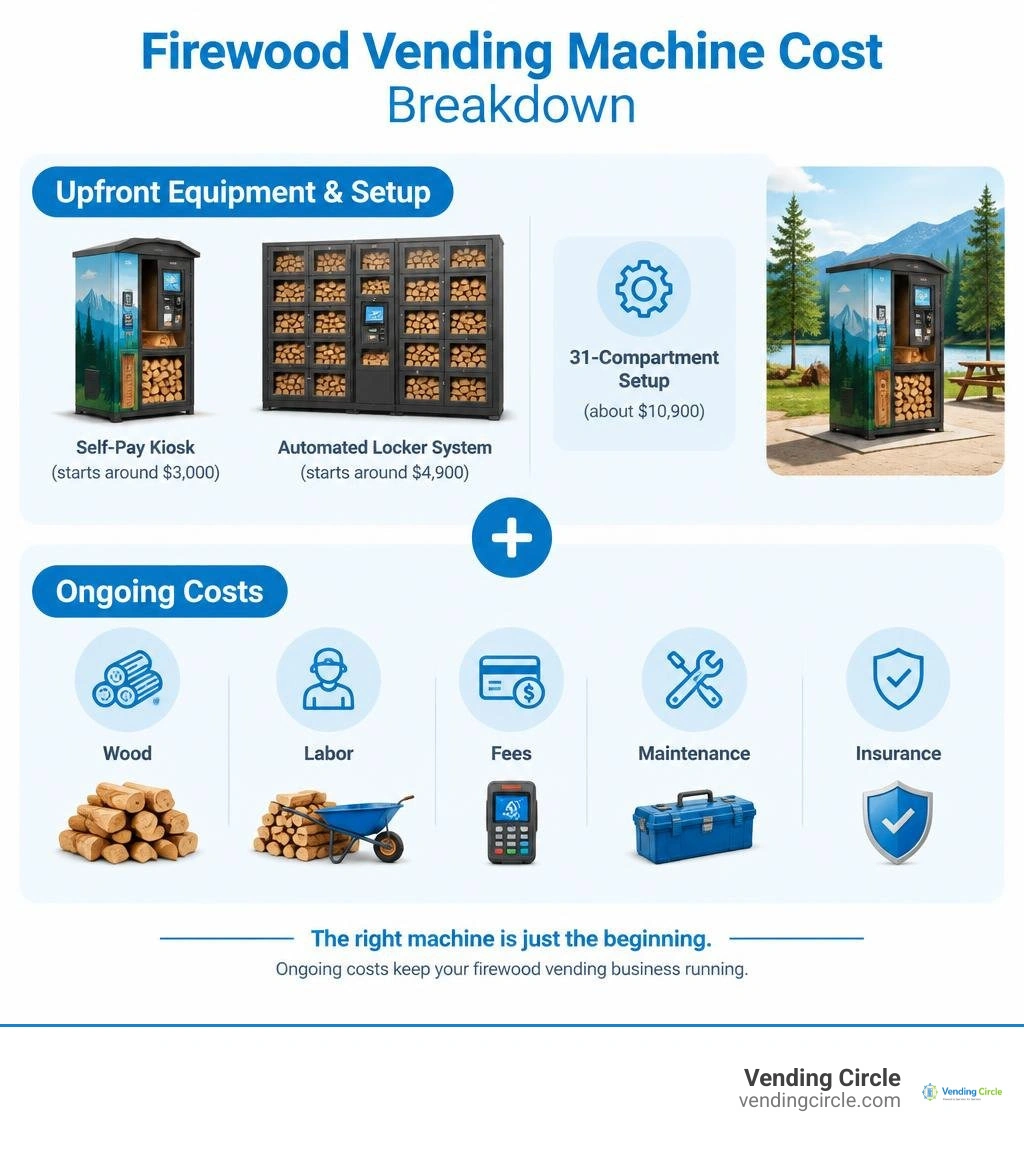
Firewood vending machine cost starts around $3,000 for a self-pay kiosk. Automated locker systems start around $4,900 for a master module; a 31-compartment setup is listed at about $10,900. Those are equipment prices, not the full cost to open. Budget separately for shipping, site setup, wood, restocking, payment fees, maintenance, and insurance.
A lower-priced kiosk takes more trust and oversight. An automated machine costs more upfront but can secure inventory and track sales. The better buy depends on how many bundles your location can sell after those ongoing costs.
I'm Manuel Mojica, founder of Vending Circle and a vending operator. My experience helping operators compare equipment and running costs shapes this guide to firewood vending machine cost.
Related content about firewood vending machine cost:
Firewood Vending Machine Cost Breakdown by Machine Type
When exploring the outdoor automated retail market, we find that firewood equipment broadly divides into two operational categories: open self-pay structures and fully automated, electronically locked compartments. Each approach serves a different operational philosophy, risk tolerance, and capital expenditure budget.
To evaluate overall equipment investment benchmarks across different automated retail sectors, check out our industry standard vending machine pricing guide.
| Machine / Kiosk Type | Upfront Hardware Cost | Capacity Range | Payment Technology | Theft Prevention | Ideal Placement |
|---|---|---|---|---|---|
| Basic Honor-System Kiosk | $3,000 – $4,000 | 20 – 40 Bundles | Cash drop box, Venmo/Zelle QR | Low (Solar camera, open bays) | Private land, manned campgrounds |
| Modular Master Locker | $4,900 – $6,900 | 7 – 15 Compartments | EMV chip, tap-to-pay, 4G POS | High (Individual electronic latches) | Trailheads, rural gas stations |
| Mid-Size Smart Locker System | $8,900 – $10,900 | 23 – 31 Compartments | Cashless touch console + telemetry | High (12-gauge powder-coated steel) | State parks, high-traffic RV resorts |
| Commercial High-Capacity Setup | $14,900 – $18,900 | 47 – 63 Compartments | Multi-door cellular smart hub | High (Heavy-duty solenoid locks) | National parks, lakeside recreation hubs |
Basic Honor-System and Self-Pay Kiosks
Entry-level kiosks establish a physical retail presence with minimal capital outlay, typically starting around $3,000 plus freight. These units arrive as pre-assembled, heavy-duty timber or metal enclosures equipped with solar-powered security cameras, weather-resistant cash deposit drop boxes, and instructional signage displaying peer-to-peer mobile payment QR codes (such as Venmo, Zelle, or Cash App).
While an entry price of $3,000 is approachable for part-time operators, honor-system setups present structural vulnerabilities. Inventory is physically accessible before payment, meaning operator margins depend on consumer honesty. Even with deterrents like app-connected solar security cameras, unattended honor boxes in remote locations routinely experience shrinkage rates ranging from 10% to 30%. These kiosks work best on private property, directly outside attended general stores, or within gated private campgrounds where visitors have verified IDs on file.
Modular Smart Lockers and Automated Firewood Vending Machine Cost
Operators seeking true automation and zero shrinkage invest in modular smart locker systems. In these configurations, each bundle rests behind an independently locked steel door that unlocks only after a successful credit card, debit card, or mobile wallet (Apple Pay, Google Pay) transaction.
The hardware architecture relies on a central hub:
- Master Modules ($4,900): Contain the computerized brain, cellular router, weatherized interactive touchscreen, EMV chip reader, and initial locker bays (typically 7 to 8 compartments).
- Add-On Modules ($2,650 each): Slave units that plug directly into the master module's daisy chain, adding 8 individual locking compartments per tower without requiring extra payment hardware.
A standard commercial configuration with 4 modules (31 total compartments) costs roughly $10,900. Larger setups scale up to 6 modules (47 compartments) for $14,900 or 8 modules (63 compartments) for $18,900.
These smart systems incorporate internal 4G telemetry that transmits live inventory data, notifying you instantly when compartments empty so you can coordinate restocking trips without guessing. For an in-depth breakdown of recurring mechanical and electrical expenses across varied machine categories, consult our comprehensive vending machine operating costs guide.
Ongoing Operational Expenses and Hidden Ownership Costs
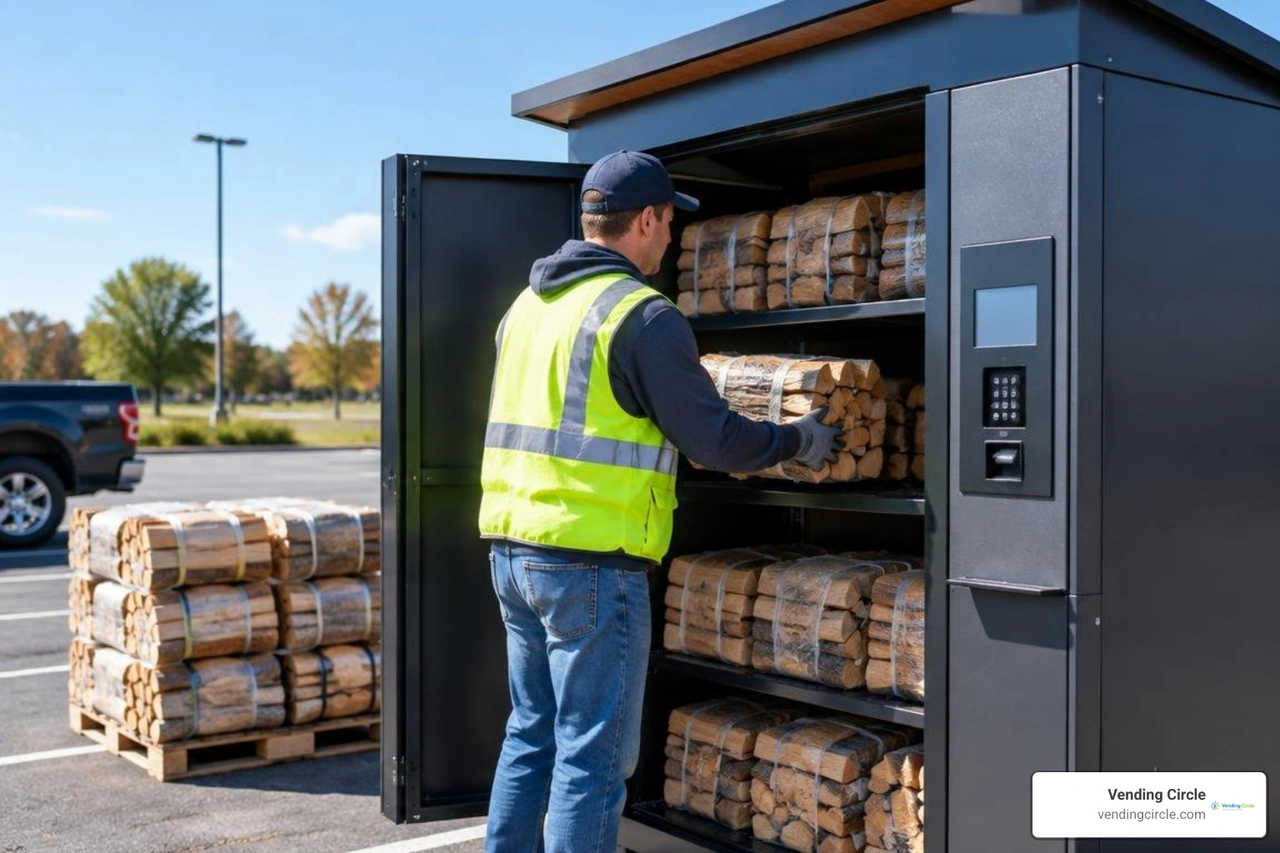
Calculating hardware procurement costs is straightforward, but running a profitable automated firewood operation requires accounting for total cost of ownership (TCO). Unplanned site expenses and recurring administrative overhead can quickly turn a profitable season upside down if not budgeted in advance.
When processing wood in-house, balancing your capital investment between processing machinery and vending equipment is essential. Understanding equipment planning and processing costs helps you maintain steady supply lines without overspending on machinery.
Power and Connectivity Upgrades
Field deployments encounter diverse infrastructural environments, requiring distinct power and telemetry configurations:
- Solar Power Retrofit Kits (~$900): Remote park and trailhead installations lacking grid access require a commercial-grade 12V solar panel array paired with deep-cycle AGM or lithium iron phosphate (LiFePO4) battery banks. These packages reliably run low-draw lock solenoids, cellular modems, and payment readers year-round.
- 110V AC Utility Direct Connections ($200 – $1,200): If placing machines at gas stations, marinas, or established RV resorts, plugging into standard grid power avoids solar battery maintenance. However, trenching conduit or installing a dedicated exterior GFCI breaker on third-party property can add $500 to $1,200 in licensed electrician fees.
- 4G/5G Cellular Data Subscriptions ($20 – $40/month): Telemetry-driven smart lockers require active cellular machine-to-machine (M2M) SIM cards for real-time transaction processing and door actuation.
- Payment Gateway and Processing Fees: Budget 2.5% to 3.5% plus $0.10 to $0.15 per swipe/tap transaction, alongside any cloud platform software access fees ($15 to $35 per month per machine).
Maintenance, Shrinkage, and Legal Compliance
Operating outdoors exposes steel and electronics to rain, snow, ultraviolet radiation, and humidity. Ongoing maintenance budgets must account for:
- Hardware Upkeep: Annual lubrication of heavy-duty stainless door hinges, solenoid pin servicing, and touch-up applications of weather-resistant powder coatings to prevent corrosion.
- Commercial General Liability Insurance ($800 – $1,800/year): Essential protection against public liability claims, fire risks, property damage, and vandalism.
- Weights and Measures Compliance: Under NIST (National Institute of Standards and Technology) Handbook 130, retail firewood sold in packaged bundles must clearly state its volume in cubic feet (or fractional parts of a cord). Selling non-compliant quantities or loosely labeled "face cords" risks civil fines from state agricultural and consumer protection departments.
- Pest Quarantines and Heat-Treatment Rules: Transporting untreated hardwood across regional or state lines violates USDA and state forestry quarantine protocols designed to halt the spread of the emerald ash borer and spongy moth. To stock public recreational park kiosks legally, sourcing USDA-certified heat-treated or certified kiln-dried wood is often mandatory.
Profit Margins and Payback Timelines: Bulk Sales vs. Vending
Traditional bulk firewood delivery involves heavy physical labor: stacking, transporting dump trailers, and unloading full cords for modest profit margins. Moving into automated retail fundamentally changes the economics of wood processing by trading low-margin bulk deliveries for high-margin, point-of-use micro-transactions.
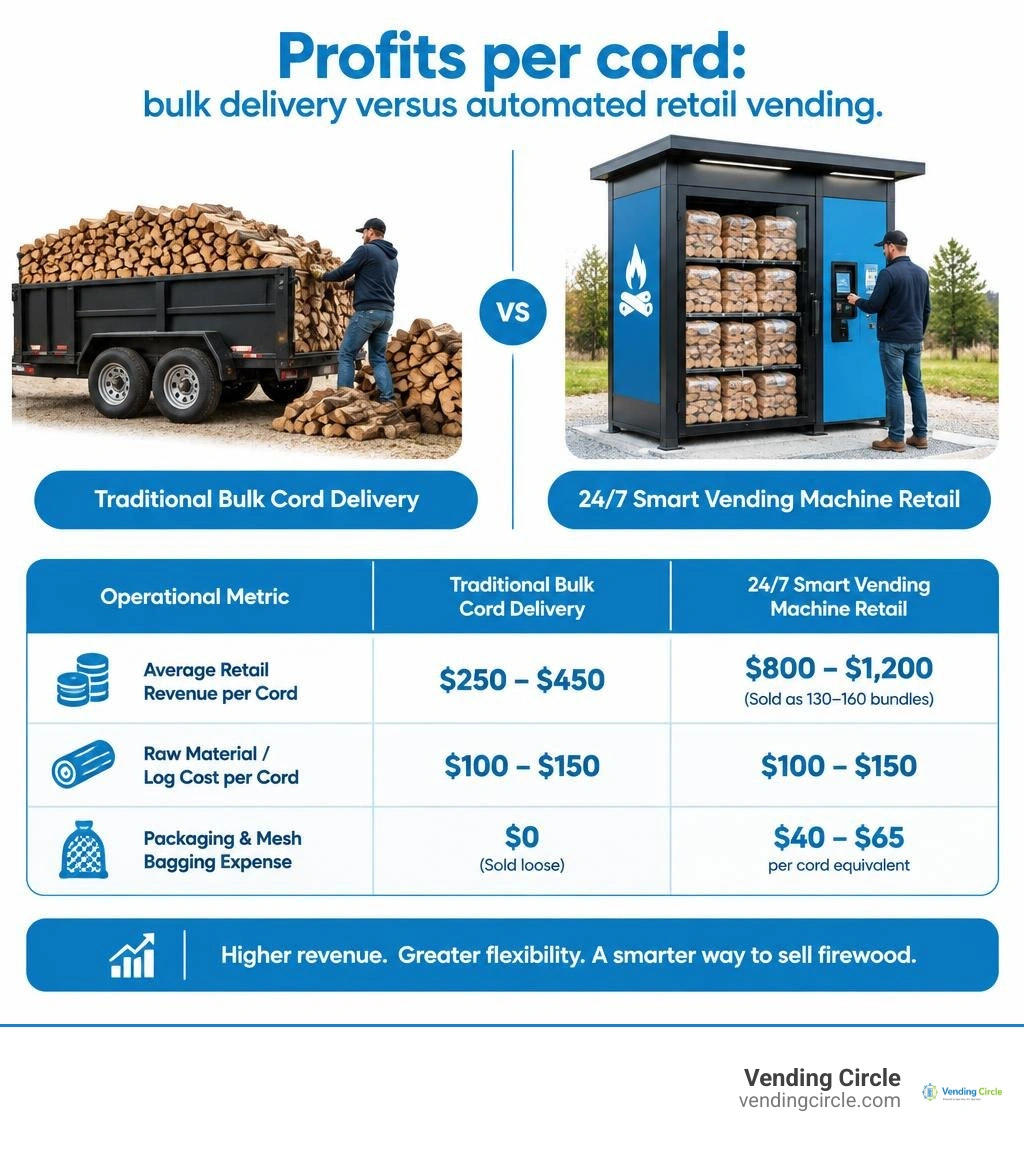
| Operational Metric | Traditional Bulk Cord Delivery | 24/7 Smart Vending Machine Retail |
|---|---|---|
| Average Retail Revenue per Cord | $250 – $450 | $800 – $1,200 (Sold as 130–160 bundles) |
| Raw Material / Log Cost per Cord | $100 – $150 | $100 – $150 |
| Packaging & Mesh Bagging Expense | $0 (Sold loose) | $40 – $65 per cord equivalent |
| Gross Margin per Delivered Cord | $150 – $300 | $650 – $985 |
| Labor Requirement | High (Loading, driving, stacking) | Low (Central restock visits on telemetry alert) |
| Payment Collection | Invoicing / Checks / Cash on arrival | Automated upfront cashless capture |
An association managing park recreation saw that transitioning from labor-intensive manual sales to an automated vending machine allowed them to raise bundle prices from $5 to $7 while eliminating volunteer strain. Their machine paid for itself well ahead of its two-year projection, as detailed in this case study on automated firewood sales revenue.
If you are evaluating this model alongside traditional drink, snack, or specialty setups, review our foundational guide on starting an automated vending business.
Calculating ROI and Break-Even on Your Firewood Vending Machine Cost
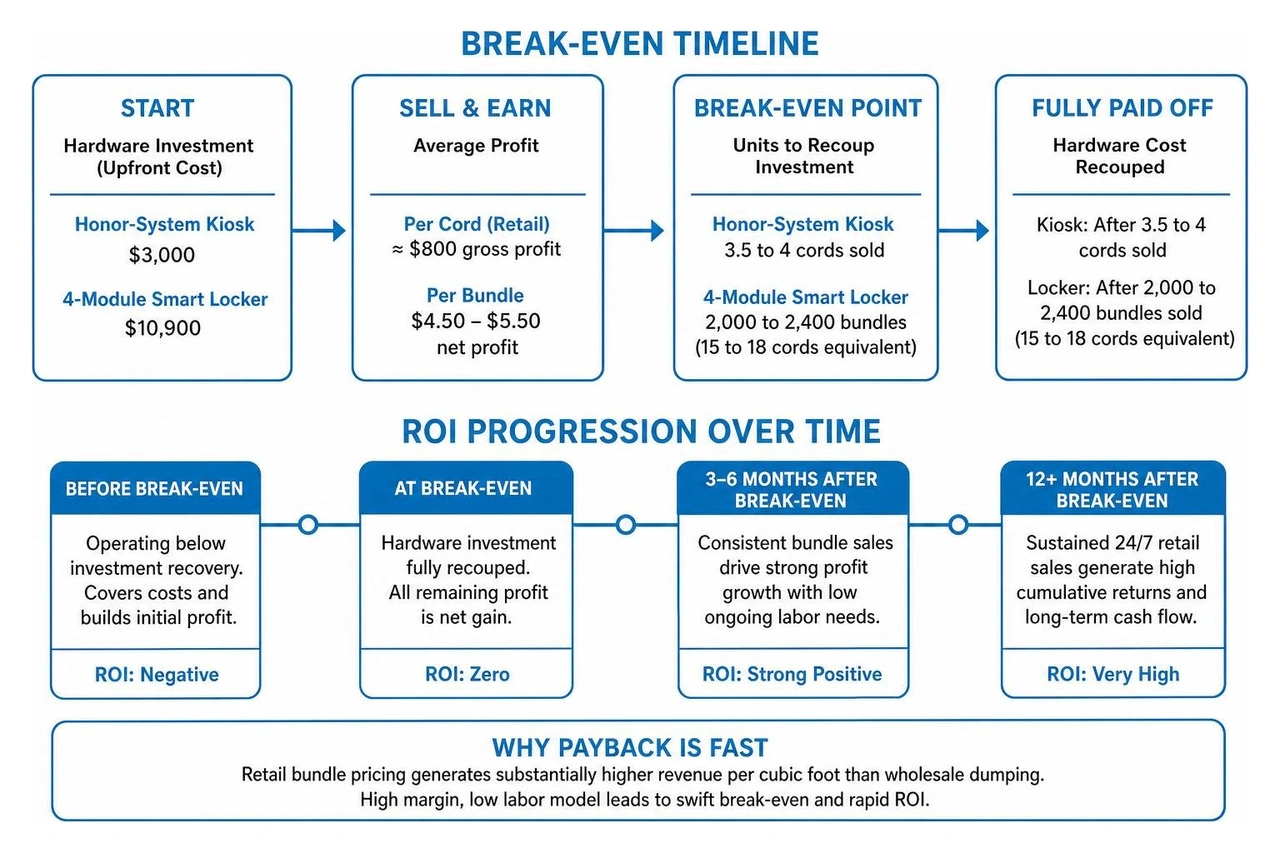
Because retail bundle pricing generates substantially higher revenue per cubic foot than wholesale dumping, payback schedules are swift:
- The Honor-System Kiosk Benchmark: With a hardware cost of $3,000 and gross profit of roughly $800 per cord sold at retail bundle rates, you reach your break-even point after moving just 3.5 to 4 cords of firewood.
- Modular Smart Locker ROI: A 4-module smart locker system costing $10,900 generates an average net profit of $4.50 to $5.50 per bundle after accounting for merchant fees, bagging, and timber costs. Selling 2,000 to 2,400 bundles (approximately 15 to 18 cords equivalent) fully recoups the hardware investment.
In high-volume state parks and busy lakeside campgrounds, operators report 100% ROI in 6 to 18 months. During major holiday stretches like Memorial Day, Labor Day, and Thanksgiving, an automated locker unit can turn over its inventory every 48 hours, yielding $1,500 to $5,000 in gross revenue in a single week.
Strategic Sourcing and Product Diversification
To maximize locker turnover, maintain consistent wood quality. Sourcing locally seasoned hardwoods (such as oak, hickory, maple, or birch) dried to under 20% moisture content ensures smoke-free, easy-lighting campfires that drive positive reviews and word-of-mouth recommendations.
When local county authorities enact seasonal burn bans that prohibit open wood fires, smart operators avoid downtime by swapping locker inventory for charcoal, fire starters, and 16-ounce camping propane bottles. For more operational insights into raw supply pipelines, read about operating margins in the firewood business.
Location Selection and Business Model Comparisons

A vending machine is only as profitable as its foot traffic and vehicle accessibility. Prime placement targets include:
- State, county, and municipal park campgrounds without late-night wood stores
- Private RV resorts and glamping retreats
- Busy 24-hour highway convenience stores and gas stations leading to recreation corridors
- Boat launches, marina staging areas, and lakeside recreation hubs
When negotiating placement, operators generally choose between two operational models:
- Outright Purchase & Retained Revenue: You buy the hardware, assume full restocking and maintenance responsibility, and pay the site host a fixed monthly pad lease ($50 to $150 per month) or a flat utility fee. You keep all remaining net profits.
- Gross Revenue Sharing (Partnership Model): You place your machine on-site at zero capital cost to the landowner (such as a state park system or private campground) and provide an automated monthly commission—typically 10% to 15% of gross sales—in exchange for pad space and electricity.
If upfront equipment capital is tight, exploring vending equipment financing and leasing options can help you acquire commercial locker hardware while preserving cash reserves for timber inventory and transport trailers.
Frequently Asked Questions About Firewood Vending Machines
How many cords of wood must be sold to recoup the machine investment?
For a standard $3,000 self-pay kiosk, you only need to sell approximately 3.5 to 4 cords of wood (packaged into bundles) to recoup your hardware purchase. For a high-tech modular locker system priced around $10,900, break-even is typically achieved after selling 15 to 18 cords (roughly 2,000 to 2,400 individual bundles).
Can firewood vending machines operate effectively during burn bans?
Yes. During regional or municipal open-flame burn bans, automated lockers can be restocked with approved cooking fuels—such as bagged lump charcoal, briquettes, and single-use propane canisters—keeping revenue flowing while competitors shut down.
Is solar power sufficient to run outdoor firewood vending lockers year-round?
Yes, provided the solar package matches the system draw. A standard 100W to 150W commercial solar panel paired with a 100Ah deep-cycle battery easily sustains low-power 4G telemetry modems, card readers, and momentary 12V pulse-lock solenoids through extended periods of overcast winter weather.
Conclusion
Automated firewood vending bridges the gap between customer convenience and unattended retail profitability. By packaging split cordwood into retail bundles sold through secure, cloud-connected lockers, operators can earn $800 to $1,200 per cord while serving outdoor enthusiasts around the clock.
Ready to scale your automated retail operations with direct supplier access, actionable blueprints, and weekly expert support? Join our peer-led community at Vending Circle and browse our extensive library of vending guides and industry resources to launch your outdoor vending enterprise with confidence.