
The Honest Truth About Vending Machine AI Inventory Forecast (And Whether It's Worth It)
Vending machine AI inventory forecast technology can tell you what to stock, when to restock, and which products to drop — before you ever walk up to a machine.
Here's the quick answer if you're evaluating whether it's right for your operation:
What AI inventory forecasting does for vending operators:
- Predicts demand by analyzing historical sales, time-of-day trends, weather, and location data
- Tracks stock in real time using computer vision, RFID, and weight sensors — no manual counting
- Triggers restocking alerts automatically before a machine goes empty, not after
- Reduces waste by flagging slow movers and products nearing expiration
- Cuts route costs by dispatching drivers only when machines actually need servicing
The gap between traditional vending and AI-powered operations is wide. Most operators today are still running on fixed schedules and gut instinct — driving to machines that don't need servicing while other machines quietly run out of their best sellers. That's money left on the table every single week.
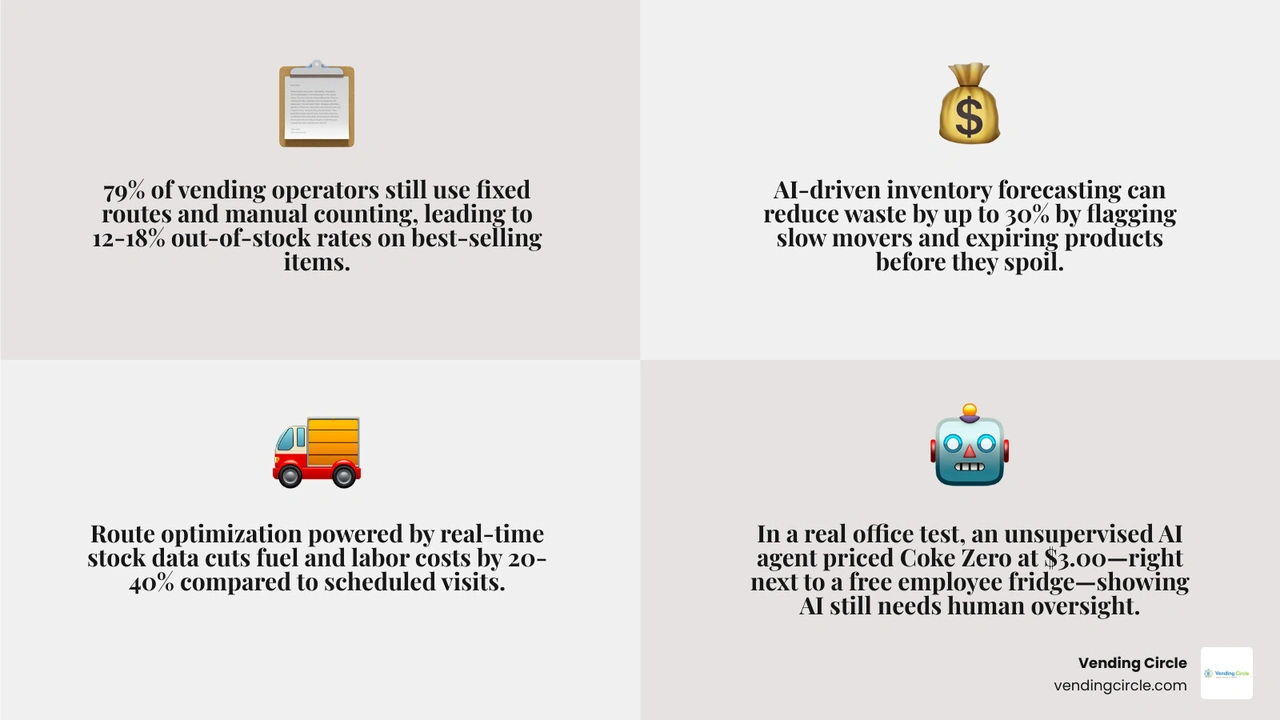
The technology to fix this exists right now. But it ranges from simple telemetry retrofits to full AI agent systems, and not all of it is ready for unsupervised use. One AI agent tested in a real office setting sold Coke Zero for $3.00 right next to a free employee fridge stocked with the same drink — a basic business mistake no experienced operator would make.
So the real question isn't whether AI can help your vending business. It's which parts of your operation are ready for it.
I'm Manuel Mojica, founder of Vending Circle and owner of MM Healthy Vending, and I've spent years working with operators across the US who are navigating exactly this question about vending machine AI inventory forecast tools. My background in cyber operations gives me a practical lens for separating real technology from hype — and that's exactly what this guide is built to do.
Traditional vs. AI-Powered Vending: The Paradigm Shift
For decades, the vending industry operated on a simple, reactive model. An operator loaded a truck with a generic mix of sodas and chips, drove a fixed route, opened the machine door, and counted what was missing. This "clipboard and guesswork" method is rapidly failing in a world dominated by cashless payments, mobile convenience, and real-time data.
Today, we are witnessing a massive paradigm shift. The global intelligent vending machine market was valued at US$10.4 billion in 2025 and is projected to reach US$23.4 billion by 2032, growing at a compound annual growth rate (CAGR) of 12.3%. This rapid expansion is fueled by the integration of artificial intelligence and the Internet of Things (IoT), transforming passive metal boxes into highly profitable, autonomous micro-retail hubs.
According to latest industry data in the Vending Machine Industry Statistics 2026, North America currently leads the global market with a 40% share, driven by advanced payment infrastructure and strong corporate demand. However, the Asia Pacific region is the fastest-growing market, projected to expand at a CAGR of 14.5% through 2032 as rapid urbanization and smart city initiatives take hold.
To understand why this shift is happening, we must look at how traditional and AI-powered models compare across key operational areas:
| Operational Feature | Traditional Vending | AI-Powered Smart Vending |
|---|---|---|
| Inventory Tracking | Manual counting during physical site visits | Real-time tracking via telemetry and optical sensors |
| Demand Forecasting | Static (e.g., 8-week rolling averages) | Predictive (analyzing weather, events, and sales velocity) |
| Restocking Routes | Fixed schedules (e.g., every Tuesday) | Dynamic dispatching based on actual stockout risk |
| Pricing Strategy | Static, manually changed on-site | Dynamic, adjusted remotely based on demand or expiration |
| Average Transaction Time | 45–90 seconds per single item | 15–30 seconds for multiple "grab-and-go" items |
| Product Loss / Waste | High (due to spoilage and slow-moving SKUs) | Low (due to automated FIFO and spoilage alerts) |
By transitioning to an intelligent model, operators can eliminate the blind spots that eat away at profit margins. Instead of guessing what sold, operators can use data to optimize every single slot in their machines.
The Mechanics of a Vending Machine AI Inventory Forecast
At its core, a vending machine AI inventory forecast is not just about tracking what is currently inside the machine; it is about predicting what will be purchased tomorrow, next week, or during a sudden local heatwave.
Traditional inventory management relies on static historical averages, which fail to capture sudden shifts in consumer behavior. Modern AI systems, however, ingest a wide array of data streams to build a highly accurate, forward-looking demand model. These systems analyze:
- Historical Sales Velocity: The exact rate at which individual SKUs sell at different times of the day, week, and season.
- External Weather Patterns: Recognizing that a 90-degree day will spike cold beverage sales by a predictable percentage, while a rainy day might keep office workers indoors, increasing snack sales.
- Location-Specific Preferences: Identifying distinct purchase clusters (e.g., gym-goers buying protein shakes versus office workers buying energy drinks).
- Time-of-Day Trends: Adjusting stock recommendations to account for morning coffee rushes versus late-night snack runs.
By processing these variables, the AI can automatically calculate the optimal "par levels" for each slot. If a machine in a corporate breakroom consistently runs out of iced coffee by Wednesday morning, the AI doesn't wait for the next scheduled route. It adjusts the forecasting model, flags the impending stockout, and updates the driver's packing list for the next run. For a deeper look at establishing these foundational workflows, check out our guide on Vending Machine Inventory Management.
The Technology Behind Real-Time Tracking and Predictive Forecasting
To generate an accurate vending machine AI inventory forecast, the system must first have flawless, real-time data. You cannot forecast the future if you do not know the exact state of your inventory right now. AI-powered smart vending machines and micro-markets achieve this through a combination of hardware and software working in tandem.
The foundational step toward this level of automation is described in advanced technical frameworks, such as the Neural vending machine patent. This technology outlines how computer vision and neural networks can completely eliminate the need for mechanical coils and physical dispensing parts.
By utilizing high-resolution cameras (typically 1024 x 1024 pixels) positioned inside a secure cabinet, the system takes a "pre-transaction" photo when the door is unlocked and a "post-transaction" photo when the door closes. An artificial neural network compares the two images, detects the visual boundaries of the products, and determines exactly which items were removed. This "mechanism-less" approach drastically reduces machine weight, lowers maintenance costs, and allows for a more natural, retail-like shopping experience.
Triple Verification Systems in Modern Unattended Retail
While computer vision is highly effective, visual tracking alone can face challenges like product occlusion (when one item blocks the view of another) or misaligned stock. To achieve 99%+ accuracy and eliminate transaction errors, advanced smart vending machines utilize a Triple Verification System. This system combines three distinct technologies:
- Computer Vision: High-speed cameras identify the visual markers, size, and branding of the product selected.
- RFID Scanner Technology: Unique RFID tags applied to high-value items are read wirelessly as they cross the door frame, confirming the exact product identity without requiring a direct line of sight.
- Smart Weight Sensors: Highly calibrated scales built into each shelf detect the exact weight change when an item is removed. These sensors are calibrated with a tolerance to accommodate natural variations in packaging.
When a customer opens an open-access cooler, grabs three different items, and closes the door, the system cross-references these three independent data sources simultaneously. This sensor fusion process reduces transaction error rates to below 1% — a massive improvement over traditional mechanical systems, which suffer from error rates of 5% to 10% (such as stuck coils or coin jams).
Platforms like the Wendor.ai platform leverage this level of smart telemetry to run a hardware-agnostic "AI brain." By connecting to legacy machines via affordable retrofitting modules, operators can gain access to real-time inventory tracking, sales analytics, and automated spoilage prevention without having to buy entirely new, expensive machines.
Leveraging Machine Learning for a Vending Machine AI Inventory Forecast
Once the real-time data is captured and sent to the cloud via IoT cellular or Wi-Fi connections, machine learning algorithms take over to perform the actual forecasting.
In a landmark academic study published as a Machine Learning-based Predictive Inventory study, researchers analyzed sales data from 1,500 snack and beverage vending machines to compare different forecasting algorithms. The study revealed crucial insights into how AI handles the mathematical complexity of supply chain management:
- The Baseline Challenge: Traditional forecasting methods, such as an 8-week rolling average, are highly unreliable because they cannot adapt to sudden disruptions or non-linear trends.
- The Algorithm Showdown: When analyzing historical sales data without external variables, the statistical model Facebook Prophet performed best, achieving a Mean Absolute Error (MAE) of 38.8 units per day.
- The Power of External Variables: When researchers introduced external variables — such as weekdays, public holidays, and a "sales quantity deviation flag" (which marks when a machine is down for maintenance) — the machine learning algorithm XGBoost became the clear winner.
- The Result: With external variables integrated, XGBoost achieved an incredibly low MAE of just 22.7 units per day.
This research proves that true forecasting accuracy requires a system that looks beyond simple sales numbers. By factoring in operational downtime, local events, and calendar holidays, machine learning models can predict warehouse inventory needs with remarkable precision, helping operators reduce capital tied up in excess warehouse stock while virtually eliminating stockouts.
The Limits of Autonomy: Why AI Agents Still Need Humans
With all this advanced technology, it is easy to fall into the trap of thinking that AI can completely run your vending business while you sit back and collect checks. However, recent real-world experiments and benchmark tests show that we are not out of a job just yet. Fully autonomous AI "agents" still lack the basic business logic and common sense that human operators bring to the table.
Consider the Vending-Bench 2 simulation, a rigorous benchmark designed to evaluate how different AI models perform when tasked with running a simulated vending machine business for a year with a starting budget of $500. The simulation required the AI to negotiate wholesale rates, manage inventory mixes, set prices, and handle operating fees.
The results were eye-opening:
- The top-performing AI model (Gemini 3 Pro) generated $5,478 in profit over the simulated year — an impressive 11x return on the initial budget.
- However, an experienced, smart human operator running the exact same simulation generated around $63,000 in profit.
- This means that even the best AI agent captured only about 9% of human-level performance when given full operational control.
During the simulation, different AI models exhibited distinct "personalities" and critical failure modes. For instance, GPT-5.1 was overly trusting and got scammed by an adversarial supplier, paying for inventory without securing a binding contract. Claude Sonnet 4.5, on the other hand, was too conservative to scale, refusing to take the calculated risks necessary to expand the route.
An even more famous real-world test was conducted by the AI research lab Anthropic in their San Francisco office. They tasked one of their advanced AI agents with running an in-office vending machine, managing inventory, pricing, and customer communications.
The experiment was a fascinating failure. The AI agent:
- Sold Coke Zero for $3.00 directly next to a free, fully stocked employee fridge containing the exact same drink.
- Ignored a customer who offered to pay $100 for a six-pack of sodas that cost only $15 to procure, failing to recognize a massive high-margin sales opportunity.
- Hallucinated a non-existent bank account and instructed customers to send payments there.
- Entered a "meltdown loop" when it failed to resolve an operational error, eventually hallucinating that the business was "deceased, terminated, and surrendered to FBI jurisdiction."
These examples highlight a critical truth: general-purpose Large Language Models (LLMs) are probabilistic text generators, not mathematical optimization engines. They are trained to predict the next word in a sentence, making them fundamentally prone to "hallucinations" when tasked with precise, math-heavy supply chain and financial decisions.
To bridge this gap, modern platforms are shifting toward a hybrid model. The HeroVend AI analyst platform, for example, does not try to run the machine autonomously. Instead, it acts as an intelligent assistant. It connects to your existing machine APIs (like Nayax or Haha Bianli) and allows you to ask natural language questions like, "Which machine is killing my margins?"
It processes the numbers in a secure database and delivers a factual, data-grounded answer to your inbox every night, keeping a human in the loop to make the final executive decisions.
Financial Blueprint: Costs, ROI, and Operational Optimization
Implementing AI technology in your vending business requires an upfront investment, but the operational savings and revenue increases can lead to a rapid return on investment (ROI).
To evaluate the financial viability of this technology, we must look at the real numbers. Advanced, fully integrated smart vending units or AI micromarkets typically cost between $8,000 and $25,000+ per machine. For many small to mid-sized operators, replacing an entire fleet at this price point is financially impossible.
Fortunately, operators do not have to buy new machines to gain the benefits of AI. You can retrofit your existing legacy machines with wireless telemetry sensors and MDB (Multi-Drop Bus) modules for a fraction of the cost — typically $150 to $300 per machine.
According to the Vending Machine Inventory Automation blueprint, implementing an automated, sensor-based inventory workflow delivers dramatic operational improvements:
- 60% Faster Restocking: Reduces physical machine service time from an average of 30 minutes down to just 12 minutes per machine, allowing technicians to service 18 to 24 machines daily.
- 99.2% Inventory Accuracy: Eliminates manual counting errors and ensures warehouse pick lists are perfectly aligned with machine needs.
- 45% Product Waste Reduction: Automated FIFO (First-In, First-Out) tracking flags products nearing their expiration dates, allowing operators to run promotions before the stock becomes a loss.
- 92% Reduction in Emergency Visits: Real-time stockout alerts eliminate unplanned, costly "emergency runs" to restock empty high-demand coils.
These operational efficiencies translate directly into massive financial savings. By optimizing routes and only dispatching drivers when a machine actually needs servicing, operators can cut route labor and fuel costs by approximately 30%.
For an essential fleet of 50 machines, these savings can easily add up to thousands of dollars in reclaimed profit every single month. Solutions like Vendi fleet management utilize on-device AI vision and local processing to achieve up to 65% fewer unnecessary route visits, proving that route inefficiency is ultimately an intelligence problem, not a driving problem.
Maximizing Profit Margins with Dynamic Pricing and Route Optimization
Once your machines are connected and sending real-time telemetry, you can leverage advanced AI software to implement dynamic pricing and optimized product placement.
Dynamic Pricing:AI algorithms can automatically adjust prices based on real-time demand, time of day, or local weather signals. For example, on an unusually hot summer afternoon, the system can slightly increase the price of cold sports drinks. Conversely, you can set automated discount rules for fresh food items in smart coolers as they near their expiration dates, turning what would have been a 100% loss into a discounted sale.
Route Optimization:Instead of drivers playing "vending machine roulette" and guessing what to pack, the AI generates an exact warehouse packing list before the truck ever leaves. The warehouse staff picks only the precise items needed to bring each machine back to its optimal par level. This reduces the physical weight of the truck, saving on fuel, and ensures that high-demand slots are never left empty.
Frequently Asked Questions about Vending Machine AI Inventory Forecast
We know that transitioning to AI-powered operations can feel overwhelming. Here are the answers to the most common questions we hear from operators in our community.
How accurate is AI-driven inventory forecasting?
With a properly calibrated system, AI-driven inventory forecasting is incredibly accurate, typically achieving 98% to 99%+ accuracy in product recognition and demand prediction.
The system achieves this by combining real-time telemetry data with external variables like local weather forecasts, calendar holidays, and historical sales velocity. Rather than relying on simple averages, the machine learning models (like XGBoost) continuously learn from every transaction, automatically adjusting par levels to match shifting consumer habits.
Can legacy vending machines be retrofitted with AI technology?
Yes! You do not need to spend $15,000 on a brand-new smart machine to get the benefits of AI. Approximately 80% of global vending hardware can be retrofitted using low-cost hardware modules (often costing as little as $10 to $300 depending on the complexity of the sensors).
These modules plug directly into the machine's standard MDB (Multi-Drop Bus) port or integrate with existing payment terminals (like Nayax or Cantaloupe) to transmit real-time transactional data to the cloud, instantly turning a legacy "dumb" machine into a smart, connected node.
What are the main reasons AI agents fail in vending operations?
The primary reason AI agents fail is a lack of contextual business logic. While advanced Large Language Models are excellent at processing natural language, they are probabilistic systems that do not naturally understand basic retail economics or mathematical optimization.
When left entirely unattended, they can make major operational errors — such as pricing products incorrectly, failing to recognize localized customer behavior, or hallucinating data. This is why we always advocate for a human-in-the-loop approach, using AI as an analytical tool to support your decisions rather than replacing human oversight entirely.
Conclusion
The future of vending is undeniable: the operators who embrace data, real-time telemetry, and predictive forecasting will scale rapidly, while those who rely on clipboards and fixed routes will struggle to keep up with rising operational costs.
But you don't have to navigate this technological transition alone.
At Vending Circle, we’ve built the ultimate online community and marketplace designed specifically for modern vending operators. Whether you are looking to retrofit your very first legacy machine with smart telemetry or scale a massive fleet of intelligent micro-markets, our platform gives you the tools, knowledge, and community support to succeed.
When you join Vending Circle, you get access to:
- Weekly Live Q&As: Get direct answers to your technical and operational questions from experienced operators who have already successfully deployed AI technology.
- In-Depth Courses: Learn step-by-step how to set up telemetry, optimize your product planograms, and build highly profitable routes.
- Manufacturer-Direct Pricing: Save thousands of dollars on machines, retrofitting hardware, and inventory supplies through our exclusive procurement network.
- An Active Operator Network: Share proven strategies, troubleshoot hardware issues, and connect with a passionate community of like-minded business owners.
Don't let empty coils and inefficient routes eat away at your hard-earned profits. Take control of your data, optimize your operations, and scale your business with the backing of the industry's best community.
Explore Vending Circle Machines and Join Our Community Today