The Best Places to Place Vending Machines Start With Demand
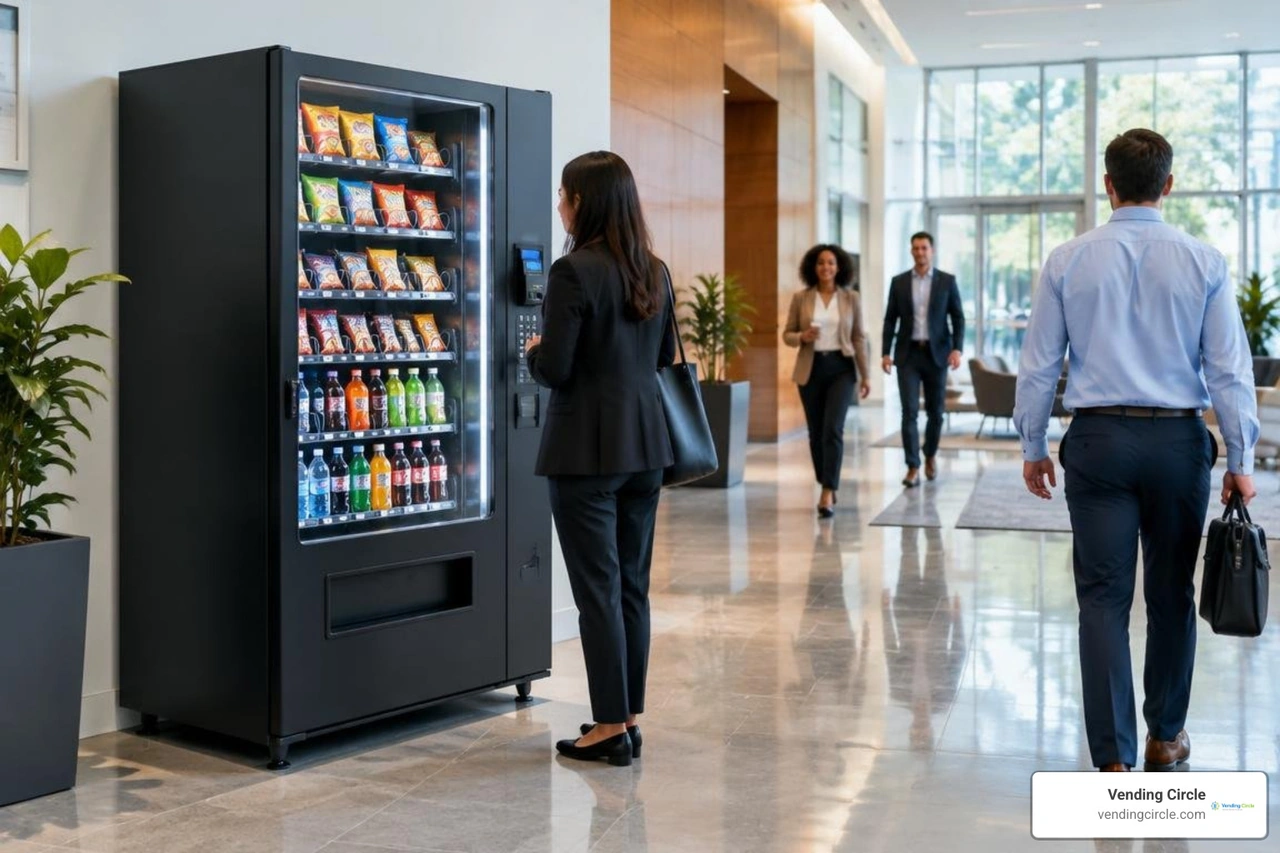
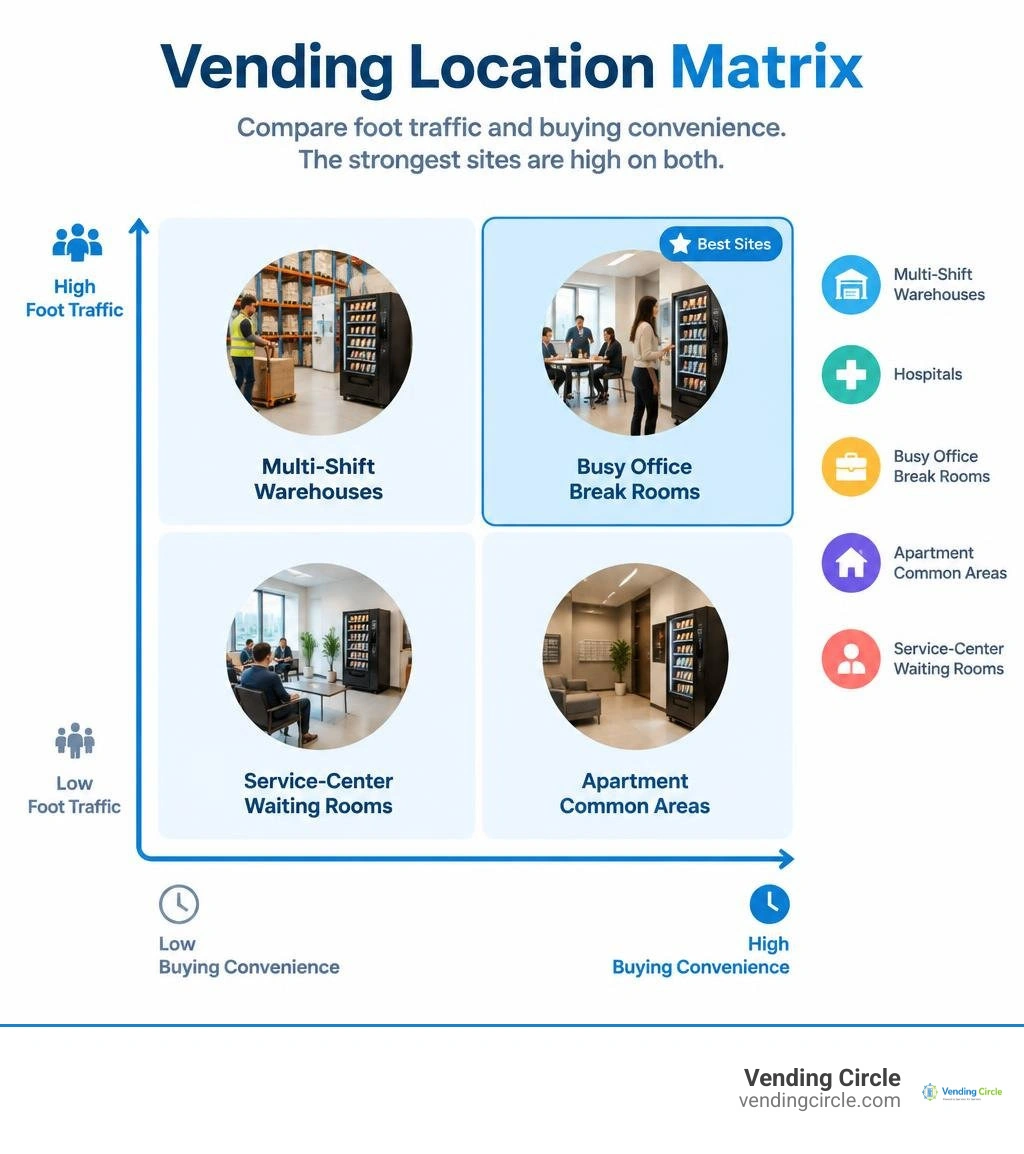
The best places to place vending machines are multi-shift warehouses, hospitals, busy office break rooms, apartment common areas, and service-center waiting rooms. Look for people who pass the machine often, have time to stop, and have few nearby options. A busy building alone is not enough: the machine needs to be visible and easy to reach.
Start with sites you can serve on your existing route. Check traffic at different times, including shift changes and evenings, before you commit. A spot that sells well but takes too long to restock may not be your most profitable one.
I'm Manuel Mojica, founder of Vending Circle and owner of MM Healthy Vending. My experience running a vending business and working with operators shapes how I assess the best places to place vending machines.
Handy best places to place vending machines terms:
- finding a location for a vending machine
- places looking for vending machines
- free places to put a vending machine
The vending industry in the United States reached an economic footprint of $40.04 billion by mid-2025, expanding by 30% over a two-year stretch as automated retail and smart hardware gained ground across commercial spaces. Globally, automated retail surpassed $51 billion, proving that automated convenience is more valuable than ever. Yet behind these macro numbers lies an unvarnished operational reality: a vending machine in an underperforming spot will struggle to make $100 a month, while that identical machine placed in a high-demand venue can clear $1,500 to $3,000 in monthly net profit.
Equipment, card readers, and eye-catching lighting matter, but location is the engine of your balance sheet. A well-placed machine generates two to three times more revenue than a poorly situated unit. When we evaluate prospective accounts across our network, we look beyond surface-level excitement and analyze the underlying fundamentals that transform ordinary floor space into reliable, passive revenue.
Core Factors That Determine Vending Location Profitability
Scouting profitable accounts requires looking past general impressions and evaluating how consumers interact with their physical environment. Before committing capital or moving heavy equipment, evaluating prospective vending machine locations against structural viability criteria helps protect operational cash flow.
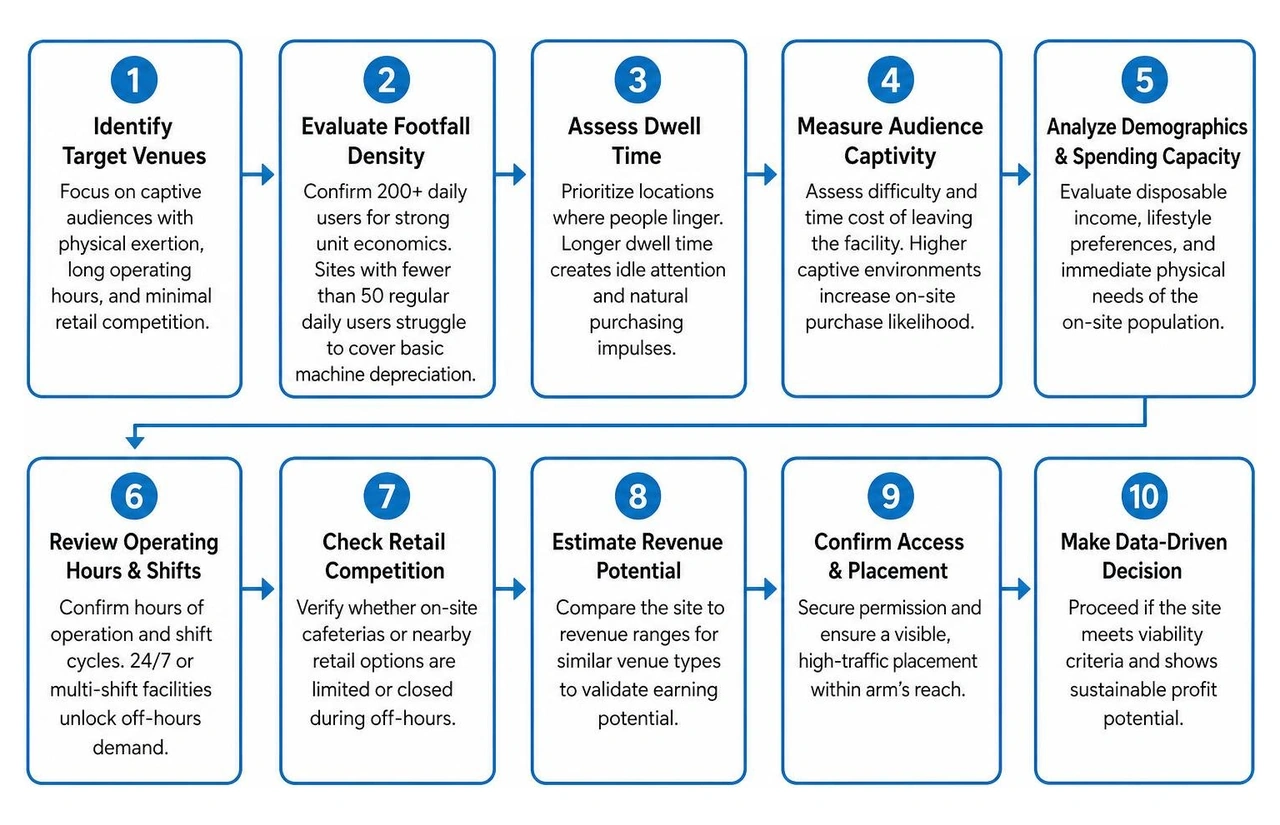
Profitability rests on five interconnected variables:
- Physical Footfall Density: The actual volume of individuals passing within arm's reach of your equipment daily.
- Customer Dwell Time: The length of time people linger near the machine with idle attention.
- Audience Captivity: The difficulty, friction, or time cost required for consumers to access outside retail alternatives.
- Demographics and Spending Capacity: The disposable income, lifestyle preferences, and immediate physical needs of the on-site population.
- Operating Hours and Shift Cycles: Whether the facility runs on a standard eight-hour workday or maintains continuous 24/7 foot traffic.
| Venue Type | Primary Buyer Dynamics | Average Dwell Time | Captivity Level | Estimated Monthly Revenue Range |
|---|---|---|---|---|
| Multi-Shift Manufacturing | Industrial staff, night shifts | 15–30 min breaks | High (Restricted off-site access) | $800 – $2,500+ |
| 24/7 Hospital & Medical | Healthcare workers, visiting families | 1–4+ hours | High (Cafeterias shut overnight) | $800 – $2,500+ |
| Automotive Dealership / Service | Vehicle buyers, repair clients | 1.5–3 hours | Moderate to High | $400 – $1,200 |
| Mid-Sized Corporate Office (100+) | Salaried employees, contractors | 8+ hours daily | Moderate | $400 – $900 |
| Class A Multi-Family Residential | Tenants, delivery couriers | Moments to 45 min | Moderate (Late-night convenience) | $300 – $800 |
| Transit Hubs & Regional Terminals | Commuters, travelers | 15–60 min | High (Time-pressured) | $600 – $1,800 |
Foot Traffic Density vs. Dwell Time
New operators often make the mistake of chasing high foot traffic alone. A busy train station corridor where thousands of commuters rush to catch a connecting train sounds impressive, but hurried commuters rarely break stride to buy a bag of chips.
Real conversion happens at the intersection of volume and dwell time. A hospital emergency waiting room or car repair lounge with 150 daily visitors consistently generates higher vending volume than an open public transit concourse with 800 hurried pedestrians. When people sit or wait, boredom and appetite create natural purchasing impulses. As highlighted in industry site selection data, locations with fewer than 50 regular daily users struggle to cover basic machine depreciation, whereas sites with 200 or more daily users unlock strong unit economics.
Captive Audiences and Off-Hours Demand
A captive audience exists whenever leaving a facility for a snack or drink requires too much time, effort, or logistical friction. In manufacturing plants, distribution hubs, and industrial parks, employees receive tightly regulated 15-minute rest breaks. Walking to a parking lot, driving to a fast-food outlet, and returning within that window is impossible. The on-site vending machine becomes their sole practical option.
Off-hours demand works as a powerful revenue multiplier. In facilities where on-site canteens or commercial cafeterias operate exclusively from 7:00 AM to 2:00 PM, the vending machine takes over food and beverage service for evening, overnight, and early morning shifts.
The Best Places to Place Vending Machines for Maximum Revenue
Selecting great locations for vending machines involves targeting facilities that offer captive audiences, physical exertion, long operating hours, and minimal retail competition.

Manufacturing Plants and Distribution Warehouses
Manufacturing plants and industrial logistics warehouses are often the most reliable, top-earning placements for independent operators. Blue-collar and industrial operations involve demanding physical work. Workers burn calories, lose hydration, and need quick sources of energy throughout their shifts.
Key advantages of industrial placements include:
- High Caloric and Hydration Needs: Energy drinks, cold waters, isotonic sports beverages, meat sticks, pastries, and hearty salty snacks turn over rapidly.
- 24/7 Multi-Shift Coverage: Warehouses operating two or three continuous shifts keep equipment earning revenue around the clock.
- Zero Outside Distractions: Industrial parks are rarely situated next to walk-in convenience stores, creating a fully captive customer base.
Hospitals and 24/7 Healthcare Campuses
Hospitals and extended-care facilities operate around the clock, providing a steady flow of potential buyers. Unlike typical commercial offices that clear out by 5:00 PM on Friday, medical campuses run continuously.
A healthcare campus serves three distinct buyer groups:
- Medical Staff: Doctors, nurses, emergency technicians, and administrative staff working 12-hour shifts who rely on quick energy boosts during late-night rounds.
- Visiting Families: Loved ones waiting in emergency rooms, surgical waiting lounges, and intensive care corridors during high-stress hours.
- Outpatients: Individuals visiting diagnostic centers, blood banks, and specialty treatment clinics during daytime hours.
Stocking these environments with functional beverages, cold coffees, protein-rich snacks, and fresh-food options yields strong sales volume week after week.
Mid-Sized Offices: Why They Are the Best Places to Place Vending Machines for Beginners
For first-time operators learning route logistics, mid-sized corporate offices housing between 100 and 300 on-site employees offer a steady, lower-complexity operational environment.
While mega-campuses often involve complex corporate procurement layers and smaller workplaces lack the headcount to justify equipment costs, mid-sized corporate sites hit the sweet spot. They provide clean environments, standard electrical setups, low vandalism risk, and predictable inventory depletion. Identifying places in need of vending machines in suburban office parks allows you to build recurring cash flow without navigating industrial security gates or round-the-clock restock schedules.
High-Dwell Service Centers and Dealerships as the Best Places to Place Vending Machines
Automotive dealerships and commercial service centers represent prime placement opportunities because of extended customer dwell times. The average consumer spends nearly three hours at a car lot when shopping for a vehicle, while service centers see routine maintenance wait times ranging from 1.5 to 3 hours.
When customers wait for an oil change, brake replacement, or financing paperwork, they gravitate toward customer lounges. Positioning a clean, modern glassfront combo machine or bean-to-cup coffee vendor in these customer waiting areas produces steady beverage and snack sales. Because automotive clients are already spending money on vehicle repairs, they are less price-sensitive toward premium cold brews, sparkling waters, and branded snacks.
Multi-Family Residential Properties and Apartment Complexes
High-density apartment complexes and multi-family residential communities (particularly those with 150 to 300+ units) offer built-in, round-the-clock customer convenience. Placing machines in centralized common areas—such as clubhouse game rooms, pool pavilions, on-site fitness centers, or mailroom lobbies—caters directly to residents who want a quick refreshment without driving to a convenience store.
Laundry facilities within multi-family communities are especially reliable. Residents typically wait 30 to 45 minutes between wash and dry cycles with their phones in hand. A cold beverage or quick snack helps pass that downtime. These properties often serve as free places to put a vending machine when pitched as an amenity that increases tenant satisfaction at zero cost to property management.
High-Volume Transit Hubs, Airports, and Train Stations
Transportation hubs are defined by massive passenger turnover and immediate customer urgency.
- Airports: The top 10 domestic airports see over 100,000 travelers pass through daily, while regional airports comfortably handle thousands. Long layovers, delayed flights, and post-security pricing encourage quick vending purchases.
- Rail and Bus Stations: Passenger rail systems carry tens of millions of passengers annually, with high-density commuter stations exceeding 34,000 travelers per day. Major intercity bus lines transport nearly 16 million passengers across regional markets, averaging over 325 travelers per station daily.
In transit hubs, speed and convenience are essential. Stocking travel-sized essentials, high-margin functional beverages, bottled water, and portable, mess-free snacks captures immediate impulse sales from travelers in transit.
Micro-Placements: Where to Position Equipment Inside a Venue
Securing the contract for a building is only half the battle. Internal placement within the facility dictates your ultimate conversion rate. A busy manufacturing plant with 400 employees will fail to generate meaningful revenue if your machine is tucked down an unlit maintenance hallway behind a fire door.
When mapping internal micro-placements, check these core operational factors:
- Dedicated Power Availability: Verify an accessible, dedicated 110V/15A or 20A electrical outlet within six feet of the machine footprint. Avoid running long extension cords across open walkways.
- Physical Line of Sight: The machine should be visible from at least 20 to 30 feet away, catching customer attention before they reach decision points.
- ADA and Walkway Clearances: Maintain at least 36 to 48 inches of unobstructed clearance in front of the unit so delivery doors and wheelchair users can pass freely without blocking fire egress routes.
- Cellular Signal for Telemetry: Ensure strong cellular connectivity at the exact wall location so cashless card readers and remote inventory monitors transmit sales data without dropping transactions.
Break Rooms vs. Main Lobbies
Deciding whether to place equipment in an internal employee break room or a public-facing entrance lobby depends on your target customer base:
In industrial warehouses, corporate offices, and operations centers, break rooms consistently outperform entrance lobbies. Break rooms capture daily, repeat buyers who view the machine as part of their regular workday routine. Conversely, in automotive dealerships, medical clinics, and municipal facilities, central waiting lobbies capture higher volume by serving high-dwell visitors.
High-Conversion Corridor Dwell Points and Transit Pinch Points
If break room space is unavailable, position your equipment near natural architectural pinch points. These are areas where pedestrian foot traffic naturally slows down, pauses, or gathers:
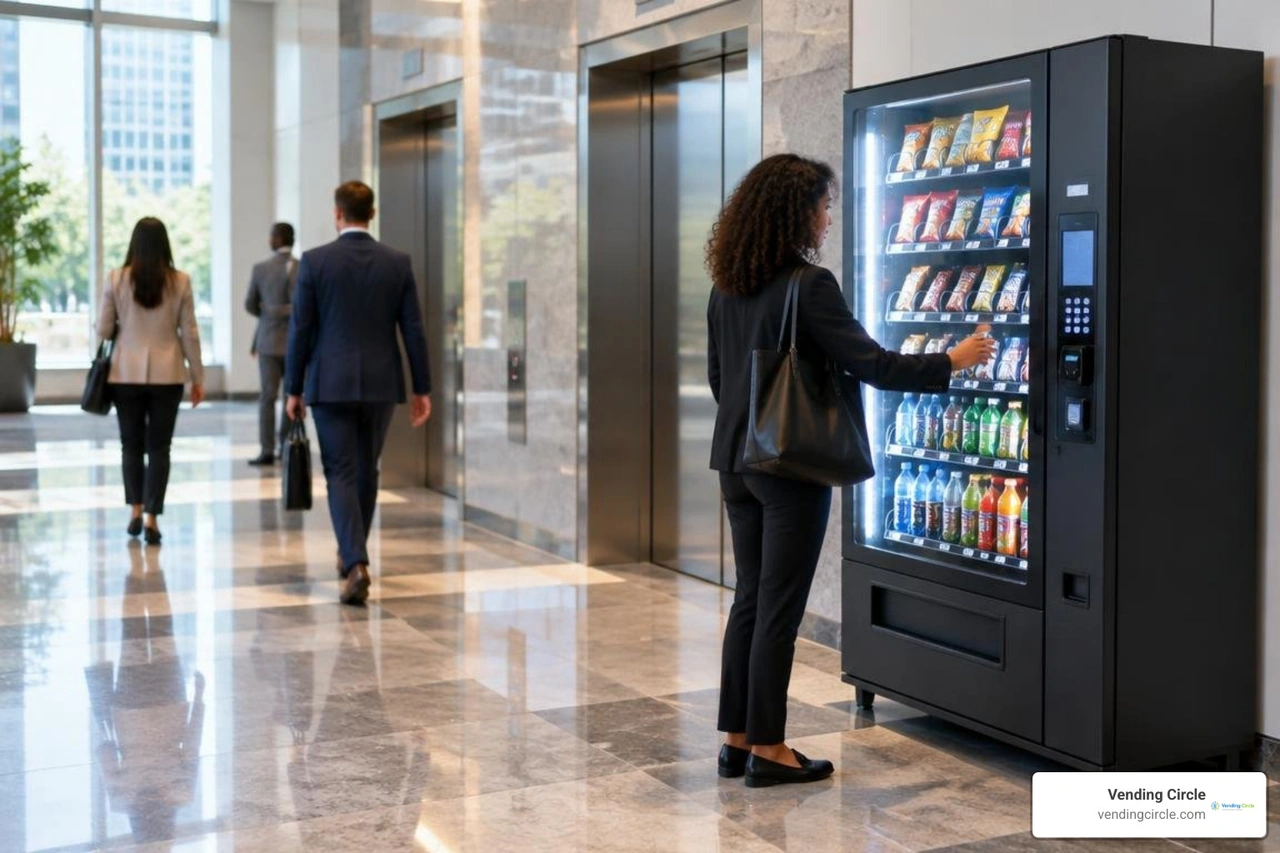
- Elevator Lobbies: Waiting for an elevator creates 30 to 90 seconds of idle dwell time—a prime window for impulse purchases.
- Restroom Approaches: Hallways leading toward main restrooms capture steady, predictable foot traffic from all departments throughout the day.
- Building Entrances and Exits: Employees arriving for early 5:00 AM shifts or leaving late in the evening appreciate grabbing a quick beverage when on-site canteens are closed.
How to Find, Pitch, and Secure High-Yield Locations
Securing profitable vending placements is a structured B2B sales effort. Rather than driving around aimlessly hoping to spot a welcome sign, successful operators build focused prospect lists and approach property decision-makers with a clear value proposition. Reviewing an operator route benchmark guide can help you establish realistic outreach targets and operational milestones.
Sourcing Leads and Cold Outreach Tactics
To build a high-probability pipeline of target locations:
- Leverage Local Business Registries: Search municipal and county business licensing databases for newly licensed logistics facilities, outpatient clinics, auto centers, and light industrial developments.
- Map Commercial Clusters: Use Google Maps and commercial real estate platforms to identify industrial parks, warehouse corridors, and Class A multi-family developments within a 15-minute radius of your current route.
- Target the Right Decision-Maker: Avoid pitching front-desk receptionists. Ask directly for the Facilities Manager, Property Director, or Human Resources Operations Lead. Facility managers oversee on-site building amenities and service contracts, making them more accessible and receptive to operational upgrades.
When evaluating target areas, look for places looking for vending where existing equipment is outdated, broken, or serviced irregularly by legacy operators. For a deeper breakdown of outreach scripts and prospecting channels, explore our guide on finding vending machine placements.
Negotiating Contracts, Commissions, and Placement Agreements
When pitching a property manager, position your service as a 100% managed, zero-cost employee and tenant amenity. You handle equipment procurement, inventory stocking, routine sanitation, and technical maintenance; they receive a modern, reliable amenity that keeps staff on-site and satisfied.
Key contractual terms to establish in your 1- to 2-page placement agreement:
- Trial Period Clause: Include an initial 60- to 90-day trial period. This lowers the barrier to entry for hesitant property managers and protects you by allowing you to pull equipment without penalty if daily sales fall below viability benchmarks.
- Commission vs. Zero-Commission Structure: In lower-to-moderate traffic venues (50–150 users), pitch the machine as a free amenity without commissions. In high-volume venues (250+ users, manufacturing facilities), offer a competitive commission of 5% to 15% of net sales (gross revenue minus card processing and sales tax).
- Service Commitments: Detail standard restock frequencies (e.g., weekly or bi-weekly) and guarantee a 24- to 48-hour response window for resolving unexpected hardware issues or refund requests.
- Liability Insurance: Carry and present proof of a standard $1,000,000 commercial general liability policy naming the host property as an additional insured party.
Locations and Red Flags Operators Should Avoid
Knowing where not to place equipment saves capital, prevents equipment damage, and protects route profitability.
Small Commercial Offices with Low Physical Headcount
A corporate office showing 60 employees on its payroll directory may seem viable on paper. However, in modern hybrid work environments where employees work remotely on Mondays and Fridays and alternate in-office days, actual daily physical headcount often drops below 15 people.
A location with fewer than 30 to 40 physically present daily workers cannot generate enough inventory turnover to keep snacks fresh and justify weekly restocking runs. Always verify physical on-site headcount across all working days before signing a contract.
Unsecured Outdoor Spots and Low-Visibility Corridors
Avoid placing standard indoor-rated equipment in open outdoor environments or unmonitored parking structures. Key risks include:
- Severe Climate Exposure: Direct summer sunlight overheats refrigeration compressors, while winter freezes cause canned sodas to burst and ruin internal control boards.
- High Vandalism and Theft Rates: Unsupervised outdoor machines invite pry-bar attacks, broken glass, and damaged coin mechs.
- Obscured Sightlines: Tucking a machine inside a remote basement or behind a distant stairwell sharply reduces impulse foot traffic.
Frequently Asked Questions About Vending Machine Placement
What is the most profitable location type for an independent vending operator?
Multi-shift manufacturing plants, logistics distribution hubs, and 24/7 hospital campuses consistently generate the highest net profit per machine. These facilities feature large captive audiences, physically demanding work, continuous day and night shifts, and limited nearby retail alternatives during off-hours.
Do I need legal permits or property permission to place a vending machine?
Yes. Placing a machine on private commercial property without a signed location contract from the authorized property owner or facility manager is illegal. Additionally, operators must maintain an active business entity (such as an LLC), hold a state sales tax permit to collect and remit sales taxes, and carry commercial general liability insurance. Public property placements require dedicated municipal permits and health department clearances if handling open or perishable food items.
How much commission do property owners typically expect from vending sales?
Commission expectations vary by location size and foot traffic volume. Small to mid-sized offices (50–150 employees) rarely demand commissions when the machine is framed as an employee benefit. High-volume industrial plants, universities, and healthcare facilities typically negotiate between 5% and 15% of net sales. Avoid offering commissions based on gross sales or agreeing to fixed monthly space rental fees unless daily volume is proven to support them.
Conclusion
Building a profitable vending route comes down to disciplined site selection, understanding captive dwell times, and executing reliable, customer-focused service. Placing reliable equipment in high-demand environments—such as distribution centers, round-the-clock medical facilities, and busy residential communities—creates steady, scalable passive revenue that increases your overall route equity over time.
At Vending Circle, we support operators through every phase of building and scaling automated retail businesses. Whether you are seeking proven location outreach templates, participating in our weekly live operator Q&A sessions, or leveraging our platform to browse commercial vending machines with manufacturer-direct pricing, our active community gives you the tools to secure high-margin placements and grow your route with confidence.