Why Vending Machine Routes for Sale Are One of the Fastest Paths to Cash Flow
If you're evaluating routes for sale vending machine deals, here's what the market looks like right now:
| Metric | Typical Range |
|---|---|
| Median asking price | ~$30,000 |
| Median annual cash flow | ~$54,000 |
| Valuation multiple (SDE) | 0.5x to 1.1x annual cash flow |
| Valuation multiple (EBITDA) | 0.7x to 1.7x |
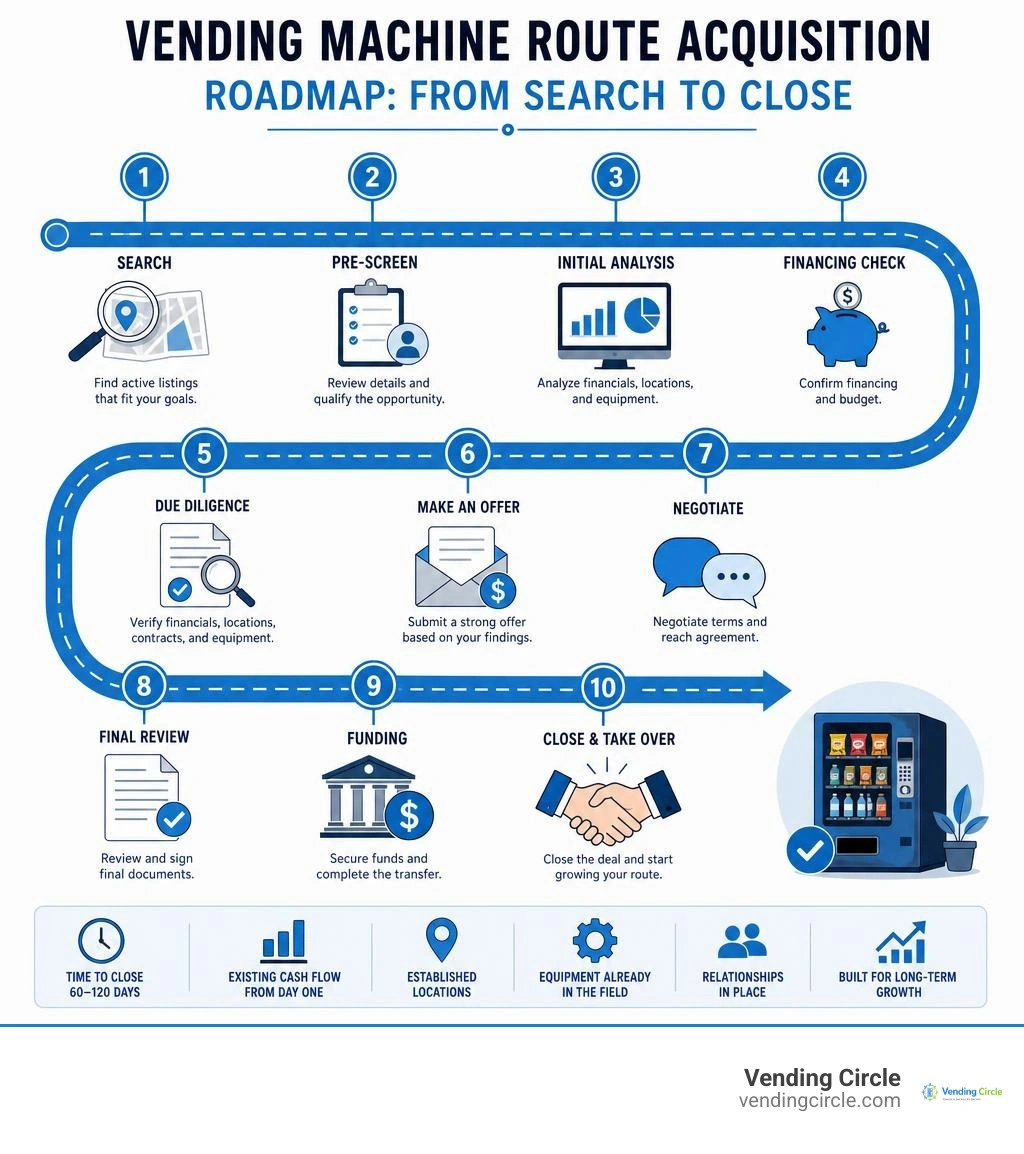
| Time to close | 60 to 120 days |
| Active national listings | ~47 at any given time |
Buying an established vending route is one of the most direct ways to acquire an income-producing business. You skip the slow build-up of prospecting locations, negotiating placements, and buying machines one by one. Instead, you get existing cash flow, equipment already in the field, and location relationships already in place — from day one.
But the market is thin. There are only around 47 active listings nationwide at any given time. That means good deals move fast, and buyers who show up unprepared — without financing clarity, a due diligence checklist, or a realistic view of valuation — lose out.
This guide cuts through the noise. Whether you're looking at a $30,000 starter route or a multi-location portfolio pushing $200,000+, you'll know exactly what to look for, what to pay, and how to close.
I'm Manuel Mojica, founder of Vending Circle and owner of MM Healthy Vending, and I've spent years in the trenches evaluating routes for sale vending machine opportunities — both for my own operation and to help other operators make smarter acquisitions. Everything in this guide comes from real market data and hands-on experience.
1. Key Valuation Metrics for Routes for Sale Vending Machine Opportunities
When you start browsing listings for routes for sale vending machine deals, you quickly notice that vending route pricing doesn't follow the same rules as traditional software companies or service businesses. Most businesses sell for 2x to 4x earnings, but vending machine routes routinely trade at a discount to annual earnings.
Understanding why this happens—and how to calculate the true value of a route—is your secret weapon as a buyer or seller.
| Valuation Metric | Multiple Range | Primary Use Case | Key Buyer Considerations |
|---|---|---|---|
| Seller's Discretionary Earnings (SDE) | 0.5x – 1.1x | Small owner-operator routes (1–3 people) | Measures total cash benefit to a single working owner; accounts for high operational dependency. |
| EBITDA | 0.7x – 1.7x | Systematized routes with hired drivers/managers | Used by institutional buyers and SBA lenders to evaluate debt service capacity. |
| Gross Revenue Multiple | 0.25x – 0.45x | Quick sanity checks or bulk vending portfolios | Highly unreliable without examining product margins and route fuel costs. |
Vending routes command lower multiples primarily because they are labor-intensive, depend heavily on the owner’s personal daily effort, and carry risk around location retention. However, this multiple compression is actually great news for cash flow buyers: you can often recoup your initial purchase price in under two years!
Evaluating Asking Price vs Cash Flow for Routes for Sale Vending Machine Deals
Across the U.S., the median national asking price for a vending machine route hovers around $30,000, while generating a median annual seller cash flow of approximately $54,000. This implies that many listings trade at a median multiple of roughly 0.6x cash flow.
However, real-world deals vary depending on size and operational model:
- Micro-Routes & Starter Accounts: Smaller routes—such as a single account or a handful of machines—might list for $4,000 to $15,000. These micro-deals often represent part-time opportunities generating a few hundred dollars per week in gross sales.
- Full-Time Owner-Operator Routes: Routes priced between $30,000 and $85,000 usually include 10 to 30 machines producing $1,000 to $3,000 in weekly sales.
- Commercial Route Portfolios: Large-scale commercial portfolios can list anywhere from $150,000 to over $1,000,000. For instance, an extensive bulk vending route portfolio across MN and ND featuring 409 machines across 355 locations was listed at $215,000, projecting annual cash flows ranging from $47,000 on the conservative side up to $114,000 under optimistic conditions. Similarly, a regional bulk route like this Charlotte area vending account listing offered 1,436 gumball machines across 661 accounts for an asking price of $63,000, generating $1,300 in gross weekly sales.
When reviewing earnings figures, always check whether the reported cash flow reflects Seller’s Discretionary Earnings (SDE) or net operational profit after paying labor. As highlighted in our analysis of vending machine industry statistics 2026, labor and product costs dictate whether a route actually keeps money in your pocket.
Key Factors Driving Route Values Up or Down
Why does one route sell for 0.5x SDE while another fetches 1.1x SDE or 1.7x EBITDA? It all comes down to specific value drivers that reduce risk for the incoming operator:
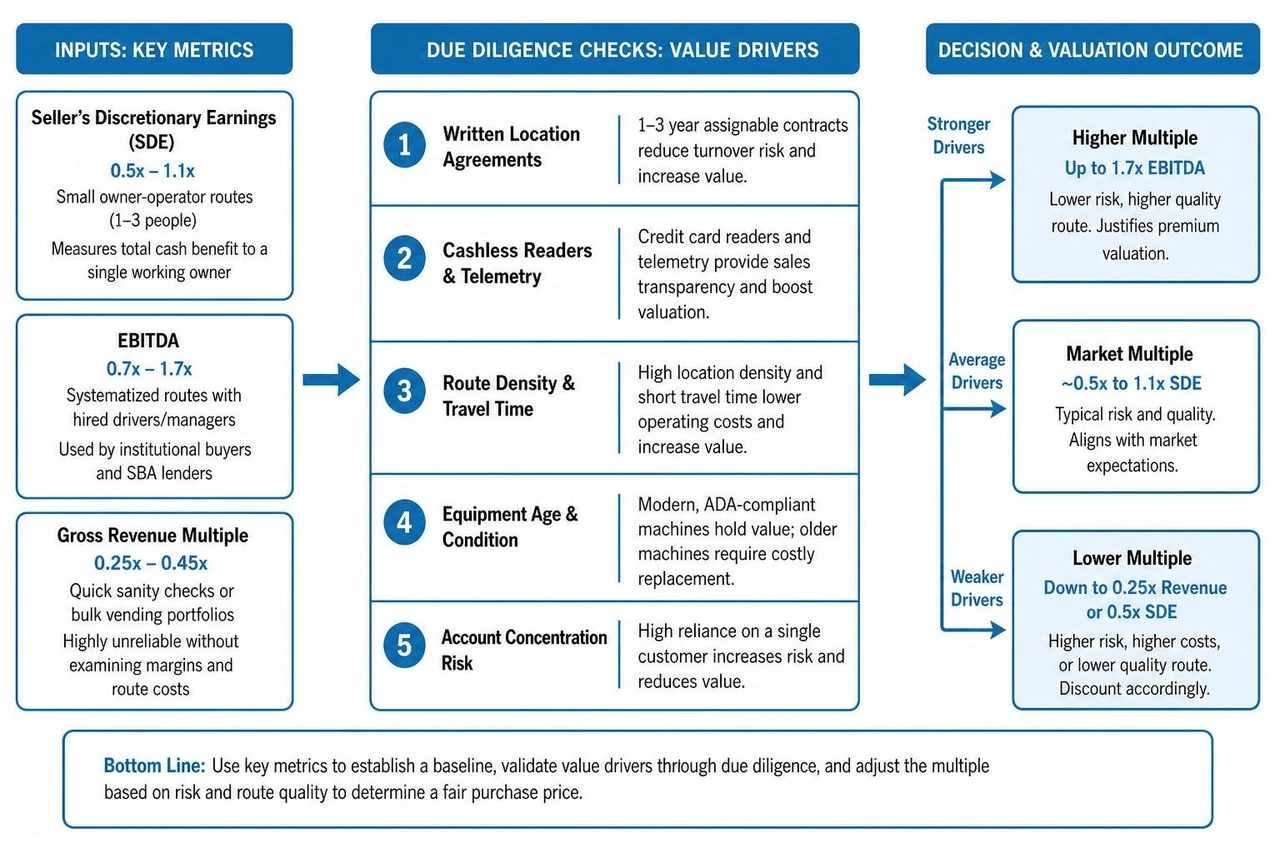
- Written Location Agreements: Handshake deals terrify smart buyers. A route backed by written, 1-to-3-year assignable contracts commands a premium. Verbal agreements force buyers to price in high turnover risk, dragging valuation multiples down.
- Cashless Readers & Telemetry: Routes equipped with credit card readers and remote telemetry systems sell faster and at higher multiples. Telemetry provides undeniable proof of sales volume. You can learn more about retrofitting equipment in our guide to buy a vending machine with card reader.
- Route Density & Travel Time: A tight route servicing 15 locations within a 5-mile radius is far more valuable than a sprawling route requiring 150 miles of driving between stops. High geographic density saves fuel, vehicle wear, and hours of labor.
- Equipment Age & Condition: Modern, ADA-compliant glassfront machines with modern bill acceptors maintain their value. Machines older than 10 years require imminent replacement or costly repairs, leading buyers to heavily discount their offers.
- Account Concentration Risk: If a single hospital or factory accounts for 40% or more of a route’s total revenue, the loss of that one customer could destroy the business. High customer concentration lowers valuation unless counterbalanced by long-term corporate contracts.
If you are looking to value your existing business or understand buyer dynamics, check out these guides on how to sell a vending machine route and how to answer what is my vending machine route worth?.
2. Essential Due Diligence and Financial Verification Steps
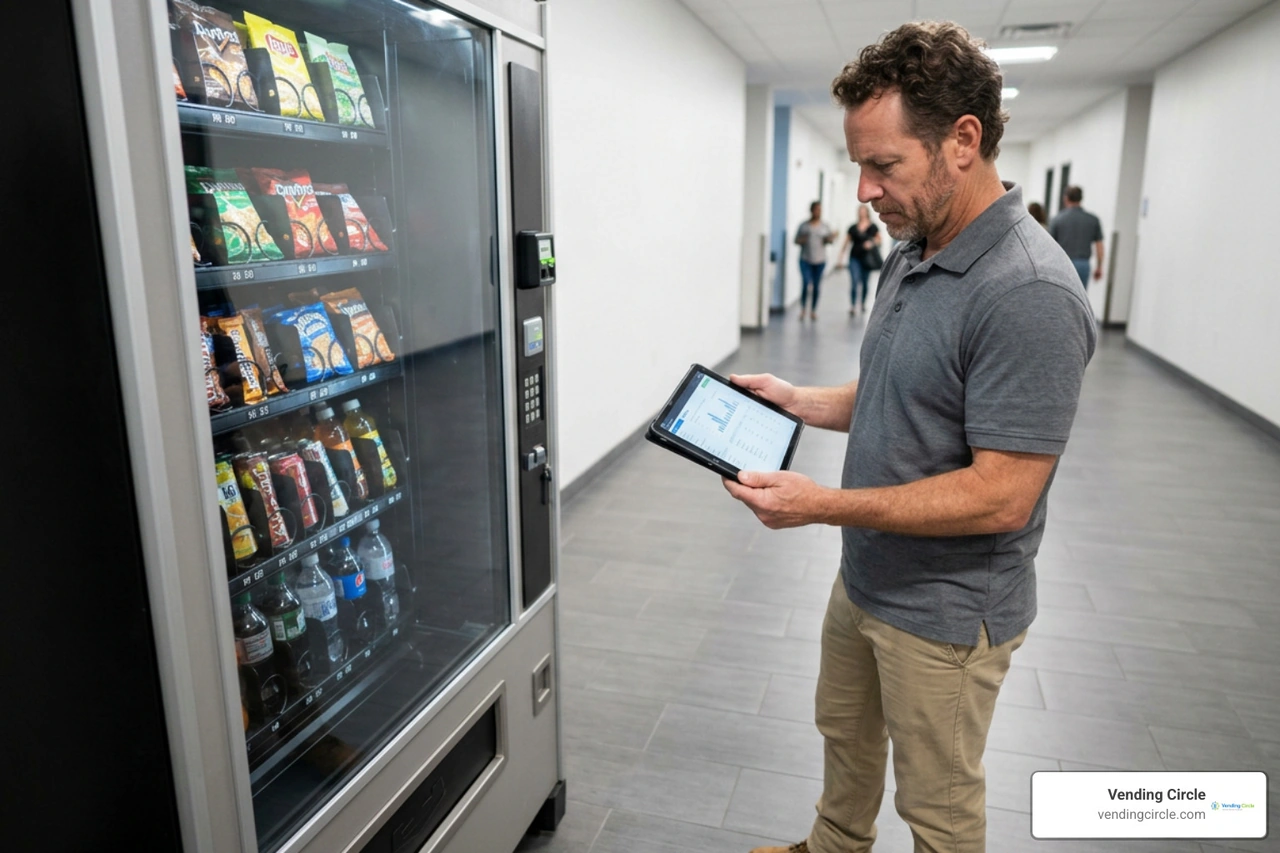
Due diligence is where deals are won or lost. Because vending has traditionally been a cash-heavy industry, buyers must be diligent when auditing a seller’s figures. Never take reported cash flow at face value without cross-referencing supporting documentation.
Verifying Revenue Records and Bank Statements
Unverifiable cash income is the single biggest deal-killer in vending acquisitions. When examining a seller's finances, insist on reviewing at least 24 months of the following records:
- Bank Statements & Reconciliation Logs: Match cash collection logs against actual bank deposit slips. If an owner claims the route nets $5,000 per month in cash, but bank statements show only $1,500 in regular deposits, treat the unverified difference with extreme caution.
- Telemetry & Card Processor Reports: Digital transactions from card readers (such as Cantaloupe, Nayax, or Parlevel) provide clean, audit-proof data. Examine merchant processing statements to verify exact vending volume per machine.
- Schedule C Tax Returns & P&L Statements: Compare reported tax income with listing flyers. Sellers often attempt to write off personal expenses to lower tax liabilities, but substantial discrepancies between tax returns and claimed SDE require thorough justification.
- Product Purchase Receipts: Cross-reference inventory purchase invoices from wholesale clubs or distributors against unit sales. If product purchases don't align with declared sales volumes based on standard industry cost of goods sold (COGS) margins (typically 35% to 45% for snacks and cold beverages), the numbers may be inflated. Maintaining effective vending machine inventory management is essential during this audit window.
Evaluating Location Contract Stability and Machine Condition
Once you have verified the revenue, turn your attention to the physical assets and host location relationships:
- Perform Physical Machine Audits: Visit every single machine on the route. Check the physical condition, cleanliness, refrigeration performance, bill validator functionality, and product expiration dates. Note any unowned or leased equipment, as leased hardware reverts to the lessor and reduces net asset transfer value.
- Review Location Contracts and Assignment Clauses: Inspect host contracts to verify remaining term lengths, commission structures (e.g., 5% to 15% host commission rates), and exclusivity clauses. Crucially, confirm that contracts contain an assignment clause allowing the contract to transfer seamlessly to a new entity upon sale.
- Assess Host Location Quality: High-traffic industrial plants operating 24/7, distribution centers, call centers, and large medical facilities represent stable host environments. Conversely, small office breakrooms with remote work policies present elevated turnover risk.
- Evaluate Wholesale Product Sourcing: Review where the current operator sources products and confirm whether current profit margins can be maintained post-acquisition using established vending machine products wholesale channels.
3. Acquisition Financing, Timelines, and Market Dynamics

Closing on a routes for sale vending machine deal requires matching your funding strategy with the size of the acquisition. Because smaller routes trade at lower transaction amounts, traditional institutional lending operates somewhat differently than in standard business sales.
Structuring SBA Loans, Seller Notes, and Cash Purchases
- Cash Transactions (Under $100,000): Micro-routes and starter deals under $100,000 are almost exclusively financed via cash reserves, personal lines of credit, or home equity loans. Small deals move quickly; cash transactions generally close within 14 to 30 days once diligence is complete.
- Seller Financing / Seller Notes: Seller financing is common in mid-market route sales ($30,000 to $150,000). A typical structure involves a 50% to 70% cash down payment with the remaining balance financed by the seller over 12 to 36 months at a reasonable interest rate (e.g., 6% to 10%). Seller notes align the seller’s financial interests with yours during the transition period.
- SBA 7(a) Loans for Portfolio Roll-Ups ($200,000+): Institutional lenders rarely underwrite standalone $30,000 micro-deals due to fixed closing costs. However, if you acquire a large regional route or roll up multiple routes into a portfolio worth $300,000 to $1,000,000+, SBA 7(a) debt becomes viable. An SBA structure might require 10% buyer equity, 10% to 15% seller standby note, and 75% to 80% SBA loan coverage over a 10-year repayment term, provided the business maintains a Debt Service Coverage Ratio (DSCR) of 1.25x or higher.
The typical closing timeline ranges from 60 to 120 days for structured transactions requiring formal escrow, contract assignment transfers, and lender underwriting, whereas simple cash acquisitions with complete records can close in as few as 30 days.
Local Market Dynamics for Routes for Sale Vending Machine Buyers
Local geography and climate significantly impact route performance and deal mechanics across different metro areas:
- Phoenix, AZ Market: Phoenix represents a dynamic vending ecosystem characterized by rapid suburban development and extreme summer temperatures (often exceeding 100°F for months). Heat serves as a natural driver for cold beverage sales, boosting machine velocity. Listings in Phoenix range from $30,000 micro-routes up to $1,200,000 commercial portfolios, with median asking prices trading around 0.6x cash flow due to operational sprawl across the valley. Buyers considering Arizona acquisitions should review local market dynamics to buy a vending machine route in Phoenix, AZ.
- Chicago, IL Market: Chicago offers high geographical density, robust transit corridors, and concentrated industrial hubs like Pilsen, Fulton Market, and suburban manufacturing zones. A compact Chicago route servicing manufacturing facilities or high-volume breakrooms minimizes vehicle travel time and fuel overhead. However, operators must account for winter weather logistics and local municipal compliance. Sellers and buyers in the Midwest can explore regional strategies to sell a vending machine route in Chicago, IL.
Regardless of your target metro area, prioritizing geographic route density—ensuring machines can be efficiently serviced without excessive transit—remains essential to controlling operating costs.
Frequently Asked Questions About Vending Routes
What is the typical asking price and cash flow for a vending machine route?
Across national listings, the median asking price for a vending machine route is approximately $30,000, with reported median annual seller cash flow around $54,000. Small starter routes sell for as low as $4,000 to $15,000, while multi-route commercial portfolios command $200,000 to well over $1,000,000 depending on location stability, machine telemetry, and documented earnings.
How long does it take to complete a vending route acquisition?
A typical vending machine route purchase takes 60 to 120 days from initial buyer conversation to official closing. Simple cash transactions with organized financial statements and assigned contracts can close in 30 to 45 days, whereas deals involving SBA financing, seller notes, or corporate legal review typically require 60 to 90 days.
Why do current owners sell their established vending machine routes?
The most common reasons route owners sell include retirement after decades of physical labor, changing personal health, partnership dissolutions, or reaching a growth plateau where expanding further would require hiring additional staff and buying service vans. In some cases, owners list routes after losing a major anchor location, making it important for buyers to review recent 12-month revenue trends during due diligence.
Conclusion
Acquiring established routes for sale vending machine deals offers a proven shortcut to establishing immediate business cash flow. By buying existing machine placements, active location contracts, and established customer traffic, you bypass the friction of starting from scratch.
To make your route acquisition a success, follow these core rules:
- Value routes based on verified cash flow (SDE/EBITDA multiples) rather than simple physical asset counts.
- Verify cash revenue using telemetry reports, bank deposit records, and wholesale COGS invoices.
- Insist on assignable, written location contracts to secure long-term revenue.
- Optimize service efficiency by prioritizing tight geographic route density and modern telemetry systems.
Whether you are seeking your very first starter route or expanding an existing fleet, having access to expert mentorship, structured deal evaluation frameworks, and wholesale supplier networks will give you a competitive edge.
At Vending Circle, we support operators through every stage of their business journey—from initial route acquisition due diligence to daily operational scaling. Explore our catalog of all vending machines to review modern hardware options, check out our operational guide on managing a vending machine emergency restock scenario, browse our resource center of all articles, or visit our home page to join our community. Ready to fast-track your path to financial independence? Enroll in Vending Circle Courses today and master the business of route operations!