How to Buy a Candy Machine Route That Actually Pays
A candy machine route for sale can give you locations, machines, and cash flow from day one - but only if you verify what is included. Before you buy, ask for collection records, inspect every machine, confirm location agreements can transfer, and calculate profit after candy costs, commissions, travel, and repairs.
A good bulk candy machine may generate roughly $50 to $100 in monthly sales in a solid location. Product costs commonly take 30% to 40% of sales, while location commissions may take another 10% to 20%. The opportunity is real, but the listing price matters far less than verified net cash flow and an efficient, tightly grouped route.
Buying an existing route can save months of finding locations and building trust with business owners. It can also bring hidden problems: aging equipment, weak stops, unrecorded cash collections, stale inventory, or locations that can remove machines with little notice. This guide shows you how to separate a worthwhile route from an expensive pile of machines.
I am Manuel Mojica, founder of Vending Circle and an operator who has built businesses around vending, operator education, and supplier access. I help vending operators assess a candy machine route for sale with practical systems for purchasing, servicing, stocking, and growing profitable equipment portfolios.
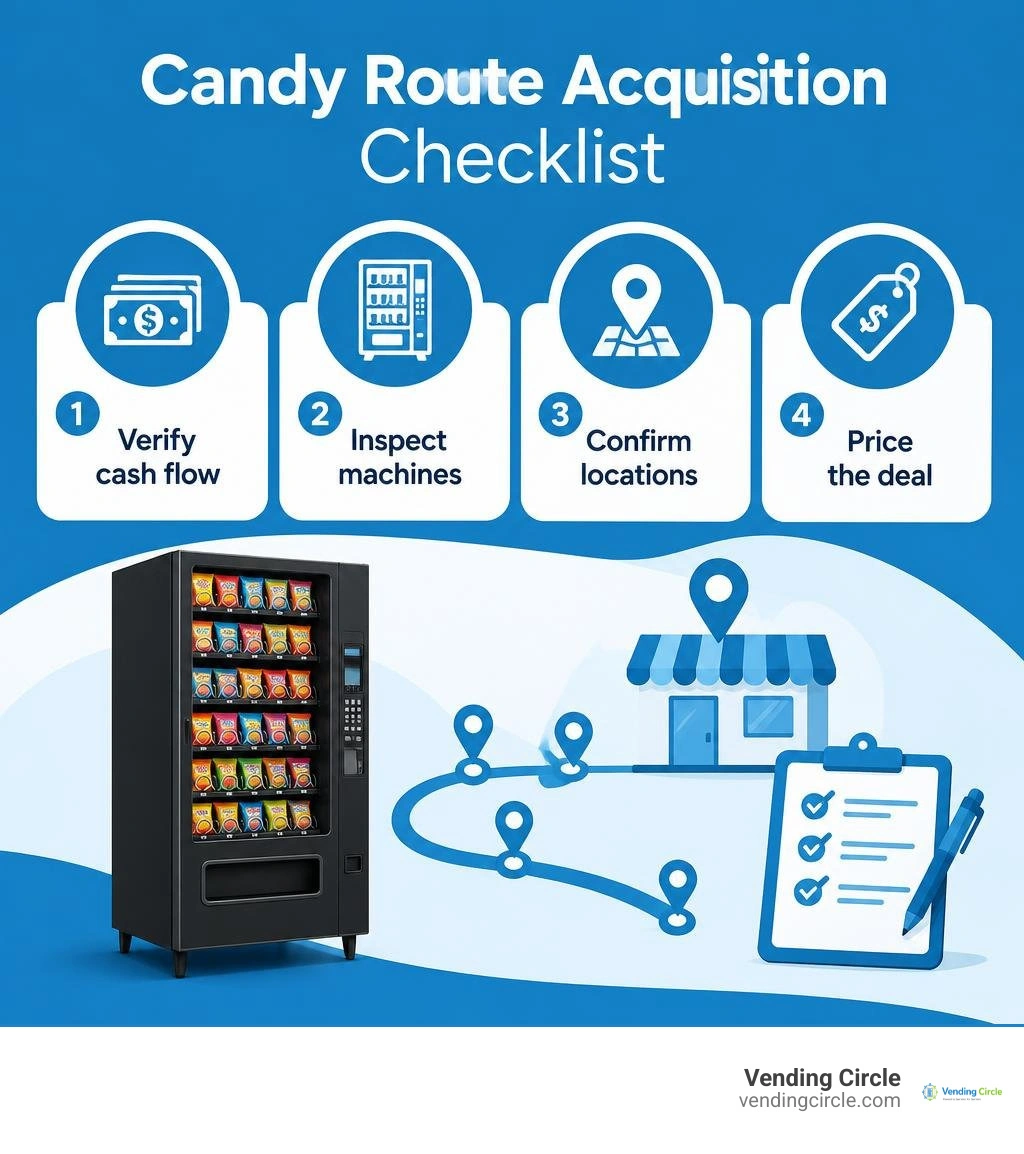
Candy machine route for sale terms you need:
Key Financial Metrics of a Candy Machine Route for Sale
When evaluating any vending business opportunity, you must look past top-line revenue and dig into the actual cash flow. Bulk candy operations are renowned for outstanding product margins (frequently 70% to 80%), but operational expenses, fuel, and location splits will directly impact your take-home pay.
To properly gauge if an asking price makes sense, we compare the total purchase cost against the Seller’s Discretionary Earnings (SDE) or net cash flow. Unlike large corporate acquisitions that sell on heavy EBITDA multiples, small-scale cash routes typically trade at 1.0x to 2.5x annual net cash flow, depending on contract stability, equipment condition, and route density. You can get a clear breakdown of ongoing equipment overhead by evaluating overall vending machine costs.
| Route Metric | Small Route Profile (30–64 Units) | Large Route Portfolio (300–700+ Heads) |
|---|---|---|
| Typical Equipment Count | 30 to 64 Machines | 150 to 400 Machines (300–700+ Heads) |
| Annual Gross Revenue | $13,500 – $45,000 | $50,000 – $120,000+ |
| Average Cost of Goods (COGS) | 20% – 30% | 18% – 25% (Bulk Buying Discounts) |
| Location Commissions | 0% – 15% (or flat charity stickers) | 10% – 25% |
| Annual Net Cash Flow (SDE) | $8,300 – $30,000+ | $37,000 – $114,000+ |
| Estimated Payback Period | 12 to 24 Months | 20 to 48 Months |
| Weekly Owner Workload | 4 to 8 Hours | 15 to 35 Hours |
A well-optimized route of just 30 machines can gross up to $45,000 annually in high-foot-traffic territories, netting over $30,000 per year on a schedule of just one day per week. Conversely, larger portfolios spanning hundreds of heads offer substantial semi-passive returns, but require stronger route management systems.
Analyzing Revenue, Margins, and Payback Periods
In bulk vending, performance is often measured by individual dispensing heads (the separate canisters on a stand dispensing candy, gumballs, or toy capsules) rather than just the stand itself. A standard triple-head machine sitting in a breakroom or diner entryway has three distinct revenue streams.
Industry data shows that healthy dispensing heads generate between $8 and $18 per month. When you model revenue:
- Daily Average Sales: A machine producing $3 to $4 per day gross yields roughly $1,100 to $1,500 per year.
- High Product Margins: Because wholesale candy (like Runts, Mike and Ike, Skittles, or pressed dextrose candies) is bought in 25-to-50-pound bulk cases, your product margins stay remarkably high at 75% to 80%.
- Pricing Mechanics: As highlighted in our analysis of vending machine pricing models, quarter-per-vend pricing allows strong unit economics, though many modern heads are configured for $0.50, $0.75, or $1.00 vends to offset inflation.
Payback periods on bulk candy routes are among the shortest in automated retail. While an electronic combo vending machine may take 3 to 5 years to break even, a properly priced bulk candy route often pays for itself in 12 to 24 months.
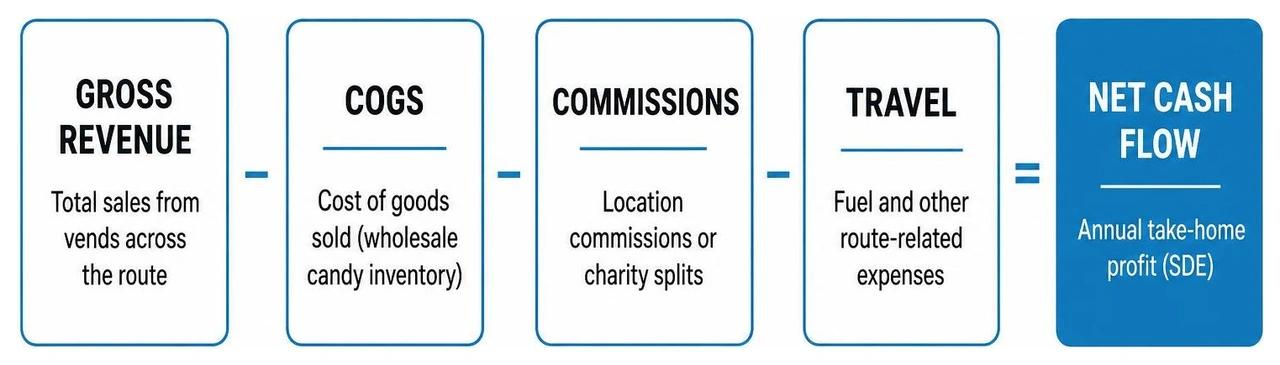
Verifying Seller Cash Flow Claims and Collection Logs
Because bulk candy vending is historically a cash-heavy, coin-operated business, verifying financials requires forensic due diligence. You cannot simply rely on a hand-written notepad or an unsubstantiated spreadsheet.
To confirm the numbers:
- Match Wholesale Candy Invoices with Revenue: Request the last 12 to 24 months of wholesale candy invoices. If an owner claims $40,000 in gross annual revenue at a 25% COGS, they must show receipts for roughly $10,000 in bulk candy purchases. If they only purchased $2,000 in candy, the revenue claims do not add up.
- Review Detailed Collection Logs: Professional operators log collections per machine per cycle. Look for consistent seasonal patterns rather than round, fabricated numbers.
- Demand Ride-Along Audits: Spend one or two service days riding along with the seller. Open the canisters, count the quarters together using a portable coin counter or coin scale, and verify that the route's daily yield matches the seller's historical logs. For a step-by-step checklist on structuring these inspections, review our tutorial on how to properly buy vending machine routes.
- Tax Return Reconciliation: Request Schedule C or corporate tax filings. Sellers may claim they underreported cash to the IRS, but you should only pay a purchase multiple based on provable, documented income.
Due Diligence: Equipment, Contracts, and Commissions
Mechanical reliability is the lifeblood of bulk vending. Because mechanical machines do not require electricity or complex circuit boards, their overhead is minimal, but neglected hardware can destroy route profitability through jams and lost sales.
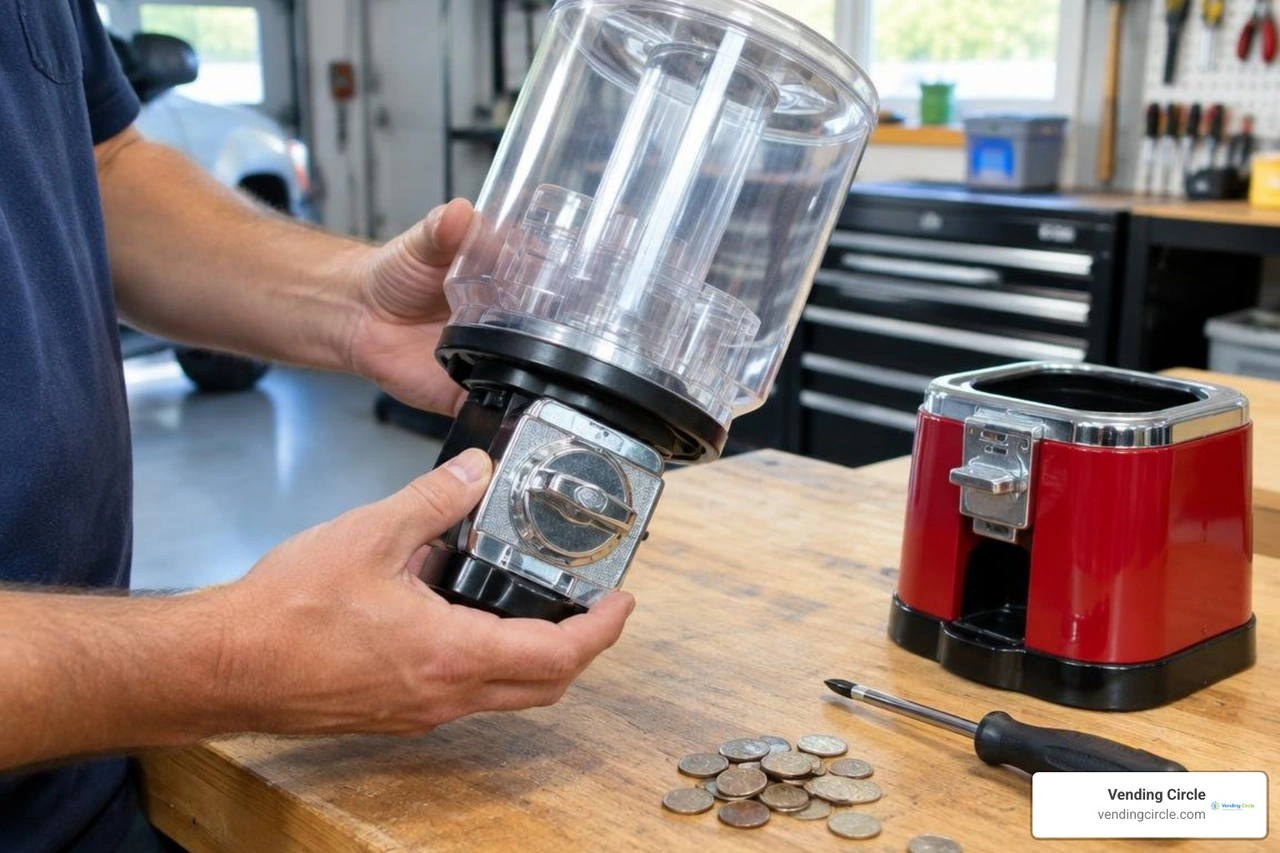
Before making an offer, you must know what hardware is on the street. High-end commercial units like Beaver, Northwestern, Oak, and Eagle are built to endure decades of commercial use. Cheap import knockoffs, however, suffer from brittle plastic globes, stripped coin gears, and fragile locks that invite vandalism. If you are comparing equipment packages, take time assessing bulk candy machines for sale to know what replacement parts cost.
Inspecting Bulk Vending Equipment and Canister Condition
During your physical audit, inspect every head for:
- Coin Mechanisms: Test each coin mech with nickels, dimes, bent quarters, and foreign slugs. A quality metal Beaver or Northwestern mech should reject incorrect coins cleanly without jamming the rotary wheel.
- Globe and Canister Plastics: Check for UV yellowing, hazing, or hairline fractures. Sunlight-exposed globes become brittle and crack, leading to moisture leaks that ruin candy.
- Dispensing Wheels: Ensure candy wheels have adjustable brush housings. If the brush housing is worn down, the wheel will crush candy (such as M&Ms or candy-coated pieces), creating sticky residue inside the globe.
- Key and Lock Integrity: Ensure all machines share keyed-alike systems across tubular or barrel locks. If a 50-machine route comes with 30 different keys, you will face an operational headache on service days.
Evaluating Location Agreements and Commission Rates
How secure are the locations? In bulk candy vending, formal long-term leases are rare; most independent locations operate on handshake agreements, month-to-month contracts, or 30-day cancellation terms.
Review the commission splits across every stop:
- Commission-Based Accounts: Typically range from 10% to 20% of gross revenue. Some high-traffic retail stores demand up to 25%, but anything higher compresses your margins unsustainably.
- Charity Sticker Accounts: Historically, many bulk operators placed machines by donating a flat monthly fee ($1 to $3 per machine) or a small percentage of proceeds to a registered charity, placing a sticker on the machine. Ensure these arrangements are compliant with local solicitation laws.
- Zero-Commission Placements: Many employee breakrooms, auto-repair waiting areas, and small retail shops welcome a candy machine as a free amenity for their staff and customers without requesting a commission check.
Before closing the deal, study how to protect your placements by formalizing vending machine agreements. Furthermore, evaluate if the current stops align with best practices for identifying prime vending machine locations, prioritizing spaces with prolonged customer dwell times like laundromats, family fun centers, barbershops, and tire shops.
Route Operations, Workload, and Expansion
Operating a candy route is one of the most flexible businesses available. Unlike perishable food or micro-market routes that demand restocking multiple times a week, bulk candy has a long shelf life, allowing operators to service accounts on bi-weekly, monthly, or even every-other-month cycles.
For a broader perspective on route operations across the automated retail industry, consult our complete vending machine routes guide.
Service Schedules and Time Management by Route Size
Your weekly operational hours depend entirely on route density—how close your machines are to one another.
- Small Routes (20–40 Machines): Requires roughly 4 to 8 hours per week (or one full Saturday every two weeks). An operator can easily service 15 to 20 machines in a single afternoon if they are tightly clustered along commercial corridors.
- Mid-Sized Routes (50–100 Machines): Demands 10 to 15 hours per week. Machines are typically split into two geographic zones, servicing Zone A on week one and Zone B on week two.
- Large Commercial Portfolios (300+ Machines): Operates on a structured 4-to-8-week cycle, often requiring 20 to 35 hours per week of route driving, cash sorting, and inventory staging.
The service routine at each stop is straightforward:
- Unlock the top lid or back door.
- Pull the cash box or empty the loose coin tray into your heavy-duty bank bag.
- Top off the candy or capsule canister, rotating older stock to the front.
- Wipe the outside of the globe and stand with an anti-static food-safe cleaner.
- Cycle a quarter through the mechanism to ensure smooth mechanical operation.
Best Practices When Taking Over a Candy Machine Route for Sale
When taking over an existing route, your first 60 days determine your long-term retention rate. If you are actively searching for vending machine routes for sale, execute these transition steps immediately after closing:
- In-Person Seller Introductions: Have the seller personally introduce you to the location manager or business owner. A warm introduction preserves goodwill and prevents the location from using the ownership change as an excuse to kick the machine out.
- Optimize the Product Mix: Don't assume the previous operator was running optimal candy selections. Replace slow-moving products with top performers (like peanut M&Ms, Mike and Ike, or Skittles). Adding a toy capsule or 1-inch bouncy ball dispensing wheel can boost head earnings by 30% to 50% without spoilage risks.
- Implement a 60-Day Trial for Weak Stops: If certain stops generate less than $15 per month, do not let them drag down your route efficiency. Give the location 60 days with fresh product; if sales do not improve, pull the equipment and relocate it to a higher-traffic venue.
Financing Options and Managing Hidden Operational Risks
Acquiring a route requires upfront capital for both the purchase price and operational working capital (inventory reserves, vehicle fuel, spare parts, and coin counting hardware).
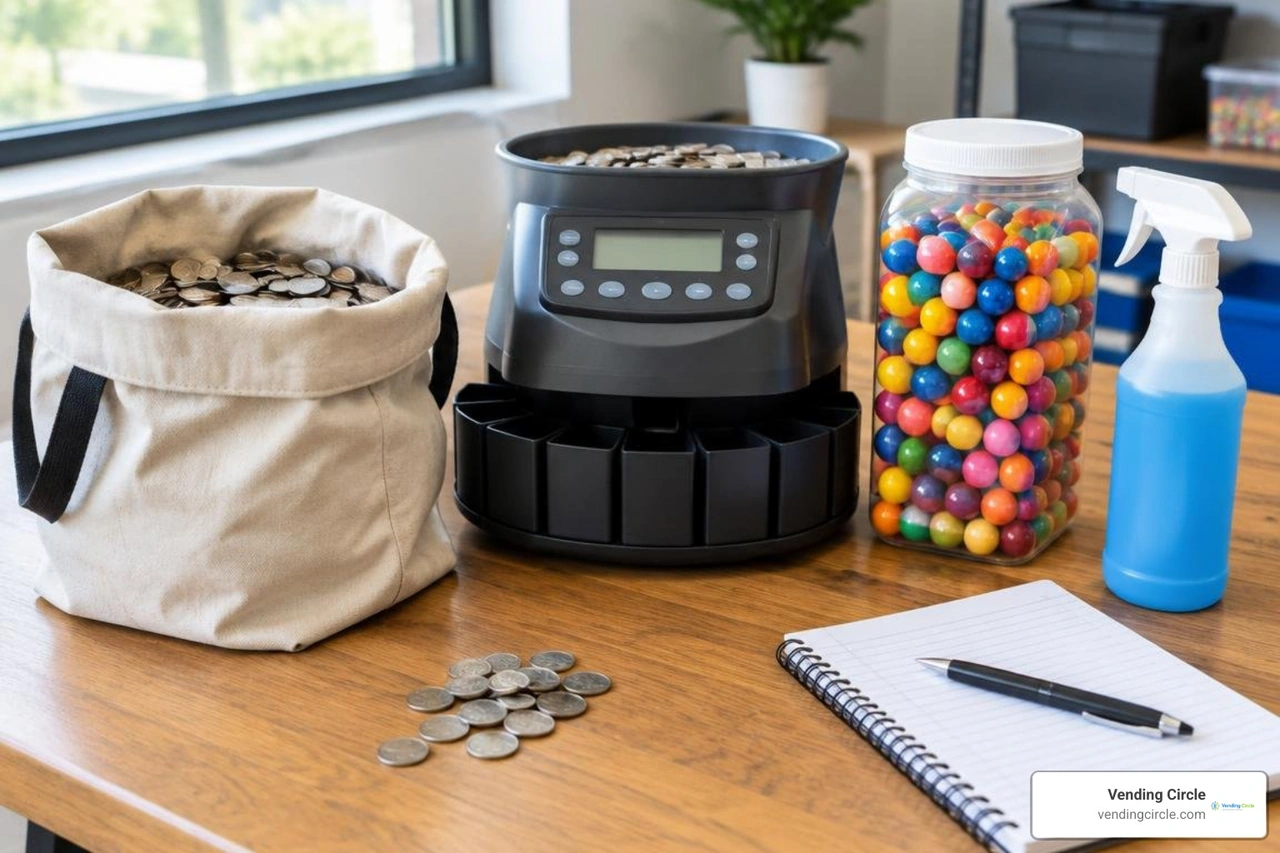
Securing Financing for a Candy Machine Route for Sale
Because mechanical vending routes possess tangible assets and clear historical cash generation, several financing avenues exist. To explore broader funding mechanisms across automated retail, check out our guide on options for vending machine financing.
- Seller Financing: The gold standard for route acquisitions. Buyers typically put down 20% to 40% in cash, with the seller carrying the remaining balance over 12 to 24 months at a modest interest rate (6% to 10%). This aligns the seller's interests with your success, ensuring they provide accurate training and smooth location handovers.
- SBA Microloans: For routes priced between $10,000 and $50,000, Community Development Financial Institutions (CDFIs) and SBA Microloan programs offer low-interest funding with terms extending up to 6 years.
- Equipment & Third-Party Asset Loans: If the route includes hundreds of high-grade commercial heads (Beaver or Northwestern), asset-backed lenders may finance a portion of the hard equipment value.
Mitigating Spoilage, Machine Jamming, and Location Turnover
While bulk candy vending is straightforward, failing to anticipate operational risks can erode your profits:
- Product Spoilage & Heat Degradation: Storing candy in non-climate-controlled garages or vehicles during summer months will ruin your inventory. Chocolate will bloom or melt into a solid block, and gummy candies will fuse together. Always store bulk inventory in a cool, dry environment (below 72°F / 22°C) and avoid placing chocolate heads in sunny storefront windows.
- Mechanical Jams and Vandalism: Use specialized candy wheels for irregular candies and gumball wheels for round stock. If a customer jams a foreign object into the coin mechanism, having quick-swap spare mechanisms in your service bag allows you to fix the machine in 60 seconds without losing the location's revenue.
- Location Churn: Businesses close, remodel, or change hands. Expect an annual location turnover rate of 5% to 10%. Protect your total revenue by scouting backup spots continuously. You can track opportunities by locating new vending machine routes for sale near me to keep your pipeline full of replacement placements.
Frequently Asked Questions About Buying Candy Routes
How much can an average bulk candy route earn annually?
A single, well-placed bulk candy machine typically generates $50 to $100 gross per month ($600 to $1,200 per year). With product margins between 70% and 80%, an operator nets roughly $500 to $1,000 per machine per year after COGS and commissions. A 30-machine route can generate $15,000 to $30,000 in net annual cash flow, while large-scale regional portfolios of 400+ machines can net $40,000 to $100,000+ depending on route efficiency and head counts.
How many hours per week are required to service the machines?
For a small-to-medium route of 30 to 60 machines, the operational commitment is only 4 to 10 hours per week. Because bulk candy and toy capsules do not spoil rapidly, machines only require servicing once every 4 to 8 weeks. Operators can batch collections into one or two weekend service days per month.
How do I verify cash revenue without digital point-of-sale data?
To verify cash revenue on an all-cash mechanical route:
- Audit wholesale inventory purchase receipts from suppliers to calculate implied product turnover.
- Review historical collection sheets tracking quarter counts per head over 12+ months.
- Conduct mandatory ride-alongs during your due diligence contingency period, counting the cash directly out of the coin trays across a representative sample of machines.
Conclusion
Acquiring an existing candy vending route offers a proven, rapid shortcut to automated retail cash flow. By stepping into established business relationships, you bypass the friction of cold calling, placement rejections, and equipment assembly. However, lasting profitability requires rigorous due diligence: verify every cash claim through inventory purchase matching, inspect the mechanical integrity of each dispensing head, and ensure the route is geographically concentrated.
At Vending Circle, our mission is to empower operators at every stage of their journey. Through manufacturer-direct supply discounts, weekly live coaching Q&As, and an active operator community, we give you the tools and insights needed to scale a sustainable vending portfolio.
Ready to master route acquisitions, contract negotiation, and operational scaling? Explore training programs at Vending Circle Courses and start building your automated retail income today.