How to Buy a Vending Machine Route Without Overpaying
To learn how to buy vending machine routes, start by buying the income and location relationships, not just a group of machines. Find routes through brokers, marketplaces, local operators, and industry contacts; then verify sales, inspect every machine, confirm that location agreements can transfer, and price the deal from verified annual cash flow.
A sound first offer is usually based on Seller's Discretionary Earnings (SDE), adjusted for machine condition, route density, and the strength of each location contract. Many established routes sell around 1x to 3x annual net profit, but weak verbal agreements, old equipment, or a route dependent on one large account should push the price down.
Buying an existing route can create day-one revenue. It can also transfer costly problems: failing refrigeration, expired inventory, unprofitable stops, missing card readers, or locations that can leave after closing. The goal is simple: pay for cash flow you can prove and retain.
I am Manuel Mojica, founder of Vending Circle and an experienced vending operator through MM Healthy Vending. I help operators understand how to buy vending machine routes with a focus on practical due diligence, profitable equipment, and stronger day-to-day operations.
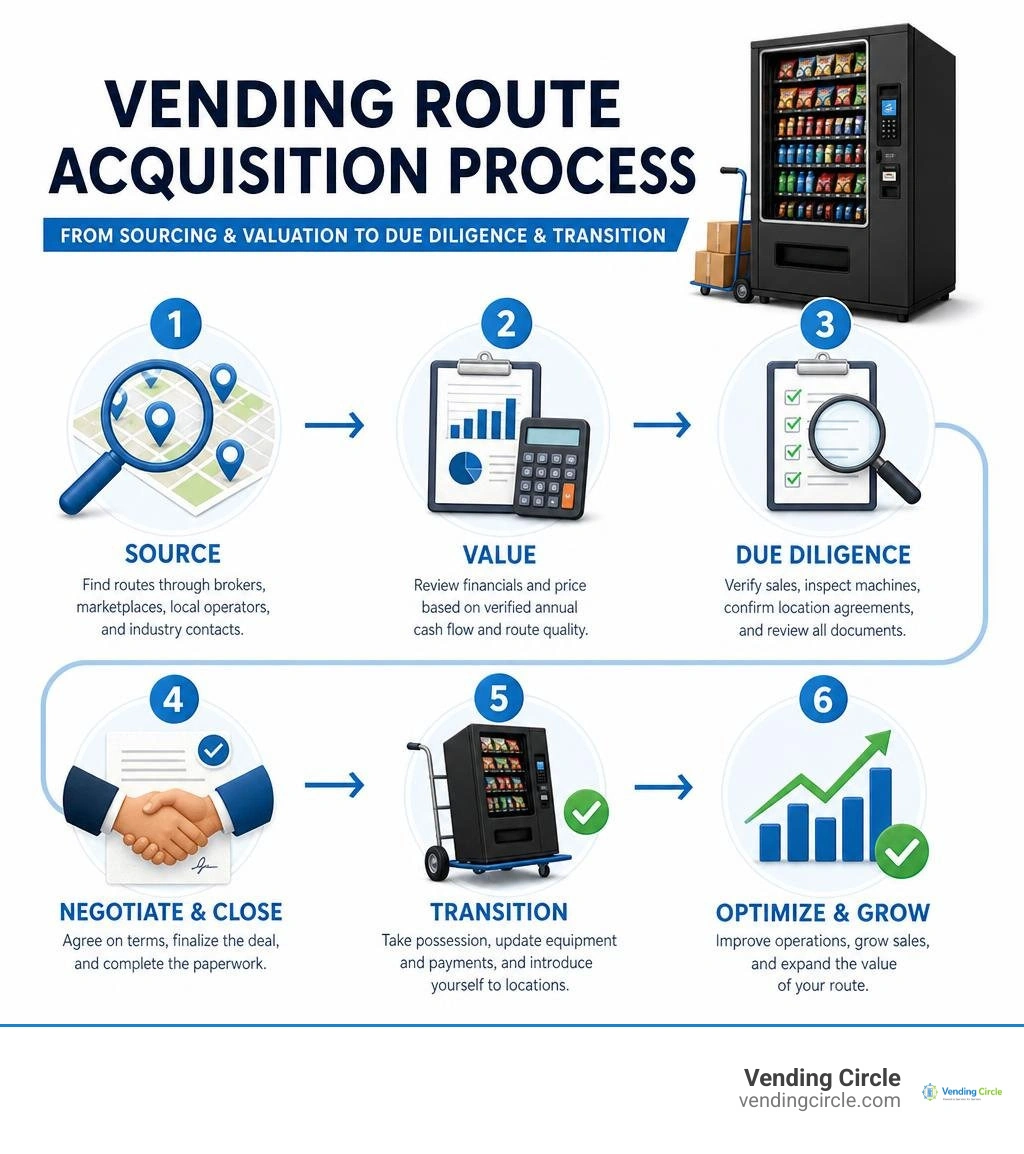
How to buy vending machine routes terms to know:
What a Vending Route Includes: Buying vs. Building Fresh
When you acquire an established route, you are purchasing a functioning automated retail business. A complete route package generally includes the physical machines, active placement agreements, immediate cash flow, established wholesale accounts, spare components, and the historical data needed to run restocking schedules efficiently.
Starting fresh requires scouting locations, cold-calling property managers, negotiating placement contracts from scratch, purchasing hardware, and waiting months for consumer traffic patterns to stabilize. Purchasing an existing operation bypasses that trial-and-error phase.
| Feature / Metric | Buying an Existing Route | Building from Scratch |
|---|---|---|
| Day-One Cash Flow | Immediate (first collection begins week one) | Zero (requires 3–9 months ramp-up) |
| Location Acquisition | Turnkey placement agreements included | Manual pitching, cold calling, and contract drafting |
| Average Initial Capital | $30,000 to $370,000+ depending on scale | $3,000 to $6,000 per new machine plus inventory |
| Hardware Setup | Pre-configured, installed on-site | Delivery logistics, moving, and onsite setup needed |
| Supplier Accounts | Established pricing tiers and order history | Must set up new distributor accounts from scratch |
| Primary Risk | Inheriting deferred maintenance or weak agreements | Securing low-traffic or unprofitable placements |
For an in-depth breakdown of operational models, review our vending machine routes guide 2026.
The primary risk to manage when buying a route is customer concentration. If a single facility generates more than 20% to 25% of the route's total gross sales, any disruption at that account—such as a corporate relocation or management change—can eliminate your net margin overnight.
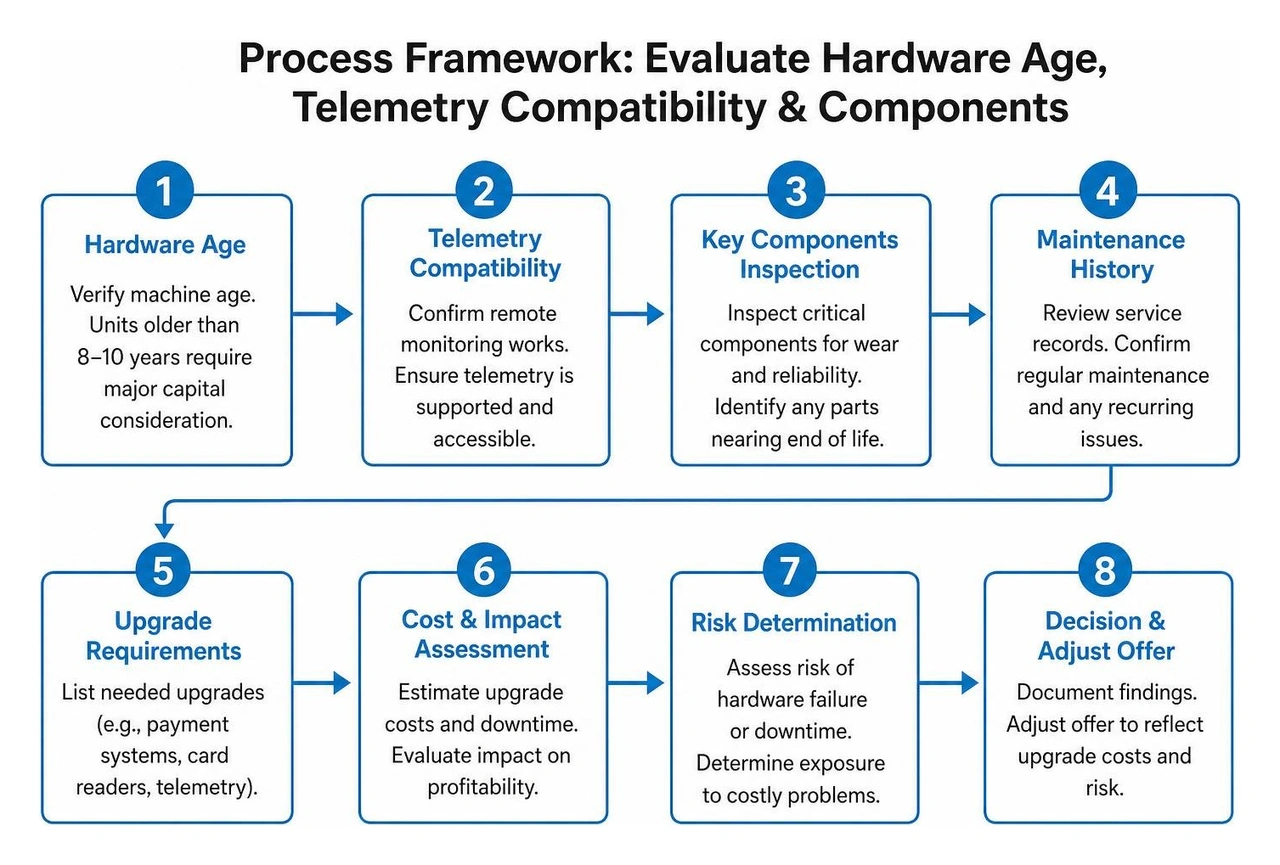
Evaluating Hardware and Technology Upgrades
Hardware condition directly dictates operational margins. A new combination snack-and-drink machine costs $3,000 to $6,000, while refurbished units run $1,200 to $3,000. If a route consists of units older than 8 to 10 years, factor substantial capital expenditure into your offer.
Key components to inspect include:
- Refrigeration Units: Compressors cost $600+ to replace, excluding diagnostic labor. Ensure temperatures hold steadily under 40°F (4°C) for cold food and drink sections.
- Bill Validators & Coin Mechanisms: Test every unit with varied bill denominations and worn currency to ensure acceptance rates exceed 95%.
- Cashless Telemetry: Modern consumers expect tap-to-pay functionality. If you need to retrofit existing equipment, buy a vending machine with card reader capability to secure an immediate 20% to 30% sales lift over cash-only setups.
Always establish the physical replacement value of the hardware as your pricing floor. If the business lost every placement agreement tomorrow, the liquidation value of the machines and inventory should represent a tangible financial backstop.
How to Value a Local Vending Route Accurately

Vending machine routes are standardly valued using a multiple of Seller's Discretionary Earnings (SDE). SDE represents the total financial benefit generated by the business for a single full-time owner-operator, calculated as:
$$\text{SDE} = \text{Net Profit} + \text{Owner Salary} + \text{Discretionary Add-backs} + \text{Depreciation} + \text{Interest}$$
Across the United States, routes trade across a wide spectrum:
- Informal Routes (Median 0.6x Multiple): The national median asking price is approximately $30,000 against $54,000 in reported cash flow. This low median multiple (~0.6x) reflects informal handshake deals, undocumented cash sales, and aging equipment lacking remote telemetry.
- Standard Established Routes (1x to 2x Multiple): Operations with verifiable bank deposits, clean books, and machines under 7 years old.
- Premium Commercial Routes (1.5x to 2.5x+ Multiple): Modern operations featuring multi-year transferable contracts, remote telemetry monitoring, diversified accounts, and cashless payment readers.
For additional transaction context and market standards, consult How to Buy a Vending Machine Route (2026 Guide) | Wendor.
Multi-Year Contracts and Revenue Stability
The durability of a route's earnings depends on location contract terms. Premium operations secure high-footfall spots across medical centers, manufacturing plants, and corporate facilities. Learn how to spot prime locations by reviewing our guide on great locations for vending machines.
Examine the specific clauses governing placement agreements:
- Transferability and Assignment: Contracts must permit assignment to a buyer without requiring a complete renegotiation of terms.
- Commission Structures: Standard property commission rates range between 10% and 20% of gross revenue. Higher commissions squeeze margins unless footfall volume compensates.
- Term Length and 30-Day Cancellation: Be aware that standard agreements often include a 30-day cancellation clause for cause. If an agreement is built purely on a personal relationship with the previous owner, that contract carries higher operational risk.
Step-by-Step Blueprint: How to Buy Vending Machine Routes
Following a structured acquisition process prevents costly mistakes and ensures legal protection:
- Target Identification & Profile: Determine your geographic service radius, available capital, and preferred route size (e.g., 5 to 25 machines).
- Initial Contact & NDA: Execute a Non-Disclosure Agreement (NDA) with the seller or broker to review financial summaries.
- Offer Submission (Letter of Intent): Draft an LOI establishing purchase price, earnest money terms, due diligence contingency periods, and seller transition commitments.
- Formal Due Diligence: Complete an in-depth audit of telemetry logs, physical hardware, bank statements, and location contracts.
- Asset Purchase Agreement (APA): Use an APA rather than a stock purchase to acquire specific assets without assuming the seller's past corporate liabilities.
- Closing & Onboarding: Release escrow funds upon successful assignment of location agreements, supplier transfers, and execution of a non-compete covenant within your operating territory.
Maintaining structured stocking routines post-acquisition is critical; implement proper vending machine inventory management protocols from day one to avoid empty product coils.
Sourcing Strategies on How to Buy Vending Machine Routes
Profitable route acquisitions are found across both public marketplaces and direct, private outreach:
- Business Broker Portals: Check listings on commercial transaction platforms where retiring operators list their businesses.
- Curated Route Directories: Browse active listings on our routes for sale vending machine board to identify local opportunities.
- Direct Operator Outreach: Contact local operators in your area. Many independent route owners who are nearing retirement have not formally listed their businesses but are open to selling.
- Equipment Suppliers and Technicians: Local repair technicians and equipment distributors know which operators are scaling back or preparing to exit.
Structuring Financing on How to Buy Vending Machine Routes
Financing strategies depend on deal size:
- Deals Under $150,000: Small routes are usually funded via cash reserves, personal lines of credit, or seller financing. In a seller-financed deal, you make an initial down payment (e.g., 50%) and pay the remaining balance over 12 to 36 months using route cash flow.
- Deals Over $150,000 (SBA 7(a) Loans): Larger operations with strong documentation qualify for Small Business Administration (SBA) financing. For complete underwriting criteria, review this How to Buy a Vending Machine Route (SBA Guide).
Key SBA acquisition parameters include:
- A Debt Service Coverage Ratio (DSCR) of at least 1.25x (ideally 1.5x to 2.0x).
- A minimum 10% equity injection (which can often be structured as 5% buyer cash combined with a 5% seller standby note).
- 24 to 36 months of verified federal corporate tax returns demonstrating consistent operating profitability.
- Working capital reserves: Budget $20,000 to $40,000 in liquid capital per $500,000 in annual revenue to support wholesale inventory cycles.
Comprehensive Due Diligence Checklist for Route Buyers
Never accept informal spreadsheets at face value. Reconcile reported numbers with primary financial and operational source records.
A restock ride-along is essential. Accompanying the seller on their route lets you verify physical machine meters, assess foot traffic, test refrigeration, and meet facility managers in person.
Additional insights on emerging retail formats can be explored in Buy Vending Machine Route 2026: Your Ultimate Guide to a Profitable Future.
Location Contract Audits and Landlord Relations
Examine every placement contract for:
- Assignment Rights: Does the contract require advance written landlord consent prior to ownership transfer?
- Termination Provisions: Are cancellations permitted without cause on short notice, or is a breach of service standards required?
- Commission Compliance: Cross-reference paid commissions against stated revenue percentages to confirm no unpaid obligations carry over.
For strategies on securing new placements or negotiating contract renewals, reference our guide on vending machine locations.
Hidden Costs and Ongoing Operating Expenses
Running a profitable route requires realistic operational budgeting. A 50% gross margin on snacks and beverages must cover all overhead expenses before delivering take-home net profit.
- Credit Card Processing & Telemetry: Merchant gateway fees generally average 5% to 6% per transaction on small ticket sales, alongside monthly cellular telemetry data fees ($5 to $10 per machine).
- Vehicle Operation & Maintenance: Fuel, commercial auto insurance, and vehicle repairs represent a major variable cost. Route density—grouping machines close together geographically—keeps travel time and fuel costs manageable.
- Product Sourcing & Bulk Ordering: Maintain competitive purchasing terms by reviewing our wholesale vending supplies guide 2026.
- Licensing, Permits, and Taxes: Municipalities often charge per-machine operating decals ranging from $10 to $250 annually. General commercial liability insurance ($1,000,000 to $2,000,000 coverage limits) is standard for corporate placements.
Frequently Asked Questions About Buying Vending Routes
How much cash do you need to purchase an existing vending route?
Entry-level micro-routes (3 to 6 machines) typically sell for $5,000 to $20,000. Mid-sized commercial routes (10 to 30 machines) range from $30,000 to $100,000+, while larger distribution routes exceed $300,000. In addition to the purchase price, you should retain $3,000 to $10,000 in liquid working capital for inventory and unexpected machine repairs.
Can property managers cancel location agreements after a sale?
Yes, if the contract contains a standard 30-day cancellation clause or if placement relies on an informal verbal agreement. You can protect your investment by requiring written assignment agreements, meeting property managers alongside the seller before closing, and maintaining reliable, clean, and well-stocked machines.
How long should the seller transition period last?
Insist on a structured 30-to-60 day handover period written into your Asset Purchase Agreement. The seller should introduce you to property managers, share access codes, demonstrate routine maintenance procedures, and help set up wholesale accounts.
Conclusion
Buying an existing vending machine route offers immediate cash flow and proven placements, bypassing the initial setup phase. Long-term profitability, however, comes down to rigorous due diligence: verifying cash collections against bank deposits, inspecting machine components, confirming contract transferability, and acquiring the route at an accurate earnings multiple.
At Vending Circle, our community helps new and experienced operators navigate acquisitions, optimize route logistics, and source hardware at scale. When you are ready to evaluate your first route deal, join our network and explore our vending machine operator courses to access deal analysis tools, operational templates, and ongoing mentorship.