Why Inventory Vending Solutions Matter Now
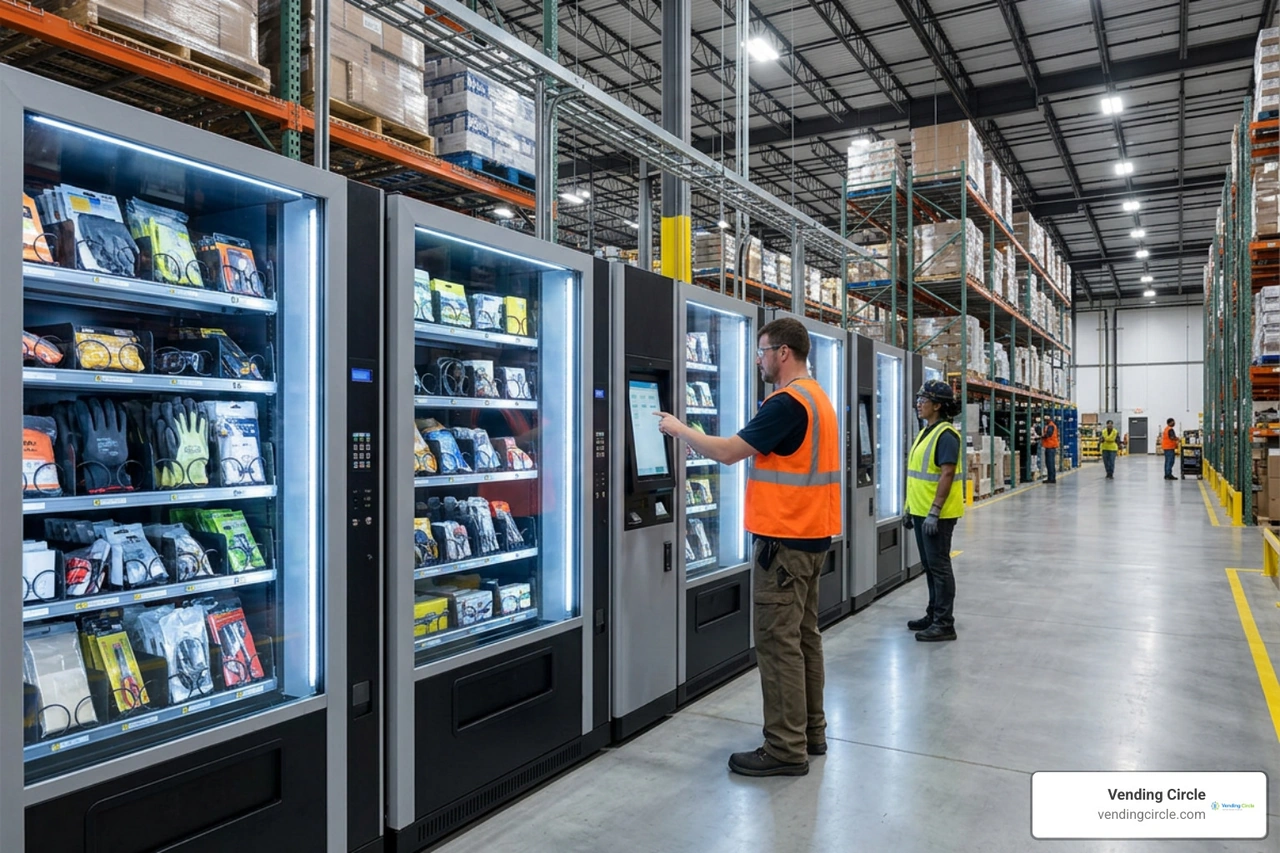
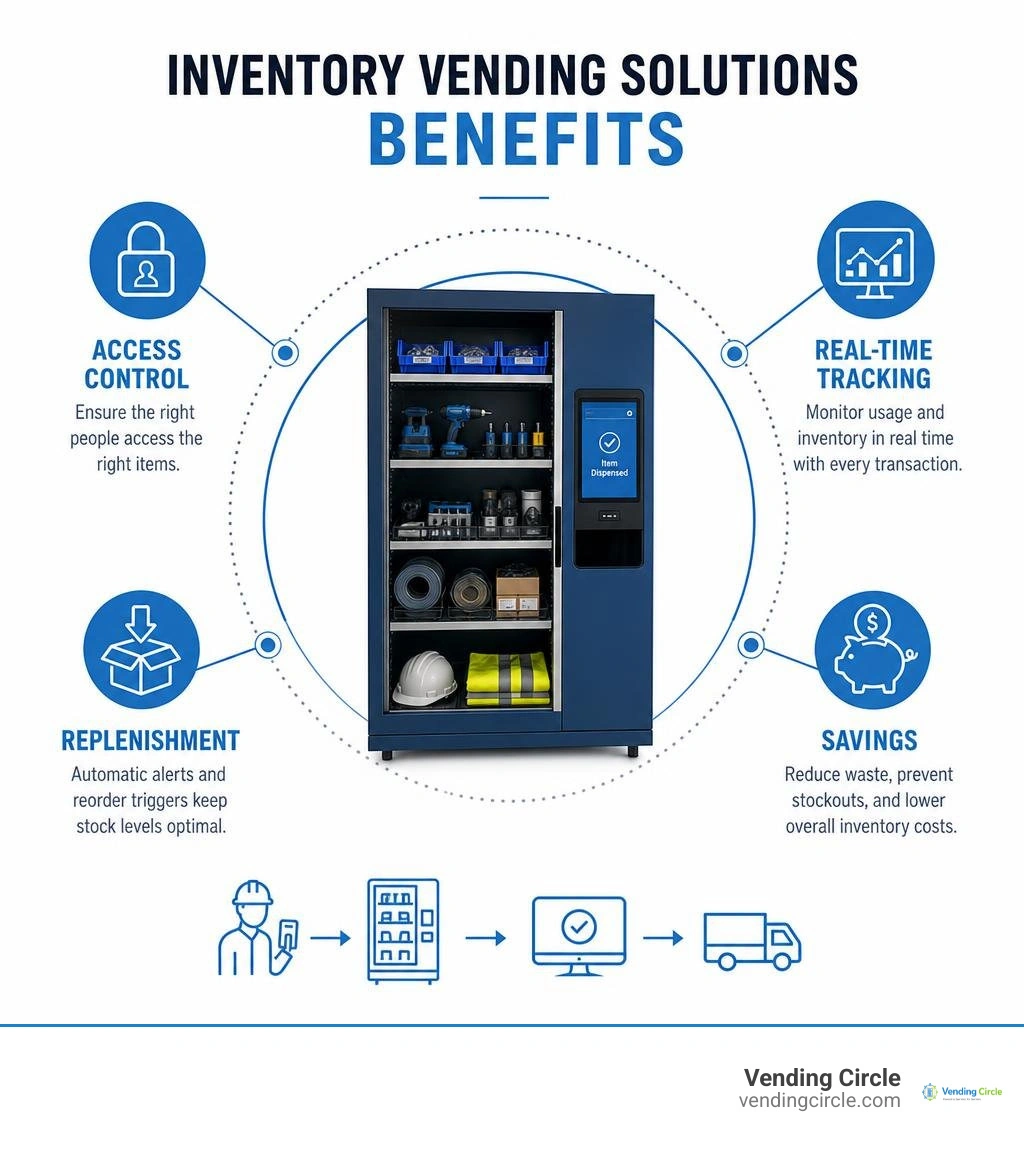
Inventory vending solutions are automated cabinets, lockers, carousels, or machines that securely issue tools, PPE, parts, and supplies while recording who took each item and when. They give operators and facilities a simple way to control stock, reduce waste, automate reorders, and keep critical items available at the point of use.
| What they do | Why it matters |
|---|---|
| Track every transaction by user | Creates accountability and helps curb loss and overuse |
| Control access with badges, PINs, or apps | Limits supplies to approved users and roles |
| Monitor stock in real time | Replaces error-prone manual counts |
| Trigger replenishment at set levels | Helps prevent costly stockouts and downtime |
| Place inventory near the work | Reduces trips to a central storeroom or tool crib |
The need is real. Manual inventory counting often produces only 63-65% accuracy, while automated tracking can reach 99% or better. In industrial settings, tighter control can reduce material consumption by 20-40% and on-hand inventory by 20-30%.
For vending operators, the same principle applies: better visibility means less cash tied up in products, fewer surprise outages, and less friction when sourcing inventory across machines and suppliers. The best setup is not always the biggest machine. It is the hardware, software, access rules, and replenishment process that fit the items being managed.
I am Manuel Mojica, founder of Vending Circle and former owner of MM Healthy Vending, where I learned how critical dependable equipment, sourcing, and inventory control are to profitable operations. My background in Cyber Operations for the U.S. Air Force also shapes how I evaluate inventory vending solutions through security, accountability, and practical execution.
How Inventory Vending Solutions Work and Key Hardware Types
At their core, inventory vending solutions combine physical dispensing mechanisms with point-of-use access control software. Instead of relying on sign-out sheets or open shelves in a central tool room, items live in secure hardware placed directly on the shop floor, warehouse dock, or maintenance bay.
When an employee needs a part, safety glasses, or a handheld scanner, they authenticate themselves at the machine. The unit validates their identity, checks their permission levels, unlocks the specific door or dispenses the requested item, and updates the central inventory database in real time.
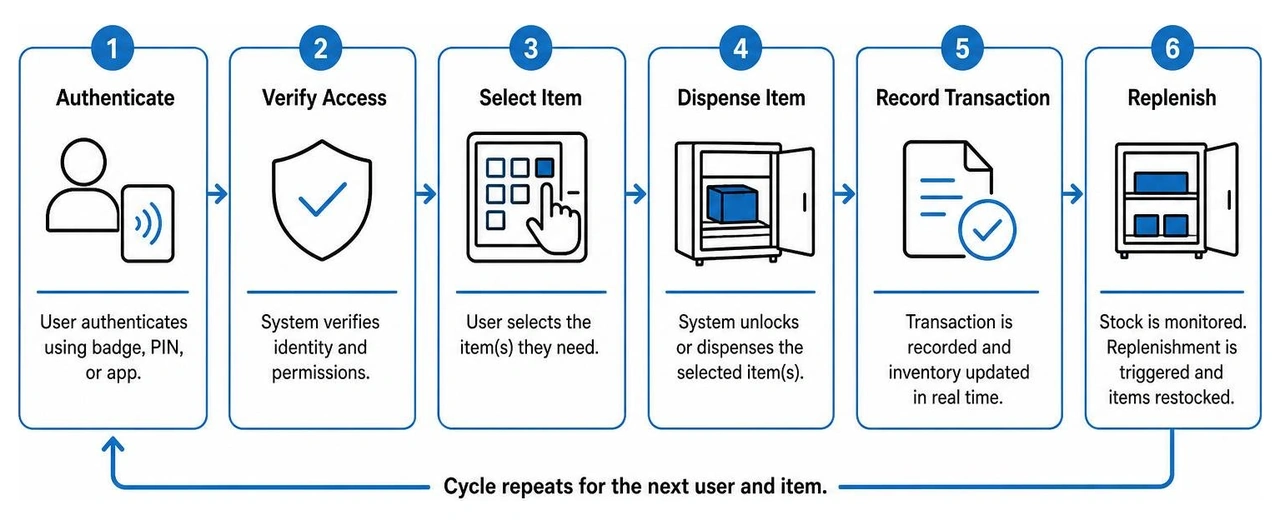
Understanding hardware options is essential because no single machine type efficiently stores every shape and size of inventory. Choosing the wrong form factor leads to jam-ups, wasted spatial volume, or high dispensing costs per item. For a broader foundational overview of inventory tracking strategy, check out our guide on Vending Machine Inventory Management.
To select the right architecture, facilities evaluate physical form factors based on item dimensions, storage density, and access protocols:
| Form Factor | Best Suited For | Key Advantages | Typical Capacity | Considerations |
|---|---|---|---|---|
| Coil / Helix Machines | Uniform, small-to-medium consumables (gloves, earplugs, small drill bits) | High item density for basic uniform packaging; low upfront machine cost | 60–80 SKUs per unit | Requires uniform packaging; prone to jams with delicate or odd-shaped parts |
| Carousel Units | Small-to-medium specialized tools, kits, cutting inserts, and delicate components | High density (up to 945 compartments); smooth counter-rotating access without drop impact | 200–945 compartments | Higher initial mechanical complexity; requires structured compartment allocation |
| Smart Lockers | Large power tools, handheld barcode scanners, test instruments, laptops | Individual door locking; transparent view doors; integrated charging and LAN ports | 10–30 doors | Lower total SKU density per square foot; ideal for asset return workflows |
| High-Density Motorless Cabinets | High-volume MRO parts, boxed consumables, mixed SKU collections | SmartBins with weight sensors or magnetic locks; motorless mechanics prevent burnout | Up to 250 SKUs per cabinet | Requires structured software bin mapping; delivers 50–70% lower dispensing cost per SKU |
To explore specialized commercial hardware variations, you can research systems like the RoboCrib® VX500 | Inventory Control Systems | Snap-on AutoCrib® and high-compartment carousels such as the IRSTOCK 945 industrial vending machine .
Evaluating Form Factors for Inventory Vending Solutions
Matching hardware form factors to part geometry is the foundation of a successful deployment. If you attempt to stuff irregular power tools into coil bays, you will experience mechanical jams and frustrated technicians. Conversely, storing boxfuls of earplugs in massive locker doors wastes valuable floor space.
- Coil & Helix Machines: Traditional coil systems stack inventory front-to-back along spiral rows. While familiar, they typically max out around 60 to 80 unique SKUs per cabinet and require products to drop into a lower retrieval bin. This makes them less suitable for delicate precision tools or heavy metal fittings.
- Carousel Drums: High-density carousels use pie-shaped rotating bins enclosed in a cylindrical cabinet. Because they do not rely on gravity drops, they safely dispense fragile cutting inserts, precision gauges, and assembly kits. Devices like the RoboCrib® VX500 | Inventory Control Systems | Snap-on AutoCrib® achieve dispense times under 10 seconds while occupying less than 10 square feet of floor space.
- Smart Lockers: Designed for oversized assets and loaner tools, smart lockers excel at asset tracking. Equipped with frameless doors, internal electrical outlets, and ethernet connections, smart lockers allow workers to check out charged handheld scanners or return high-value torque wrenches while tracking exact shift reconciliation.
- High-Density Motorless Cabinets: Modern alternatives to coil machines use motorized drawers or magnetized bins built on adjustable shelves. Systems like those detailed on Industrial Vending Machines - 250 SKU Capacity | SecuraStock pack up to 250 unique SKUs into a single footprint—roughly triple the density of standard coil units. By removing mechanical motors, these cabinets vend in 2 to 3 seconds, significantly reduce dispensing costs per SKU, and carry extended 3-year hardware warranties compared to the 12-month industry average.
Authentication Methods and Access Controls
Uncontrolled inventory environments are inherently vulnerable to human error and unaccounted loss. Automated inventory vending solutions solve this by serving as secure gateways that mandate user authentication prior to item release.
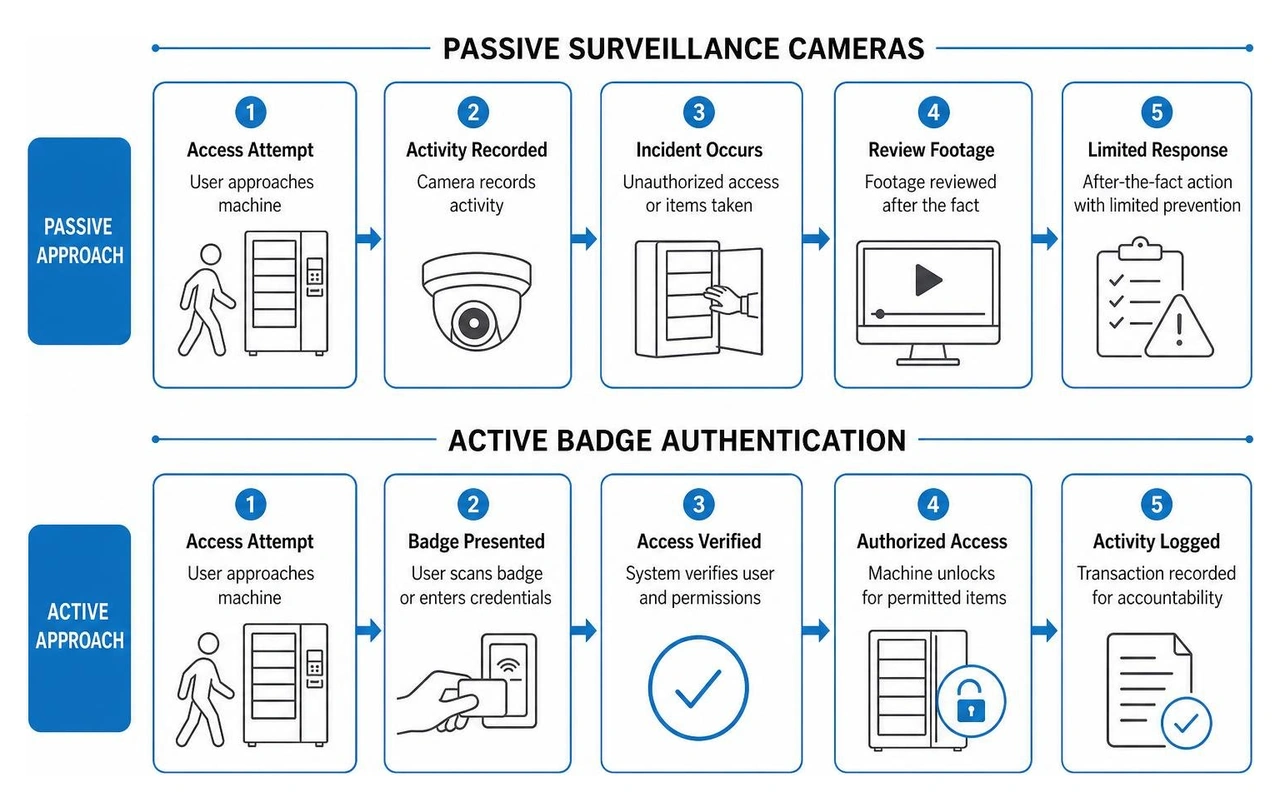
Modern point-of-use systems support multiple authentication formats:
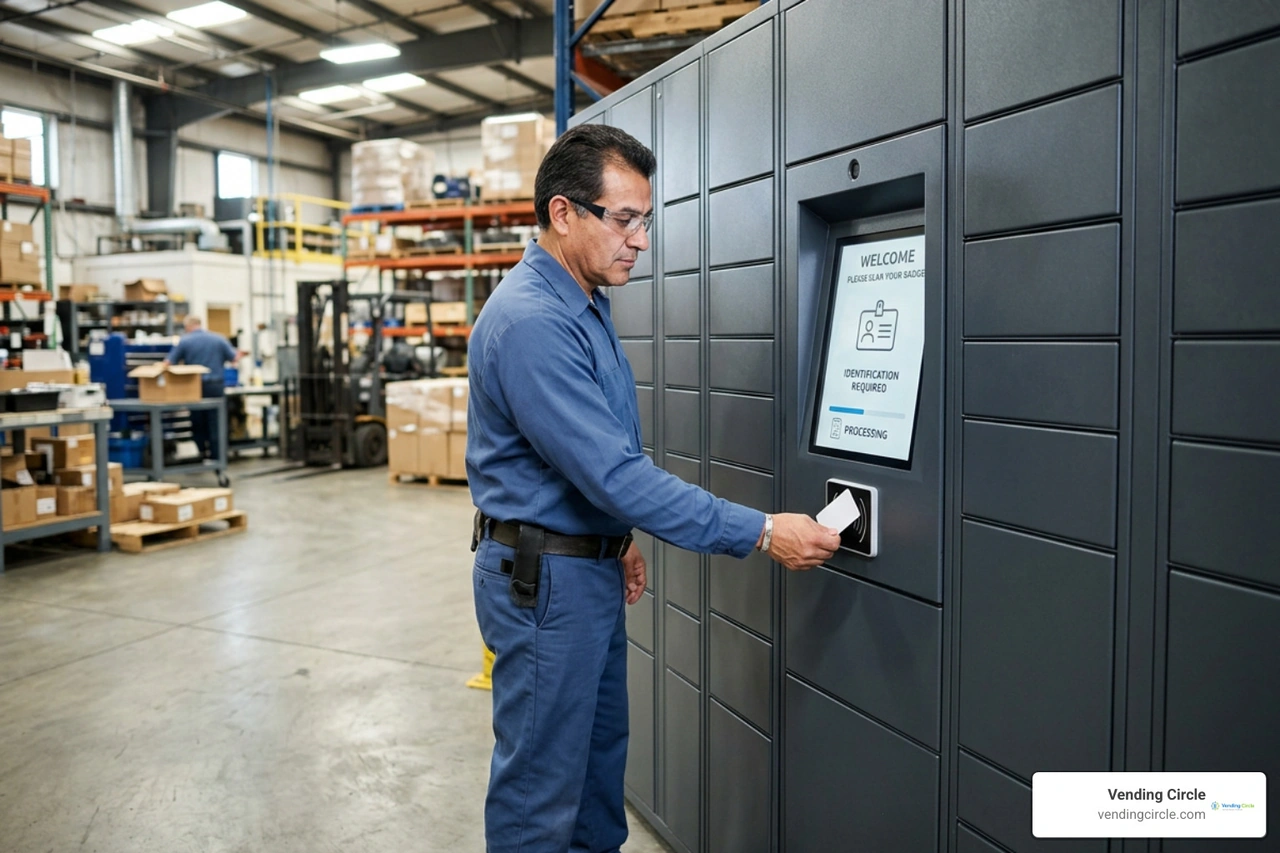
- RFID Badge Scanning: Employees swipe their existing corporate ID or proximity badge to instantly gain access based on assigned permission profiles.
- PIN & Employee ID Entry: Touchscreen interfaces allow secure access via personal PINs or badge numbers when physical credentials are misplaced.
- Mobile App Authentication: Wireless protocols enable technicians to select items via smartphone apps, triggering automated cabinet unlocks without touching public screens.
- Card Readers & Biometrics: For high-security environments, integrated magnetic stripe or chip card readers ensure strict chain-of-custody tracking. If you are upgrading your own commercial machine lineup, explore options to Buy a Vending Machine with Card Reader and review hardware choices for Vending Card Readers.
By linking user authentication directly to software permissions, managers can restrict high-value tooling to certified operators, cap daily PPE issuance per associate, and establish automated digital audit trails for complete operational transparency.
Key Operational Benefits of Automated Inventory Management
The financial impact of implementing automated point-of-use vending is substantial and immediate. Internal theft costs U.S. businesses roughly $50 billion annually, with industry research showing that 87% of warehouse theft is committed by internal employees with legitimate building access.
At the same time, manual inventory counting suffers from an alarming human error rate—present in 43% of facilities worldwide—leaving manual inventory counts with an average accuracy of just 63–65%.
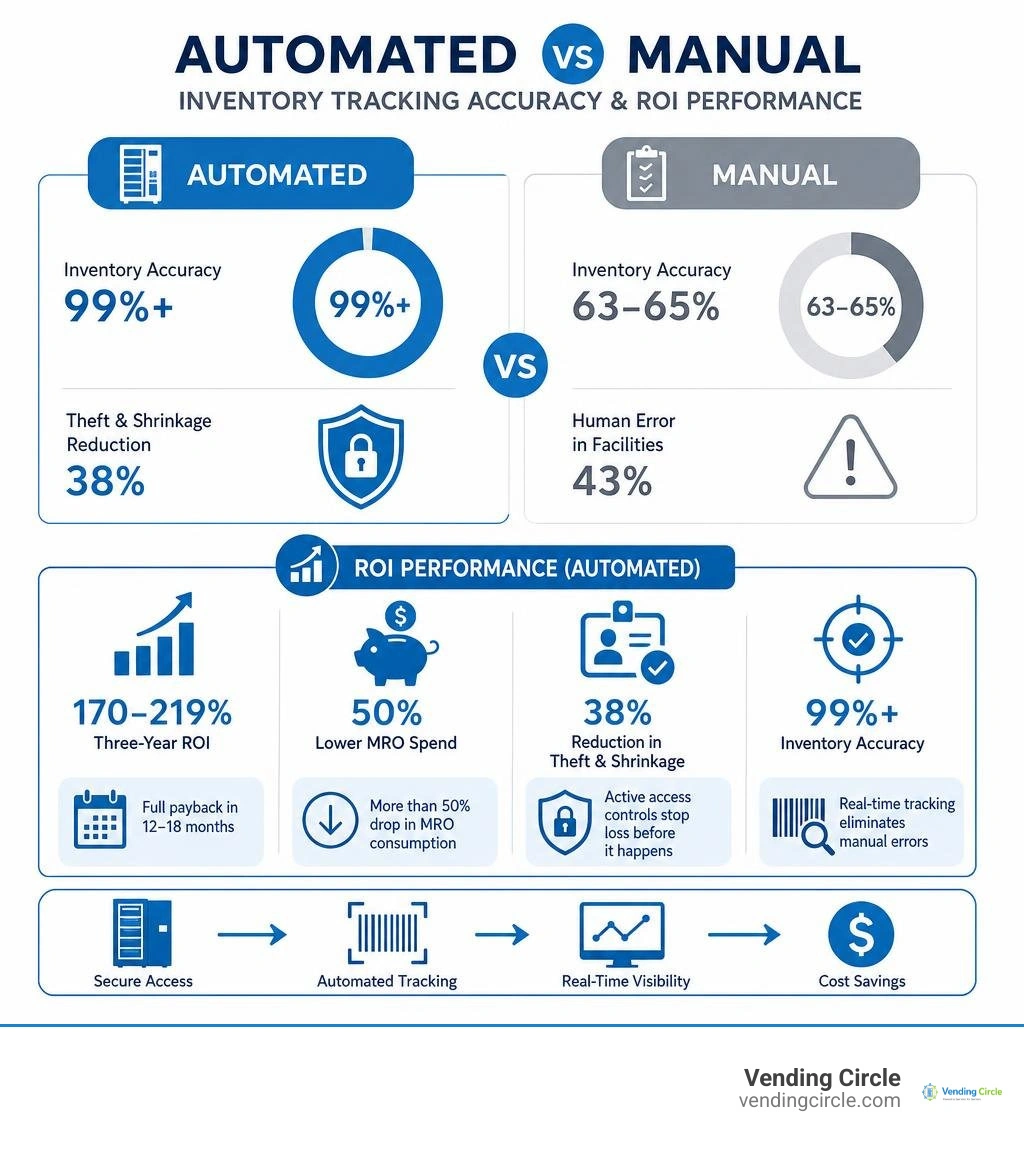
Automated inventory vending solutions transform these statistics:
- 99%+ Inventory Accuracy: Barcode, weight scale, and bin-level tracking eliminate manual accounting errors.
- 38% Reduction in Theft & Shrinkage: Replacing passive security cameras with active badge authentication stops unauthorized consumption before it happens.
- 170–219% Three-Year ROI: Facilities deploying secure distribution setups typically achieve full equipment payback within 12 to 18 months.
- 50% Lower MRO Spend: Case studies across power generation and manufacturing sites regularly show more than a 50% drop in MRO item consumption directly following vending installation.
For deeper context on industry trends, take a look at our full report on Vending Machine Industry Statistics 2026.
Reducing Material Consumption with Modern Inventory Vending Solutions
Why does automated dispensing cut material consumption by 20% to 40% almost overnight? The answer lies in the psychology of accountability combined with physical access limits.
When supplies sit on open shelves, employees often hoard extra gloves, batteries, or drill bits in their personal lockers "just in case." Unmetered items are perceived as zero-cost consumables. However, when every transaction requires a badge scan linked to an employee's name, department, and active job order number, borrowing behavior changes immediately.
Consider these real-world enterprise outcomes highlighted in industry research:
- A major automotive manufacturer saved over $800,000 annually simply by installing badge-controlled vending machines to manage a single commodity: work gloves.
- A Fortune 500 pharmaceutical facility that previously budgeted over $100,000 per year for lost or misplaced tools reduced its tool replacement budget to ZERO after implementing point-of-use checkout lockers.
- In logistics and fulfillment centers detailed on Industrial Vending for Warehousing & 3PL | SecuraStock , tracking RF scan guns ($1,500 to $3,000 per unit) via associate badge lockers cut device loss by roughly 80%.
Preventing Unplanned Downtime and Stockouts
For industrial facilities, the true cost of inventory management is not just the purchase price of parts—it is the catastrophic cost of missing them when a machine goes down. Manufacturers suffer an average of 800 hours of unplanned downtime annually, costing up to $260,000 per hour in lost throughput. Furthermore, 60% of companies report experiencing weekly supply chain disruptions.
When a critical maintenance component, specialized drill bit, or replacement sensor stocks out, entire production lines grind to a halt while technicians hunt for parts.
Point-of-use vending hardware eliminates these blind spots by providing 24/7 availability directly on the shop floor. Technicians no longer waste 20 to 30 minutes walking across giant facilities to central tool cribs. More importantly, real-time software continuously monitors stock levels against pre-set minimum thresholds. The moment inventory dips below safe limits, the system triggers an automated purchase order or alert to your supplier, guaranteeing that high-turnover parts are replenished long before a stockout occurs.
Enterprise ERP Integration and Automated Replenishment
Hardware is only half of the equation; software is where automated inventory vending solutions deliver true long-term scalability. Modern vending machines act as smart edge devices connected directly to enterprise resource planning (ERP) and warehouse management systems (WMS) such as SAP, Oracle, Plex, Microsoft Dynamics, and ServiceNow.
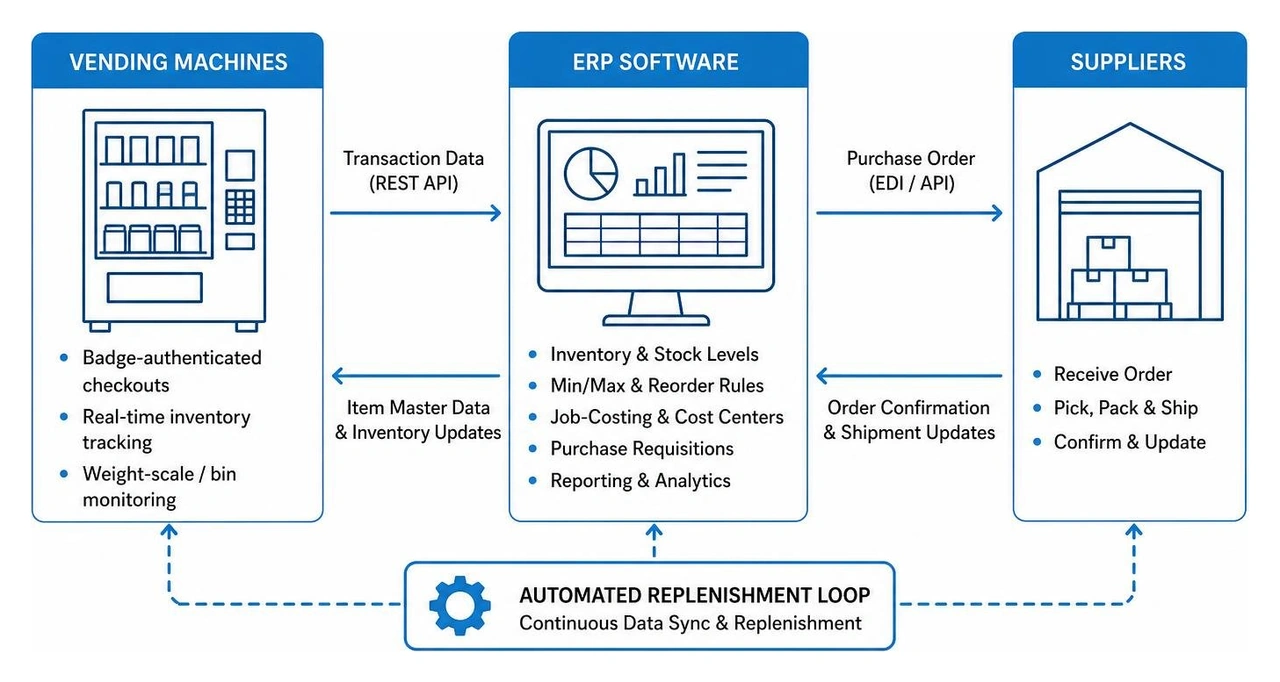
Through cloud-based software architectures and REST APIs—such as those detailed on Secure Inventory Distribution Solutions | IVM, Inc. —the system synchronizes transaction data continuously across your enterprise tech stack:
- Automated Min/Max Reordering: When stock reaches a defined reorder point, the vending software generates an automated purchase requisition or direct EDI order to your distributor without manual administrative entry.
- Job-Costing and Cost Center Allocation: Every checkout is logged against specific cost centers, work orders, or client accounts, providing precise financial accounting for Sarbanes-Oxley compliance and job profitability tracking.
- Weight-Scale & Smart Bin Monitoring: Integrated weight sensors detect exact item counts for micro-fasteners and bulk fittings, instantly updating inventory balances without requiring manual counting.
- Multi-Site Aggregation: Facilities management dashboards aggregate consumption data across multiple plants or logistics centers, allowing corporate procurement teams to negotiate vendor volume discounts and optimize safety stock across locations.
Implementation Best Practices for Facility Managers
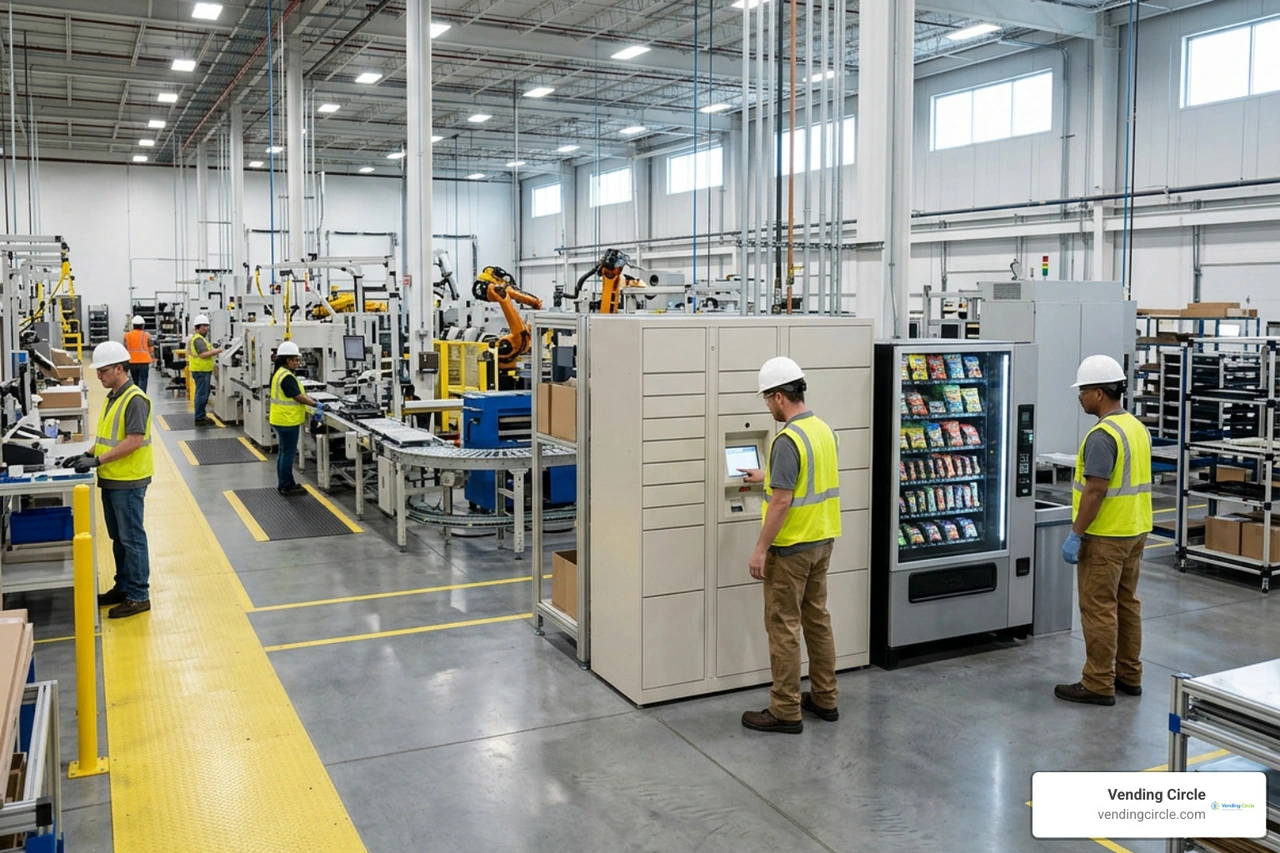
Rolling out an industrial vending initiative requires thoughtful planning across operations, IT, and shop-floor workflow. To ensure rapid adoption and high ROI, follow these proven implementation steps:
- Conduct an ABC Inventory Analysis: Prioritize high-cost, high-turnover, or critical items (Category A) for high-density vending and smart lockers. Low-cost, non-critical bulk items can remain in secondary bins.
- Select Strategic Point-of-Use Locations: Place vending hardware directly near high-traffic work zones, assembly lines, or maintenance bays. Eliminating 20-minute round trips to central storerooms saves hundreds of productive labor hours per associate annually.
- Involve End Users and Focus on UX: Shop-floor adoption depends on speed and simplicity. Select hardware with quick dispense times (2 to 3 seconds) and clear touchscreen menus so technicians can grab required tools without friction.
- Pilot Before Full Rollout: Start with a single machine or cell location to refine user permissions, test ERP software sync, and validate associate badge credentials before launching plant-wide.
- Establish Clear Supplier Partnerships: Collaborate with your industrial distributors for vendor-managed inventory (VMI) services. Many distributors will supply hardware or manage restocking routines directly, freeing up internal staff. To review comprehensive software-hardware options, explore Vended Inventory Solutions — Smart Industrial Vending & Inventory Control .
Frequently Asked Questions about Inventory Control Systems
How much do inventory vending systems reduce consumption?
Implementing point-of-use inventory vending machines typically reduces overall material consumption by 20% to 40% and cuts on-hand inventory levels by 20% to 30%. By requiring badge or PIN authentication, employees become conscious of item usage, eliminating supply hoarding, unmonitored scrap, and casual theft while giving management complete audit visibility.
What form factor is best for large tools and electronics?
Smart lockers are the premier form factor for oversized assets, power tools, diagnostic laptops, and handheld RF barcode scanners. Unlike coil or carousel units, smart lockers feature spacious individual compartments with transparent view doors, integrated charging ports, and network LAN cables to ensure returned electronic assets are fully charged, software-updated, and ready for the next shift.
How do automated vending systems integrate with ERP software?
Modern smart vending cabinets connect to central management software that communicates directly with enterprise ERP and WMS platforms (like SAP, Oracle, and Microsoft Dynamics) via REST APIs and webhooks. When inventory drops below pre-set threshold levels, the system automatically transmits reorder requisitions directly to your purchasing platform or industrial supplier for seamless automated replenishment.
Conclusion
Automated inventory vending solutions have evolved far beyond simple supply dispensers. They represent a fundamental shift toward data-driven, accountable, and frictionless inventory management across manufacturing, logistics, and field service operations.
By eliminating manual counting errors, controlling access, stopping tool loss, and preventing costly downtime, smart vending systems deliver a rapid 12-to-18-month payback and predictable 99%+ inventory accuracy. Whether you operate a single machine shop or manage multiple distribution centers, selecting the right mix of lockers, carousels, and high-density cabinets will streamline your supply chain and protect your operational bottom line.
At Vending Circle, we bring operators, facility leaders, and industry vendors together to share real-world strategies, access direct supplier pricing, and stay ahead of modern equipment trends. Ready to elevate your inventory setup or expand your vending operations? Explore our resources, connect with expert mentors, and browse available equipment today on our dedicated marketplace: Explore Vending Circle Machines.