Find the Nearest Ice Machine Near Me, Fast
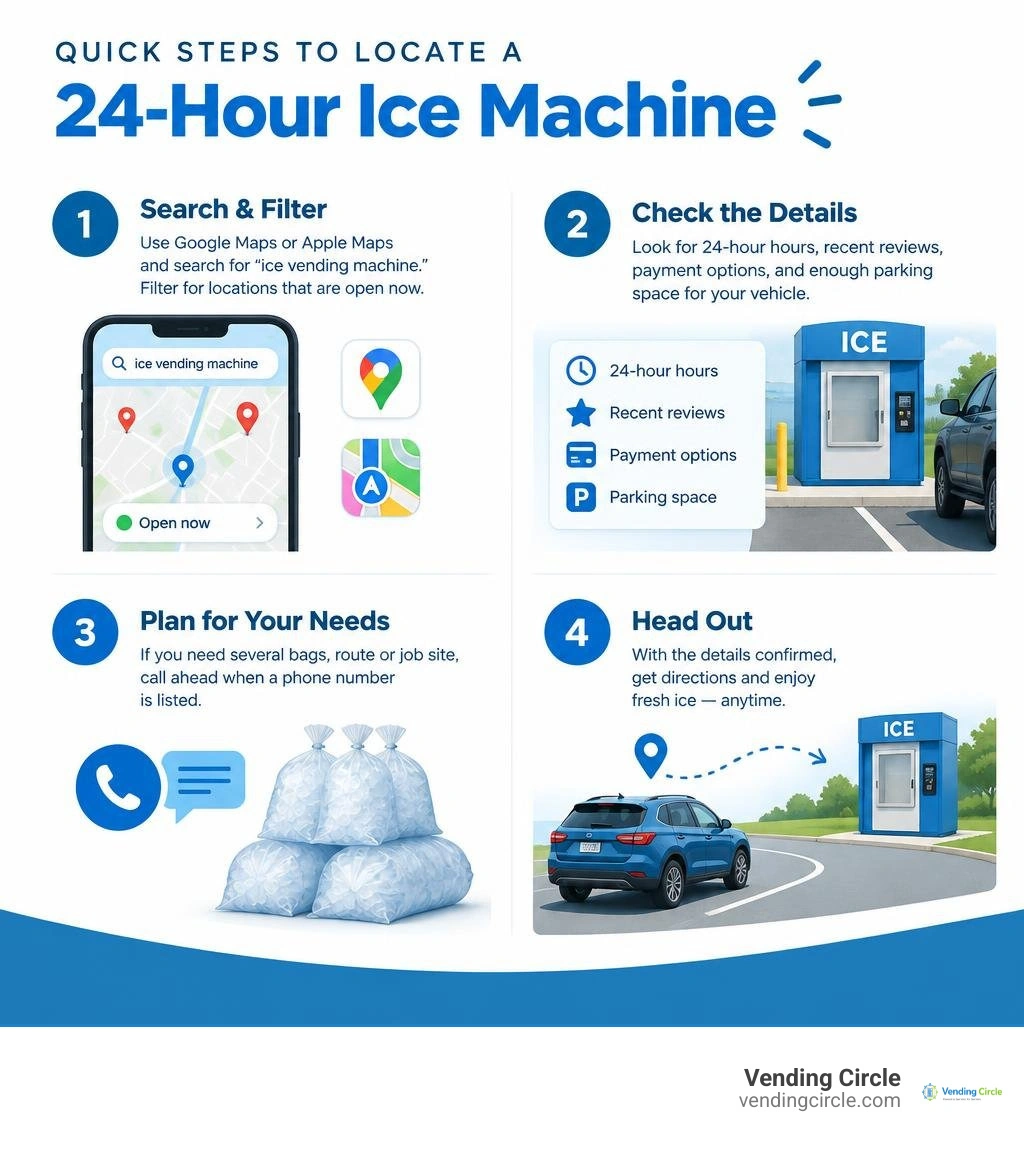
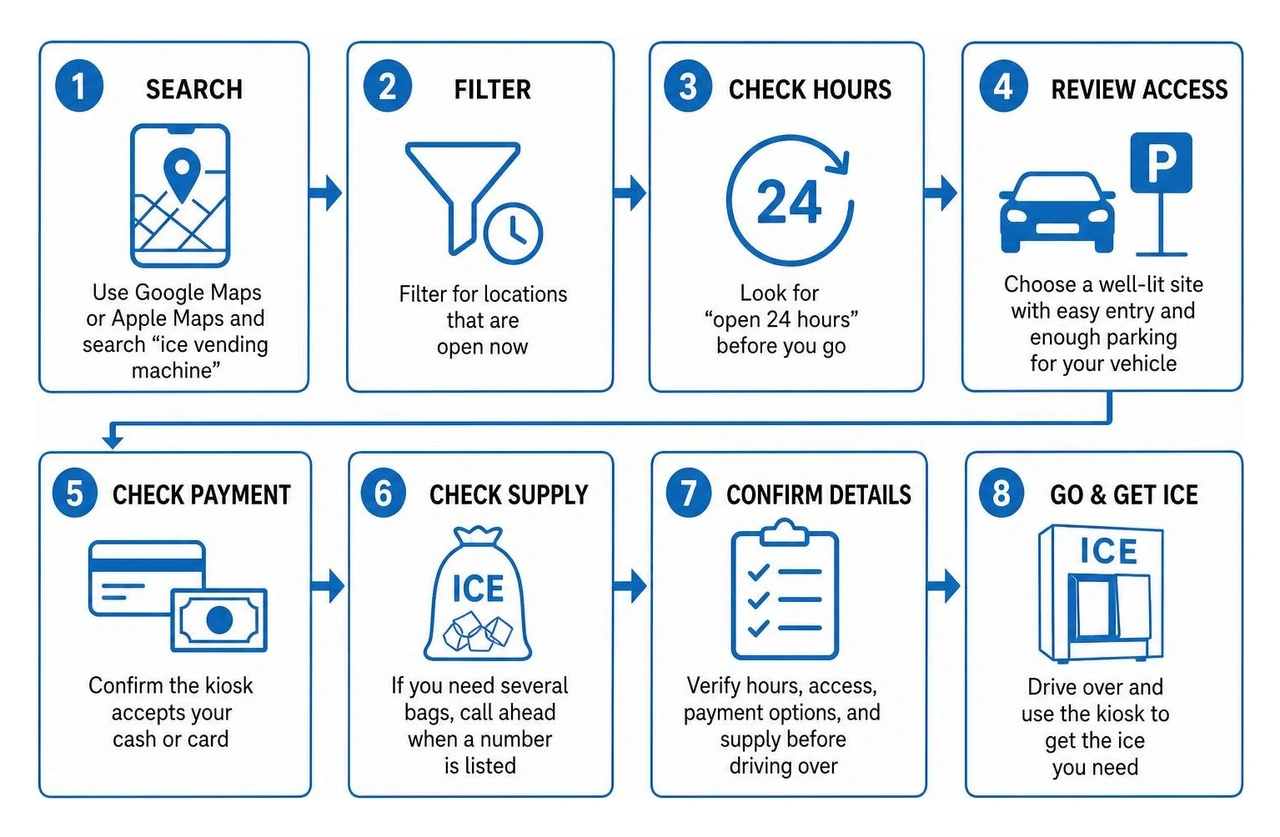
To find the nearest ice machine near me, search Google Maps or Apple Maps for "ice vending machine" and filter for locations that are open now. Check the listing for 24-hour hours, recent reviews, payment options, and enough parking space for your vehicle. Many automated ice kiosks are placed at busy retail centers, gas stations, and shopping-center parking lots, where customers can buy ice any time with cash, credit, or debit.
For a quick stop, confirm these details before driving over:
- Hours: Look for "open 24 hours" rather than assuming a listed location is always available.
- Access: Choose a well-lit site with easy entry and room for trailers, vans, or larger rigs if needed.
- Payment: Check whether the kiosk accepts the card or cash method you have available.
- Supply: If you need several bags for an event, route, or job site, call ahead when a phone number is listed.
Ice vending kiosks can be a practical alternative to a grocery run when stores are closed or retail freezers are empty. They are built for self-service, on-demand purchases, while commercial undercounter and freestanding machines serve businesses that need steady daily production and on-site storage.
I am Manuel Mojica, founder of Vending Circle and an experienced vending operator focused on helping operators source equipment, reduce downtime, and run profitable routes. In this guide to finding the nearest ice machine near me, I will also cover the equipment, access, and maintenance details that matter to both buyers and operators.
How to Find the Nearest Ice Machine Near Me Fast
Finding fresh ice when preparing for a weekend fishing trip, stocking up for a catering gig, or handling a sudden kitchen refrigeration breakdown should never be a guessing game. Modern automated stations make sourcing crystal-clear ice easier than ever, provided you know where to search and what operational factors to verify before heading out.
When searching for an on-demand ice kiosk, keep navigation efficiency in mind. Opening your mapping app and typing general queries might yield standard grocery stores that lock their merchandiser freezers after business hours. Instead, target dedicated outdoor units that operate unattended around the clock.
Online Tools and Directories for Finding the Nearest Ice Machine Near Me
Digital search tools are the quickest route to finding an active kiosk. By utilizing GPS-enabled search engines, mapping applications, and specialty industry locators, you can identify stations within seconds.
- Mapping Platforms: Use targeted terms like "24-hour ice vending," "automated ice station," or "bulk ice dispenser" on Apple Maps, Google Maps, or Waze. Look for listings that display user-submitted photos and updated operational hours.
- Specialized Directories: Industry platforms and directories like our guide on locating neighborhood ice kiosks catalog independent and franchised machines across diverse zip codes, showing real-time operational status and customer feedback.
- Directory Listings and Reviews: User reviews on mapping platforms provide vital ground-level intelligence, verifying whether a machine accepts cards, produces fresh batches without jamming, or maintains sanitary conditions.
Strategic Retail Spots for the Nearest Ice Machine Near Me at Any Hour
Automated kiosks thrive in specific retail and commercial environments designed for high vehicular turnover and effortless customer access.
- Home Improvement and Big-Box Retail Centers: Large retail parking lots—such as those outside major home improvement warehouses—frequently host standalone ice houses. Stations are strategically positioned in prominent retail plazas (often near anchor stores or adjacent to bank drive-thrus), offering generous vehicle turning radiuses.
- Strip Malls and Commercial Plazas: Centrally positioned plazas near major intersections make quick pull-ins seamless. These locations offer multiple ingress and egress routes, allowing trucks hauling boats or commercial trailers to maneuver without getting trapped.
- Gas Stations and Convenience Hubs: High-volume arterial gas stations often feature freestanding ice vending units near perimeter lighting or air pumps, combining refueling with bulk ice procurement.
- Dedicated Industrial Hubs: Specialty ice suppliers provide round-the-clock automated dispensing right outside their commercial depots.
When scouting profitable real estate or seeking safe nighttime stops, identifying prime vending machine locations requires evaluating wide entrance aprons, continuous floodlighting, and active security cameras.
Understanding Different Types of Ice Machines and Vending Kiosks
Not all ice machines serve the same operational purpose. Equipment spans everything from self-contained outdoor retail factories to undercounter restaurant gear. Understanding these classifications helps consumers identify the right source and assists operators in sizing their investments.
24-Hour Automated Ice Vending Kiosks
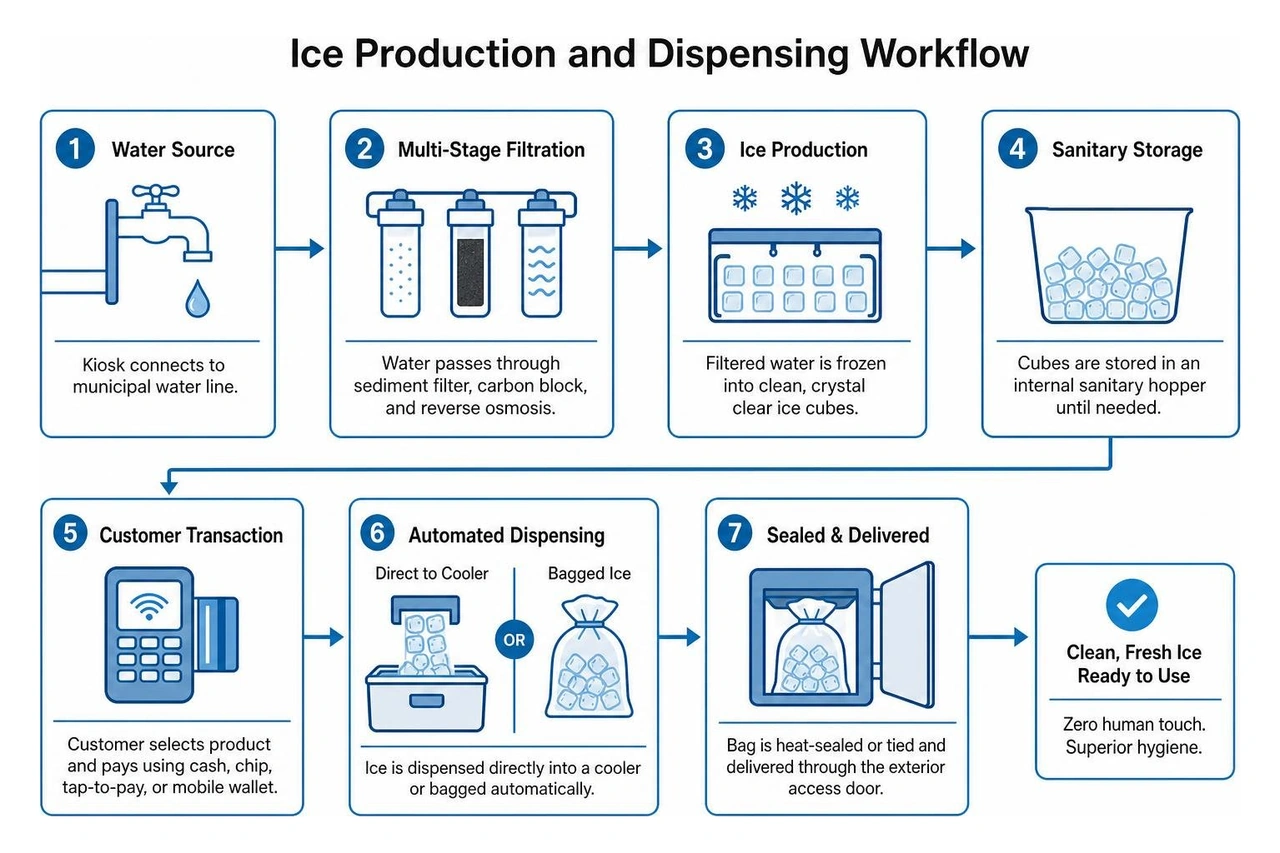
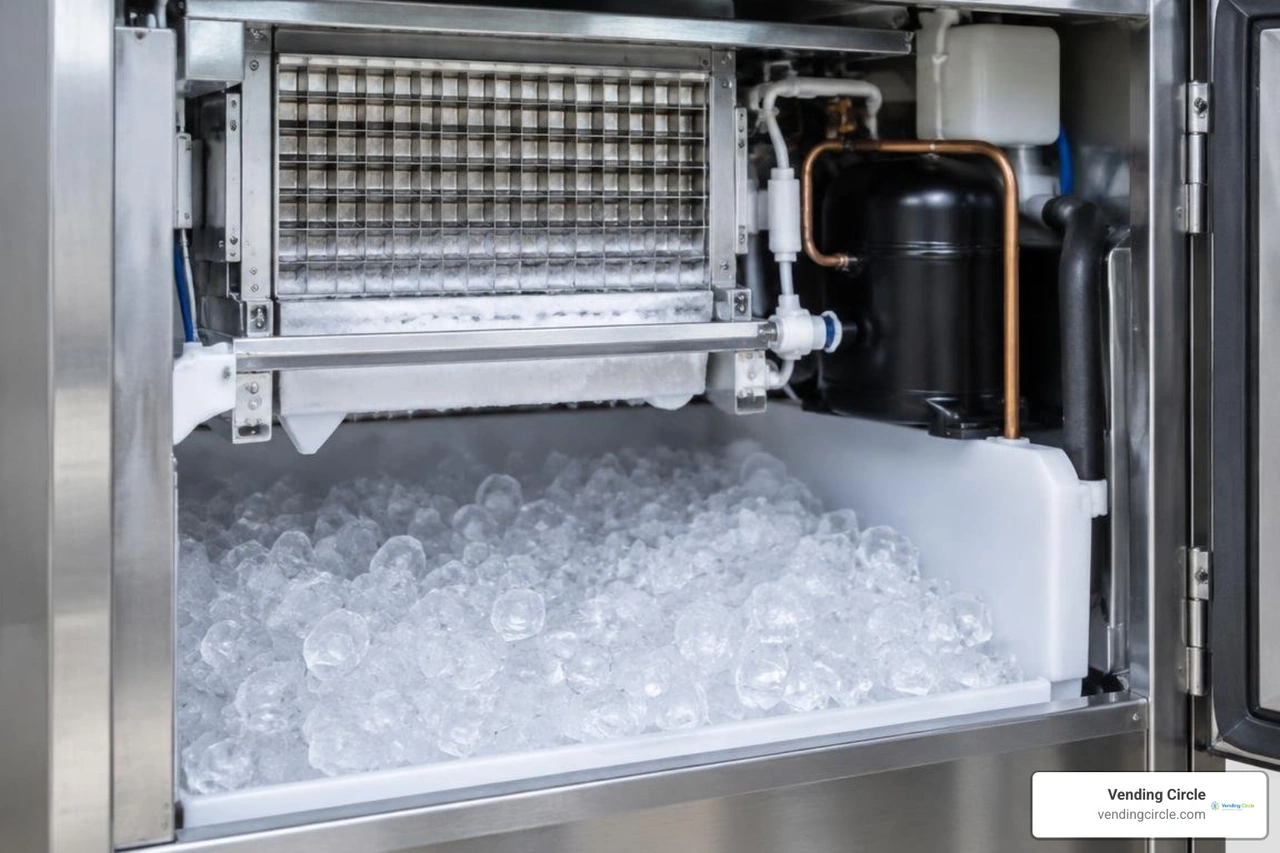
Automated ice kiosks are self-contained production, storage, and retail facilities engineered for outdoor duty. These heavy-duty kiosks tap into municipal water lines, run the water through multi-stage commercial filtration (often combining sediment filtration, carbon block treatment, and reverse osmosis), freeze the cubes, and store them in an internal sanitary hopper.
When a customer initiates a transaction, the kiosk dispenses loose ice directly into an awaiting cooler or automatically drops the cubes into a plastic bag, heat-seals or ties it, and delivers it through an exterior access door. This automated mechanism eliminates human contact with the ice, delivering superior hygiene. Sourcing untouched, filtered ice is ideal when packing fresh ice in the best coolers for camping, where food safety and extended cooling retention are critical.
Commercial Undercounter and Freestanding Units
For businesses requiring continuous ice production within their own facilities—such as restaurants, coffee shops, catering halls, and office breakrooms—compact indoor machines are the standard choice.
- Undercounter Ice Machines: Designed to slide under standard commercial countertops, units like the Manitowoc NEO Undercounter Machine generate up to 315 lbs of full dice ice daily while housing a built-in 119 lb storage bin. These heavy-duty models utilize advanced R-290 hydrocarbon refrigerants (possessing zero Ozone Depletion Potential and an ultra-low Global Warming Potential of 3) to comply with EPA SNAP regulations while lowering power consumption.
- Freestanding Commercial Cabinets: Standalone units like the VEVOR 130 lb Commercial Ice Maker provide a balance of small footprint and reliable output, producing full-sized cubes with 24 lbs of onboard insulated storage. Similarly, fast-cycling alternatives such as the VEVOR 100 lb Ice Maker Machine can produce a batch of 55 cubes in just 12 to 15 minutes, holding up to 33 lbs of ice for immediate service.
These indoor machines frequently work alongside commercial cold drink machines to provide refreshing beverages across hospitality and workplace settings.
Comparing Ice Vending Kiosks vs. Traditional Retail Store Bags
Purchasing ice from an automated 24-hour vending kiosk differs significantly from buying pre-bagged ice from a supermarket merchandiser. Understanding these differences helps consumers save money and assists entrepreneurs in identifying profitable market gaps.
| Feature / Metric | 24-Hour Automated Ice Vending Kiosks | Traditional Grocery / Gas Station Freezers |
|---|---|---|
| Availability | 24/7/365 continuous access | Restricted to store business hours |
| Average Pricing | $1.50 – $3.00 per 10–20 lb bag | $3.50 – $6.00+ per 7–10 lb bag |
| Ice Freshness | Made on-demand on-site; free-flowing cubes | Stored for weeks; frequently frozen into solid blocks |
| Sanitation & Handling | Zero human touch; fully automated internal bagging | Handled by third-party delivery drivers and clerks |
| Dispensing Options | Bagged ice or direct-to-cooler bulk dump | Bagged units only |
| Payment Technology | Cash, EMV chip, tap-to-pay, mobile wallets | Standard retail register checkout |
| Environmental Impact | Minimal plastic waste (optional direct drop); no truck transport emissions | Plastic-heavy packaging; diesel transport emissions |
By producing ice on location, automated vending kiosks bypass third-party transport and distribution overhead. This operational model cuts the consumer's cost per pound while yielding higher margins for operators evaluating high-traffic vending spots.
Buying vs. Sourcing: Key Specifications for Commercial Ice Equipment
If you manage a bustling restaurant, a food truck fleet, or a commercial venue, relying solely on retail runs quickly becomes expensive and inefficient. Investing in dedicated commercial ice gear stabilizes your supply chain, but choosing the right equipment requires evaluating technical specifications against your daily demand.
Production Capacity, Storage, and Insulation
When sizing equipment, separate daily output from storage bin capacity:
- 24-Hour Production Capacity: The total weight of ice the machine can manufacture under ideal ambient conditions (typically rated at 70°F air / 50°F water). Commercial kitchen units range from 100 lbs to over 300 lbs per day, while industrial vending houses manufacture thousands of pounds daily.
- Storage Bin Capacity: The physical volume of ice the internal bin can hold before a mechanical sensor shuts off the freezing cycle. A machine yielding 315 lbs per day paired with a 119 lb bin ensures a steady reserve during peak morning rush without overfilling the chamber.
- Thermal Insulation: High-grade cyclopentane foam insulation prevents premature melting. Quality insulation keeps stored ice frosty for 6 to 8 hours during power interruptions or off-peak shutoffs, saving energy and preserving cube structure.
Installation Requirements and Plumbing Setups
Proper commercial installation prevents costly leaks, bacterial contamination, and premature compressor burnout.
- Potable Water Connection: Commercial ice machines require a dedicated cold-water inlet line (typically 3/8-inch female flare or standard NPT connections) capable of maintaining steady water pressure between 20 and 80 PSI.
- Drainage Architecture: Melting ice runoff must be routed away cleanly. Gravity drains work well when a floor sink is located directly below the machine. If draining across distances or working against gravity, you must install an external condensate pump to prevent overflow.
- Electrical Profiles: Smaller commercial units (100–130 lb yields) run on standard 110–120V circuits drawing under 15 amps. Larger, high-capacity commercial platforms often require dedicated 208–230V single-phase connections to power heavier compressors.
- Ventilation Clearances: Air-cooled machines require at least 5 to 8 inches of unobstructed clearance around air intake and exhaust vents to maintain efficient heat transfer.
Essential Maintenance and Quality Troubleshooting
Neglecting routine upkeep degrades ice quality and shortens equipment life. Implementing a disciplined maintenance schedule keeps your machine running cleanly and efficiently:
- Water Filtration Changes: Replace sediment and carbon cartridges every 6 months. High-mineral feed water scales up evaporator plates, causing undersized or cloudy cubes and voiding manufacturer warranties.
- Automated Self-Cleaning Cycles: Run manufacturer-approved descaling and sanitizing solutions through the unit's one-touch cleaning cycle every 3 to 6 months to eliminate mineral deposits, algae, and biofilm.
- Troubleshooting Thin or Misshapen Cubes: If the machine produces hollow or thin cubes, check for low water inlet pressure, clogged water distribution tubes, dirty air filters, or high ambient kitchen temperatures.
- Managing Noise and Vibration: Operating noise should remain below 65 dB. Elevated grinding or humming usually indicates fan blade obstruction, scale buildup on the water pump impeller, or unlevel leveling legs.
Frequently Asked Questions About Finding Local Ice Machines
How much does ice typically cost at a 24-hour vending kiosk compared to a grocery store?
Automated 24-hour ice kiosks generally charge between $1.50 and $3.00 for a 10-to-20-pound bag, or a direct-dispense drop into your personal cooler. In contrast, retail grocery stores, big-box supermarkets, and corner gas stations often charge between $3.50 and $6.00 for smaller 7-to-10-pound bags. Buying from an automated kiosk delivers significant savings because on-site manufacturing eliminates transportation logistics and retail distribution markups.
What payment methods do automated ice vending machines accept?
Modern outdoor ice vending stations feature versatile payment systems. Most stations include:
- Bill acceptors accepting $1, $5, $10, and $20 notes.
- Coin mechanisms accepting standard currency.
- EMV chip readers and magnetic stripe card terminals for credit and debit transactions.
- Contactless NFC readers supporting Apple Pay, Google Pay, and tap-enabled bank cards.
How long will ice stay frozen in a commercial ice machine during a power outage?
Thanks to dense cyclopentane insulation and sealed bin gaskets, modern commercial ice makers and vending hoppers can keep stored ice frozen and usable for 6 to 8 hours without active power. To maximize retention during an outage, keep the bin door closed to maintain the internal thermal barrier.
Conclusion
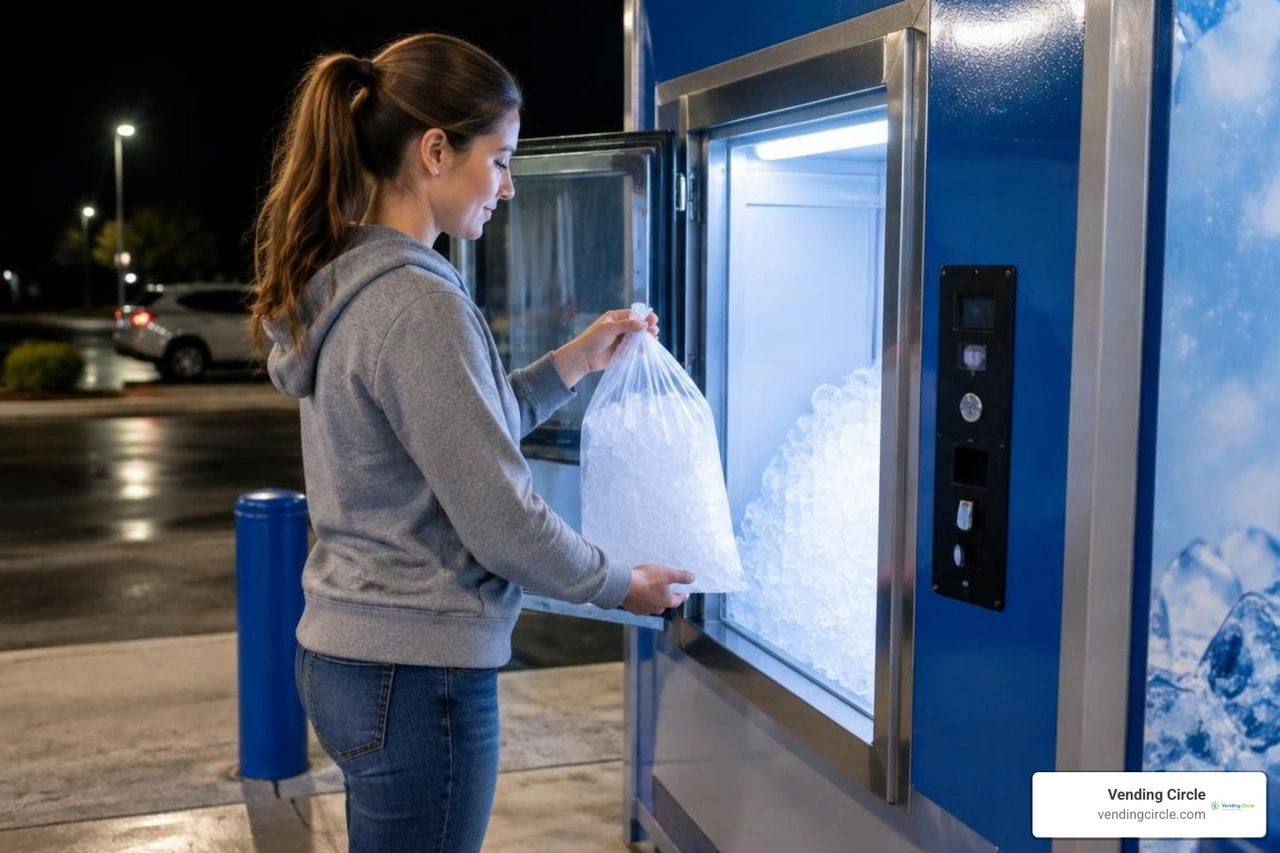
Whether you need a fast bulk-ice stop at midnight or are outfitting your own commercial kitchen, knowing how to locate and evaluate automated ice equipment saves time, protects your budget, and guarantees high-purity ice. Automated 24-hour vending kiosks provide an efficient, touchless, and cost-effective alternative to retail store freezers, dispensing on-demand cubes at any hour of the day.
For vending entrepreneurs, adding automated ice solutions represents a resilient, high-margin revenue stream. At Vending Circle, our collaborative community supports operators with weekly live technical Q&As, professional development courses, and direct manufacturer connections to help scale equipment routes efficiently.
Explore our comprehensive ice machine locator to find clean, convenient ice stations in your area or discover how to launch your own automated ice operation today.