What Are Vending Machine Routes (And Are They Worth It)?
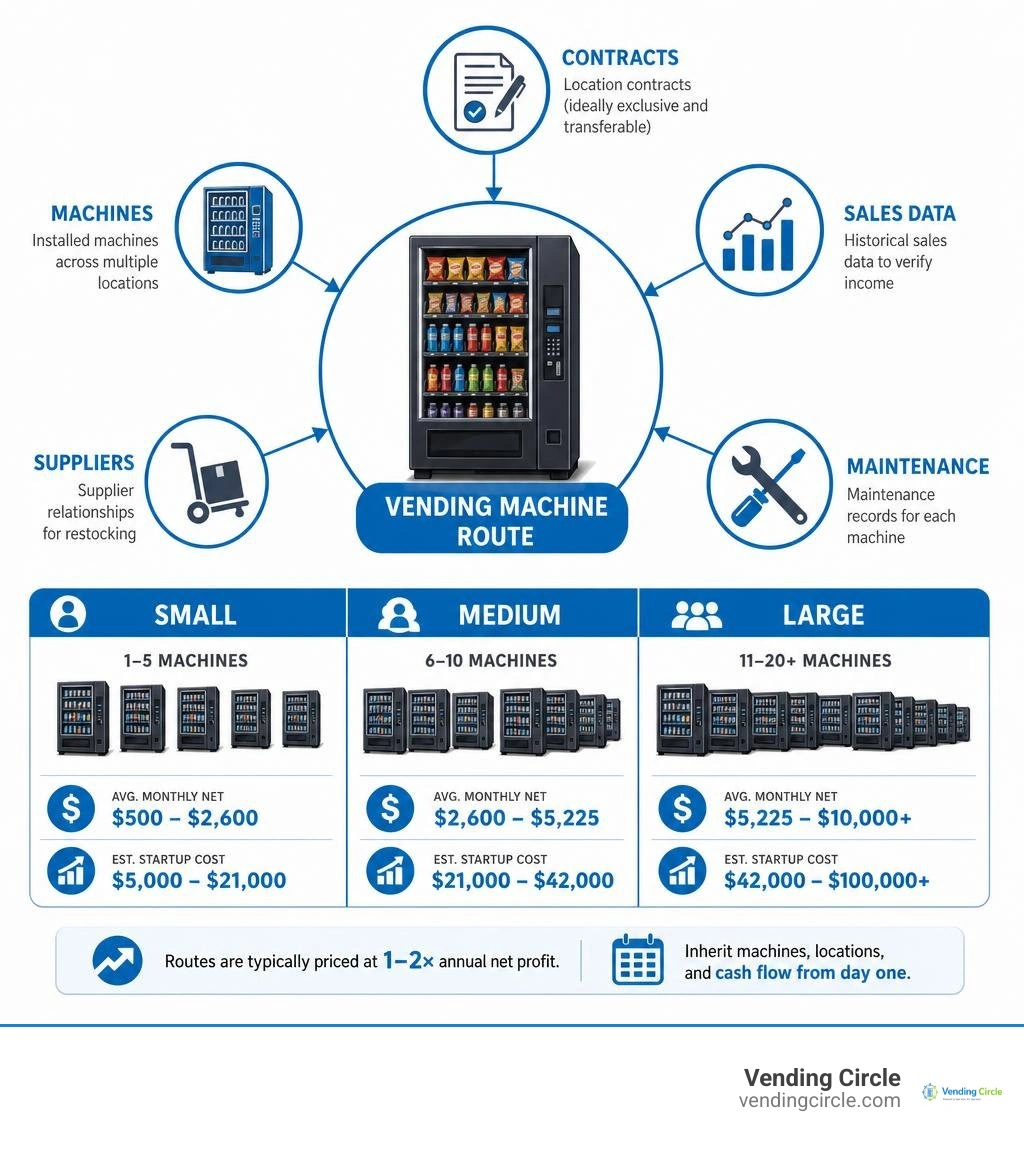
Vending machine routes are packaged businesses made up of multiple vending machines, each already placed and generating sales at established locations. When you buy a route, you typically get:
- Installed machines across multiple sites
- Location contracts (ideally exclusive and transferable)
- Historical sales data to verify income
- Supplier relationships for restocking
- Maintenance records for each machine
Here's what the numbers look like at a glance:
| Route Size | Machines | Avg. Monthly Net | Est. Startup Cost |
|---|---|---|---|
| Small | 1-5 | $500 – $2,600 | $5,000 – $21,000 |
| Medium | 6-10 | $2,600 – $5,225 | $21,000 – $42,000 |
| Large | 11-20+ | $5,225 – $10,000+ | $42,000 – $100,000+ |
Routes are typically priced at 1–2× annual net profit, with asking prices ranging from under $5,000 for entry-level part-time routes to well over $370,000 for large multi-location operations.
The appeal is straightforward: instead of cold-calling businesses and waiting months for your first dollar, you inherit machines, locations, and cash flow from day one. The vending market is also growing at a steady 4% CAGR, making it a durable business model — not a fad.
That said, not every route is a good deal. Inflated revenue figures, aging cash-only machines, and non-transferable contracts are common pitfalls that can turn a promising acquisition into a money pit.
I'm Manuel Mojica, founder of Vending Circle and owner of MM Healthy Vending, and I've spent years building and managing vending machine routes across the United States. In this guide, I'll walk you through everything I've learned — from evaluating a route's true value to optimizing it for maximum profit.
What Is a Vending Machine Route and How Does It Work?
At its core, a vending machine route is a turnkey operational system. Rather than managing physical inventory in a central retail store, you operate a distributed network of automated retail micro-locations. Each route comprises physical hardware (snack, beverage, coffee, or combo units), binding property agreements, historical sales logs, established wholesale distributor accounts, and maintenance histories.
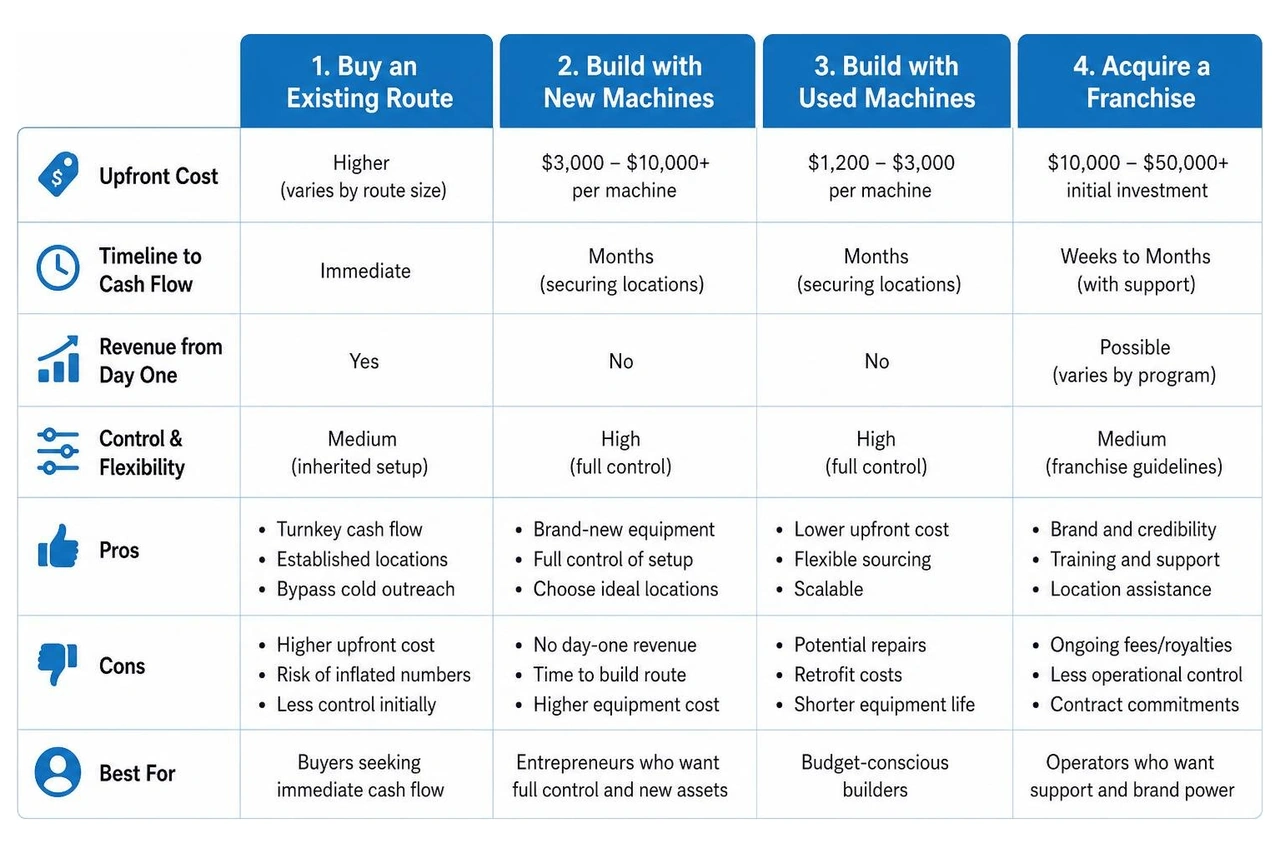
When entering the industry, aspiring operators face four primary pathways:
- Buying an Existing Route: Inherit turnkey cash flow and active locations from day one. While carrying higher initial capital risk, it bypasses cold outreach.
- Building from Scratch with New Equipment: Brand-new machines cost $3,000 to $6,000 each (or up to $10,000 for specialty units). You retain complete choice over machine features and placement, but face zero day-one revenue while securing locations.
- Building with Used or Refurbished Machines: Sourced between $1,200 and $3,000 per unit, refurbished equipment offers lower initial capital requirements. However, retrofitting cashless readers ($200–$400) or repairing worn cooling compressors ($600+) can eat into upfront savings.
- Franchise Acquisition: Franchises demand initial investments from $10,000 to $50,000+ along with ongoing royalty fees. In return, they offer brand equity, structured training, and established location assistance.
To better understand industry benchmarks, review our guide on Vending Machine Industry Statistics 2026.
How to Find Profitable Vending Machine Routes
Finding lucrative vending machine routes requires combining formal market searching with targeted local outreach:
- Brokerage Directories & Online Marketplaces: Specialized business brokers list routes ranging from $5,000 part-time setups to multi-state operations yielding $100,000+ annually.
- Direct Local Scouting: Look for locations with aging, cash-only equipment or empty spiraling racks in busy breakrooms. Approaching facility managers directly can uncover operators looking to sell.
- Industry Networking: Connect with established route owners through direct outreach and professional operator groups. For advice on building these relationships, read our article on How to Find a Vending Machine Mentor.
- Evaluating Community Resources: Choosing between local peer networks and dedicated groups can significantly impact your deal sourcing. Learn more in our comparison of Paid Vending Machine Community vs Free Forums and explore Vending Circle vs Facebook Groups Forums.
When securing locations, contract terms determine long-term asset value. Always negotiate written, multi-year location agreements featuring contract exclusivity (preventing property owners from bringing in competing operators) and sensible commission rates. While 24/7 manufacturing plants and warehouses often expect minimal commissions (0% to 5%) because vending serves as an employee benefit, competitive sites like gyms or recreation centers may demand 10% to 20% of gross sales. For a comprehensive walkthrough on launching from scratch, consult How to Start a Vending Machine Business: Machines, Locations & Profit | ZenBusiness.
Due Diligence When Buying Vending Machine Routes
Thorough due diligence separates profitable route acquisitions from expensive mistakes. Never rely on raw seller spreadsheets or unverified claims. Follow these mandatory audit steps:
- Verify Bank Statements: Match reported monthly sales directly against consecutive business bank deposits and merchant processor payouts for a minimum of 6 to 12 months.
- Review Tax Clearance & Tax Returns: Request official state tax clearance letters to ensure no back taxes or uncollected sales taxes follow the business purchase. Cross-reference Schedule C or corporate tax filings with seller revenue claims.
- Inspect Hardware On-Site: Audit all machines on location. Check compressor health, bill validator functionality, coin mechanisms, and DEX telemetry compatibility. Verify that units accept modern cashless solutions like Apple Pay and contactless cards.
- Confirm Contract Transferability: Review every location contract's assignment clause. Ensure property managers consent in writing to transfer agreements to your legal entity without renegotiating lower rates or higher commissions.
- Investigate Seller Motivation: Determine why the owner is selling. Are they retiring, or did a major 200-employee warehouse on the route announce a plant closure next quarter?
- Check Public Records: Search municipal and county records for outstanding liens, lawsuits, or UCC filings against the target assets.
For deeper insights on joining peer networks to share deal-vetting strategies, check our round-up of the Best Vending Machine Communities Forums Mentorship Programs.
Valuation, Costs, and Profitability of Vending Machine Routes
Calculating the fair market value of vending machine routes standardly relies on a profit multiple:
$$\text{Asking Price} = \text{Annual Net Profit} \times (1.0 \text{ to } 2.0)$$
Route valuations vary based on machine age, location stability, contract length, and whether machines are equipped with smart cashless telemetry. A small 10-machine route generating $62,700 in net annual pre-tax income is typically valued between $60,000 and $120,000 depending on location quality and contract health.
To understand true earnings potential, examine this breakdown across route sizes:
| Financial Metric | Small Route (3 Machines) | Medium Route (10 Machines) | Large Route (20 Machines) |
|---|---|---|---|
| Monthly Gross Revenue | $4,380 | $14,600 | $29,200 |
| Cost of Goods Sold (40-50%) | $1,970 | $6,570 | $13,140 |
| Location Commissions (5-10%) | $300 | $1,022 | $2,044 |
| Fixed/Variable Expenses | $540 | $1,783 | $3,516 |
| Pre-Tax Net Income/Mo. | $1,570 | $5,225 | $10,500 |
| Annual Pre-Tax Net | $18,840 | $62,700 | $126,000 |
| Est. Initial Capital Cost | $12,600 | $42,000 | $84,000 |
| Target Payback Period | ~8 Months | ~8 Months | ~8 Months |
| Weekly Time Commitment | 5 – 7 Hours | 15.5 – 23.5 Hours | 35 – 45 Hours |
A typical 10-machine setup with an initial capital investment of ~$42,000 (covering used machines, card readers, initial inventory, and reserves) can achieve full payback in approximately 8 months. To dive into exact financial models and location assumptions, review How Much Does a 10-Machine Vending Route Make? ~$5,200/mo Net (2026).
Machine Types and Location Impact on Profit Margins
Product categorization and foot-traffic quality dictate machine yields:
- Snack & Beverage Combos: These serve as industry workhorses. Gross margins on standard chips, pastries, and sodas sit around 50% to 60%. They thrive in breakrooms, laundromats, and waiting areas.
- Coffee & Hot Beverage Systems: Coffee equipment boasts gross margins exceeding 70% to 80%. Placed in corporate environments or universities, coffee units produce high return per refill visit.
- Specialty Vending (Vape, Specialty Retail): Specialty niches yield premium retail price points and elevated net margins. However, they require strict age-verification hardware and compliance with local municipal ordinances.
Foot traffic density and captive audience metrics dictate top-line numbers. Placing a machine in a 24/7 manufacturing facility with 300 blue-collar workers can produce $2,000 to $3,500 per month, whereas an office with 25 part-time workers may struggle to break $300 per month.
Route Optimization and Operational Efficiency

Efficiency separates high-earning operators from burnt-out ones. Driving inefficient paths between scattered stops quickly drains profits through excess fuel consumption and vehicle wear.
Top vending operators cut route time by up to 40% through smart route planning automation. By integrating cloud-based telemetry solutions, you can transform service schedules from fixed calendar visits to dynamic, inventory-driven restocks. For an in-depth breakdown of field-tested efficiency gains, refer to Vending Machine Route Optimization: Cut Costs by 40%.
Case studies across modern fleets show how real-time inventory visibility allows operators to service significantly more machines per route while scaling back labor requirements per stop. Learn how leading operators leverage data by reading the Hensing Vending Route Planning Case Study | Vendon.
Key techniques for operational efficiency include:
- Pre-Kitting in the Warehouse: Using DEX telemetry data, pack exact product counts into totes before loading the service vehicle. This eliminates constant back-and-forth trips to the truck.
- Clustering Locations: Group service stops geographically to minimize windshield time and keep route density high.
- Handling Emergency Restocks: High-volume locations occasionally sell out prematurely. Establishing emergency restocking workflows prevents empty coils and lost sales. Read our framework on managing Vending Machine Emergency Restock.
Financial Management, Bookkeeping, and Legal Requirements

Treating a 20-machine route as a single business entity can obscure underlying financial issues. In reality, a route is a collection of individual micro-businesses. A high-volume machine generating $2,500 a month might actually lose money if burdened by a 25% site commission and high card processing fees, while a modest $800 machine with zero commission and high cash volume yields strong net profits.
To track true location margins, establish your bookkeeping around machine-level cost centers. Calculate per-machine performance using this core metric:
$$\text{Contribution Margin} = \text{Gross Sales} - \text{COGS} - \text{Site Commissions} - \text{Cashless Fees} - \text{Direct Repairs}$$
Reconcile physical cash counts against DEX telemetry deltas on every visit to identify coin mechanism jams, validator errors, or shrinkage immediately. For a masterclass on per-machine accounting, read Vending Machine Route Bookkeeping: Reconciling Cash, Tracking COGS, and Knowing the True Profit of Every Location | Beancount.io.
To optimize profitability and streamline operations, master wholesale procurement and equipment choices by studying our resources on Vending Machine Products Wholesale, proper Vending Machine Inventory Management, and upgrading hardware through Buy a Vending Machine with Card Reader.
From a compliance standpoint, operating legally requires:
- General Business License: Filed at municipal or county levels.
- Seller's Tax Permit: Required by state revenue departments to collect and remit retail sales tax.
- Per-Machine Health & Operational Permits: Ranging from $10 to $250 per machine annually depending on local health department regulations.
- Commercial Liability Insurance: Property managers typically mandate $1,000,000 to $2,000,000 in general liability coverage naming them as an additionally insured party.
Frequently Asked Questions About Vending Machine Routes
What is the realistic weekly time commitment for running a 10-machine route?
A well-optimized 10-machine route requires approximately 15.5 to 23.5 hours per week (averaging ~18 hours). This includes driving, restocking, pre-kitting inventory, cash collection, basic cleaning, maintenance, and wholesale inventory runs.
What are the biggest red flags to watch out for when buying a route?
Key red flags include seller reliance on raw spreadsheets without matching bank deposits, outdated cash-only machinery, non-transferable location agreements, recent loss of major anchor locations, and unrecorded cash variances between actual collections and DEX telemetry readings.
What licenses and permits are required to operate a vending route legally?
Operators typically require a general business registration (e.g., LLC), state seller's sales tax permit, local health department permits for perishable food items, individual per-machine license decals where required by municipal code, and commercial liability insurance policies.
Conclusion
Acquiring or building vending machine routes offers one of the most reliable paths to business ownership and financial independence. By focusing on detailed due diligence, negotiating multi-year location contracts, implementing dynamic route planning, and tracking per-machine profitability, you can build a stable cash-flowing asset.
Want to discover how Vending Circle helps operators shorten their learning curve, streamline wholesale procurement, and access active mentor support? Learn more in our breakdown of What is Vending Circle.
Ready to take the next step in acquiring, building, and scaling your own profitable vending business? Master Vending Machine Routes with Vending Circle Courses and join our network of active operators today!