How Route Optimization Software Makes Daily Routes Easier
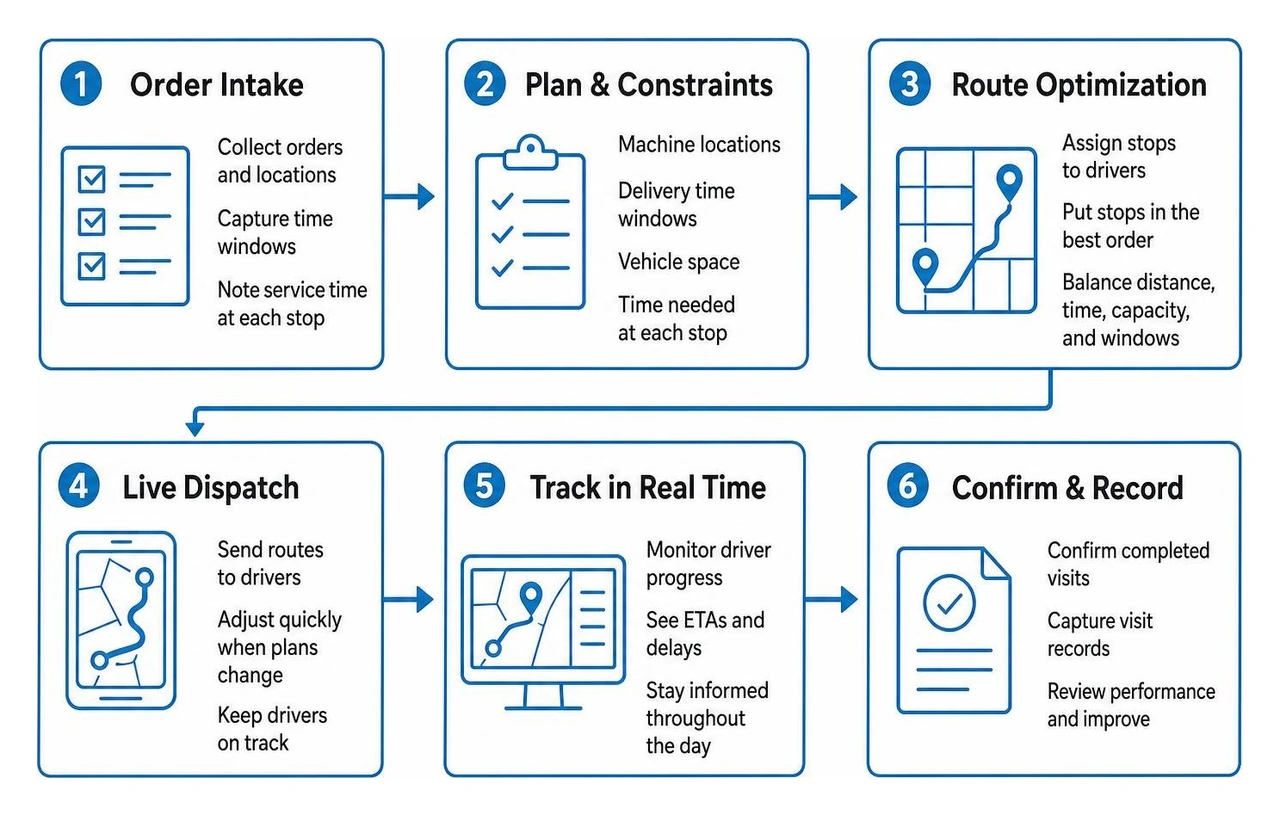
Route optimization software assigns stops to drivers and puts them in a practical order. For a vending operator, the right tool should account for machine locations, delivery time windows, vehicle space, and the time needed at each stop. Look beyond mileage: compare how easily you can change a route, track drivers, and confirm completed visits.
A map can show you where to drive. Route optimization software helps you decide who should visit each location, in what order, and when. This article covers five ways that changes a daily schedule, plus what to check before choosing a tool.
I'm Manuel Mojica, founder of Vending Circle and owner of MM Healthy Vending. My vending experience shapes how I evaluate route optimization software: a useful route must work for the operator filling and servicing machines, not just look short on a map.
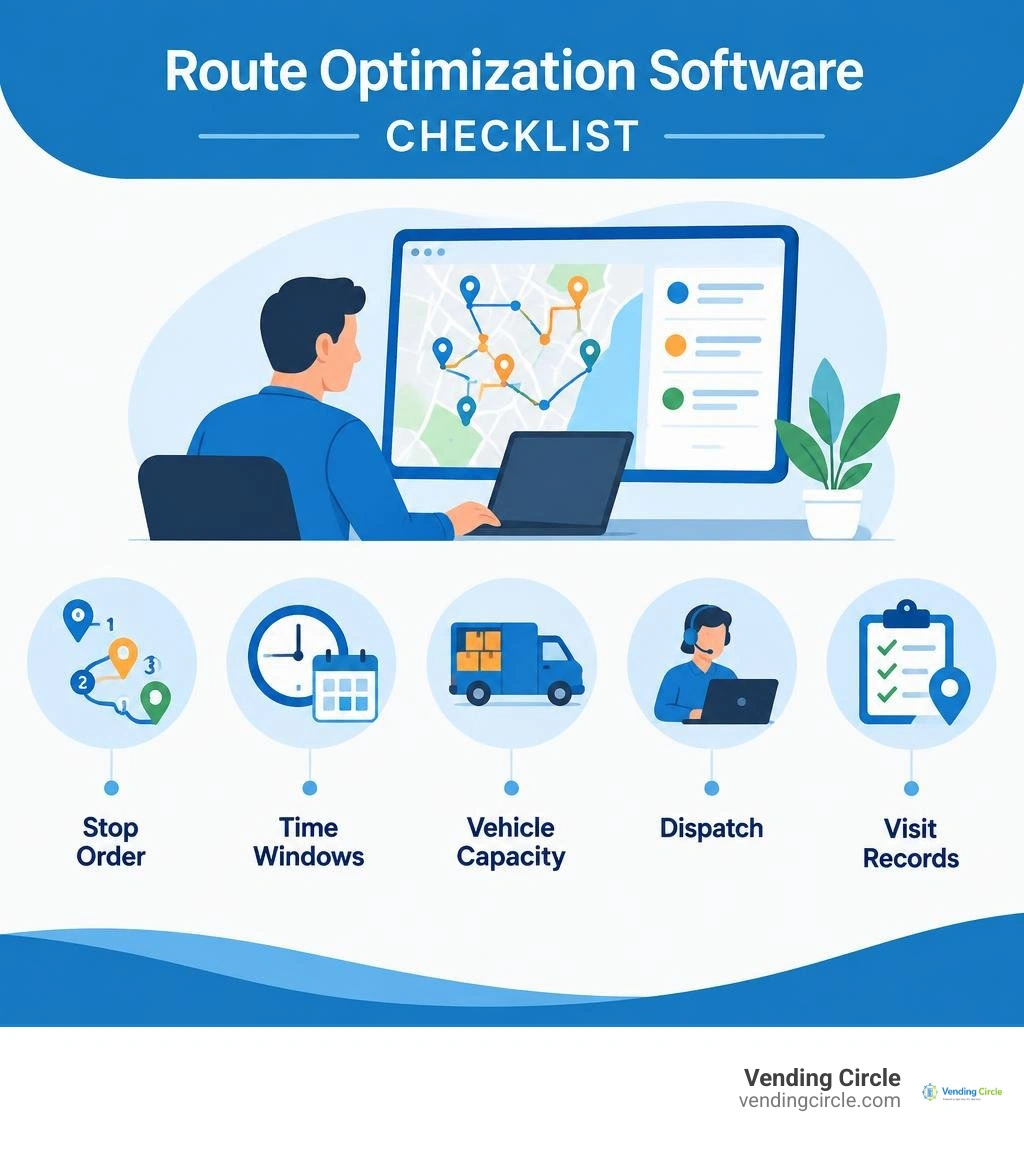
Route optimization software glossary:
How Route Optimization Software Solves Complex Dispatch Challenges
Last-mile delivery is notoriously expensive, often accounting for more than half of total shipping expenses. For field service operators, couriers, and vending businesses, daily logistics can quickly descend into chaos without structured planning. When dispatchers juggle dozens of stops manually using basic map pins or spreadsheets, they inevitably face empty miles, vehicle overload, and missed delivery windows.
Automated route optimization transforms this dynamic. By solving the vehicle routing problem—a mathematically complex puzzle where computing every possible combination for just a dozen stops yields hundreds of millions of variations—modern software cuts delivery costs by up to 40%. Whether you run a distribution network or are studying our commercial vending machine routes guide, replacing guesswork with algorithmic dispatching eliminates deadhead miles and streamlines daily fleet operations. Advanced logistics research, including studies on the Optimization of DND Multi-Depot Split-Load Pickup-Delivery Problem, demonstrates that mathematical modeling consistently outperforms human intuition when balancing complex constraints across multiple vehicles.
Route Planning vs Algorithmic Optimization
Many fleet operators confuse basic route planning with true algorithmic route optimization:
- Basic Route Planning: Involves sequencing a static list of addresses from point A to point B. It relies on standard navigation tools to find the shortest path between stops, but it does not account for vehicle capacities, driver shift limits, or dynamic customer arrival windows.
- Algorithmic Route Optimization: Uses computational heuristics and metaheuristics to distribute hundreds of orders across an entire fleet simultaneously. It balances multi-vehicle capacity, historical traffic speeds, driver work-hour regulations, and order priorities in real time.
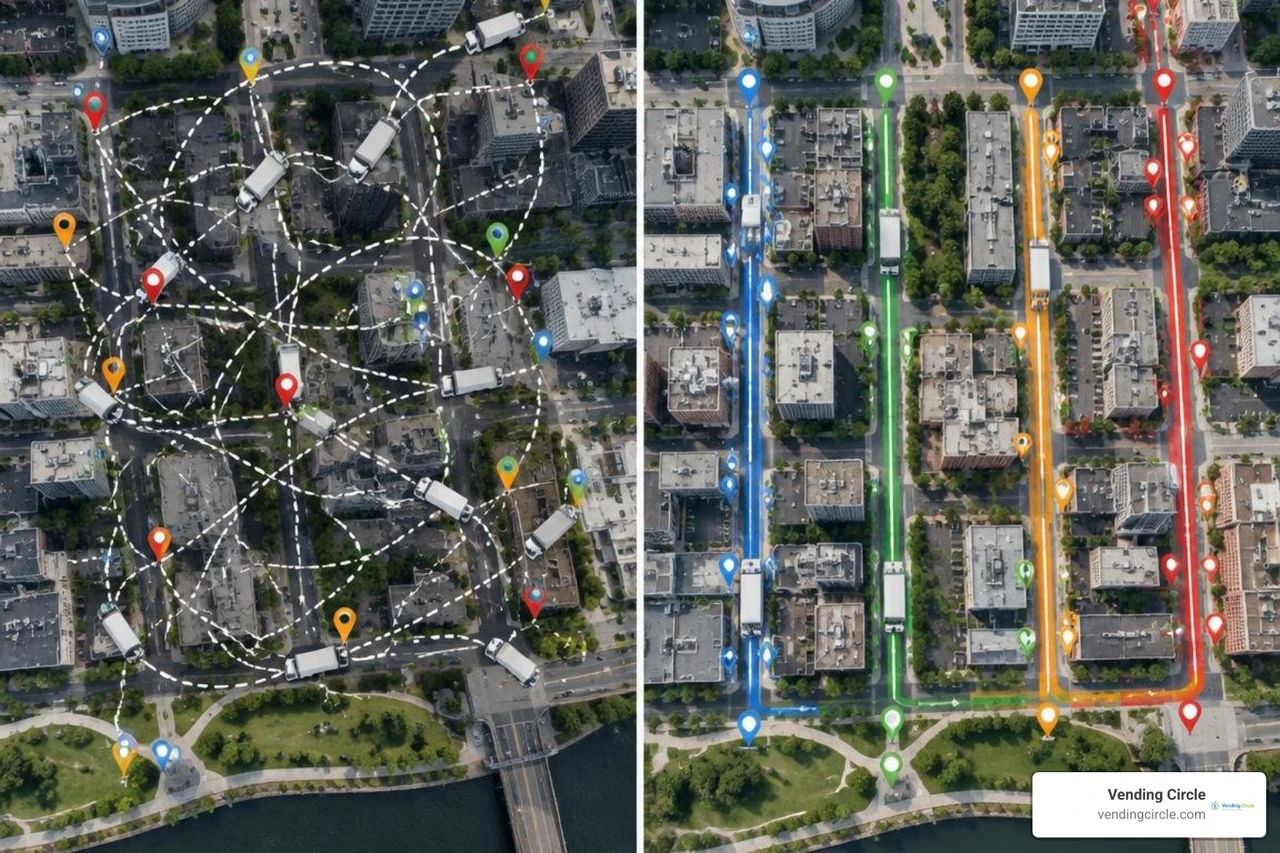
Eliminating Spaghetti Routes for Driver Acceptability
A major issue with unrefined routing algorithms is the generation of "spaghetti routes"—plans that look optimal on a spreadsheet but send drivers crisscrossing over one another's paths. Drivers hate these tangled routes because they feel illogical on the ground, creating confusion and frustration.
True commercial-grade optimizers prioritize driver acceptability alongside distance reduction. For example, benchmark testing conducted with MIT revealed that advanced routing engines produced roughly seven times fewer route crossings than standard open-source solvers. Furthermore, refined algorithms distribute shift lengths evenly—narrowing the variance between the longest and shortest driver shifts to under two and a half hours, compared to gaps of three and a half hours or more in unoptimized systems. Balanced workloads prevent driver burnout, reduce turnover, and ensure your team stays productive throughout the week.
5 Core Transformations in Daily Delivery Schedules

When an operation switches from static spreadsheets to modern automated routing, daily delivery workflows change dramatically. Whether you are expanding an established fleet or evaluating routes for sale, these five core transformations highlight how intelligent software reshapes daily schedules.
1. Dynamic Multi-Stop Sequencing and Time-Window Adherence
Manual planning often forces dispatchers to spend two to four hours every morning organizing stops. Dedicated route optimization platforms can achieve a 90% potential reduction in planning time, turning hours of tedious work into a few minutes.
The software automatically sequences dozens of daily stops while adhering strictly to narrow customer time windows and variable stop durations. If a commercial building only allows restocking between 8:00 AM and 10:00 AM, the algorithm ensures that stop is prioritized before routing the driver to locations with open afternoon dock access.
2. Multi-Vehicle Capacity and Inventory Balancing
Running out of vehicle cargo space halfway through a shift wastes valuable driving hours. Modern optimization engines evaluate the physical cubic volume, weight limits, and compartment capabilities of each vehicle before assigning orders.
In operations requiring precise replenishment schedules, integrating routing tools with vending machine inventory management allows dispatchers to match vehicle loads directly with real-time stock requirements. Advanced platforms, such as multi-constraint optimization platforms, can even handle multi-temperature zones, scheduled mid-day depot reloads, and mixed fleet parameters (such as company vans operating alongside independent contractors) without manual recalculation.
3. Live Fleet Visibility and Exception Dispatching
A delivery route is rarely static once drivers hit the road. Road closures, vehicle breakdowns, customer cancellations, and urgent same-day orders can disrupt the best-laid plans.
With integrated GPS tracking and CAN bus telematics, dispatchers maintain a live view of the entire fleet. When an unexpected change occurs, the dispatcher can insert a new stop into the system, and the platform recalculates the optimal schedule on the fly. Real-time arrival alerts keep warehouse staff, drivers, and customers aligned without continuous phone calls.
4. Direct Mileage, Fuel, and Emission Reductions
Optimized routes consistently reduce total distance traveled by 15% to 20%. By eliminating backtracking, minimizing vehicle idling in traffic, and consolidating stops into tight geographical clusters, businesses see immediate drops in fuel bills.
These efficiency gains yield a 15% to 20% reduction in vehicle carbon emissions. Fleets can track these metrics directly within analytics dashboards for environmental, social, and governance (ESG) reporting while extending vehicle lifespan through reduced mechanical wear and tear.
5. Automated Proof of Delivery and Customer Notifications
Modern logistics tools connect the office, the driver, and the customer through integrated mobile apps:
- Electronic Proof of Delivery (ePOD): Drivers capture digital signatures, high-resolution photos, and barcode scans directly on their mobile devices upon completing a visit.
- Automated Customer Alerts: Customers receive automated SMS or email notifications containing live tracking links and dynamic arrival estimates, virtually eliminating missed deliveries and customer support inquiries.
Evaluating Route Optimization Software Features and Pricing
Selecting the right platform depends on your operational size, customer requirements, and growth plans. If you are learning how to buy vending machine routes or scaling an existing logistics business, understanding software pricing models and feature sets ensures you do not overpay for unused capabilities.
| Feature / Model | Per-Driver Pricing | Per-Order Pricing | Enterprise Multi-Depot |
|---|---|---|---|
| Best Suited For | Fixed fleets with high stop density | Fleets with fluctuating seasonal order volumes | Multi-hub regional and national distribution |
| Cost Structure | Flat monthly fee per active vehicle/driver | Micro-fee per order or delivered stop | Tiered custom licensing + compute usage |
| Key Advantage | Unlimited stops per vehicle with predictable costs | Cost scales up or down directly with revenue | Advanced multi-hub modeling & AI analytics |
| Core Capabilities | Dispatch, ePOD, live GPS tracking, time windows | Dynamic route planning, customer notifications | Multi-depot balancing, LEZ rules, ERP/TMS APIs |
Comparing Per-Driver vs Per-Order Route Optimization Software
Software vendors typically price their tools under two primary models:
- Per-Driver Licensing: You pay a fixed monthly subscription for each vehicle or driver seat (commonly ranging from $35 to $150 per driver per month). This model is ideal for operations with consistent daily fleet sizes and high stop counts per truck, as adding more stops does not increase your software bill.
- Per-Order (Per-Stop) Pricing: You pay a fee based on the number of stops or deliveries planned each month (often pennies per task). This model suits businesses with variable or seasonal volume, ensuring software expenses align directly with incoming revenue.
Enterprise Constraints and Multi-Depot Route Optimization Software
For larger operations managing multiple distribution centers, simple single-depot routing is insufficient. Advanced systems must balance cross-depot transfers, regulatory driver rest breaks, low-emission urban zone restrictions, and territory sectorization.
Platforms designed for enterprise logistics, including enterprise multi-depot planning solutions and scalable AI logistics engines, allow companies to run "what-if" simulations, evaluate fleet utilization, and connect directly with existing ERP and TMS software via enterprise APIs.
Frequently Asked Questions About Route Optimization
What is the difference between basic route planning and route optimization?
Basic route planning simply finds the shortest road path to connect a pre-ordered list of stops. Route optimization uses mathematical algorithms to analyze hundreds of variables simultaneously—including order priority, vehicle load capacities, time windows, driver shift limits, and real-time traffic—to determine the best stop sequence and vehicle assignment for an entire fleet.
Can free route planners handle commercial delivery fleets?
Free routing tools (such as standard web map multi-stop planners) typically cap routes at 10 to 25 stops and only support a single vehicle at a time. They lack commercial delivery essentials like multi-vehicle balancing, customer time windows, automated dispatching, driver mobile apps, and electronic proof of delivery. Commercial fleets quickly outgrow these limitations.
How much can businesses save with route optimization software?
Most commercial fleets achieve a 15% to 20% reduction in total mileage, a 90% decrease in daily route planning time, and overall operating cost reductions of up to 40%. The combination of lower fuel usage, fewer overtime labor hours, reduced vehicle maintenance, and improved customer retention delivers a rapid return on investment.
Conclusion
Transitioning from manual spreadsheets to modern dispatch technology removes daily operational friction, lowers fleet fuel expenses, and keeps drivers satisfied with balanced, realistic schedules. Automating your delivery sequencing allows your team to focus on customer service, operational quality, and sustainable business growth.
At Vending Circle, we support operators through every stage of business development. Our combined learning and procurement platform offers weekly live Q&A sessions, practical courses, manufacturer-direct product pricing, and an active community where operators share proven strategies. Explore our marketplace and educational resources by visiting the Vending Circle platform to streamline your operations today.