Official Corporate Kiosks vs. Independent TCG Dispensers
Pokémon vending machines work by integrating high-definition touchscreen interfaces, contactless cashless payment terminals, and internal Multi-Drop Bus (MDB) controllers that operate specialized dispensing systems—such as robotic elevator lifts or narrow coils—alongside optical drop sensors and cellular telemetry. When a customer selects an item on screen and taps to pay, the system verifies the transaction in seconds, dispenses the product safely without damaging fragile packaging, and syncs live inventory data to cloud management software.
When you see a card kiosk in the wild, it falls into one of two clear operational buckets: an official automated retail unit managed directly by the brand, or a machine owned and operated by an independent entrepreneur.
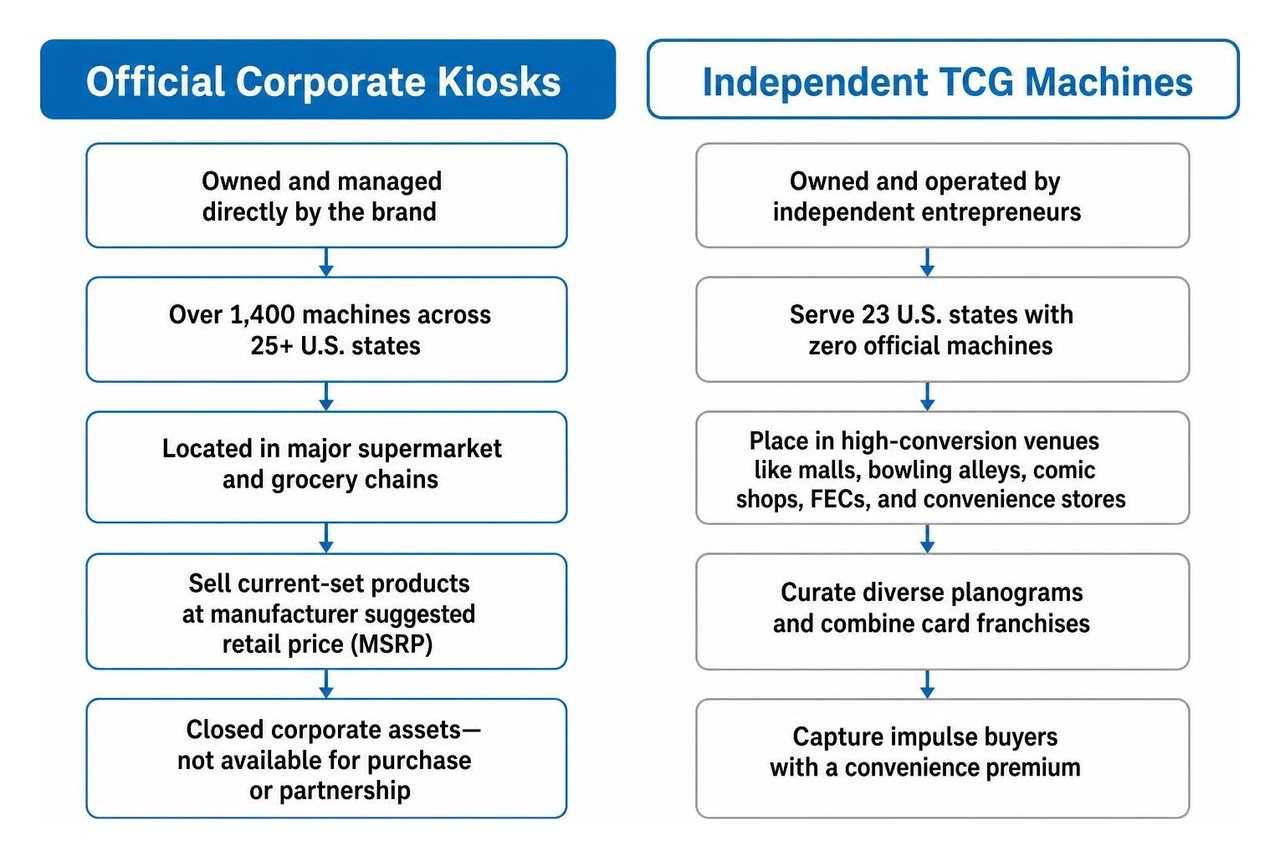
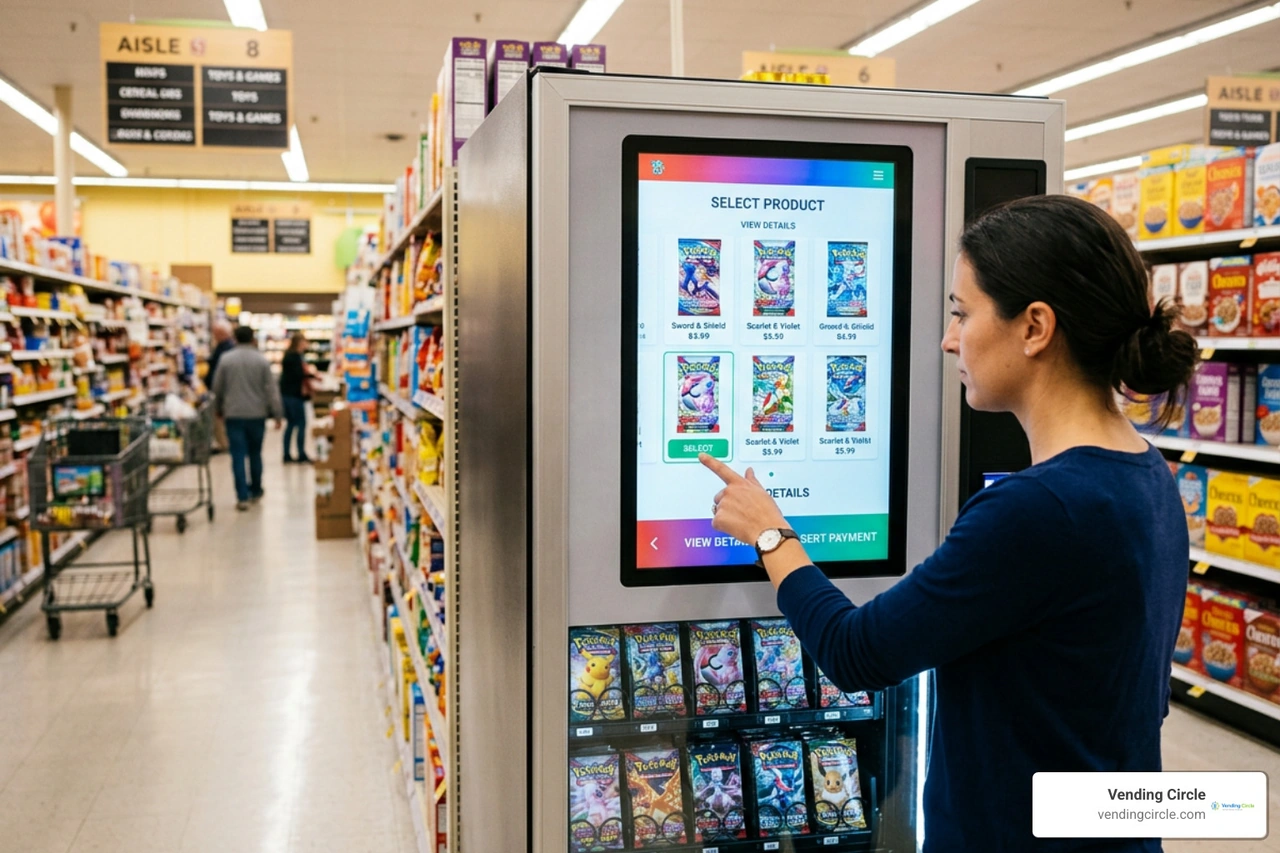
Official automated retail machines are corporate assets owned and managed directly by The Pokémon Company International (TPCi). As of early 2026, over 1,400 official TPCi machines operate across more than 25 U.S. states, primarily located inside major supermarket and grocery chains like Kroger, Safeway, H-E-B, and Fred Meyer. Because TPCi owns these units end-to-end, they sell current-set products strictly at manufacturer suggested retail price (MSRP). However, an everyday entrepreneur cannot buy an official machine or partner with TPCi to host one—they are completely closed corporate assets.
This corporate exclusivity creates a massive opening in the market. There are currently 23 U.S. states with zero official TPCi machines—including major markets like Florida, New York, North Carolina, Minnesota, and Connecticut. Furthermore, corporate contracts lock official units into grocery store lobbies, leaving high-conversion venues like shopping malls, bowling alleys, comic shops, family entertainment centers (FECs), and 24-hour convenience stores untouched.
Independent route operators bridge this gap using commercial hardware. By purchasing dedicated automated retail hardware, independent operators can curate diverse planograms, combine different card franchises, and capture impulse buyers at a convenience premium. Many collectors use resources like this Pokemon Vending Machines: Locations, Prices & Restock Guide to discover both official corporate kiosks and independent automated setups in their local areas.
Legally, independent vending is protected under the United States First Sale Doctrine. Once an operator legally buys genuine, authentic Pokémon products from authorized wholesale distributors or licensed retail sources, they have the full legal right to resell those products through automated dispensers without paying royalties or obtaining a franchise license.
The only strict legal boundary involves trademark protection: independent operators cannot paint official protected character logos or registered trademarks onto their machine cabinets, and must keep their exterior wrap design generic (e.g., "Trading Card Kiosk" or "TCG Drop").
| Feature | Official TPCi Automated Kiosks | Independent Operator Machines |
|---|---|---|
| Ownership | Exclusively owned & operated by TPCi | Owned by private business owners/operators |
| Machine Purchase | Not available to the public | Commercially available ($2,850 – $14,000+) |
| Primary Locations | Supermarket & grocery chains (25 states) | Malls, arcades, FECs, card shops, C-stores |
| Product Pricing | Fixed strictly at standard retail MSRP | Flexible (typically MSRP + 20–50% convenience margin) |
| Product Selection | Current sealed TCG sets, ETBs, and tins | Mixed sets, vintage packs, PSA slabs, card sleeves |
| State Availability | 25 states (23 states have zero units) | Nationwide deployment anywhere with foot traffic |
How Do Pokemon Vending Machines Work: Step-by-Step Architecture
At a mechanical level, a trading card vending machine combines an interactive front-end consumer interface with an industrial internal control board running standard vending communications protocols.
Inside the machine, the central processing unit links to peripheral hardware through the Multi-Drop Bus (MDB) protocol standard. The internal controller constantly talks to the payment terminal, optical vend sensors, motor coils, and telemetry boards. When an operator chooses to buy a vending machine with card reader pre-installed, these components are factory-calibrated to ensure zero-latency communication between the bank processor and internal dispensing motors.
Additionally, modern high-end automated retail units feature passive optical sensors mounted near the top of the cabinet. These sensors calculate foot traffic by counting passersby to help operators determine visitor-to-sale conversion rates. In keeping with modern data compliance standards, these sensors track movement vectors without capturing, transmitting, or storing personal video feeds.
How Do Pokemon Vending Machines Work for End Buyers
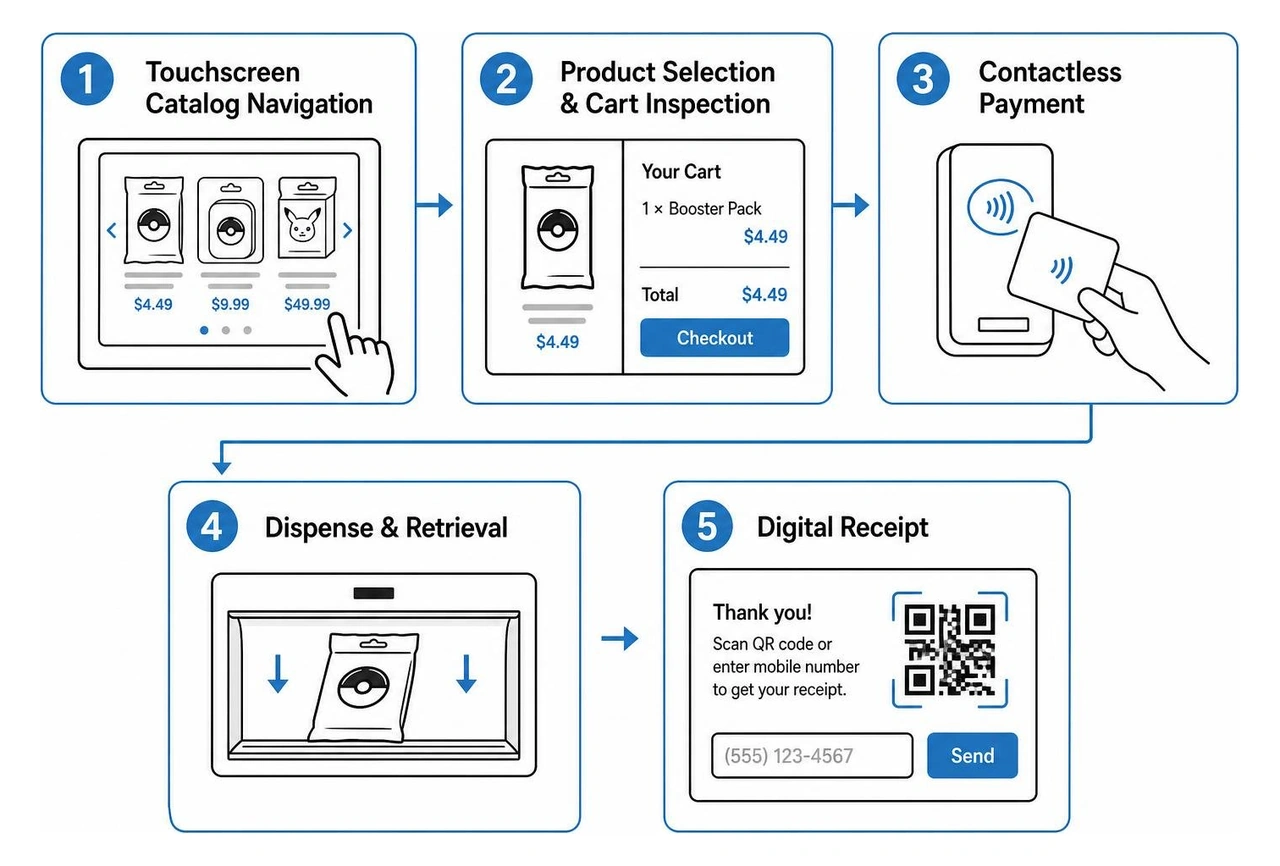
The buying experience is built for speed, taking less than two minutes from browse to dispense:
- Touchscreen Catalog Navigation: The customer approaches the high-definition touchscreen (ranging from 10 to 21.5 inches) and scrolls through digital cards showing pack art, set names, item pricing, and detailed SKU descriptions.
- Product Selection & Cart Inspection: The buyer taps their desired item—such as an expansion booster pack, mini tin, or Elite Trainer Box—and reviews the purchase summary.
- Contactless Payment: The buyer taps their contactless credit/debit card, Apple Pay, Google Pay, or mobile wallet against the integrated NFC terminal.
- Dispense & Retrieval: Once the payment pre-authorization clears (typically under two seconds), the internal dispensing mechanism activates, gently delivering the item to the bottom pickup box.
- Digital Receipt: The customer can scan an on-screen QR code or enter their mobile number to receive a digital receipt. All sales from automated retail units are final.
How Do Pokemon Vending Machines Work for Route Operators
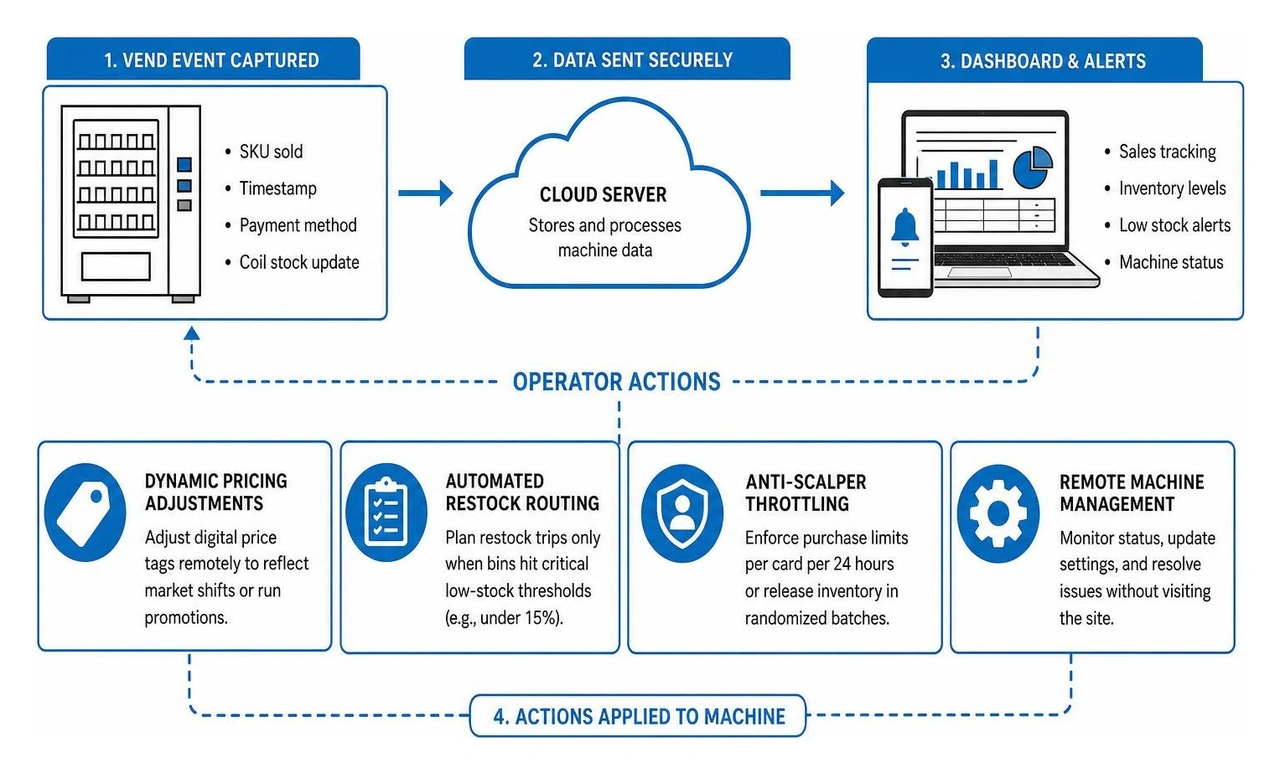
Behind the scenes, the operator manages the machine as a smart node via cloud telemetry:
- Remote Inventory & Sales Tracking: Every single vend is logged instantly in a web dashboard, showing the exact SKU sold, timestamp, payment method, and remaining coil stock.
- Dynamic Pricing Adjustments: Operators can adjust digital price tags remotely from their smartphone or laptop to reflect secondary market shifts or run weekend promotions without driving to the machine.
- Automated Restock Routing: Instead of driving blind routes, operators leverage smart vending machine inventory management to plan restocking trips only when specific bins hit critical low-stock thresholds (e.g., under 15% capacity).
- Anti-Scalper Throttling: High-demand sets (like Prismatic Evolutions) often attract bulk buyers. Modern telemetry software lets operators enforce hard limits (such as a maximum of 2 to 5 packs per payment card per 24 hours) or release inventory in randomized hourly batches to prevent a single buyer from clearing out the machine.
Gentle Dispensing Mechanics: Protecting Slabs, Tins, and Booster Packs
The single biggest engineering challenge in collectible vending is preventing product damage. In standard snack vending, dropping a bag of chips six inches onto a metal bin does not hurt the contents. In trading card vending, a minor drop can bend pack corners, scratch foil wrap, dent collectible metal tins, or shatter the sonically welded plastic casing of a $500 PSA 10 graded slab.
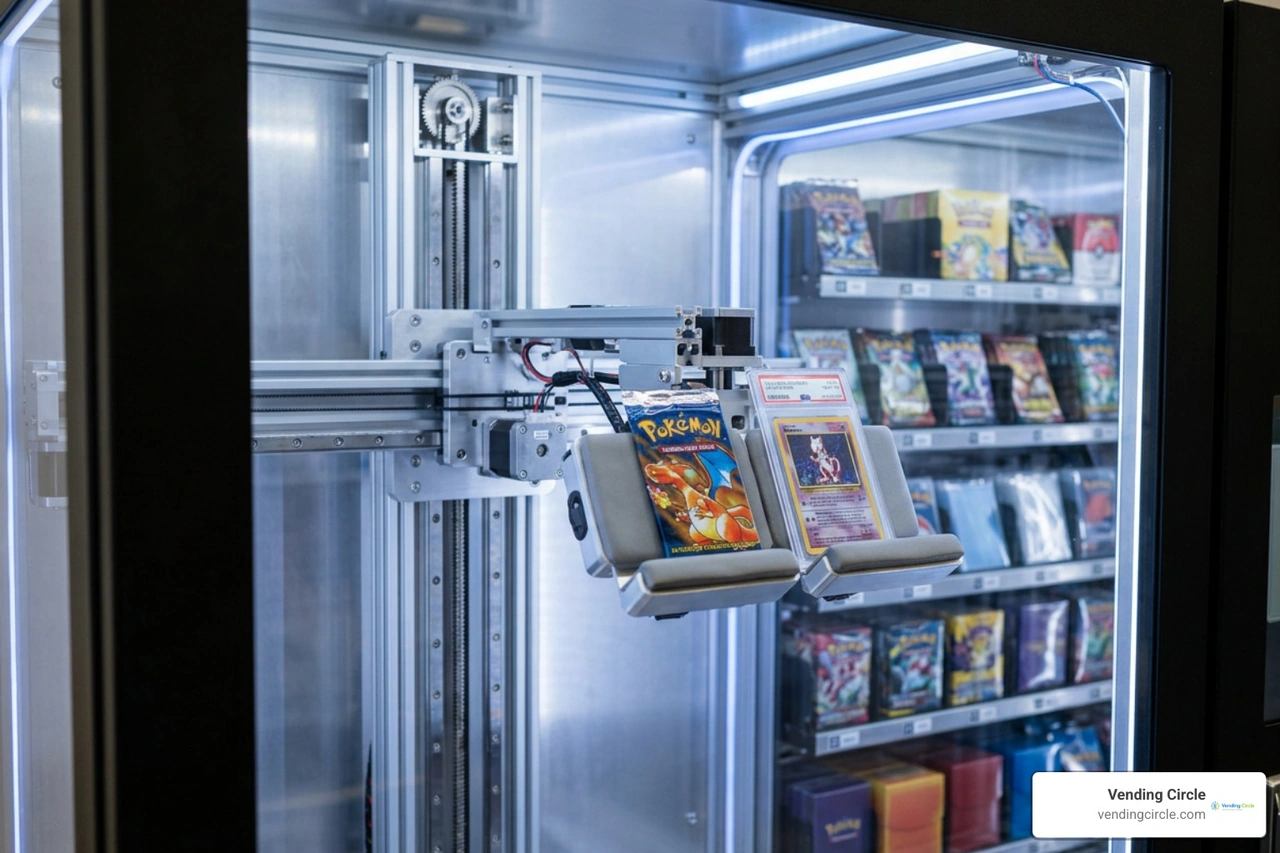
To protect fragile inventory, modern card machines use two distinct delivery architectures:
1. Robotic Elevator Arm Systems
For high-value items, Elite Trainer Boxes (ETBs), booster bundles, character tins, and graded card slabs, an internal motorized elevator platform is the gold standard. When a transaction completes, the elevator glides vertically and horizontally along an X/Y axis track directly to the selected shelf. The product is pushed smoothly onto the padded elevator tray, which then descends gently to the collection bin door before releasing the latch. Zero free-fall means zero damage.
2. Specialized 22mm Spiral Coils with Toploaders
For standard foil booster packs in high-density spiral machines, standard 50mm snack coils are far too wide and will cause packs to sag, slide, or jam. Operators use purpose-built 22mm narrow card coils. Furthermore, high-volume operators slide booster packs into rigid plastic semi-rigid cases or toploaders before placing them into coils. This rigid sleeve shields the pack edges against friction during rotation and prevents crimping when it drops into a padded bottom retrieval bin.
To eliminate phantom charges, internal chutes are lined with infrared optical drop beams. If a pack fails to break the sensor beam, the machine rotates the coil a second time or immediately voids the transaction authorization so the customer is never charged for an unvended item.
Telemetry, Payment Processing, and Backend Operations
Unattended retail relies on continuous, secure data transmission. Every modern card machine requires a reliable cellular vending machine network connection utilizing an industrial 4G LTE or 5G modem. Using dedicated cellular connections avoids the security hurdles and dropouts associated with tapping into a host location's guest Wi-Fi.
With over 71% of all U.S. vending machine sales processed via cashless methods—and TCG card buyers skewing above 90% card/mobile usage—a reliable cashless terminal is vital. When an operator is adding a card reader to a vending machine, the hardware connects directly to the MDB port, handling encrypted tokenization for Visa, Mastercard, American Express, Apple Pay, and Google Pay. Standard payment gateway processing fees average around 3.5% + $0.20 per swipe, alongside a monthly cellular gateway connection fee of $9.99 to $29.00.
Beyond simple transaction processing, advanced operators in 2026 use automated tools outlined in our vending machine AI forecast guide 2026 to predict set depletion timelines. These algorithms analyze local sales velocity, set release calendars, and day-parting statistics (for example, recognizing that over 65% of card vending sales occur between 6:00 PM and 6:00 AM) to auto-generate distributor purchase orders before popular sets run dry.
Machine Malfunctions and Buyer Support Protocols
Even the most advanced automated hardware can occasionally encounter a jammed tray, a bent bill, or an interrupted cellular signal during bank settlement.
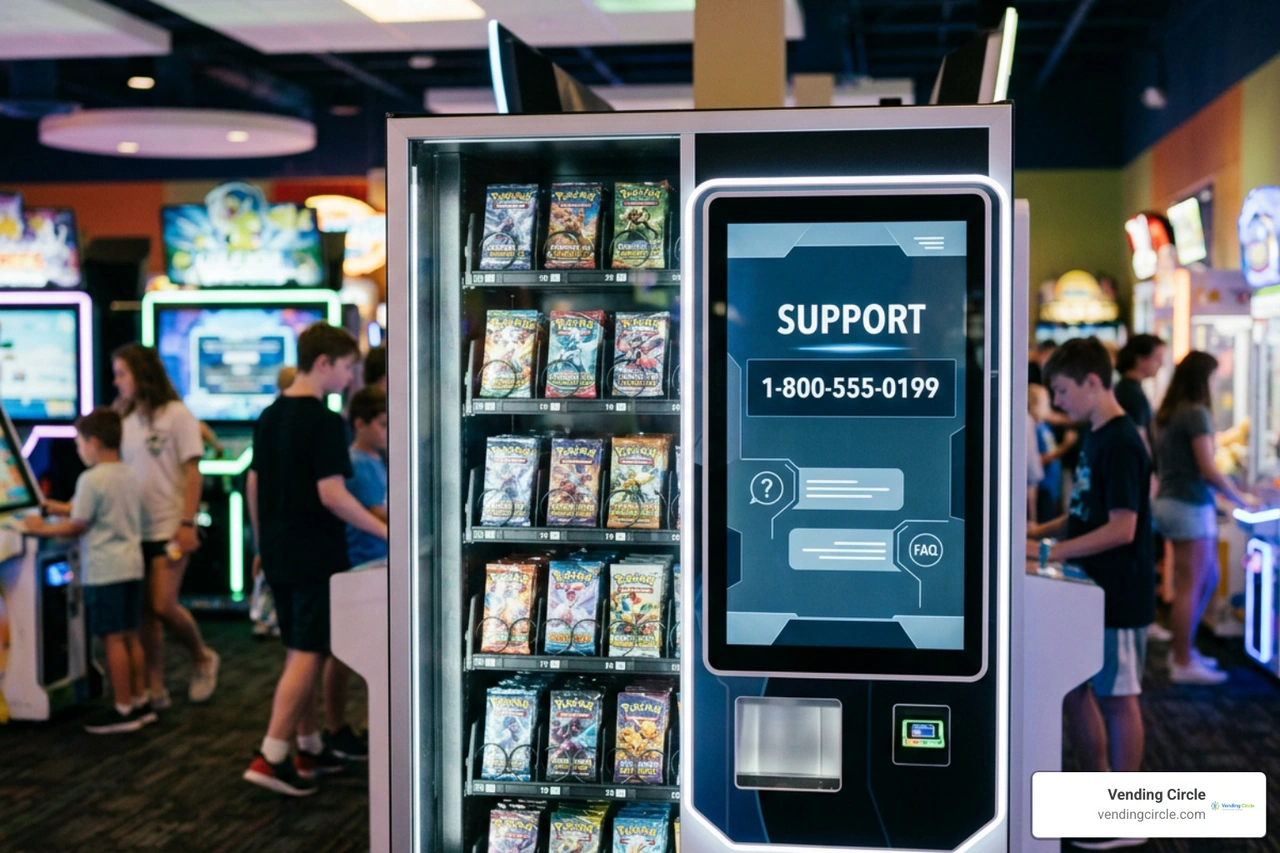
When a machine fails to deliver a selected product, the internal system handles it via several built-in safety steps:
- Optical Failure Detection: If the infrared drop sensors do not register an item passing through the dispense chute, the motor controller immediately halts the vend cycle and signals the card reader to cancel the pre-authorization hold.
- Bank Pre-Authorization Reversals: Most credit card banks place a temporary pending authorization ($10–$50) the moment a customer swipes. If the vend fails, the gateway transmits a void command. While the charge drops off within 24 to 72 hours depending on the buyer's banking institution, it can momentarily confuse buyers who check their mobile banking apps in real time.
- Host Location Staff Separation: Venue retail employees (such as grocery store cashiers or arcade attendants) do not have keys, mechanical access, or software permissions for the machine. Independent operators and corporate kiosks display dedicated support labels on the cabinet face.
- Support Hotlines and Live Tickets: Official TPCi machines direct users to their central toll-free support line (866-872-4790) or web portal. Independent operators list their own direct dispatch phone numbers or QR-based ticketing portals on the machine frame to process prompt Venmo, Cash App, or credit card refunds when a rare mechanical jam occurs.
Frequently Asked Questions About Pokemon Vending Machines
Do Pokémon vending machines accept cash or only cards?
The vast majority of modern trading card vending machines are entirely cashless. All official TPCi automated kiosks in the United States accept only electronic payments, including chip cards, tap-to-pay credit/debit cards, and mobile NFC wallets like Apple Pay and Google Pay. While some independent operators install optional bill validators on their freestanding tower units, the overwhelming standard is cashless. Cash-only customers can purchase a prepaid Visa or Mastercard debit card inside host stores to complete their purchases.
What should a customer do if a machine fails to dispense an item?
If a machine accepts payment but fails to drop your product, first check your banking app to verify whether the transaction is an actual cleared charge or merely a temporary pending authorization hold. If the charge settles, take a photo of the machine, noting the machine ID number, date, time, and the slot number selected. If it is an official Pokémon Center kiosk, call 866-872-4790 or submit a ticket at the Pokémon Center support desk. If it is an independent operator's machine, call or text the support number clearly printed on the machine's external contact label.
Is it legal for independent operators to sell Pokémon cards in vending machines?
Yes. Under the U.S. First Sale Doctrine, once an authentic, genuine product is legally manufactured and sold into commerce, the purchaser has the legal right to resell that specific item without obtaining permission, licensing, or franchise agreements from the copyright or trademark owner. Independent operators must simply ensure their inventory is 100% genuine sealed merchandise sourced through reputable distributors and avoid printing trademarked logos or official character artwork on their machine exterior wraps.
Conclusion
The explosive expansion of automated trading card kiosks represents one of the most exciting shifts in modern specialty vending. By combining 24/7 self-service convenience with damage-free elevator mechanics and real-time cellular telemetry, modern card machines solve pain points for collectors while building an automated business for operators.
Whether you are placing your first wall-mounted dispenser or scaling a regional route across high-traffic entertainment centers, long-term success comes down to solid location scouting, reliable wholesale product sourcing, and robust hardware. Upgrading your machines with reliable, high-speed vending card readers ensures your customers never experience failed transactions or payment friction during busy drops.
At Vending Circle, we bring together thousands of active vending operators sharing proven placement pitches, real sales data, and manufacturer-direct hardware discounts. Explore our community and training resources today to turn collectible demand into a scalable automated retail business.