How to Evaluate an Ice Machine Business for Sale
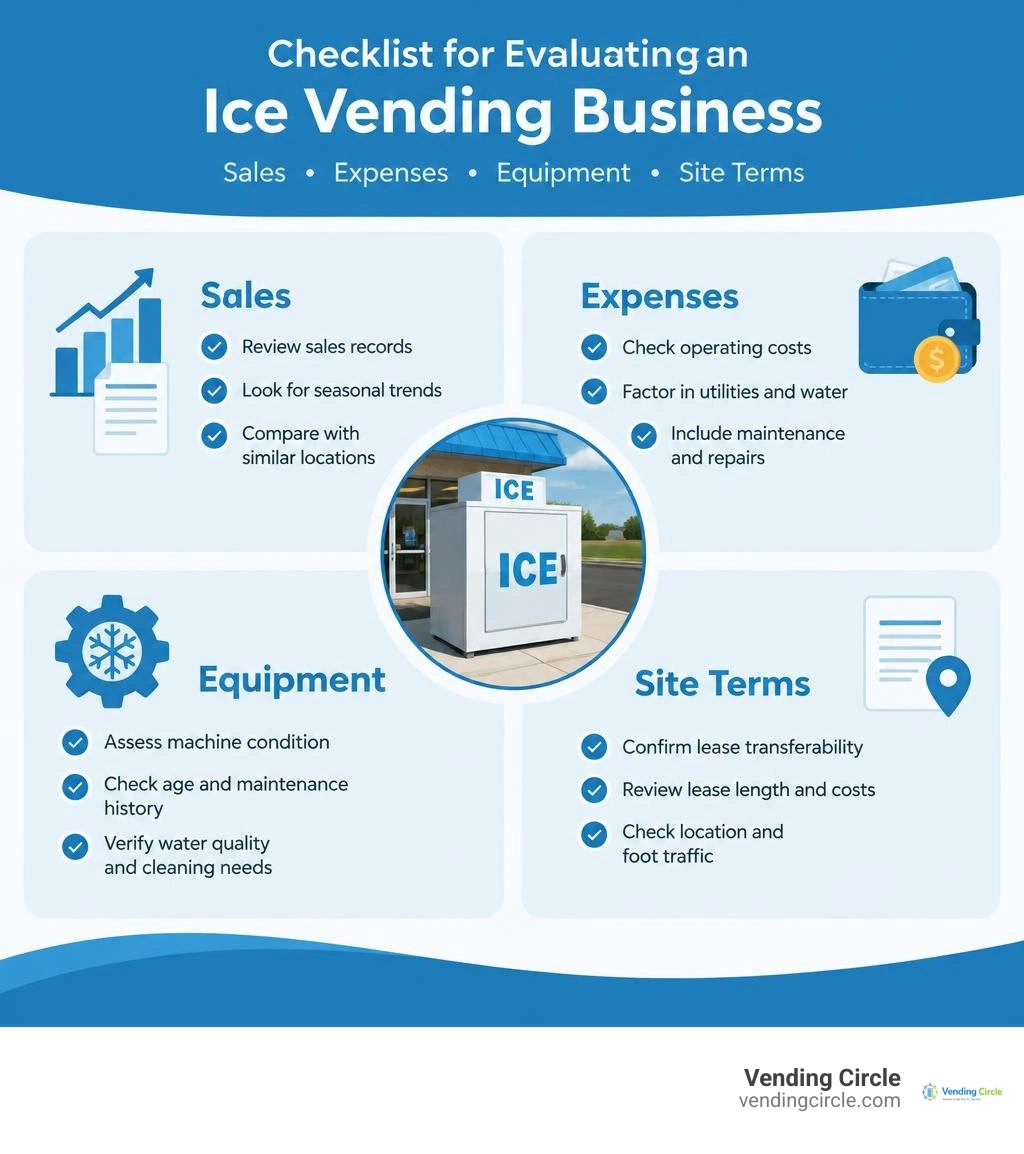
Listings tagged ice machines business for sale may offer a machine alone or an operating business with a location and sales history. Before you make an offer, ask for sales records, maintenance logs, and the site agreement. Check whether the lease can transfer to you, then compare the asking price with the cash the business actually keeps after expenses.
Ice vending can mean less inventory work than a stocked vending route, but it is not hands-off. Water quality, cleaning, repairs, and a good location all affect what you earn. When you evaluate an ice machine business for sale, treat the equipment, the site, and the operating history as one combined asset.
I'm Manuel Mojica, founder of Vending Circle and owner of MM Healthy Vending. My experience as a vending operator shapes this guide to evaluating ice machines business for sale listings without relying on a seller's profit claims.
Easy ice machines business for sale glossary:
Introduction
Finding an automated kiosk that produces and bags its own product on demand is one of the most exciting entries into starting a vending business. The packaged ice industry in the United States generates $2.5 billion annually, with automated ice vending expanding at roughly 35% each year. Unlike traditional retail freezers that rely on refrigerated diesel trucks hauling bags across town, an automated ice kiosk freezes, dispenses, and bags fresh ice directly on site.
For entrepreneurs pursuing steady passive revenue, buying an established turnkey operation eliminates the guesswork of scouting raw land or negotiating utility permits from scratch. However, finding success requires knowing how to separate a genuinely lucrative asset from an overvalued, high-maintenance headache.

The Economics of Ice Vending: Profit Margins, Costs, and ROI
The core appeal of owning an ice vending business comes down to fundamental unit economics. When you search for an ice kiosk near me, you see an automated system converting local municipal water into clean, frozen retail bags around the clock with zero physical inventory loading.
Unit Economics: Production Costs vs. Retail Pricing
Traditional vending operators must purchase drinks, chips, or candy at wholesale prices, manage expiration dates, and transport inventory. In contrast, an ice vending kiosk manufactures its own goods.
A standard 10-to-20-pound bag of ice requires municipal tap water, electricity for the refrigeration compressor and mechanical augers, and a plastic dispensing bag. The total utility and material cost to manufacture a standard bag generally ranges from $0.30 to $0.50 (and in some low-utility regions, as little as $0.07 to $0.10 for pure electrical run-time).
Operators sell these bags for $2.50 to $4.00 each. This creates gross profit margins reaching 70% to 98%. Traditional store-bought ice distribution struggles with razor-thin margins of around $0.50 per bag, making decentralized on-site vending far more profitable.
Payback Period and Long-Term Return on Investment
A well-placed ice vending kiosk generating an average of 25 to 30 bag sales per day yields around $1,800 to $2,500 in monthly gross revenue. After deducting utility bills ($150 to $250), site ground rent ($200 to $500), water filtration maintenance, and cashless merchant processing fees, an owner typically nets between $1,200 and $1,800+ per month per machine.
Across the industry, the average payback period for a standalone ice kiosk investment ranges between 24 and 30 months (2 to 3 years). Once the initial capital expenditure is recovered, commercial-grade kiosks continue to generate predictable cash flow for 10 to 15 years with routine maintenance. Seasoned operators who scale into multi-unit operations frequently build portfolios producing upwards of $1,000,000 in total gross annual revenue.
Evaluating an Ice Machines Business for Sale: Due Diligence & Valuation
When assessing an existing operation, you must verify the physical assets and past operational performance rather than trusting advertised financial estimates.

Understanding broad commercial ice equipment acquisitions helps buyers contextualize valuations across equipment distribution and retail vending networks alike.
How to Find an Ice Machines Business for Sale Listing
You can locate established opportunities through commercial business broker platforms, regional business-for-sale classifieds, and specialized vending communities. Listings vary significantly:
- Turnkey Multi-Unit Routes: Complete operational businesses with established ground leases, active customer habits, and existing utility meters.
- Single Turnkey Kiosks: Individual machines already placed at high-traffic sites (such as listings like a turnkey water and ice setup in El Paso, TX, offered around $58,000).
- Secondary Asset Sales: Unplaced or decommissioned machines being sold by owners retiring from routes.
Consulting with an experienced ice machine expert before submitting a binding letter of intent can help you confirm whether an asking price aligns with the local market.
Verifying Cash Flow, Telemetry Data, and Asset Condition
Never rely on handwritten earnings logs or seller estimates. Modern ice vending units utilize built-in cellular telemetry and smart monitoring software that tracks every transaction, vend cycle, and water filtration volume in real time.
Ask the seller for at least 12 to 24 months of raw telemetry data, merchant processor settlement statements, and matching municipal utility bills. Cross-referencing sales spikes against seasonal weather patterns confirms realistic earnings. Ensure the hardware includes modern cashless payment terminals by referencing our vending cashless reader guide 2026 to avoid surprise card-reader upgrade costs.
Location Leases and Utility Agreement Audits
An ice machine is only as valuable as the dirt it sits on. Review the underlying site lease agreement carefully:
- Assignability: Can the existing property lease transfer cleanly to your business entity?
- Lease Duration and Options: Does the contract guarantee at least 3 to 5 years of occupancy with renewal options?
- Utility Sub-metering: Are water and electric lines independently metered, or does the host charge a flat monthly fee?
- Exclusivity: Does the lease prevent the property owner from allowing another ice kiosk on the parcel?
Solidify these details using formal vending machine agreements before closing your purchase.
New vs. Used Equipment: Machine Models, Costs, and Capabilities
Choosing between brand-new manufacturer equipment and secondary-market units plays a major role in your upfront capital requirements and ongoing maintenance needs.
| Brand & Model Line | Daily Ice Capacity | Storage Capacity | Avg. New Retail Price | Secondary Market Used Price |
|---|---|---|---|---|
| Everest VX Series (VX1/VX3/VX4) | 1,500 – 1,900 lbs | 550 – 1,000 lbs | $35,000 – $54,000 | $8,600 – $24,000 |
| Kooler Ice (IM600 / IM1500 / IM2500) | 600 – 2,500 lbs | 400 – 1,500 lbs | $32,000 – $65,000 | $12,000 – $38,000 |
| Just Ice / Twice The Ice Kiosks | 3,000 – 6,500 lbs | 2,000 – 4,000 lbs | $75,000 – $140,000 | $28,000 – $90,000 |
| Compact Purified Water/Ice Hybrid | 220 – 500 lbs | 150 – 300 lbs | $12,000 – $22,000 | $6,000 – $11,000 |
Major Brands and Model Comparisons
The automated ice vending sector features several well-established manufacturers:
- Everest Ice and Water: Known for their single-moving-part dispensing mechanism ("VersaVend"), eliminating complex internal jam-prone augers. Models like the VX3 and VX4 offer integrated 5-stage reverse osmosis water filtration.
- Kooler Ice: A long-time industry staple featuring automated bagging, multi-stage filtration, and robust remote SmartIce monitoring software.
- Large-Format Kiosks (Ice House America / Twice The Ice / Just Ice): High-capacity industrial machines designed for massive volume (thousands of pounds daily), ideal for prime locations near highways and waterways.
If budget constraints dictate starting with a cheap ice machine or a pre-owned unit from our used vending machines guide 2026, ensure critical internal components like water pumps, condenser coils, and freezing plates have been inspected by a certified technician.
Pricing Breakdown: Turnkey Routes vs. Standalone Units
Secondary-market equipment values fluctuate based on age and condition. For instance, a brand-new high-capacity machine retailing for $54,000 might appear on classified marketplaces for as low as $19,000 in uninstalled, crated condition—such as these secondary market unit listings.
Turnkey operating businesses typically carry a valuation multiple of 2.0x to 3.5x annual Seller's Discretionary Earnings (SDE), reflecting the immense value of an established location, proven utility hookups, and existing daily foot traffic.
Securing Prime Locations and Navigating Regulatory Requirements

A machine's physical placement dictates your bottom-line return. Even the most advanced commercial kiosk will struggle if it lacks visibility and vehicle accessibility.
High-Traffic Location Scouting and Footprint Requirements
When reviewing an operational route or scouting new placements, target locations that fit specific traffic and customer profiles:
- Vehicle Ingress & Egress: Customers pulling trailers, work trucks, or boats require easy drive-up access and turning clearance.
- Complementary Hubs: Gas stations, 24/7 convenience stores, marinas, boat launches, RV campgrounds, and sports complexes.
- Footprint: Most compact commercial kiosks require only a single standard parking space (roughly 8 ft x 10 ft to 10 ft x 20 ft) along with clean access to a 220V/240V 30-to-50-amp electrical supply and a dedicated 3/4-inch potable municipal water line.
To expand your placement network, review our guide on finding high-performing vending machine locations.
Health Codes, Water Quality, and Local Permits
Packaged ice is classified as a consumable food product under federal and state law. The Food and Drug Administration enforces strict guidelines for commercial water filtration and ice safety. Operators must comply with:
- Backflow Prevention: Certified backflow preventer valves are required at the water main connection to protect the municipal supply.
- Filtration Standards: Multi-stage filtration (sediment filters, activated carbon blocks, reverse osmosis, and ultraviolet sanitation lamps) must be tested on a documented schedule.
- Local Health & Building Permits: Most municipal jurisdictions require a food handler's establishment permit, environmental health inspections, and electrical/plumbing permits for outdoor kiosks.
Operations, Maintenance, and Financing Strategies
Operating an automated ice vending business takes only a few hours of physical labor per week per machine, but strict operational routines are essential to prevent downtime.
Financing Your Ice Machine Business for Sale Acquisition
If you prefer not to purchase an operating route or machine entirely with cash, several commercial funding options are available:
- Equipment Financing & Leasing: Lenders secure the loan using the ice kiosk itself as primary collateral, often requiring down payments between 10% and 20%.
- SBA 7(a) & Express Loans: Ideal for purchasing existing, cash-flowing turnkey businesses with verifiable tax returns.
- Seller Financing: A seller carries 20% to 50% of the purchase price over a 2-to-5-year term, signaling confidence in the business's ongoing financial stability.
Review our dedicated vending machine financing guide 2026 for step-by-step application walkthroughs and underwriting advice.
Ongoing Maintenance Schedules and Remote Telemetry
To maintain peak hygiene and production rates, follow a consistent maintenance schedule:
- Weekly (1 hour): Wipe down exterior surfaces, sanitize the dispensing chute, inspect the area for litter, and check plastic bag roll levels.
- Monthly: Inspect pre-filters for sediment buildup, check water pressure gauges, test the coin and card-reader mechanisms, and clean condenser coils.
- Semi-Annually: Replace 5-micron sediment and carbon block filtration cartridges; replace UV sanitation lamps according to manufacturer operating-hour limits.
- Annually: Descale and sanitize the internal ice-making evaporator grids and storage bin using food-grade nickel-safe solutions.
For additional equipment care tips, consult our machine maintenance tips 2026.
Frequently Asked Questions About Buying an Ice Vending Business
How much profit does a typical ice vending machine generate each month?
An ice vending machine in a solid location typically produces between $1,200 and $2,000 in monthly net profit, representing net margins of 70% to 80% after factoring in site lease rent, utility bills, and merchant card processing fees.
How many hours per week does it take to operate an ice vending route?
Most operators spend just 1 to 3 hours per week per machine. Responsibilities include wiping down the collection area, restocking bagging supplies, inspecting filters, and performing routine sanitation checks.
Do I need a franchise agreement to buy an ice vending business?
No. While some franchise brands exist, the vast majority of ice and water vending operators own their equipment independently. Purchasing standalone commercial machines means you keep 100% of the revenue without paying ongoing royalties, marketing cuts, or franchise fees.
Conclusion
Acquiring an existing ice vending business gives you access to an automated, recession-resistant asset with high gross profit margins. By performing careful due diligence on telemetry records, checking lease terms, and ensuring your equipment passes health inspections, you can build a reliable passive revenue stream that pays for itself in just a few short years.
When you are ready to evaluate vetted equipment, find discount supplies, and connect with experienced commercial operators, explore our inventory of commercial machines and join the Vending Circle community today.